- 256 pages
- English
- ePUB (mobile friendly)
- Available on iOS & Android
eBook - ePub
About this book
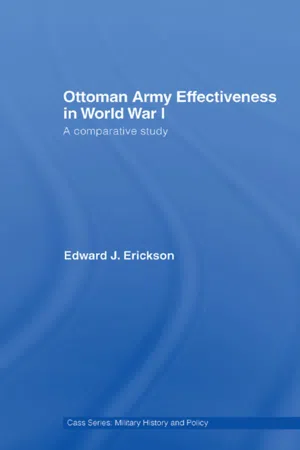
This volume examines how the Ottoman Army was able to evolve and maintain a high level of overall combat effectiveness despite the primitive nature of the Ottoman State during the First World War. Structured around four case studies, at the operational and tactical level, of campaigns involving the Ottoman Empire and the British Empire: Gallipoli i
1
From the ashes of disaster
Taking the Turkish Army as a whole, I should say it was militia only moderately trained and composed of tough, but slow witted peasants liable to panic before the unexpected.(P.P.Graves, 10 November 19141)
Appreciations, 1913
The Ottoman Army enjoyed but a single year of peace from the end of the Second Balkan War in July 1913 until the mobilisation of August 1914. The world thought that the ragtag army that emerged from the Ottoman camps and garrisons at the end of that period was poorly trained, inadequately led, and miserably equipped. In fact, the Turks had used their time well to correct many of the deficiencies uncovered by the disastrous defeats of 1912/13 and, although cloaked by a poor reputation, the Ottoman Army was approaching higher levels of combat effectiveness that would surprise the world.
British opinion regarding the failure of the Ottoman Army to meet modern standards was particularly strident.2 The British military attaché at Constantinople, Lieutenant Colonel Fredrick Cunliffe-Owen, sent numerous dispatches concerning the ineptness of the Ottoman high command in mobilisation and organisation, the failure of the army to adopt modern methods, and its indiscipline.3 In his section of the annual 1913 report, Cunliffe-Owen characterised the Ottoman Army’s high command as showing ‘an absolute incapacity for getting such machinery as there was into order’.4 An informed visitor to Constantinople in October 1913, Colonel Henry Wilson (the British Army’s Director of Military Operations), judged that ‘the Turkish Army is not a serious modern army…no sign of adaption to western thoughts and methods. The army is ill-commanded, ill-officered and in rags.’5 Cunliffe-Owen also noted that the army had not returned to its fixed garrisons of 1912 (causing dislocation and inefficiency) and that the army was deficient in all kinds of equipment.6 Even the Germans of the newly established German Reform Mission formed similar opinions about the Ottoman Army in early 1914.7
In addition to these low opinions, there seemed to be a generalised lack of interest on the part of the West in the internal military affairs of the Ottoman Army itself. The British embassy in Constantinople was focused on the arrival and portfolio of German General Otto Liman von Sanders and on the revitalisation of the British Naval Mission.8 During the period 1 July 1913 to 1 September 1914, the American Army’s military attaché in Constantinople, Major J.M.R. Taylor, sent 159 dispatches to the US War Department, of which only twenty dealt directly with the Ottoman Army.9 The only foreign intelligence service that actively collected information concerning the Turks was that of the Russians, who maintained an effective spy ring in the Ottoman capital, and collected materials on the ongoing army reorganisation.10
In actuality, this period was marked by a frenzy of military activity on the part of the Turks aimed at restructuring their army and increasing its combat effectiveness in light of the lessons learned from the Balkan Wars.11 Although the Europeans were aware of the huge reorganisation of the Ottoman Army, they remained largely unaware of the many smaller initiatives in the development of improved training, combined arms tactics, dynamic leadership, staff work, and in the standardisation of tactical operating procedures. Moreover, the West failed to recognise the effect that such endeavours would have on the Ottoman Army.
Institutional response and change
After the Balkan Wars, the Ottoman officer corps became immediately interested in analysing the reasons for their defeat at the hands of the Balkan League. Unusually, this was done in a largely public forum and the most lucid exposition of the disaster came from the pen of Staff Major Asım (later Asım Gündüz), a trained General Staff officer who had served on the Ottoman General Staff during the war. Staff Major Asım published a short two-part book in the fall of 1913 titled Why Were we Defeated in the Balkan Wars? that clearly identified nine major reasons for the defeat.12 These were: political mistakes, deficiencies in military preparations, failure to give priority to the navy, national faults, errors in mobilisation, errors in assembly, errors in strategy, ignorance of tactics, and poor morale in the army. In particular, Asım identified poor linkages between active and reserve units, poor reserve training, incompetent officers, incomplete mobilisation, poor co-ordination between infantry and artillery, and poor coordination in moving from march columns into combat as the primary culprits in the army’s inefficiency.13 This book was circulated widely and reflected a rigorous and honest understanding of the Ottoman defeat.14
Later in the winter of 1913, Staff Major Mehmet Nuri (later Nuri Conker) gave a lecture at a 1st Infantry Division training conference titled ‘Officer and Commander’ (Zabit ve Kumandan), which likewise addressed the army’s problem in the Balkan Wars. In May 1914, Mehmet Nuri’s friend, Staff Lieutenant Colonel Mustafa Kemal, then stationed in Sofia as military attaché, wrote and published a public response titled Officer and Commander: A Friend’s Private View.15 The opinions of these men were similar to those expressed earlier by Staff Major Asım.
The loss of the First Balkan War (October 1912-April 1913) was a disaster of huge consequence for the Ottoman Empire and for the Ottoman Army. The empire lost its productive European provinces (modern Albania, Macedonia, Epirus, and Kosovo) that it had held since the early fifteenth century. Moreover, the army lost thirty-six active and reserve infantry divisions and six army corps headquarters as well as casualties approaching 250,000 men. Equally important, it also lost huge reserves of equipment and supplies. Nevertheless, the Turks were determined to reconstitute and retrain their army as quickly as possible. The architect of the work was Ahmet Izzet Paşa, the chief of staff of the Ottoman Army, who began this undertaking in the fall of 1913.16
Ahmet Izzet Paşa began by implementing a radical restructuring of the army on 11 December 1913 called the New Organisation of Active Forces according to Army, Independent Corps and Division Areas.17 This plan was necessitated by the loss of an entire field army and the recruiting districts in which it was stationed, and by the need to recreate the lost European formations in Anatolia. It began the complex process of returning the army from Thrace to its permanent peacetime garrison homes.18 The plan was, however, more than a simple restationing plan and imposed significant structural changes on the army as well.
In one sweeping change, Ahmet Izzet eliminated all organised reserve units in the army, with the minor exception of a reserve cavalry corps. The reorganisation was contrary to conventional European practices that relied on organised reserve regiments, divisions, and corps to expand peacetime armies to wartime mobilised strength. This was a direct result of the recent poor performance of the Ottoman Army’s reserve formations (Redif), which had proven unready in the Balkan Wars. Henceforth, all reserve soldiers reported to mobilisation depots as individuals and not as members of organised units.19 From there they were to be fed into a personnel pipeline to fill active army units to authorised wartime strength.
In peacetime (after December 1913), active Ottoman Army units of division strength and below were maintained in a cadre status of approximately 40 per cent authorised wartime strength and were to be filled with qualified reservists for major field manoeuvres and for combat.20 For example, in the summer of 1914, the infantry divisions of the III Corps (the 7th, 8th and 9th) contained an average of 175 officers, 5,000 soldiers, and 700 animals in each division (out of an authorised wartime authorisation of approximately 300 officers, 12,000 soldiers, and 2,300 animals).21 Upon mobilisation, reservists filled the regiments of all Ottoman infantry divisions to wartime authorisations. Consequently, mobilisation in 1914 did not increase immediately the number of infantry divisions (thirty-six) in the Ottoman Army. In comparison, Germany mobilised thirty-one reserve infantry divisions, France mobilised twenty-five reserve infantry divisions, and Britain mobilised fourteen territorial infantry divisions.22
December 1913 also saw the arrival of General Otto Liman von Sanders, the newly designated chief of the German Reform Mission, and about twenty highly trained Prussian and Bavarian General Staff officers. The German mission was to assist the Turks in revitalising their army by forming model regiments that the Turks could emulate. Additionally, several of the Germans were tasked to instruct at the Ottoman War Academy and to serve on corps and army level staffs.
Enver Paşa’s reforms
On 3 January 1914, the Young Turk Committee of Union and Progress replaced Ahmet Izzet Paşa with one of their own, Colonel Enver Paşa, a young nationalist, who was eager to rebuild the Ottoman Army into an effective fighting force. Within two months Enver involuntarily retired almost 1,300 ageing officers, who he felt were obstructions to modernisation or who were opponents of the Young Turks.23 This cleared the way for Enver to issue specific instructions for retraining the army in line with correcting the deficiencies outlined by Major Asım six months earlier.
Enver released General Orders No. 1 on 14 March 1914, which contained detailed guidance for the conduct of army troop and unit training at the tactical level.24 The first section of the order dealt with the imperative to exercise direct leadership from the front. Section two dealt with tactical instructions for moving from march columns rapidly into combat formations, offensive operations and immediate counter-attacks, defensive operations, including rapid entrenching, integration of machine guns, and the development of effective artillery fire support. These measures were to be integrated immediately into the training of the army and demonstrated institutional willingness to address problems in a meaningful way.25 Significantly, General Orders No. 1 showcased a newly found awareness by the Ottoman Army of the importance of firepower by stressing the imperative of quickly establishing combined arms fire superiority over the enemy. The importance of this document and its impact on the Ottoman Army’s operations will be shown in Chapters 2 and 3.
In contrast to Enver’s tactical thinking it may be useful, at this point, to compare contemporary British tactical thinking as illustrated by the writing of Captain J.F.C.Fuller, who was student at the Staff College in Camberley in 1914. Between January and June 1914 (simultaneously with Enver’s General Orders No. 1), Fuller wrote three papers which ‘all contained unorthodox views and all met with opposition from the directing staff’.26 Fuller’s inflammatory ideas postulated that direct penetration of enemy lines was dependent on the co-operation of infantry and artillery fire, and that artillery fire superiority was paramount, as was rapid entrenchment.27 Brian Bond, writing of Fuller’s trip to Larkhill, noted that ‘It is revealing of the separateness of the three arms in those days that Fuller, though a regular officer and in his thirty-sixth year, had never before seen a battery of guns in action.’28
To remedy the strategic problems highlighted by Major Asım, Enver relied on the Ottoman General Staff working under the staff oversight of German Colonel Fritz Bronsart von Schellendorf (who was assigned as the Second Assistant Chief of the Ottoman General Staff) to revise the mobilisation and campaign plans.29 The twelve war plans of 1912 were discarded in favour of a single coherent defensive war plan that was approved on 7 April 1914. A single mobilisation plan and a single concentration plan backed this up. Unlike the war plans of the major European powers, the Ottoman war plan was not tied to events or to a timeline driven by external factors.30 In truth, mobilisation and concentration were rendered problematic by the antique transport system of the Ottoman Empire and tying the war plan to unrealistic delivery schedules had proven nearly fatal in the Balkan Wars. The Ottoman Army was thus freed from the tyranny of timetable planning that threatened to concentrate prematurely unready forces.
Enver also centralised and accelerated the resurrection of the Ottoman Army’s formal schools system. He established three centralised training sites in the First, Second, and Third Inspectorates (or army areas) at Constantinople, Erzincan, and Aleppo, respectively. On 14 April 1914, Enver placed these training sites directly under the Turkish commanders of the I, VI, and X Corps.31 A week later, in General Orders No. 7, the Ottoman War Academy was placed directly under the supervision of Bronsart von Schellendorf.32
On 24 May 1914, the Ottoman General Staff published general orders which contained comprehensive instructions for the writing and formatting of war diaries (Harp Ceridesi).33 The orders also contained a list of the units required to maintain war diaries. The format was standardised into seven sections covering organisation and signals; orders, reports, and operations; missions; logistics; personnel and animals; special trials and experiments; and special instructions. The war diaries were classified as secret documents, and were opened and closed for operations or at the end of each calendar quarter. Completed war diaries were sent quarterly to the Ottoman General Staff.34 At the same time, the formats of written battle reports and situation reports were standardised in the Ottoman Army’s Instructions for Field Service (Hidemati-ı Seferiye Talimnamesine).35 Spot reports also followed a specified format but could be either oral or written.
The army itself spent the autumn, winter, and spring moving the divisions that had been engaged in the Balkan Wars back to their home garrisons. However, a major portion of the army had been destroyed or had surrendered during the war and had to be reconstituted from battered cadres in new garrison locations in Anatolia or Arabia.36 Twelve active infantry divisions, which had been destroyed, were reconstituted from regiments and battalions evacuated from the Balkans in June of 1913 and two infantry divisions were rebuilt from evacuated divisional cadres. Altogether, fourteen of thirty-six active Ottoman infantry divisions the spring of 1914 were undergoing reconstitution. A further eight infantry divisions had returned from Thrace to their home garrisons in Anatolia.
German influence, 1914
Thus, as the Ottoman Army entered the dangerous summer of 1914, much work had been done to put in place remedies to...
Table of contents
- Cover Page
- Ottoman Army Effectiveness in World War I
- Cass series: military history and policy
- Title Page
- Copyright Page
- Illustrations
- Preface
- Acknowledgements
- Abbreviations
- Introduction
- 1: From the ashes of disaster
- 2: Gallipoli, 1915
- 3: Kut Al Amara, 1916
- 4: Third Gaza-Beersheba, 1917
- 5: Megiddo, 1918
- 6: Conclusion
- Appendix A
- Appendix B
- Appendix C
- Notes
- Selected bibliography
Trusted by 375,005 students
Access to over 1.5 million titles for a fair monthly price.
Study more efficiently using our study tools.
Frequently asked questions
Yes, you can cancel anytime from the Subscription tab in your account settings on the Perlego website. Your subscription will stay active until the end of your current billing period. Learn how to cancel your subscription
No, books cannot be downloaded as external files, such as PDFs, for use outside of Perlego. However, you can download books within the Perlego app for offline reading on mobile or tablet. Learn how to download books offline
Perlego offers two plans: Essential and Complete
- Essential is ideal for learners and professionals who enjoy exploring a wide range of subjects. Access the Essential Library with 800,000+ trusted titles and best-sellers across business, personal growth, and the humanities. Includes unlimited reading time and Standard Read Aloud voice.
- Complete: Perfect for advanced learners and researchers needing full, unrestricted access. Unlock 1.5M+ books across hundreds of subjects, including academic and specialized titles. The Complete Plan also includes advanced features like Premium Read Aloud and Research Assistant.
We are an online textbook subscription service, where you can get access to an entire online library for less than the price of a single book per month. With over 1.5 million books across 990+ topics, we’ve got you covered! Learn about our mission
Look out for the read-aloud symbol on your next book to see if you can listen to it. The read-aloud tool reads text aloud for you, highlighting the text as it is being read. You can pause it, speed it up and slow it down. Learn more about Read Aloud
Yes! You can use the Perlego app on both iOS and Android devices to read anytime, anywhere — even offline. Perfect for commutes or when you’re on the go.
Please note we cannot support devices running on iOS 13 and Android 7 or earlier. Learn more about using the app
Please note we cannot support devices running on iOS 13 and Android 7 or earlier. Learn more about using the app
Yes, you can access Ottoman Army Effectiveness in World War I by Edward J. Erickson in PDF and/or ePUB format, as well as other popular books in History & Military & Maritime History. We have over 1.5 million books available in our catalogue for you to explore.