- 254 pages
- English
- ePUB (mobile friendly)
- Available on iOS & Android
eBook - ePub
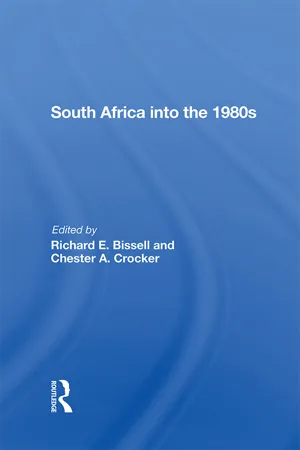
South Africa Into The 1980s
About this book
The question of South Africa's future has become a paramount issue in global politics. This book examines the position of South Africa as it faces the 1980s—its strengths, its weaknesses, and the probable influences of other states on South Africa in the years to come. The authors share a common interest in an analytical approach to a topic often argued with more emotion than rationality. They discuss South Africa's internal situation, with particular emphasis on the interests and aspirations of the political parties competing for power; then they focus on external realities, looking at the country's ability to project influence abroad as well as the power of others to affect events within it. In sum, they highlight crucial trends shaping South Africa's current and future development.
Information
Part 1
Internal Dynamics and Sources of Change
1
The Afrikaner Nationalist Perspective
John Seller
For the foreseeable future, the central fact of South African political life will be the effective domination of all political institutions by Afrikaner nationalism. Since the November 1977 parliamentary elections, the standing and prospects of white opposition parties have reached a historical low point. As external and internal pressures increase, South African whites are likely to become even more supportive of the National party (NP) government and more willing to accept repression of black and white dissent at home and assertive military steps in the region.
Whatever change comes in South Africa—short of a prolonged civil war augmented by external invasion—will be defined by Afrikaner nationalist perceptions, shaped by Afrikaner nationalist interests, and processed by institutions monopolized by Afrikaner nationalists. Thus any effort to measure the likelihood and character of change emanating from white South Africans must be, in the final analysis, an assessment of Afrikaner nationalist perceptions, interests, and institutional behavior.
The Role of White Perspectives and Attitudes
The ruling National party does not function in a vacuum. To the contrary, it is remarkably sensitive to Afrikaner political and economic interests, most especially the overriding preoccupation of many Afrikaners (too often associated only and overnarrowly with verkrampte, or very conservative, individuals) that Afrikaner communal identity or even its survival will be at risk if too many concessions are made to pressures for change initiated outside Afrikaner nationalist circles. National party interest in non-Afrikaner support is another matter altogether. Only intermittently, but clearly more often since the 1974 Portuguese coup with its repercussions for increased regional instability, the South African government has actively sought support from non-Afrikaner whites (and even from Coloureds, Indians, and blacks). At a rhetorical and conceptual level, the term "Anglo-Afrikaner nation" is used to suggest a coherent group distinct from and functioning vis-à-vis the other officially sanctioned "nations" within South Africa: Coloureds, Indians, Zulu, Xhosa, Tswana, Sotho, Shangaan, Vemda, et al. In practice, the government still does very little—except coincidentally via shared training and active service requirements in the South African Defense Force—to carry out the implications of a single white community. Only one English-speaking white holds a cabinet post—Senator Owen Horwood, minister of finance. Most top-level civil service posts are held by Afrikaners. Non-Afrikaner whites (including a substantial Jewish community and relatively small numbers of Portuguese, Greek, and other groups) are asked to support government policies, but because Afrikaner nationalist distrust of non-Afrikaners remains very strong, they can only hope for a passive, supportive role. Whether by calculation or instinct, the government will probably succeed in this policy, since most whites find government policy—especially its foreign and security policies—increasingly attractive and seem likely to continue their support.
Because the perceived attitudes of its Afrikaner nationalist constituents are the key to South African government policy-making, clues to the direction and limits of policy change lie in shifts in the strikingly narrow range of these attitudes. To be fair, this range (as measured by opinion surveys) encompasses a growing willingness to accept Coloureds as full members of the Afrikaner political community and to make major concessions in social-economic (but not political) matters to blacks. The "gamut" of views held by National party leadership runs from the "accommodationist" position held by Piet Koornhof and R. F. (Pik) Botha to the "dogmatic" position espoused by Andries Treurnicht. Koornhof and Botha, along with some number of their cabinet colleagues, seem willing to consider major adaptations in existent policies in order to reduce or at least to mitigate international and domestic pressure bearing on the government. At the other extreme, Treurnicht represents a growing sector that believes that even marginal policy changes —the opening of the Nico Malan Theatre to nonwhites, extensive interracial athletic competition—will lead inevitably to a profound dilution of the central elements of separate development policy and, in time, to the dissolution of Afrikaner integrity. Despite these significant differences, aired often vehemently in the Afrikaans press and apparently growing in intensity, both the "accommodationists" and the "dogmatists" share a profound commitment to the dual causes of Afrikaner communal identity and ethnically based political development. Given this commitment, their differences remain tactical and should not be interpreted as symptomatic of polarization or even disintegration of Afrikanerdom.
To buttress their own underlying commitments, Afrikaner nationalist leaders share a peculiar political myth: they construe their constituents to be far more conservative than themselves, what is sometimes called verkrampte (inwardturning, stubbornly resistant to change), in polar opposition to verligte (enlightened, open to change). Frequent opinion polls belie this conviction, but it remains the dominant constraint to policy change among both cabinet members and National party parliamentarians, For those leaders with verligte instincts, their efforts to adjust policies require persuasion of their own colleagues, then the NP parliamentary caucus, and finally prominent Afrikaner nationalists outside of government so that this mythical Afrikaner constituency will not somehow rise in wrath and disown the government. As a reflection of this unrealistic appraisal, those few Afrikaner institutions with genuinely verkrampte attitudes —especially the white miners union—get far more attention than their numbers justify. In any case, even if the government were willing to take into account the implications of opinion surveys, its members are profoundly committed to separate development, certainly in the political realm, almost as clearly in the social realm, and more ambiguously (given the interdependent nature of the South African economy) in the economic realm.
The Concept of Change in Afrikaner Nationalist Politics
Anglo-American political thought gives centrality to the articulation of political differences through political parties and to their resolution in peaceful electoral competition. Thus, conflicting values are at least accepted as inescapable, with emphasis put instead on the processes by which they are resolved or mitigated. Very few white South Africans hold to this faith. Afrikaner nationalists were prepared to use democratic electoral processes to achieve political power, but since 1948, despite a strong lingering regard for the independence of the judiciary, the press, and the universities, they have responded bluntly to repress any opposition to their continued domination. In the decade or so after World War II, liberal democratic values were relatively widespread among English-speaking whites, but the rapid decline of effective political opposition after the NP victory in 1948 shrunk their ranks and left the few survivors embittered and apolitical. Now, most South African Englishspeaking whites, without referring to any cogent political philosophy, prefer a benign politics wherein conflict is resolved by executive mandate and their own interests are protected. Their institutions—family, schools, churches—all support deference to and respect for established authority. Neither social nor political conflict is encouraged. Each is seen as distasteful, lacking in civility, when not actually a threat to social and civil order.
For most Afrikaners, this pattern of deference and loyalty to established authority takes on a more rigorous (and, some observers would say, ideological) form. Despite its antidemocratic implications, it is justified as democratic, because it provides distinct realms for independent activity for family, school, church, and government, under the overarching rubric of religious and ethnic loyalty. In practice, since 1948 and even before, the National party has most often defined and effectively constrained the range of freedom available to each of these social realms. Although public criticism of government policy has become increasingly acceptable—in Afrikaans newspapers, but not in the English-language papers more critical of the government—and stringent, although imprecise limits still exist on the extent and maintenance of such criticism. The professional and social ostracism heaped on Professor Willem Kleynhans and Rev. Beyers Naude are classic cases from two decades ago. The very recent instances involving Gerhard Totemeyer at Stellenbosch University and Professor J. D. van der Vyver at Potchefstroom University demonstrate that the pressures toward conformity are as strong as ever.
In any case, for most Afrikaners the widespread international discussion about what might serve as acceptable change in South Africa has neither significance nor relevance. For them, the policy of separate development is the only acceptable platform for change, a process that most of them believe has been occurring in a sustained way at least since Dr. Hendrik Verwoerd announced twenty years ago the eventual independence of black homelands. The 1961 declaration of the republic was another crucial step in this evolving process. Whatever differences they may have among themselves about particular points in the process, they have faith that the basic changes implied in separate development will continue for the foreseeable future. Pressure from outside Afrikanerdom is either not acknowledged at all or (a newer trend) interpreted as misinformed or even evil in intent, and hence not to be taken into account. "Conflict" has no constructive role in this change process, although its existence even among Afrikaners becomes increasingly difficult to deny. When it becomes necessary to note basic changes in policy, the impact of present or potential pressure is not acknowledged and often not perceived. Instead, the government and the media (even the opposition newspapers) talk blithely of new "dispensations," without any awareness of the authoritarian history of the term.
Proposals for Basic Change from Non-Afrikaners
Against this background, the continued Afrikaner nationalist negative attitude about proposals for basic change emanating from non-Afrikaner sources should be more comprehensible. It is true that some immeasurable shift has taken place since the National party's confidence about its political primacy increased from the early 1950s to the peak of confidence achieved toward the end of the 1960s. It may even be that the massive electoral victory of November 1977 has given P. W. Botha's new government confidence enough not only to assess more dispassionately such proposals, but even to acknowledge their import for subsequent policy changes. Nonetheless, longterm evidence to the contrary cannot be ignored.
There has been a plethora of recommendations for basic social change from non-Afrikaner sources, including opposition political parties, English-language newspapers, academicians at English-language universities, businessmen and business organizations, church leaders and church organizations, and (most conspicuously) the South African Institute for Race Relations, the Christian Institute of South Africa, and the National Union of South African Students.
Although generally unenthusiastic about all such recommendations, the government has always given at least modest attention to the moderate opposition parties—first, the United party, and now its successor fragment, the New Republic party. At the same time, proposals from the Progressive party and its successors—the Progressive Reform party and the current Progressive Federal party—get scathing public comment. More than anything else, this probably reflects NP sentiment that moderate opposition can be converted to NP support, something borne out by the November 1977 elections, whereas "liberal" opposition (South African liberals are usually considerably to the right of their U.S. counterparts) represents a latent threat to the survival of Afrikanerdom.
Business interests get attention on relatively narrow matters affecting their own well-being and profitability. Their public criticisms of underlying government policies are usually muted, and on one of the rare occasions when a predominantly English business group entertained a discussion generally critical of the government, Prime Minister Vorster himself bluntly warned its conferees that they took a grave risk in going beyond the boundaries of acceptable discourse.
Proposals from other non-Afrikaner sources get even less consideration, because the government sees the organizations involved as influential with blacks and potentially disruptive of racial harmony. The Rand Daily Mail and to a lesser extent the Star (Johannesburg) are national newspapers with substantial black readership. Some churches have black members and even in a few instances black leadership. The South African Institute for Race Relations has in its long history consistently endorsed a liberal approach to racial policy and actively encouraged black participation and leadership. More recently, the Christian Institute of South Africa (proscribed from further operation in October 1977), led by Beyers Naude, took an even stronger position in opposition to racial policies. The government has often rebuked these organizations, sometimes warned them of unspecified greater hazards, and finally resorted to banning individual leaders and staff. In understandable response to the debilitating impact of this government attitude, most Englishspeaking critics have become extraordinarily cautious about both their criticism of present policy and their advocacy of alternative policies.
The irony is that almost all proposals originating from non-Afrikaner sources in the past fifteen years have been strikingly moderate, even conservative, in their assumptions, goals, and timetables. In addition, perhaps to ease an expected negative reaction from the government, most have been narrowly focused rather than all-inclusive in nature. Throughout this entire period, only the National Union of South African Students called for the rapid dismantling of separate development, a position that never gained support either among university students or the wider white population. For the rest, the most "radical" position was adopted by the Liberal party in its call for a qualified nonracial franchise. After the dissolution of the Liberal party under the terms of the Interference in Politics Act of 1964, because it had both white and black members, its successor, the Progressive party, adopted the same position. The general posture was distinctly ameliorative, in the hope that gradual political change would satisfy blacks while at the same time protecting established white political and economic interests.
A very good example of inherent moderation and disproportionate official reaction lies in the report of the Study Project on Christianity in Apartheid Society (Spro-cas), sponsored by the Christian Institute of South Africa. Its political commission, composed of thirteen distinguished members, some nonnationalist Afrikaners and others English-speaking, met occasionally from August 1969 until February 1971. Its report was drafted during 1972 and published in 1973.1
With strikingly lucid organization and style, the report attacked the ethical and functional underpinnings of separate development policy as actually implemented by the South African government. Then, it examined the implications of South Africa's "divided plural society" and concluded that alternatives to the Westminster system—including consociational models utilized in some smaller Western European countries—deserved more attention. Without forcing specific political preferences onto its readers, the commission argued for a number of transitional steps that it believed took into account both the demands of justice and the complexities of South African society.2
The government s reaction was frosty. In turn, the Christian Institute of South Africa felt impelled to take a more aggressive approach in the encouragement of social change. In its next project, Spro-cas II, it sharply and often wildly attacked the government, characterizing it as fascist and evil. It was an approach unlikely to win support even from critics of government policy, so there was relatively little public sympathy to the institute when the government first cut off its access to foreign financial contributions and then in October 1977 ended its activities and banned Beyers Naude.
Recently, the report of the first project has become ironically relevant to the burgeoning public discussion of political alternatives to the Westminster system. In 1974 and 1975, consociationalism was taken up with more enthusiasm than insight by a number of Afrikaner scholars. It was then given wider credence by a cabinet committee headed by P. W. Botha, which recommended as one beginning step the Council of Cabinets—linking white, Coloured, and Indian executive bodies—whose full implementation is not yet completed. By the end of 1978, consociationalism was the rubric for most discussion in Afrikaner media and scholarly circles about South Africa's political future. Abstruse and increasingly accurate references are made to the detailed operations of Swiss cantons, to cultural accommodation in the Netherlands, and other such examples.3 In all this current enthusiasm, which is unlikely to fade, no retrospective thanks have been extended to Spro-cas for initially raising the prospective relevance of this political approach.
The same intrinsic moderation dominates the 1978 constitutional plan offered to the white electorate and to any interested blacks by the Progressive Federal party (PFP). Drafted by a committee chaired by PFP parliamentarian Frederic van Zyl Slabbert, a former sociology professor, the PFP plan does move away from the concept of a qualified franchise, at least by implication accepting the fait accompli of universal adult suffrage now common in black homelands. It holds to the longhonored liberal South African call for a national convention to adopt a basic constitutional framework, but even here it is cautious in its insistence that participation would be denied groups "which advocate or use violence or subversion." Reflecting a growing abhorrence among whites of the black nationalist resort to violence, what whites inevitably see as "terrorism," the PFP plan is ambiguous about the status of the...
Table of contents
- Cover
- Half Title
- Series Page
- Title
- Copyright
- Dedication
- Contents
- Introduction
- The Contributors
- Part 1 Internal Dynamics and Sources of Change
- Part 2 External Linkages and Pressures
- Further Readings
- Index
Trusted by 375,005 students
Access to over 1.5 million titles for a fair monthly price.
Study more efficiently using our study tools.
Frequently asked questions
Yes, you can cancel anytime from the Subscription tab in your account settings on the Perlego website. Your subscription will stay active until the end of your current billing period. Learn how to cancel your subscription
No, books cannot be downloaded as external files, such as PDFs, for use outside of Perlego. However, you can download books within the Perlego app for offline reading on mobile or tablet. Learn how to download books offline
Perlego offers two plans: Essential and Complete
- Essential is ideal for learners and professionals who enjoy exploring a wide range of subjects. Access the Essential Library with 800,000+ trusted titles and best-sellers across business, personal growth, and the humanities. Includes unlimited reading time and Standard Read Aloud voice.
- Complete: Perfect for advanced learners and researchers needing full, unrestricted access. Unlock 1.5M+ books across hundreds of subjects, including academic and specialized titles. The Complete Plan also includes advanced features like Premium Read Aloud and Research Assistant.
We are an online textbook subscription service, where you can get access to an entire online library for less than the price of a single book per month. With over 1.5 million books across 990+ topics, we’ve got you covered! Learn about our mission
Look out for the read-aloud symbol on your next book to see if you can listen to it. The read-aloud tool reads text aloud for you, highlighting the text as it is being read. You can pause it, speed it up and slow it down. Learn more about Read Aloud
Yes! You can use the Perlego app on both iOS and Android devices to read anytime, anywhere — even offline. Perfect for commutes or when you’re on the go.
Please note we cannot support devices running on iOS 13 and Android 7 or earlier. Learn more about using the app
Please note we cannot support devices running on iOS 13 and Android 7 or earlier. Learn more about using the app
Yes, you can access South Africa Into The 1980s by Richard E Bissell,Chester A. Crocker in PDF and/or ePUB format, as well as other popular books in Politics & International Relations & African Politics. We have over 1.5 million books available in our catalogue for you to explore.