First published in 1998, this volume responds to the increase in performance review driven by government policies and examines the performance environment and processes for local government. Rob Ball explores the political and managerial environment before moving onto service planning, performance indicators and the Citizen's Charter along with case studies. It is hoped to be of particular interest to undergraduate and postgraduate students of public administration or public management.
- 203 pages
- English
- ePUB (mobile friendly)
- Available on iOS & Android
eBook - ePub
Performance Review in Local Government
About this book
Information
1 Performance review – the political and managerial environment
Introduction: the need for performance review
Organisations that operate in the traded sector of the economy have a range of measures available to evaluate their performance. Such measures include profit, market share and a range of financial ratios such as solvency and productivity ratios. Most of these performance measures are reasonably well established although their appropriate use still involves problems in interpretation and choice of a suitable timescale.
There are no such well established measures of performance in the non traded and public sector into which local authorities fall. Nevertheless, such approaches are necessary. If performance is not monitored then it is impossible to tell if reasonable progress is being achieved in delivering organisational objectives. Neither can the authority respond effectively to attacks from central government and elsewhere.
The need for performance review has long been recognised in local government. As far back as 1972 the Bains committee (which was advising on management structures following the 1974 local government reorganisation) advised setting up a specialist performance review sub-committee to complement the work of the policy and resources committee in achieving corporate objectives. In Scotland the Paterson committee (1973) suggested that performance review questions should be handled at the full policy and resources committee. Following local government reorganisation in the 1970s many authorities took the recommendation of the Bains and Paterson reports on board. Indeed, some commentators feel that in some cases authorities adopted some elements of these committee recommendations rather uncritically. In our studies we found a few systems that were introduced in the 1970s that were still in existence and that some current systems are modifications of ‘earlier’ systems dating from this time.
Performance review was also considered in the Layfield report on local government finance published in 1976. This report was focused mainly on issues relating to local government finance, but also touched on efficiency and ‘value for money’ questions. Performance review was considered by this committee to be a useful service to management, ‘encouraging elected members to participate more effectively in the accountability process’.
This book is concerned with the current state of the art with respect to performance review in British local authorities. It is based on a three year Economic and Social Research Council study, and focuses on experience of British local authorities in the performance review field, views of officers and members together with ideas for good practice.
It would clearly be rather myopic to focus on performance review in isolation. A number of issues are so closely associated with the performance review process that they have to be included in any comprehensive survey of this topic. Amongst these is the question of local authorities becoming a policy driven organisation. Without such an orientation the power of performance review becomes questionable. After all, if organisations have no idea what they are trying to achieve, why go to the effort of trying to monitor it? Planning issues relating to the development and implementation of policy objectives over a period of time are also closely related to performance review questions. Indeed, our studies indicate that the majority of local authorities had managed, to some extent, to integrate the operation of their performance review system with their planning system. Thus, we shall be exploring in depth the work of local authorities with both strategic planning and service planning systems.
These planning issues will be discussed in the next chapter. Further clarification of terms related to performance review will be presented in Chapter 3.
Becoming a policy led council
There is little point in a council trying to assess its performance unless it has some idea what it is trying to achieve. Without some kind of policy perspective, performance review is liable to become a meaningless bureaucratic chore.
Although politics is a dominant factor in running most local authorities, the statutory framework on which local authorities are based and which reflects coiporate decision making may not easily facilitate this. Thus, even if a council is politically controlled it may not be policy led. Clearly, if policies are not properly specified, then performance review procedures will be ineffective. This problem was recognised in the Widdicombe report (1986).
In summary local government institutions are in many respects poorly attuned to the modern political environment. The weakness has always existed but has been masked out by the successful operations of convention in a period of growth and relative consensus. More recently the extent and pace of political change has exposed this weakness. The political process, instead of fitting into a regulated framework within the local government system is tending to operate outside and at odds with the system. At best this is causing uncertainty and instability. At worst power is being abused ... the local government system does not formally recognise the existence of politics.
(Widdicombe report, 1986, p63)
Councils that are ‘political’ but fail to become policy led either because of their problems of explicitly introducing politics into local authority structures (as described above) or through lack of will of the political group may exhibit the following features:
- 1 An excessive operational focus. Since members are unable/unwilling to get to grips with policy issues, attention focuses on operational issues with members trying to second guess managers.
- 2 A proliferation of committees and sub committees spending unnecessarily large amounts of time discussing routine business.
- 3 Because of the focus on operational issues a bureaucratic culture tends to develop.
- 4 Since the council is not proactive in pursuing its own policy initiatives it will be reactive, simply responding to outside events. Without a clear policy perspective it will tend to respond clumsily.
- 5 Given the existence of a policy vacuum, it will be difficult to establish a corporate response to issues. As a result it is likely that departmentalisation will be rife with director ‘baronies’.
- 6 Chairs of committees will tend to become departmental spokespersons in the political group rather than vice versa.
- 7 Lack of a policy perspective will make it impossible to develop appropriate strategic approaches. This will result in a ‘finance driven’ authority.
- 8 Disappointment with lack of political progress in implementing the manifesto and delivering other political commitments will result in poor relationships between the group and its political party. Often because of their inward looking culture such authorities have poor relationships with the public.
Most readers of this book will recognise some of the above elements in councils with which they are familiar. Indeed the author was a member of a council that had such a perspective for many years. The perspective of this group was cogently summarised by the Times Educational Supplement (Scotland) 1986:
Central Region’s Labour group represents not so much the Labour party of yesterday, but the Labour party of the day before yesterday.
The group were demoralised by their failure to make headway on developing a political perspective and decided to hold a two day seminar at a hotel in the countryside 30 miles distant from the council offices. Although such a proposal brought the usual accusations of ‘junketing’ from the press and opposition groups it was agreed essential as such an event in council offices could not be expected to generate an adequate level of commitment, attention or attendance. A facilitator from a nearby university was appointed to structure and draw out the discussion.
During the two days there was close examination of what the authority had been doing and some extremely plain speaking. Many members were disenchanted, feeling that they were putting considerable time and effort into their council work and yet, at the end of the day, felt that there was little concrete evidence of solid achievement. One particularly salutary exercise was an examination of the roads and transportation committee’s agenda. Of 57 agenda items only three appeared to have any policy implications.
At the end of the meeting most members came to the conclusion that there was no prospect of becoming a policy led council unless operations were radically altered to allow the time and opportunity for developing policy issues. Opportunities existed to make such radical changes since the council was approaching a new election after which all convenerships and vice convenerships would be reallocated. In addition, the chief executive had already resigned and there would be the opportunity of appointing another one who might embrace this new agenda.
In the event far reaching changes were agreed. Firstly the committee structure was radically revised in a way to reduce the number of committees and to try to emphasise policy questions. The former policy and resources committee had been ineffective. It had met on two occasions in each cycle. The first meeting was intended to discuss policy issues. Sometimes, the agenda for this meeting contained details of new legislation, but more often than not it was cancelled ‘because of lack of business!’. The other committee meeting, called the ‘Minutes’ meeting, involved desperately picking over the bones of other committee’s minutes to identify issues that could be deemed to have some policy significance. Thus the approach of this committee was reactive and nugatory and in order to try to develop a strong policy framework it was suggested that a separate policy committee should be instigated. Although now separated from resources, the committee would still nevertheless operate within the overall resource context of the council.
Otherwise committees and particularly sub committees were drastically pruned as can be seen from Figures 1.1 and 1.2 which show the council’s committee structure before and after restructuring. A feature of this was that all resource committees (finance, lands and buildings and personnel) were absorbed into a new ‘resources’ committee.
Reduction of the number of committees is in itself only a partial solution if all the agenda items are simply redistributed amongst the new committees. There is an additional need for pruning the agendas themselves. This was done by changing standing orders to delegate to officers many decisions which were simply routine applications of existing policy (e.g. admission of children to special needs schools). Many routine information items were also removed from committee agendas. It was still necessary to maintain accountability and in order to do this a document called the bulletin was issued which contains a record of actions taken on the matters now delegated to managers. Members were entitled to question officers on such matters at council meetings. In the event few if any questions are ever in fact asked. Another important development was the introduction of pre-agenda meetings. This restored control of agendas to elected members.

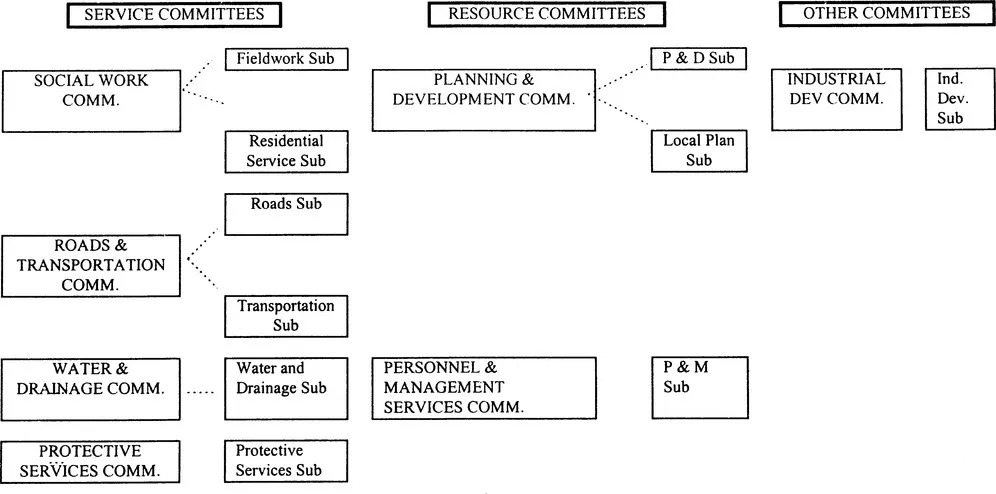
Figure 1.1 Former committee structure
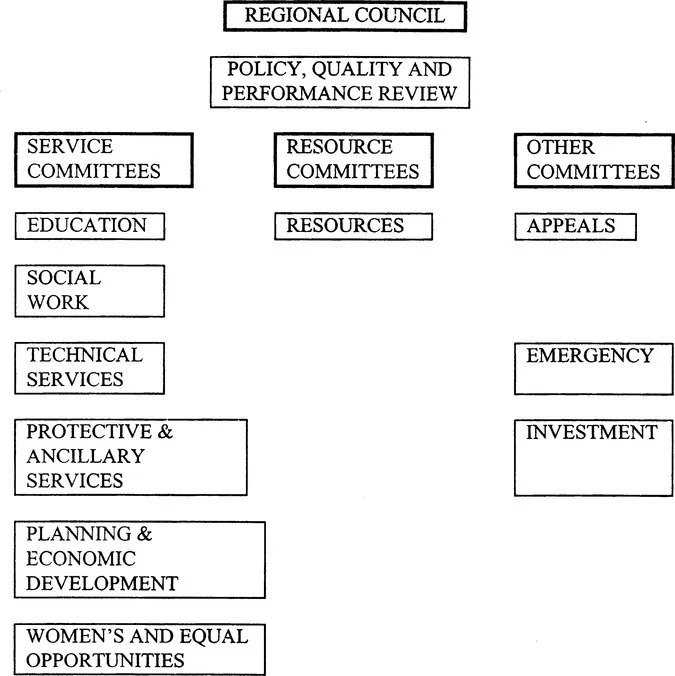
Figure 1.2 New committee structure
Developing policy initiatives
As we have seen, setting a framework within which policy development may take place is essential. In addition to this it is essential to set up mechanisms for generating policy developments.
One method employed very successfully was the member/officer group. This was used to develop policy in a number of areas such as transportation, under fives, Europe etc. Member/officers groups usually consisted of four officers and four members (all from the majority group). Membership of groups was based on an individual’s potential contributions rather than status (often third or fourth level officers were involved). Convenors of the relevant committees were excluded. Officers involved had their normal workload reduced and sometimes received secondment from their normal duties. In practice, this structure worked well and very valuable policy documents were produced. In fact the transportation policy document ‘All Change’ received national recognition. It was also recognised that appropriate performance review systems would be an essential part of ensuring effective policy implementation.
In a number of other areas policy development was achieved by major internal review. Such reviews took place in development and planning, technical services and education.
In the next section we shall review the political and economic climate, in which performance review takes place.
Performance review: the political environment
Clearly, in considering this topic we have to take account of both the national and local political environment. We shall first consider the national political environment.
The national political environment
The former Conservative Government propagated the idea widely that the public sector is inherently less efficient than the private sector. Local government down the years was particularly singled out for vitriolic attacks and abuse from government ministers, of which the following is a typical example:
By 1979 Local Government had become a barely controllable free wheeling employment machine which for year after year had been run largely for the benefit of the machine minders.
(Heseltine, 1987, p43)
Crude prejudices of this kind, however, were given intellectual underpinning by the proponents of public choice theory. Public choice theorists apply economic type approaches in which participants adopt utility maximising behaviour to the political process. Stated crudely this means that politicians achieve their goals of attaining office by exclusively carrying out programmes which please most voters. Governments which wish to maximise political support will carry out those acts of spending which attract the most votes supported by those acts of financing which loses the fewest votes (Downs, 1957). The implication of the above is that political systems should converge and that politicians never seek office to carry out particular policies for ideological reasons; they simply offer policies which enable them to gain office for the rewards of income, prestige and power.
Although the basic tenets of this theory may seen bizarre (particularly to elected members in local government whose rewards in terms of income...
Table of contents
- Cover
- Half Title
- Title Page
- Copyright Page
- Dedication Page
- Table of Contents
- Figures and Tables
- Acknowledgments
- Preface
- Chapter 1 Performance Review – the Political and Managerial Environment
- Chapter 2 Strategic and Service Planning
- Chapter 3 Performance Indicators
- Chapter 4 Performance Review Systems
- Chapter 5 Performance Review: An Overall Picture
- Chapter 6 Performance Review: Case Studies
- Chapter 7 Performance Review: General Issues
- Chapter 8 The Citizen’s Charter
- Chapter 9 The Future of Performance Review
- Bibliography
Trusted by 375,005 students
Access to over 1.5 million titles for a fair monthly price.
Study more efficiently using our study tools.
Frequently asked questions
Yes, you can cancel anytime from the Subscription tab in your account settings on the Perlego website. Your subscription will stay active until the end of your current billing period. Learn how to cancel your subscription
No, books cannot be downloaded as external files, such as PDFs, for use outside of Perlego. However, you can download books within the Perlego app for offline reading on mobile or tablet. Learn how to download books offline
Perlego offers two plans: Essential and Complete
- Essential is ideal for learners and professionals who enjoy exploring a wide range of subjects. Access the Essential Library with 800,000+ trusted titles and best-sellers across business, personal growth, and the humanities. Includes unlimited reading time and Standard Read Aloud voice.
- Complete: Perfect for advanced learners and researchers needing full, unrestricted access. Unlock 1.5M+ books across hundreds of subjects, including academic and specialized titles. The Complete Plan also includes advanced features like Premium Read Aloud and Research Assistant.
We are an online textbook subscription service, where you can get access to an entire online library for less than the price of a single book per month. With over 1.5 million books across 990+ topics, we’ve got you covered! Learn about our mission
Look out for the read-aloud symbol on your next book to see if you can listen to it. The read-aloud tool reads text aloud for you, highlighting the text as it is being read. You can pause it, speed it up and slow it down. Learn more about Read Aloud
Yes! You can use the Perlego app on both iOS and Android devices to read anytime, anywhere — even offline. Perfect for commutes or when you’re on the go.
Please note we cannot support devices running on iOS 13 and Android 7 or earlier. Learn more about using the app
Please note we cannot support devices running on iOS 13 and Android 7 or earlier. Learn more about using the app
Yes, you can access Performance Review in Local Government by Rob Ball in PDF and/or ePUB format, as well as other popular books in Social Sciences & Politics. We have over 1.5 million books available in our catalogue for you to explore.