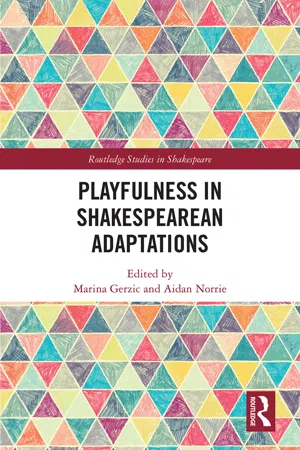
Four hundred years after William Shakespeare's death, his works continue to not only fill playhouses around the world, but also be adapted in various forms for consumption in popular culture, including in film, television, comics and graphic novels, and digital media. Drawing on theories of play and adaptation, Playfulness in Shakespearean Adaptations demonstrates how the practices of Shakespearean adaptations are frequently products of playful, and sometimes irreverent, engagements that allow new 'Shakespeares' to emerge, revealing Shakespeare's ongoing impact in popular culture. Significantly, this collection explores the role of play in the construction of meaning in Shakespearean adaptations—adaptations of both the works of Shakespeare, and of Shakespeare the man—and contributes to the growing scholarly interest in playfulness both past and present. The chapters in Playfulness in Shakespearean Adaptations engage with the diverse ways that play is used in Shakespearean adaptations on stage, screen, and page, examining how these adaptations draw out existing humour in Shakespeare's works, the ways that play is used as a pedagogical aid to help explain complex language, themes, and emotions found in Shakespeare's works, and more generally how play and playfulness can make Shakespeare 'relatable,' 'relevant,' and entertaining for successive generations of audiences and readers.
eBook - ePub
Playfulness in Shakespearean Adaptations
- 254 pages
- English
- ePUB (mobile friendly)
- Available on iOS & Android
eBook - ePub
Playfulness in Shakespearean Adaptations
About this book
Information
1 “Did Shakespeare Really Write This Racy Stuff?”
Playfulness in Shakespearean Adaptations
Marina Gerzic and Aidan Norrie
William Shakespeare, both the man and his works, occupies a ubiquitous place in Western culture. His cultural capital means that his oeuvre is adapted to appear in the most unlikely of places. In a perhaps unexpected engagement in early-modernism,1 the writers of “Much Ado About Deadpool,” in Marvel’s Deadpool #21 (2016), set a story in a Shakespeare-inspired, ‘medieval-esque’ alternate universe where many of Shakespeare’s plays are lived out, and interact. In the story, the eponymous anti-hero wakes up in an unfamiliar place, only able to speak in iambic pentameter. Over the course of the issue, Deadpool meets with characters from a variety of Shakespeare’s plays, including Hamlet, King Lear, Romeo and Juliet, Macbeth, The Tempest, and The Merry Wives of Windsor.
On first glance, the mash-up of Shakespeare and Deadpool might seem bizarre: but the two figures actually have much in common. In much the same way that Shakespeare wrote soliloquies that characters would speak directly to the audience and not be heard by other characters on the stage, Deadpool routinely breaks the fourth wall and speaks directly to his audience. Likewise, both men spend a lot of time away from their respective families, are known by monikers related to their professions (Shakespeare as the ‘Bard of Avon,’ Deadpool as the ‘Merc[enary] with a Mouth’), and are queer.2 And finally, just as Deadpool’s mutation means that he is virtually immortal, so too does Shakespeare’s continuing popularity means that he embodies the Greek concept of immortality, which was perhaps best summarised in Terry Pratchett’s Going Postal with the observation that “a man is not dead while his name is still spoken.”3
“Much Ado About Deadpool” was released in December 2016: the year that saw worldwide celebrations to commemorate the 400th anniversary of the death of Shakespeare, and the same year that the highly successful film, Deadpool, which starred Ryan Reynolds as the title character, was finally released after more than fifteen years in development hell. These two highly publicised and commented-on pop culture events no doubt informed each other, and Deadpool comics certainly benefitted from higher sales in the latter part of 2016 and into 2017.4
“Much Ado About Deadpool” was written by Ian Doescher, who is perhaps most famous for his re-telling of the Star Wars films.5 Doescher has turned each film into a Shakespeare-esque play, written almost entirely in iambic pentameter (where even R2-D2 beeps in this meter), which are liberally sprinkled with quotes, misquotes, and allusions to Shakespeare’s works.6 Doescher has claimed that each book contains an allusion to every Shakespeare play, but some are so fleeting and vague that only those intimately familiar with Shakespeare’s works will notice them.7 Doescher has been explicit in his reasons for playing with Shakespeare in such a way, wanting the re-tellings to introduce reluctant students to Shakespeare and his plays, claiming, “Shakespeare already has a reputation for being rather elite and stodgy.” For Doescher, much of this view is the fault of the archaic language of the plays, because “Young people… see unfamiliar words like ‘fardels’ and ‘codpiece’… and just assume they won’t be able to do it.” To overcome this issue, he decided to use famous modern stories to introduce the works of Shakespeare, believing that students “already know the storyline [of Star Wars], so they won’t have trouble following what is happening, and reading the book will expose them to iambic pentameter, some of Shakespeare’s basic vocabulary and a handful of literary devices.”8 Doescher certainly makes some of the references easy to spot: in Star Wars: Verily, A New Hope, he references Julius Caesar when he puts Marc Antony’s line in Luke’s mouth, “Friends, rebels, starfighters, lend me your ears”;9 and in The Clone Army Attacketh, anthropomorphised versions of the reek, the acklay, and the nexu (violent alien species used as executioners) become the three witches from Macbeth, “Now foes are food, and food is fair, / Come, blood, through fog and filthy air.”10 Others are not as obvious: after adapting much of Edmund’s soliloquy in Act I, Scene 2 of King Lear for Darth Maul in The Phantom of Menace, Doescher references Hamlet’s line, “Who calls me villain?” by having Maul ask, “And who shall call me ‘villain’ for the choice?”11 The fact that the books have all appeared on the New York Times bestseller list shows that his endeavours have met with considerable success, and Doescher himself has spoken of his delight that the works have been received so positively.12 The idea is certainly laudable, but as the chapters in Playfulness in Shakespearean Adaptations show, it is merely another attempt at making Shakespeare ‘relevant’ for contemporary audiences by playing with Shakespeare’s own words.13
In the gap between the release of Star Wars: The Force Awakens (2015) and Star Wars: The Last Jedi (2017), Doescher turned his hand to comic books, with the result being “Much Ado About Deadpool.” Deadpool as a character is known for his irreverence, wisecracking, and brazenness, and these traits not only all appear in the comic, but also make him a prime candidate for Doescher’s Shakespeare-treatment. Indeed, the main purpose behind the comic seems to be to make Shakespeare ‘fun’: for instance, when Lady Macbeth launches into her “unsex me here” speech—particularly the line “come to my woman’s breasts, and take my milk”—Deadpool takes it as a sexual advance, replying: “Unsex thee? Drink thy milk? We have just met! Did Shakespeare really write this racy stuff?”14 While his Star Wars books were intended to help introduce students to Shakespeare—a fact made all the more pronounced by the Educators’ Guides he has created for use in classrooms15—Doescher’s Deadpool story goes a step further, making use of the visual element of comics to not only create an original story using Shakespearean conventions, but also to make Shakespeare seem less “stodgy,” and more ‘real.’ Doescher here contributes to a long line of comic book adaptations of Shakespeare. Some comics adapt the plays themselves, such as the Manga Shakespeare series, Graphic Shakespeare, the No Fear Shakespeare graphic novels, and the Shakespeare Comic Book project; other adaptations re-use the stories and/or characters of Shakespeare, including the Kill Shakespeare series, various issues of Neil Gaiman’s The Sandman,16 Romeo X Juliet, and Prince of Cats. The medium of comic books, with their mix of playfulness and irreverent reverence, is an ideal way of making Shakespeare ‘relevant’ to contemporary audiences.17
Doescher’s aim to take Shakespeare off the pedestal he is placed on in modern culture is made abundantly clear on the fourth page of the comic. Deadpool cannot understand why he is only able to speak in iambic pentameter; Shakespeare appears, and explains: “It is the lingua franca of the gods, / the very music of the spheres. / It signifies you are but a character in a play / A play of mine–.” Shakespeare’s speech is cut short as Deadpool takes out his crossbow (his trademark “metal weapon [has been] turn’d into a bow”) and fires a bolt straight into his chest. Shakespeare lies dead, pierced with an arrow, but still manages to hold his quill—a rather dramatic literalisation of Roland Barthes’ “death of the author” theme.18 This itself plays with Shakespeare’s legacy and his cultural capital: while the first page of the comic is a mock-up of an eighteenth-century theatre bill that states “Written by some hack pretending to be Master William Shakespeare” (which itself is perhaps a swipe at Anti-Stratfordians), the character of Shakespeare never introduces himself. Readers are perhaps alerted to Shakespeare’s presence by the quill he holds, but his identity is confirmed through the unmistakable receding hairline known from the portrait included in the First Folio (and also the Chandos portrait), and the fact that he claims iambic pentameter “signifies you are but a character in… a play of mine.”19 Despite the fact that Shakespeare was neither the first, nor the last, premodern writer to use the device—Geoffrey Chaucer, Edmund Spenser, Philip Sidney, John Webster, and John Milton all employed it in various ways20—it is here quintessentially linked with Shakespeare, even though his plays did not employ it as rigidly as Doescher implies. Again, Shakespeare is unmistakeably “stodgy,” and his archaic way of spe...
Table of contents
- Cover
- Half Title
- Series Page
- Title Page
- Copyright Page
- Dedication
- Table of Contents
- List of Figures
- List of Contributors
- Acknowledgements
- 1 “Did Shakespeare Really Write This Racy Stuff?”: Playfulness in Shakespearean Adaptations
- Section I Page to Stage/Stage to Page
- Section II Practising Shakespeare On Stage and Screen
- Section III Adapting the Man
- Section IV Adapting the Plays
- Index
Trusted by 375,005 students
Access to over 1.5 million titles for a fair monthly price.
Study more efficiently using our study tools.
Frequently asked questions
Yes, you can cancel anytime from the Subscription tab in your account settings on the Perlego website. Your subscription will stay active until the end of your current billing period. Learn how to cancel your subscription
No, books cannot be downloaded as external files, such as PDFs, for use outside of Perlego. However, you can download books within the Perlego app for offline reading on mobile or tablet. Learn how to download books offline
Perlego offers two plans: Essential and Complete
- Essential is ideal for learners and professionals who enjoy exploring a wide range of subjects. Access the Essential Library with 800,000+ trusted titles and best-sellers across business, personal growth, and the humanities. Includes unlimited reading time and Standard Read Aloud voice.
- Complete: Perfect for advanced learners and researchers needing full, unrestricted access. Unlock 1.5M+ books across hundreds of subjects, including academic and specialized titles. The Complete Plan also includes advanced features like Premium Read Aloud and Research Assistant.
We are an online textbook subscription service, where you can get access to an entire online library for less than the price of a single book per month. With over 1.5 million books across 990+ topics, we’ve got you covered! Learn about our mission
Look out for the read-aloud symbol on your next book to see if you can listen to it. The read-aloud tool reads text aloud for you, highlighting the text as it is being read. You can pause it, speed it up and slow it down. Learn more about Read Aloud
Yes! You can use the Perlego app on both iOS and Android devices to read anytime, anywhere — even offline. Perfect for commutes or when you’re on the go.
Please note we cannot support devices running on iOS 13 and Android 7 or earlier. Learn more about using the app
Please note we cannot support devices running on iOS 13 and Android 7 or earlier. Learn more about using the app
Yes, you can access Playfulness in Shakespearean Adaptations by Marina Gerzic, Aidan Norrie, Marina Gerzic,Aidan Norrie in PDF and/or ePUB format, as well as other popular books in Literature & European Literary Criticism. We have over 1.5 million books available in our catalogue for you to explore.