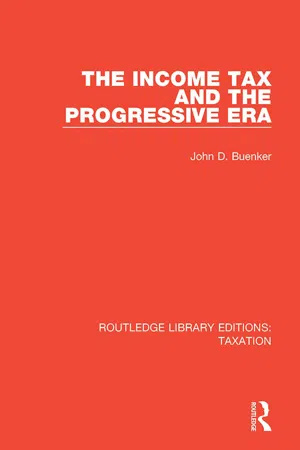
This book, first published in 1985, investigates the enactment of the federal income tax as a case study of an important Progressive Era reform. It was a critical issue that likely divided people along socioeconomic lines, thus helping to provide insight into the debate over the 'class origins' of the reformist movement.
- 514 pages
- English
- ePUB (mobile friendly)
- Available on iOS & Android
eBook - ePub
The Income Tax and the Progressive Era
CHAPTER 1
BUILDING A NATIONAL CONSENSUS
The enactment of a federal income tax in 1913 was the culmination of nearly a century of effort. Over the years, its sponsors ranged all the way from agrarian radicals to sophisticated political economists, and the arguments ranged widely from the need for increased revenue to the desire for a fundamental redistribution, of wealth. Twice before, during the Civil War and in 1894, its advocates achieved success, only to see their handiwork undone. Even in the reformist euphoria of the Populist-Progressive Era, the obstacles remained formidable enough to postpone its adoption for nearly two decades. In the end, though, the conditions demanding the enactment of the tax led to the creation of a broad-based coalition from nearly all walks of life, who saw in it at least a partial solution to their economic problems. The notion of an income tax was anything but a novelty by the onset of the Progressive Era. Beginning with Massachusetts Bay in 1634, numerous colonies had employed a rough form of income levy known as the faculty tax. Since most colonial revenue was derived from imposts on real and personal property, the faculty tax was designed to reach “those persons who derived their incomes from other sources.” It sought to tax the “returns and gains” of tradesmen, artificers, and handicraftsmen “according to his estate and with considerations of all his other abilities whatsoever,” and “proportionate unto other men for the produce of their estates.” The faculty tax was not, strictly speaking, an income tax as it was levied on a person’s assumed income, but it did establish two significant precedents—that taxes could be assessed on something other than tangible property and that their weight should be determined as far as possible by the ability to pay. In the opinion of Randolph Paul, long-time Treasury Department counsel, the faculty tax “went a considerable distance in the direction of modern income taxation.” Although several colonies abandoned the attempt, South Carolina and Massachusetts retained the levy after the American Revolution and developed it into something closer to a real income tax. An estimated one-third of the states partially financed the costs of the Revolutionary War through some variation of the faculty tax.1
Numerous states experimented with an actual income tax at various periods. The severe depression of the 1840s led several states, especially in the South, to resort to income taxation as a fiscal measure. Nearly all that region’s states resorted to an income tax during the Civil War. Although there was a brief hiatus in its use during the next two decades, at least seventeen states had utilized it at some point by 1895; four of these—Massachusetts, Virginia, North Carolina and Louisiana—still retained it. During the next three decades, there was a dramatic renewal of interest in state income taxes. By 1910 twenty states, mostly east of the Mississippi, had enacted income levies of some type, and such important states as Wisconsin, New York, Massachusetts and Missouri adopted the levy in the next decade. The income tax was also a worldwide phenomenon, having been adopted in such diverse nations as Switzerland, England, Austria, Italy, New Zealand, Tasmania, Japan, Prussia, and the Netherlands by 1910.2
Proposals for a federal income tax dated back to 1815. The revenue demands of the War of 1812 led Jeffersonian Secretary of the Treasury Alexander Dallas to call for an income levy. Given his political affiliation, it is also likely that Dallas was motivated by a desire to shift the burden of financing the war onto manufacturers and financiers. The Peace of Ghent removed the most compelling argument for the levy, however, and Congress made no effort to act upon Dallas recommendation. The staggering cost of the Civil War finally forced the enactment of the nation’s first income tax law in 1862. The eastern leadership of the Republican Party originally proposed to meet the need for increased revenue by the issuance of bonds, raising tariff rates, and additional excise taxes. When these proved insufficient, Thaddeus Stevens of Pennsylvania, chairman of the House Ways and Means Committee, sponsored a direct tax upon land. The objection of agrarian representatives, though, was so intense that Stevens was forced to resort to an income tax instead. Establishing a pattern that still persisted in 1913, the Civil War income tax was one of moderate rates levied upon a very small percentage of the nation’s income receivers. After the experience of those years, there could be no doubt that a federal income tax was a levy only upon the nation’s most affluent citizens. For the duration of the war, most such taxpayers were disposed to acquiesce in the necessity for the income tax, despite periodic debates over rates, administration, and the principle of graduation. The cessation of hostilities, however, touched off a seven year debate over the retention of the tax in peacetime that generally pitted the representatives of the Northeast against those of the South and West. In the end the former won out; the tax was repealed in 1872.3
During the next two decades, income tax bills were introduced in almost every session of Congress, nearly all by the representatives of the South and West. Finally, the measure was sponsored by Democrats of both houses in the depression year of 1893. Presenting the income tax primarily as an alternative source of revenue that would allow for the reduction of tariff receipts, the majority party was finally able to mandate its inclusion in the Wilson-Gorman Tariff of 1894. True to the Civil War pattern, the new tax was a flat two percent levy on incomes over $4,000. The collection machinery had scarcely been established, however, before Charles Pollock, a stockholder in the Farmer’s Loan and Trust Company of New York, successfully challenged the case in court. In one of the most controversial and precedent breaking decisions in history, the Supreme Court overturned the 1894 income tax on a 5–4 decision. The Pollock Decision seemed to take the steam out of the pro-income tax forces for a decade or so, but the mounting pressure was intense enough to cause both President Theodore Roosevelt and the national Democratic Party to advocate its adoption by 1908. Clearly, the notion of a federal income tax was a familiar one to most Americans by the height of the Progressive Era.4
Yet this familiarity by no means guaranteed the enactment of a federal income tax, even in an era when Roosevelt achieved popularity by verbally flaying the “malefactors of great wealth.” For one thing, the previous operation of the tax, on both the state and federal level, inspired no great confidence that it would actually reach the people that it was designed to affect. In Louisiana, in 1899, only two of the fifty-nine parishes returned any revenue yield at all. In South Carolina, in 1896, only thirty-nine of ninety-six counties did so. The amount of revenue raised in most states was described, even by such pro-income tax experts as E.R.A. Seligman, K.K. Kennan, and Delos R. Kinsman, as “insignificant” and “ludicrously” inadequate. Assessment was generally left to the individual taxpayer, and collection was usually in the hands of local, elected tax assessors. Excessive zeal in collecting revenue ticketed for the state capital was not the best platform for continuation in office. Many state tax commissions conceded the essential justice of tax, while recommending against adoption because of the formidable enforcement problem. Not until the enactment of a centralized system of administration by Wisconsin in 1911 did most of the onus of bad administration in state income taxes disappear. Actually the operation of state income tax was a mixed bag so far as the chances of a federal income tax were concerned. Besides the drawbacks already noted, the existence of a state tax often provided opponents of a federal measure with the argument that it would preclude a source of revenue that rightfully belonged to the state. On the other hand, the dismal record of failure in the states.gave pro-income tax people the claim that only the federal government could do an effective job of taxing incomes. “If an income tax is to be utilized at all in the United States,” E.R.A. Seligman contended, “it must be a national income tax.” The sentiment was echoed by the Chautauquan which pronounced state income taxes a “melancholy failure” and concluded that only a “federal income tax could be uniform, fair, and evasion-proof.” Conversely, as Yearley has demonstrated, the adoption and operation of the federal tax provided a strong impetus to the enactment of state income taxes. Despite the efforts of income tax opponents in several states to obfuscate the issue, the sources of support and opposition to both state and federal income taxation were essentially the same.5
The operation of the Civil War income tax did not hold out much promise that federal income taxation would be much more equitable or productive. Once the patriotic fervor subsided, there was, according to Internal Revenue Service Commissioner David Wells, a “considerable falling off in the revenue to be derived from the income tax.” The number of taxpayers declined from 460,170 in 1866 to only 72,949 in 1872. The latter figure was .06 percent of the nation’s population, and an estimated ten percent of its eligible taxpayers. The revenue yield similarly declined from 24.8 percent of total federal income to a mere 4.4 percent. By the time of repeal, Senator Justin Morrill of Vermont claimed, with a good deal of justification, that the income tax “had become little more than the sum each man chose to pay on his own estimate of his income.” Harry Smith, the most thorough student of the Civil War tax, later concluded that “it would seem that the greatest weakness of the system was the incapacity of the lower officers and the dishonesty of the higher ones.” In any case, the open evasion of the income tax in the post-war years earned it the reputation of being easily circumvented and unevenly administered. 6
In addition, the income tax faced the heavy burden of its popular association with political radicalism. Despite its endorsement by respectable academics, such upright middle class groups as the National Tax Association, and such mainstream politicians as Roosevelt and the Democratic Party, a large portion of the American public understandably connected it with the agitation of less established segments of society. The 1894 tax materialized contemporaneously with, and partly in response to, Populism. The Anti-Monopoly, Greenback, Union Labor, and United Labor Parties also advocated income taxation, as did the rapidly growing Socialist Party of Eugene Debs. An increasing number of newspapers, especially in the industrial Northeast, regularly stigmatized the tax as “class legislation”, while the Philadelphia Public Ledger strongly questioned the notion that the rich should pay taxes “solely because they are rich.” The New York Sun branded an income levy as “taxation of the few for the benefit of the many,” while the New York Herald seriously suggested that “instead of taxing income, [the government] ought to pay premiums to men for achieving financial success.”7
Its 1894 Congressional opponents labeled the tax variously as anarchism, communism, socialism, and populism, sentiments echoed by the plaintiff’s attorneys in the Pollock Case, and even by some of the justices who concurred in the majority opinion. Whether these views represented sincere conviction or constituted rationalizations contrived to mislead the middle and lower classes is impossible to determine with certitude. Like most people, the nation’s rich probably experienced little difficulty in convincing themselves that an attack upon their well-being was an assault against the foundations of national society. In any case, their contentions apparently helped to frighten large numbers of people away from support of a tax that would not even affect them. The income tax, as C.K. Yearley has put it, “unquestionably suffered as well from the company it kept.” Allegations of class legislation, as a Nashville, Tennessee paper observed, totally missed the point that those whose incomes were too meager to be reached by a federal income tax would have gladly changed places with those whose incomes would be so burdened. The playwright George Fitch characterized potential taxpayers as members of “an exclusive club” which “the ordinary wage earning man cannot hope to enter” and suggested they “organize the Sons of Simoleons with a golden ribbon on the coat lapel for a badge.”8
The true nature of the income tax issue was also obscured by several other misconceptions on the part of many who logically should have had a stake in its enactment. The notion of taxing citizens at different rates, based upon their varying incomes, seemed inherently undemocratic, especially since so many would not be taxed at all. Its opponents eagerly rallied behind the argument because it enabled them to pose as defenders of the cherished notion of democracy, and to claim that all men should bear the burden of financing government equally. W.D. Guthrie, one of Pollock’s attorneys, stressed that concept with telling effectiveness in his opening remarks; anti-income tax newspapers and legislators frequently advanced it. A more sophisticated appreciation of the socioeconomic base of a democracy, as Yearley has demonstrated, has led to an understanding that tax burdens can only be equalized by taking into account what portion of a man’s worth the levy is, rather than insisting upon strict mathematical parity. This was a lesson that people were slow to learn, however, and the “pseudo-democratic” contention of strict dollar for dollar equality died hard.9
The waters were further muddied by the spectre of sectionalism. It was clearly understood that the major impetus for a federal income tax emanated from the West and the South. Nearly all the bills introduced in Congress from the Civil War on came from representatives of those regions, while the delegates from the industrial Northeast, regardless of party, formed a nearly solid phalanx of opposition. This was a natural function of the face that those individuals with sufficient incomes to be effected by the proposed tax were heavily concentrated in the Northeast. Almost seventy-two percent of the revenue from the Civil War income taxes came from the northeastern states, while the whole region west of the Mississippi paid only about twenty-two percent; the entire South yielded but 5.6 percent. This geographical circumstance made it possible for opponents of the tax to fuzz over the fact that the tax was to be paid by individuals, no matter where they lived, and to animate the resistance of those northeasterners without sufficient income to be affected by styling the tax a sectional plot. This was especially effective in an era when the South was still associated with secession and the West with agrarian radicalism. Ironically, some southern opponents of tax tried to stigmatize it as a northern plot to despoil the region of what little it had been able to recoup from the ravages of war and Reconstruction. As a concomitant of the sectional argument, bitter debates often raged over which region would benefit most by the increased revenue that a federal income tax might bring. Anti-income tax forces in the Northeast were extremely vocal in insisting that the revenue would be expended to develop the West at the expense of eastern taxpayers.10
Tnis tendency to obscure the fact that the income tax was a levy upon individuals was also present in the frequent reminders that the bulk of the burden would fall upon only a few states. Approximately eighty percent of the Civil War tax had been paid by the residents of eight states—New York, Pennsylvania, Massachusetts, Ohio, Illinois, California, New Jersey, and Maryland. The first three alone had produced almost sixty percent of the revenue, with New York accounting for one-third the national total. In 1916 these top eight states still accounted for three-fourths of the total personal and corporate income tax paid, with New York alone producing more than thirty-five percent. Beyond those states, there were only eight others—Connecticut, Delaware, Michigan, Minnesota, Missouri, Oklahoma, Texas and Wisconsin—that accounted for more than one percent of the national total. It was easy enough to portray the tax as a scheme of the forty or so “have-not” states to raid the “haves”. In the South, consideration of the issue on a state-against—state basis caused many to view a federal income tax as a threat to the hallowed tradition of state rights.11
This tendency to think of the income tax as a levy upon states rather than upon individuals was given tremendous impetus by the interpretations of the direct tax clause of the U.S. Constitution. That highly controversial provision required that direct taxes had to be apportioned among the states on the basis of population. This was the clause that had been insisted upon by Southern slaveholders to ameliorate any possible federal taxation of their two most valuable assets—land and slaves. They had added to it the “Three-Fifths Clause” that provided for the counting of three slaves for each five for the purposes of both representation and taxation. Unfortunately, no one had ever determined what the Founding Fathers considered direct taxes. According to James Madison’s Journal of the Constitutional Convention, Rufus King “asked what was the precise meaning of direct taxation,” and “no one answered.” A century of Supreme Court decisions had established only that capitation and land levies fell into that elusive category. The Pollock Decision flew in the face of all previous precedents by declaring the 1894 income tax a direct one, and voiding it because it was not apportioned among the states on the basis of population. Had it been so apportioned, it was estimated that South Carolina would have been assessed three times as much as Massachusetts in relation to the income of its citizens, Mississippi four times as much as Rhode Island, and North Carolina four times as much as New York. In 1875 the New England states paid about $4,000,000 in federal taxes. If these had been apportioned by population, their bill would have been $9,350,000 and if by wealth, ballooned to $14,000,000. The northwestern states, on the other hand, paid $43,500,000 in customs and excise taxes, a total that would have dropped to $30,333,333, if apportioned by population, and to $27,500,000, if levied by wealth. Needless to say, the tax bill of those subject to an unapportioned income tax would shrink to virtually nothing if the tax were apportioned, while those who had escaped the Civil War and 1894 taxes would be forced to pay. This inability to get a definitive interpretation of the direct tax clause confused the income tax debate for decades, giving opponents a formidable constitutional shield behind which to hide. The Pollock Decision even seriously divided the measure’s advocates between those who wished to pass another statutory tax in order to confront the Court over the direct tax issue, and those who desired to enact a constitutional amendment that would specifically remove the income tax from that nebulous category.12
Its previously disastrous administrative record and confusion over charges of radicalism, sectionalism, its anti-democratic nature, and state rivalries not withstanding, the most serious obstacle faced by the income tax was that ...
Table of contents
- Cover
- Half Title
- Title Page
- Copyright Page
- Table of Contents
- Preface
- Chapter I Building A National Consensus
- Chapter II An Amendment of Curious Origins
- Chapter III The Chronology of Ratification
- Chapter IV Triumph in the West
- Chapter V Unexpected Trouble in the South
- Chapter VI Toppling the Keystone: The Amendment in New York
- Chapter VII Breaking the Iron Rectangle: The Northeastern States
- Chapter VIII The End of the Road
- Chapter IX The Income Tax and the Progressive Era
- Notes
- Bibliography
- Index
Trusted by 375,005 students
Access to over 1.5 million titles for a fair monthly price.
Study more efficiently using our study tools.
Frequently asked questions
Yes, you can cancel anytime from the Subscription tab in your account settings on the Perlego website. Your subscription will stay active until the end of your current billing period. Learn how to cancel your subscription
No, books cannot be downloaded as external files, such as PDFs, for use outside of Perlego. However, you can download books within the Perlego app for offline reading on mobile or tablet. Learn how to download books offline
Perlego offers two plans: Essential and Complete
- Essential is ideal for learners and professionals who enjoy exploring a wide range of subjects. Access the Essential Library with 800,000+ trusted titles and best-sellers across business, personal growth, and the humanities. Includes unlimited reading time and Standard Read Aloud voice.
- Complete: Perfect for advanced learners and researchers needing full, unrestricted access. Unlock 1.5M+ books across hundreds of subjects, including academic and specialized titles. The Complete Plan also includes advanced features like Premium Read Aloud and Research Assistant.
We are an online textbook subscription service, where you can get access to an entire online library for less than the price of a single book per month. With over 1.5 million books across 990+ topics, we’ve got you covered! Learn about our mission
Look out for the read-aloud symbol on your next book to see if you can listen to it. The read-aloud tool reads text aloud for you, highlighting the text as it is being read. You can pause it, speed it up and slow it down. Learn more about Read Aloud
Yes! You can use the Perlego app on both iOS and Android devices to read anytime, anywhere — even offline. Perfect for commutes or when you’re on the go.
Please note we cannot support devices running on iOS 13 and Android 7 or earlier. Learn more about using the app
Please note we cannot support devices running on iOS 13 and Android 7 or earlier. Learn more about using the app
Yes, you can access The Income Tax and the Progressive Era by John D. Buenker in PDF and/or ePUB format, as well as other popular books in Business & Business General. We have over 1.5 million books available in our catalogue for you to explore.