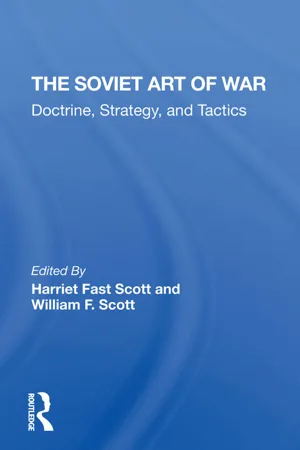
No other nation has invested as much intellectual capital in the study of war as has the Soviet Union over the last six decades, and the doctrine, strategy, and tactics that have been developed by Soviet theoreticians are bound to guide any future Soviet military action. The Soviet Art of War makes available to Western readers selections from the most significant and influential Soviet military writings from 1917 to the present. The Scotts have examined thousands of Soviet military publications, including the restricted journal of the Soviet General Staff, Voyennaya Mysl', to make this book the most comprehensive account of Soviet military theory and practice yet published. The papers they have chosen thoroughly illustrate the development of the basic features of Soviet military art, from the days of trench warfare to the era of the nuclear battlefield. These documents demonstrate the emphasis on surprise, on deception, on mass deep penetration of enemy defenses, and on a unified strategy for all services. They also show the forms of military action—destruction and attrition, defense and offense, maneuver and position-as seen through the eyes of leading Soviet marshals, generals, and admirals. The usefulness of this material is further enhanced by the Scotts' commentary and their analysis of each group of readings.
eBook - ePub
The Soviet Art Of War
Doctrine, Strategy, And Tactics
- 325 pages
- English
- ePUB (mobile friendly)
- Available on iOS & Android
eBook - ePub
The Soviet Art Of War
Doctrine, Strategy, And Tactics
About this book
Information
Part 1
Early Development of Soviet Military Thought, 1917-1941
Introduction
In the mid-1960s the Soviet Armed Forces were in the midst of a strategic nuclear buildup. Soviet writing on military doctrine, strategy, and tactics was concerned primarily with nuclear war. Western analysts paid little attention to a book, Problems of Strategy and Operational Art in Soviet Military Works: 1917-1941, which appeared in 1965, or to a companion work on tactics, published in 1970.1 In 1972 Red Star reported that the two books, as a pair, had been nominated for the prestigious Frunze prize for distinguished military literature.2
These books, which are collections of Soviet military writing of the 1920s and 1930s, were published for a distinct purpose. Although Soviet doctrine in the 1960s had stressed nuclear warfare, Soviet spokesmen asserted that multimillion-man forces would be needed in a future war. The leadership wanted to ensure that its forces could conduct combined arms operations, with or without the use of nuclear weapons. The revolutionary changes in warfare brought about by nuclear weapons had not invalidated all military fundamentals. Basic concepts and principles of the art of war, applicable in either nuclear or nonnuclear conditions, needed to be reaffirmed.
This early Soviet military literature generally was new to all but the older Soviet officers. As Marshal M. V. Zakharov, then chief of the Soviet General Staff, explained in his introduction to the collection, many of the books and journals from which they were taken had been destroyed or preserved in only single copies during Stalin's regime. Among those whose works had been completely destroyed were I. E. Yakir, V. K. Blyukher, A. I. Sedyakin, R. P. Eideman, and others. Zakharov did not mention that these four officers, as well as approximately half of those whose work appeared in the collections, had been killed during Stalin's 1937-1938 military purges.3
Soviet officers found that many current military concepts, such as deep operations, echeloned formation in the attack, the primacy of the offensive, and the importance of the meeting engagement, were formed during the first two decades of Soviet rule. According to Marshal Zakharov, the writings of these early military theorists "contain the most precisely formulated fundamental positions on Soviet military-theoretical thought."4 They form the basis on which Soviet military doctrine, strategy, operational art and tactics of the 1970s and early 1980s were developed.
For example, M. V. Frunze, who in 1925 briefly succeeded Leon Trotsky as head of the Red Army, described the necessity of a single view on fundamental military questions, such as combat training and operations. He wrote that any future war would be a class struggle. Lightning combat action was possible, but Soviet planning must prepare for a protracted conflict. Frunze stressed maneuverability, but he did not exclude the possibility of positional warfare in some areas. Soviet military writing of the 1980s covers the same issues.
Both early and current Soviet military theorists refer frequently to V. I. Lenin as the final authority on Soviet military thought. In particular, they quote Clausewitz's dictum that "war is a continuation of policy by other means," with Lenin's addition: "i.e., by forceful means."
Soviet spokesmen acknowledge that little progress was made in strategic theory during the 1920s and 1930s. The only work of consequence during that period was A. A. Svechin's 1927 publication, Strategy.5 It is regarded as the first and only worthwhile Soviet work in this area during the pre-World War II years and is considered to have had a positive influence on the development of Soviet military thought. Those who opposed Svechin's book accused him of being unable to envisage the impact that the new Soviet state would have on military art on the grounds that his writing reflected his bourgeois background as an excolonel in the czar's Imperial Army.
Svechin's discussion of the strategy of destruction and the strategy of attrition is superb and well worth reading for analysts concerned with current Soviet strategy. A strategy of destruction is based on one massive thrust such as (in 1980 terms) launching a massive nuclear strike to achieve the primary objective of the war. A number of consecutive operations might be regarded as an entity—as one major offensive. Operations are based on speed, straight-line action, and mass. Svechin described the strategy of attrition as based on gradually exhausting and weakening the enemy. Destroying the enemy's military forces may be only part of the task of the armed forces. The enemy must be weakened in every possible way, including political and economic actions. Armed forces are assigned limited tasks; they must have flexible maneuvering tactics designed to create superiority preparatory to the final, decisive strike.
Unless one considers that a war can be won with a single nuclear strike, no modern conflict can be characterized simply as one of attrition or destruction. The war may begin as one of attrition, and then in the final stages a strategy of destruction may be adopted by one side. Nevertheless, an understanding of these two strategies will help the military planner project future moves and possibly better anticipate an opponent's actions.
In the 1920s and 1930s M. N. Tukhachevskiy, one of the outstanding military leaders of the time, also outlined new strategic concepts. Β. M. Shaposhnikov, another noted Soviet military theoretician, wrote about the General Staff, which he considered the "brain of the army." Navy theoreticians, such as Boris Zherve, wrote on concepts of naval strategy that were unworkable at the time because the Soviet Union did not have sufficient resources to build the surface ships needed.
Development of Operational Art and Tactics
According to early Soviet theorists, the decisive weapons in future wars would be tanks, artillery, and aircraft. The 1929 Five-Year Plan for Industrialization was intended, among other things, to give the Red Army superiority in these three critical weapons. Just as ballistic missiles and nuclear weapons led to new ideas on military doctrine, strategy, and tactics in the 1950s, so reequipping the Red Army with new conventional weapons in the pre-World War II period also spawned novel military theories.
Many of the theoretical concepts formulated at that time, especially in operational art and tactics, were far ahead of Soviet military capabilities, especially in armaments. Soviet military theory, however, is intended to precede capabilities and to give purpose and direction to future developments.
As the selections that follow will show, many Soviet perceptions of war in the 1930s differed little from those described in Soviet military literature of the late 1970s and early 1980s. A future war "would be an armed struggle of enormous million-man armies." The belligerent sides "would pursue decisive goals—the complete destruction of the enemy." An armed struggle would consist of a series of consecutive operations. The main and basic task of military art "is not to allow the formation of a solid front, imparting to operations and battle annihilating strikes and swift tempos." Positional war should be avoided in favor of a war of maneuver. Forces of enormous penetrating power would be formed, capable of delivering successive strikes through the whole depth of the enemy front. These strikes would be conducted with deeply echeloned masses of infantry, tanks, and artillery, supported by aviation. This was the basis of "deep operations," the ideal Soviet method of combat at the time.
The concept of deep operations became official for the Red Army in 1933, with the issuance of orders entitled "Temporary Instructions on the Organization of Deep Battle." The 1936 Field Service Regulations, prepared under the direct leadership of M. N. Tukhachevskiy and A. I. Yegorov, reflected the tactics of deep battle and deep operations. Marshal M. V. Zakharov, Chief of the Soviet General Staff from 1960-1963 and 1964-1971, described this concept as follows:
The deep operation as a process included several stages: breakthrough of the tactical defense and forming a breach in it by the combined efforts of the infantry, tanks, artillery and aviation; the exploitation of tactical into operational success by means of sending masses of tanks, motorized infantry, and mechanized cavalry through this breach and also by means of making air landings (the destruction of reserves and liquidation of the enemy's operational defense); the exploitation of operational success (operational pursuit) to the complete destruction of the enemy grouping selected as the objective of the operation and seizing a favorable assault position for a new operation. The first stage is the foundation for a deep operation since without a breakthrough of the tactical defense it would not have taken place at all, that is, it would have been frustrated. But its main point was that artillery, tanks (several echelons), aviation and infantry, cooperating among themselves, simultaneously inflict a defeat on the enemy's combat order throughout its whole depth and, as if by a single, surprise, deep and powerful strike, they break his defense, forming breaches in it and try to reach the operational area. In accomplishing this, all branches of service act in support of the infantry.6
The deep operations concept continues to interest the Soviet military leadership. Volume 2 of the Soviet Military Encyclopedia, published in the late 1970s, has a long essay on this subject, signed by Marshal Ν. V. Ogarkov, chief of the Soviet General Staff.7
However, the regulations prepared by M. N. Tukhachevskiy on deep operations "never saw the light of day." Soviet military concepts developed in the 1920s and early 1930s were used only in the latter stages of World War II. In 1937 Stalin's purges of the military began, resulting in the loss of leaders who were experienced in conducting modern battle. A less proficient Stalinist officer crops drew incorrect lessons from the Spanish Civil War (1936-1939) and the Russo-Finnish War of 1939-40. These officers brought about immediate and profound changes throughout the Soviet military structure.
Stalin and Soviet Military Theory
In major cities throughout the Soviet Union memorials honor the Soviet soldiers killed during the Great Patriotic War. There also are monuments and statues in memory of those killed during the Civil War. But the greatest losses of Red Army commanders occurred during Stalin's military purges. Tukhachevskiy, Uborevich, Svechin8—these and thousands of other officers were shot or died slow deaths in forced labor camps. Few senior officers escaped. There are no Soviet monuments to those murdered men, or to the millions of innocent Soviet civilians who also died as a result of Stalin's actions.
By the late 1930s the writings of Soviet military theoreticians had been destroyed or suppressed. Military theory then became essentially "mosaics from speeches by Stalin on military operations." The theory of deep operations was discounted "on the basis that in it were no pronouncements of Stalin and that its creators were enemies of the people." The concept of independent actions of large mechanized units ahead of the front was called an attempt to sabotage the armed forces.9
Soviet military thought was thrown into further disarray as a result of Soviet military participation in the Spanish Civil War. Stalin's troops and equipment were no match for the elite German forces sent into Spain by Hitler. Based on the Spanish experience, the Soviet high command became convinced that mechanized corps were not effective; they were therefore abolished. Soviet air forces were limited in mission to close support of ground troops. Military concepts developed earlier by Tukhachevskiy and others were abandoned.
Then came the German invasion of Poland, unleashing World War II. The blitzkrieg tactics used by Hitler's forces were thought to herald new concepts of warfare. After Germany's successes with armored units, the Soviets began to restore their mechanized corps. There were frantic efforts to produce new weapons, ranging from tanks and antitank guns to aircraft. Later the Finnish war, which required a major Soviet commitment, revealed weaknesses throughout the Soviet military structure.
In 1941, when Hitler moved against the Soviet Union, Soviet military thought proved of little practical value. Stalin assumed that his forces still had the equipment and capability to break through enemy lines, after which they would perform an encircling maneuver and bring about the complete destruction of the opposing side. Problems that should have been expected at the beginning of a war, such as seizing the operational and strategic initiative, had not been addressed. The Soviet high command had thought that any future war would be fought outside Soviet territory.
As the war progressed, the ideas of Soviet military strategists and tacticians of the 1920s and 1930s came into wide use. The original texts were reprinted in the late 1960s; their impact on Soviet military doctrine, strategy, and tactics formulated since that time is of the utmost significance. For this reason, pre-World War II military writing warrants careful study and analysis.
Marshal M. V. Zakharov appears to have been one of the officers most responsible for reintroducing the works of the early Soviet strategists in the post-Stalin era. From 1945 through 1949 Zakharov had headed the General Staff Academy. In I960 he succeeded Marshal V. D. Sokolovskiy as chief of the General Staff. In March 1963, a few months after the Cuban crisis, he was once again appointed commandant of the General Staff Academy. In 1964, shortly after Khruschev's ouster, he was again designated chief of the General Staff, which he headed until he became seriously ill in 1971. In these assignments, he was in a unique position to direct or influence the education and training of the Soviet Armed Forces.
In the mid-1960s Marshal Zakharov wrote that initial German successes were due in part to their adoption of earlier Soviet military theories. For example, "the Second World War showed that fascist Germany used the methods of deep operations worked out earlier by us. The Germans borrowed the achievements of Soviet military theoretical thought and not without success used them in the war with Poland and the West."10 This statement is misleading. Soviet texts fail to mention that Tukhachevskiy, Uborevich, and other leading officers of the 1930s had attended military courses and field training in Germany and had served under German advisers in the Soviet Union after the Treaty of Rapallo. Some of the concepts they set down as their own creations may have been developed initially in German classrooms during the 1920s.
Nor did Marshal Zakharov reveal that textbooks used by military schools in Western Europe and the United States during the 1920s and 1930s often were translated into Russian and widely used as texts by the Soviet military services. Works of many of the leading Western military strategists (such as the Italian general Giulio Douhet, who advocated the strategic use of air power, and the Britisher J.F.C. Fuller, who stressed the role of armored forces) also were used in Soviet military schools and academies. A 1937 Soviet catalog of military books contained dozens of works translated into Russian.11 Particularly significant among these were the U.S. Army Infantry School's Infantry in Battle, Fuller's Operations of Mechanized Forces, Charles de Gaulle's The Professional Army, Machiavelli's Art of War, Clausewitz's On War, and the Austrian general Eimansberger's Tank War.
The following selections will give the reader an appreciation of the early development of Soviet doctrine, strategy, operational art, and tactics, which are an essential part of current Soviet military concepts.
Notes
1. Α. Β. Kadishev, ed., Voprosy Stratega i Operativnogo Iskusstva v Sovel· skikh Voyennykh Trudakh: 1917-1940 [Problems of strategy and operational art in Soviet military works: 1917-1940] (Moscow: Voyenizdat, 1965), and A. B. Kadishev, ed., Voprosy Taktiki v Sovetskikh Voyennykh Trudakh, 1...
Table of contents
- Cover
- Title
- Copyright
- Contents
- Preface
- Introduction
- Part 1 Early Development of Soviet Military Thought, 1917-1941
- Part 2 The Great Patriotic War and the Last Years of the Stalin Era, 1941-1953
- Part 3 The Revolution in Military Affairs, 1953-1959
- Part 4 The Drive for Nuclear Status, 1960-1968
- Part 5 Development of a Controlled Conflict Capability, 1969-197
- Part 6 Opening Era of Power Projection, 1974-19??
- Conclusions
- Selected Bibliography
- Appendix
- Index
- Other Westview Titles of Interest
- About the Book and Editors
Trusted by 375,005 students
Access to over 1.5 million titles for a fair monthly price.
Study more efficiently using our study tools.
Frequently asked questions
Yes, you can cancel anytime from the Subscription tab in your account settings on the Perlego website. Your subscription will stay active until the end of your current billing period. Learn how to cancel your subscription
No, books cannot be downloaded as external files, such as PDFs, for use outside of Perlego. However, you can download books within the Perlego app for offline reading on mobile or tablet. Learn how to download books offline
Perlego offers two plans: Essential and Complete
- Essential is ideal for learners and professionals who enjoy exploring a wide range of subjects. Access the Essential Library with 800,000+ trusted titles and best-sellers across business, personal growth, and the humanities. Includes unlimited reading time and Standard Read Aloud voice.
- Complete: Perfect for advanced learners and researchers needing full, unrestricted access. Unlock 1.5M+ books across hundreds of subjects, including academic and specialized titles. The Complete Plan also includes advanced features like Premium Read Aloud and Research Assistant.
We are an online textbook subscription service, where you can get access to an entire online library for less than the price of a single book per month. With over 1.5 million books across 990+ topics, we’ve got you covered! Learn about our mission
Look out for the read-aloud symbol on your next book to see if you can listen to it. The read-aloud tool reads text aloud for you, highlighting the text as it is being read. You can pause it, speed it up and slow it down. Learn more about Read Aloud
Yes! You can use the Perlego app on both iOS and Android devices to read anytime, anywhere — even offline. Perfect for commutes or when you’re on the go.
Please note we cannot support devices running on iOS 13 and Android 7 or earlier. Learn more about using the app
Please note we cannot support devices running on iOS 13 and Android 7 or earlier. Learn more about using the app
Yes, you can access The Soviet Art Of War by Harriet Scott, William Scott, Harriet Fast Scott,William F. Scott,Harriet Scott,William Scott, Harriet Fast Scott, William F. Scott in PDF and/or ePUB format, as well as other popular books in Politics & International Relations & Politics. We have over 1.5 million books available in our catalogue for you to explore.