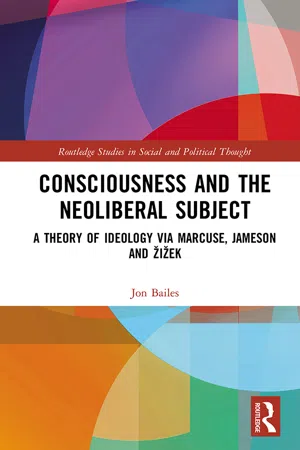
Consciousness and the Neoliberal Subject outlines a theory of ideological function and a range of ideological positions according to which individuals rationalise and accept socio-economic conditions in advanced consumer capitalist societies. Through a critical examination of the social and psychoanalytic theories of Herbert Marcuse, Fredric Jameson, and Slavoj Žižek, the author extends the understanding of ideology to consider not only the unconscious attachment to social relations, but also the importance of conscious rationalisation in sustaining ideologies. In this way, the book defines different ideologies today in terms of the manner in which they conditionally internalise a dominant neoliberal rationality, and considers the possibility that entrenched social norms may be challenged directly, through conscious engagement. It will appeal to scholars of social and political theory with interests in ideology, neoliberalism, psychoanalytic thought and critical theory.
eBook - ePub
Consciousness and the Neoliberal Subject
A Theory of Ideology via Marcuse, Jameson and Žižek
- 196 pages
- English
- ePUB (mobile friendly)
- Available on iOS & Android
eBook - ePub
Consciousness and the Neoliberal Subject
A Theory of Ideology via Marcuse, Jameson and Žižek
About this book
Information
1 An ideology model
The model of ideology outlined in this chapter is one of ‘dualisms’that exist in a state of mutual dependence and tension. On one level, this idea refers to the relationship between a dominant ‘background’rationality and the various ways people internalise it. On another, it refers to the psychological bond between unconscious attachment and conscious rationalisation. Finally, it refers to the way any attachment is either affirmative or oppositional in relation to the background, and what can cause a shift from one pole to the other.
Before we consider this concept in detail, and its relevance to theories of political change, the chapter begins with four proposals, which define the model in relation to other theories of ideology. The first three of these proposals generally accord with the theories advanced by Marcuse, Jameson and Žižek, while the fourth marks our shifted focus from the unconscious to rationalisation. In effect, all of these proposals affirm the idea that ‘ideology is the mediatory concept par excellence’, which links ‘the individual and the social, […] objectivity and the subject, reason and the unconscious, the private and the public’ (Jameson, 2008a, p.ix). Yet we argue that in Jameson’s theory, along with Marcuse’s and Žižek’s, the relationship between reason and the unconscious especially often prioritises the latter, and our aim is to reintroduce a greater sense of mediation between them. The proposals are:
- Ideology is always present and always political
- Ideology relates to class division and struggle
- Ideology is produced by and produces social relations
- Ideology relies on conscious, contestable beliefs
The first proposal demonstrates that ideological analysis is itself affected by the ideology of the theorist, and there is no absolute truth. Everyone has an ideology, whether or not they are interested in social matters, primarily because their actions and beliefs (tacitly) support or reject the existing social order. The possibility of rejection then indicates that the social itself is a particular (not universal) historical formation that promotes certain values over others. The second proposal views this exclusion along ‘class’lines to show how, today, the capitalist logic has deep implications for all aspects of social life, and overdetermines the general ‘background’ideology to which ideological positions respond. Thus, as the third proposal makes clear, even if culture appears fragmented and lacking a unifying structure, it is linked by the demands of this logic. But because people do not all internalise social relations in the same way, they generate ideas that exceed it, and even influence the structure itself. This suggests a ‘conditional’relationship between background and ideological positions, based on justificatory narratives and repression of subordinate ideas. The fourth proposal follows from it: rationalisations within ideological positions can be contested, and may be contingently committed to the social order.
Ideology is always present and always political
The first purpose of this statement is to indicate that ideology is not only a matter of ruling ideas or social domination, but part of all politically significant thought, whether dominant or subordinate (Eagleton, 2007, p.2). Because consciousness emerges through language embedded within particular social relations, any viewpoint is implanted in networks of power. Also, while not every action or thought is politically motivated, many have political effects in that they strengthen or disrupt the social order. The fact that viewpoints contradict each other means that some will be dominant and some subordinate, but there is no non-ideological or ‘uncontaminated’position, even within ideological analysis. However, some positions may be more self-reflexive or consider social relations in terms of what they repress and their potentials for transformation. Marcuse, Jameson and Žižek all suggest that particular subordinate positions represent limits in common assumptions that may otherwise be missed. This notion also has political implications, but recognises the contingency of any ideology, including its own.
In this way, ideologies can be understood dialectically, as partial views that are incomplete and contain a potential to transform within their own contradictions. Recognising this incompleteness then enables us to view society as a ‘totality’that is supported by various ideologies but also contingent and antagonistic, promoting certain norms of behaviour at the expense of others. That repression creates hierarchy and prohibits ideas and actions, whose continued existence points to an alternative totality. The politics of such theory thus tends to identify with what is normally excluded, and indicates that all theorisation of ideology is politically infused, because it either promotes what is repressed, or reinforces current social relations by not considering potentials for transformation.
This dialectical approach is key to the theory of ideology outlined in this book and the primary theoretical strand linking Marcuse, Jameson and Žižek. In Marcuse’s work, it is manifested particularly in his contrast between ‘one-dimensionality’, or automatic absorption of dominant ideas, and ‘two-dimensional’thinking, which perceives those ideas as expressions of particular and transcendable social forms. As he puts it, the aim is that dialectical philosophy ‘frees thought from its enslavement by the established universe of discourse and behaviour’, and ‘projects its alternatives’. He continues that, although this position remains ideological, its ‘effort may be truly therapeutic – to show reality as that which it really is, and to show that which this reality prevents from being’(Marcuse, 1964, p.199). The point here is not that reality as it ‘really is’involves some concrete truth of absolute values, but that it reveals the ideological nature of any view, which is ‘therapeutic’ because it shows that current social conditions are not universal and can be changed.
A similar notion is present in Jameson’s concept of History, which is lost when any particular set of dominant values appears universal, because it would otherwise mark the contingency of that dominance and its repression of other values. History implies a continual struggle, where today’s dominant values were once subordinate and could become so again, but is only recognisable through its effects, or social groups that embody the incompleteness of the existing totality. It is not, for Jameson, that there is a correct interpretation of History, but that historicising highlights the attempted ideological closure in any interpretation or narrative. It shows that, while there are only interpretations, ‘every individual interpretation must include an interpretation of its own existence, must show its own credentials and justify itself’ (Jameson, 2008b, p.7). In this sense, Jameson’s Marxist method is ‘true’ not because it provides final answers but because it continuously reveals the limits and repressed potentials in interpretations (including Marxist ones).
Žižek’s Lacanian theory emphasises how the dialectical relationship is embedded in the psychic structure. Consciousness means entry into language and ideology, because attachment to language means stabilising meaning through particular interpretations of concepts, and with no absolute, external guarantee of meaning, subjects require a ‘fantasy’ that represses this lack. Lacanian psychoanalysis then asks subjects to recognise the lack, or the arbitrariness of meaning, and take responsibility for their own symbolic attachment (see for example: Lacan, 1992, chs.XXII–XXIV). The important point here for Žižek is not that such ideas render all meaning equally ‘false’, but how subjects react to the lack of meaning, and the political consequences that follow. Thus, he explains ‘although ideology is already at work in everything we experience as “reality”, we must none the less maintain the tension that keeps the critique of ideology alive’ (Žižek, 1994, p.17).
These theories highlight how ideology is always present, even though it can be split between subjects who are ‘complicit in concealing the radical contingency of social relations’ and those who ‘are attentive to its constitutive character’ (Glynos and Howarth, 2007, p.14). Thus, two-dimensional thinking, Marxist historicising, and confronting the lack in subjectivity all involve ideological suppositions. There is no distinction made here, for example, as that made by Althusser between ideology and the ‘science’ of investigation (Althusser, 1969, p.231). In Althusser’s terms, because Marxism is more self-reflexive it is less ideological, whereas in our terms, while some ideologies involve greater degrees of self-awareness or analysis, what makes them ideologies is the core structure of ultimate groundlessness. Our focus is on the political consequences of different views, while acknowledging that political and moral assumptions remain present in the critique. As Porter explains of Žižek’s theory, while ‘we can never be certain of the terms of our own ideological enslavement’, ‘we can maintain a critical position enabling us to point up and negate the limits of ideologies we encounter in the social field’ (Porter, 2002, p.62).
Furthermore, because dialectical theory assumes a critical position towards the established political field, it implies that theories lacking such critical dimensions fail to consider repressed social potentials. In some cases, such theory may even repress the role of ideology itself. In analytic philosophy such as that of Rawls, for example, ideology is a category of irrational fundamentalism in contrast to open-minded, reasonable thought. As he explains in an early text, ‘ideologies, of whatever type, claim a monopoly of the knowledge of truth and justice for some particular race, or social class, or institutional group’, whereas ‘competent moral judges […] are associated with coming to know something, and not by means of characteristics which are the privileged possession of any race, class, or group’ (Rawls, 1999, p.5). He later states that ‘a well-ordered society does not require an ideology in order to achieve stability’ (Rawls, 1999, p.326n), because ‘full publicity’, or complete institutional transparency, can function in its place. Yet, as conscious subjects we take particular, partial positions, and no matter how many layers of preconception are stripped away, if we do not see these positions as ideological we cannot examine how they intertwine with power relations. Rawls emphasises that ‘a reasonable man’ must try to take his own predilections into account (Rawls, 1999, p.3), but if those predilections are socially dominant assumptions, they may remain unnoticed, and ‘reasonable’ can come to mean that which aligns with established (liberal) thinking (Mouffe, 2000, p.26). With full publicity, meanwhile, there are ideological assumptions regarding its meaning and value, as well as its ideological effects in practice to consider, in terms of how information is presented and prioritised.
Even theories that focus specifically on ideology do not always adequately account for power relations. For example, various introductory texts to ‘political ideologies’ describe the content of conscious value systems, largely according to established political categories (see: Eatwell and Wright, 1993; Eccleshall and others, 2003; Heywood, 2007; Macridis and Hulliung, 1996; Sargent, 2009; Vincent, 2010). As studies of ideology, these texts historicise and contest political terms, but rarely analyse how their categorisation reflects the social order. They generally distance themselves from Marxist approaches to ideology that create a framework of materialist cause and effect (Eatwell, 1993, p.10), or present oppositions between illusion and reality (Freeden, 1996, p.1). Yet in doing so they jettison the structural elements of Marxism from ideology theory, which contextualise ideological meaning in concrete social circumstances. As such, decisions about what qualifies as a political ideology follow common assumptions, such as that cultural and identity issues are more ideology forming today than class or economic ones (Heywood, 2007, p.20), or that capitalism and democracy are not ideologies because they ‘can involve notably different forms’ (Eatwell, 1993, p.6), resulting in similar categorisations: liberalism, socialism, conservatism, nationalism, ecologism and feminism.
These ideologies are of course significant in consumer capitalist societies, but a ‘Marxist’ analysis poses the question of what it means, ideologically, to define the social totality in this way. First, there is the relationship between capitalism and ideology, or the cultural aspects of capitalism. If cultural and identity issues are now predominant, how does contemporary capitalism function ideologically to accentuate these issues, or otherwise structure the horizon of ideological investigation? In some cases, liberalism is understood to have this kind of structuring role, because liberal terms go widely unquestioned and frame what is deemed acceptable and possible. Bellamy, for instance, critically analyses ‘liberalism’s transformation from ideology to a supposedly neutral meta-ideology, capable of providing the ground-rules for all legitimate ideological disputes’ (Bellamy, 1993, p.23). Even so, liberal concepts do not cover the whole cultural logic, and many terms that define norms and expectations are more clearly capitalist, such as the way freedom is presented in terms of owning and trading property, or national success is measured in GDP. Here, the ‘neutral meta-ideology’ is a neoliberal economic logic as much as a liberal philosophy, and it is counterintuitive to make the former a subcategory of the latter.
We can then question whether established categorisations of ideology are still the most relevant. For instance, a major ideological clash today is that between pluralist ‘identity politics’ and anti-relativist ‘enlightenment values’. Defined as ‘political ideologies’, both positions are most clearly liberal, which tells us little about how they oppose each other. Defining them as separate positions, however, registers this difference while retaining the structural characteristics that make them ideologies. For example, they both still offer ‘an account of social and political reality’ and ‘political ideals aimed at detailing the best possible form of social organisation’ (McKenzie, 2003, p.2), ‘an overt or implicit set of empirical and normative views about (i) human nature; (ii) the process of history; (iii) the socio-political structure’ (Eatwell, 1993, p.7), and attempts ‘to legitimate certain activities or arrangements’ and ‘integrate individuals, enabling them to cohere around certain core conceptual themes’ (Vincent, 2010, p.18). So why not define ideologies in terms of culturally and politically relevant debates and trends? Even if, as Freeden says, ‘ideology is ubiquitous only inasmuch as it indicates a general type of human thought-product’, rather than ‘all forms of political thought’ (Freeden, 1996, p.135), it is unclear where the line is drawn. A ‘Marxist’ analysis in this respect can identify the political effects of analysing the ideological order in terms that merely repeat dominant conceptions. While any approach is a particular perspective, the dialectical approach is valuable in exploring what is repressed, and how different positions relate to a dominant ‘background’ logic.
Once this concept of background ideology is introduced, power relations between ideological positions become central to their composition. All ideologies and discourses attempt to dominate by exercising power at points throughout society, and even the most self-reflexive positions impose their assumptions. As Foucault makes clear, power is dispersed in ‘local and unstable’ states (Foucault, 1978, p.93), and domination is not the reserve of the state. This idea is useful in how it views domination outside the realm of explicit political control, as part of other institutions and cultural relations. However, while power is not only the possession of particular groups, it remains important to focus on the exercise of power concentrated in dominating institutions and interests, most notably in ‘the bureaucratic state and the organization of the social order by capital’ (Brown, 1995, p.16). In Foucault’s case, while he acknowledges the role of these institutions in maintaining power relations, de-centralising them from our understanding of power underplays their structuring function. His statement that ‘all other forms of power relation must refer to’ the state, but only ‘because power relations have come more and more under state control’ (Foucault, 1983, p.224), does not fully account for how, in all societies, some background logic of dominance and subordination legitimises norms that overdetermine more localised power relations. As Vighi and Feldner put it, Foucault’s approach suggests a hermetically sealed universe of discourses that ‘does not contemplate the notion of an immanent exception hinting at the indiscernible wherefrom (vanishing mediator) and the im/possible beyond (the Real of an act) of a socio-symbolic regime’ (Vighi and Feldner, 2007, p.24). While our definition of ideology thus follows Foucault’s concept of discourse in distancing itself from false consciousness and absolute truth, it also seeks to ascertain the macro-political effects of discourses in prescribing the field of discourse itself, and the forms of exclusion they produce.
Ideology relates to class division and struggle
Having constructed an approach to ideology around a split between domination and subordination, the next step is to define the content of that split. Here, we again draw on Marcuse, Jameson and Žižek in focusing on class division, and the forms of exclusion inherent in any apparent totality. Social and economic disparity are embodied in groups that control resources, institutions and political ideas, groups that lack such control, and the way the existence of one is conditional on the existence of the other. That is, there is no such thing as a ruling class without a subordinate class, a...
Table of contents
- Cover
- Half Title
- Series Page
- Title Page
- Copyright Page
- Dedication
- Table of Contents
- Acknowledgements
- Introduction
- 1. An ideology model
- 2. Herbert Marcuse: One-dimensional rationalisation
- 3. Marcuse: The art and politics of revolution
- 4. Fredric Jameson: A postmodern narrative
- 5. Jameson: Reconstructing class consciousness
- 6. Slavoj Žižek: Disavowing the Real
- 7. Žižek: Enacting negation
- Conclusion
- Index
Trusted by 375,005 students
Access to over 1.5 million titles for a fair monthly price.
Study more efficiently using our study tools.
Frequently asked questions
Yes, you can cancel anytime from the Subscription tab in your account settings on the Perlego website. Your subscription will stay active until the end of your current billing period. Learn how to cancel your subscription
No, books cannot be downloaded as external files, such as PDFs, for use outside of Perlego. However, you can download books within the Perlego app for offline reading on mobile or tablet. Learn how to download books offline
Perlego offers two plans: Essential and Complete
- Essential is ideal for learners and professionals who enjoy exploring a wide range of subjects. Access the Essential Library with 800,000+ trusted titles and best-sellers across business, personal growth, and the humanities. Includes unlimited reading time and Standard Read Aloud voice.
- Complete: Perfect for advanced learners and researchers needing full, unrestricted access. Unlock 1.5M+ books across hundreds of subjects, including academic and specialized titles. The Complete Plan also includes advanced features like Premium Read Aloud and Research Assistant.
We are an online textbook subscription service, where you can get access to an entire online library for less than the price of a single book per month. With over 1.5 million books across 990+ topics, we’ve got you covered! Learn about our mission
Look out for the read-aloud symbol on your next book to see if you can listen to it. The read-aloud tool reads text aloud for you, highlighting the text as it is being read. You can pause it, speed it up and slow it down. Learn more about Read Aloud
Yes! You can use the Perlego app on both iOS and Android devices to read anytime, anywhere — even offline. Perfect for commutes or when you’re on the go.
Please note we cannot support devices running on iOS 13 and Android 7 or earlier. Learn more about using the app
Please note we cannot support devices running on iOS 13 and Android 7 or earlier. Learn more about using the app
Yes, you can access Consciousness and the Neoliberal Subject by Jon Bailes in PDF and/or ePUB format, as well as other popular books in Social Sciences & Rural Sociology. We have over 1.5 million books available in our catalogue for you to explore.