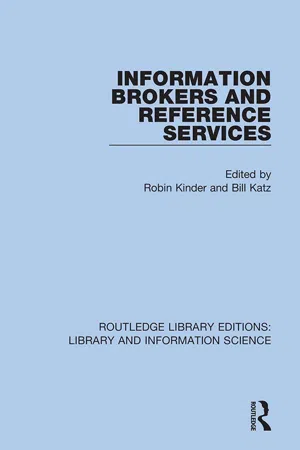
The contradictory yet complementary relationship between libraries and information brokers is examined in this volume, first published in 1988. Since its escalation in the 1960s, information brokering has challenged the role of the library in society. Librarians discuss their concerns about information brokers - the impact of brokers on reference services, the competence of brokers, abuse of library services by brokers, and whether libraries should provide competing fee-based services. Brokers share their own view as 'entrepreneurs', providing background, offering advice, and explaining the risks involved in their business. This lively, often controversial discussion offers suggestions for improving relations between libraries and information brokers, while continuing to serve the public well.
- 326 pages
- English
- ePUB (mobile friendly)
- Available on iOS & Android
eBook - ePub
Information Brokers and Reference Services
About this book
Information
II. ATTITUDES:
THREE SURVEYS AND AN OPINION
The Attitudes of Academic Reference Librarians Towards Information Brokers
Elizabeth Bramm Dunn
SUMMARY. This study describes a questionnaire survey of reference librarians working at the eighty-nine academic ARL (Association for Research Libraries) member institutions in the United States. The survey was conducted to determine the extent to which information brokers use the materials available in academic reference departments, the types of sources which are consulted, and the nature of the relationship between librarians and information brokers. The data collected in the present study indicate that none of the personal and professional conflicts between information brokers and reference librarians that were reported in the library literature during the first half of the 1970s is either widespread or serious. Possible explanations for the change include: (1) an increased professionalism characterizing brokers; (2) the attrition of the less competent brokers; and (3) the establishment and clarification of a role for commercial providers of information which is separate from and not threatening to that of librarians.
Elizabeth Bramm Dunn is Reference Librarian, Reference Department, Perkins Library, Duke University, Durham, NC 27706.
INTRODUCTION
My first acquaintance with information brokers occurred six years ago when I was working as a paraprofessional in the business and social science reference department of a large state university library. Three quite distinct information businesses used the reference department extensively. One broker, a librarian with an MBA degree, was a one-woman enterprise. She worked without partners or assistants and was both friendly and straightforward about her use of our facilities. Another business was run by a husband/wife team and the half dozen part-time assistants who did most of their legwork and photocopying. When the husband, a former paraprofessional employee of the department, came in to do work he generally entered and left unobtrusively. We saw far more of the “runners” who, judging by their naivete, had received little training and therefore required considerable assistance. The third organization was larger and more complex than the first two. This one was directed by a librarian and her assistant, also a librarian. Their part-time staff were primarily local library school students who were able to function independently of the reference staff. Yet this particular organization suffered from a rather bad reputation among local librarians. It was commonly believed that the director’s husband routinely requested photocopies of articles intended for his wife’s clients through the interlibrary loan department of his university. We all felt this to be an unethical abuse of the interlibrary loan service. Some of the assistants employed there confessed their suspicion that the routine sale of photocopied books and journals constituted a serious violation of copyright laws.
This early experience with information brokers fascinated me. Here were entrepreneurs doing much the same work as librarians but apparently being paid royally and working with much more independence: no predetermined hours, no worry over promotion, no tedious committee meetings. Yet there were also negative aspects to the work. Beyond the worries and risks of any small business, I sensed some ambiguous professional ethics. Many brokers had ties with the profession of librarianship and with the local community of librarians, but the issues mentioned above—the insufficiently trained assistants, the misuse of interlibrary loan services, the possible copyright violations, and the personal reticence of some brokers—seemed to color the relationships between the reference librarians and some of the information brokers a not altogether attractive hue. Yet perhaps, I thought, there was some jealousy influencing the librarians9 view of their more autonomous cohorts. I determined to take a more systematic look at the situation.
LITERATURE REVIEW
When I began my research in the spring of 1984, it had been some time since anyone had written about these issues. James B. Dodd explores them in his 1976 article, “Information Brokers.”1 He points out that when he questioned thirty-two information brokers, “none of those interviewed or who responded to the written inquiry was the least bit critical of their means of operation. Their view, simplified, is that they are performing a needed service, doing it well, and are having little difficulty with the libraries and other sources that they use.”2 Yet, having interviewed a number of library staff members at institutions frequented by brokers, Dodd knew that all was not well. He divided the problems he noted into three major categories: (1) conflicts of interest; (2) disagreement over fees; and (3) misrepresentation of a librarian’s work as the information broker’s own.3
Other writers have reported on brokers’ impression of their relationship with librarians. Annette Hirsch, president of Information Specialists, Inc. of Cleveland, denies competing with free libraries at all.4 Susan LaForte tries to dispel what she considers two popular misconceptions: that brokers should not charge because information is free and that brokers are trying to supplant public libraries. In fact, she says, information ...
Table of contents
- Cover
- Half Title
- Title Page
- Copyright Page
- Original Title Page
- Original Copyright Page
- Contents
- Agreeing to Disagree: The Relations Between Librarians and Brokers
- I. Fee-Based Services: Beginning of An Era
- II. Attitudes: Three Surveys And An Opinion
- III. Information Systems And Products: Impact On Reference Services
- IV. Brokers And Consultants: The New Entrepreneurs
- V. Current Trends In Reference Services
Trusted by 375,005 students
Access to over 1.5 million titles for a fair monthly price.
Study more efficiently using our study tools.
Frequently asked questions
Yes, you can cancel anytime from the Subscription tab in your account settings on the Perlego website. Your subscription will stay active until the end of your current billing period. Learn how to cancel your subscription
No, books cannot be downloaded as external files, such as PDFs, for use outside of Perlego. However, you can download books within the Perlego app for offline reading on mobile or tablet. Learn how to download books offline
Perlego offers two plans: Essential and Complete
- Essential is ideal for learners and professionals who enjoy exploring a wide range of subjects. Access the Essential Library with 800,000+ trusted titles and best-sellers across business, personal growth, and the humanities. Includes unlimited reading time and Standard Read Aloud voice.
- Complete: Perfect for advanced learners and researchers needing full, unrestricted access. Unlock 1.5M+ books across hundreds of subjects, including academic and specialized titles. The Complete Plan also includes advanced features like Premium Read Aloud and Research Assistant.
We are an online textbook subscription service, where you can get access to an entire online library for less than the price of a single book per month. With over 1.5 million books across 990+ topics, we’ve got you covered! Learn about our mission
Look out for the read-aloud symbol on your next book to see if you can listen to it. The read-aloud tool reads text aloud for you, highlighting the text as it is being read. You can pause it, speed it up and slow it down. Learn more about Read Aloud
Yes! You can use the Perlego app on both iOS and Android devices to read anytime, anywhere — even offline. Perfect for commutes or when you’re on the go.
Please note we cannot support devices running on iOS 13 and Android 7 or earlier. Learn more about using the app
Please note we cannot support devices running on iOS 13 and Android 7 or earlier. Learn more about using the app
Yes, you can access Information Brokers and Reference Services by Robin Kinder,Bill Katz in PDF and/or ePUB format, as well as other popular books in Languages & Linguistics & Library & Information Science. We have over 1.5 million books available in our catalogue for you to explore.