eBook - ePub
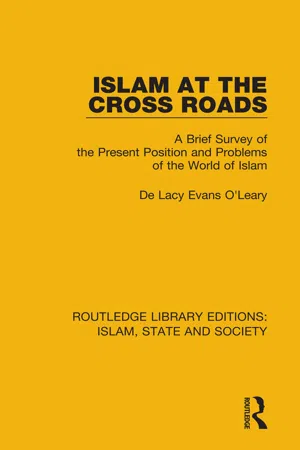
Islam at the Cross Roads
A Brief Survey of the Present Position and Problems of the World of Islam
- 222 pages
- English
- ePUB (mobile friendly)
- Available on iOS & Android
eBook - ePub
Islam at the Cross Roads
A Brief Survey of the Present Position and Problems of the World of Islam
About this book
This title, first published in 1923, examines the historical development of the Islamic faith from its origins through to its position in the early twentieth century. It also examines the historical reactions of Islam to the West, including the Babist Movement in the nineteenth century. This title will be of interest to students of history and M
Information
Islam at the Cross Roads
Chapter I
The Historical Development of Islam
THE history of Islam begins with the ministry of the Prophet Muhammad from about 569 A.D. to 623 A.D., and has its locus in the south-west corner of Asia, the land of Arabia which was then a little-known territory and one of those outlying parts which had remained untouched by the progress of civilization. In this isolated region it seems indeed that a section of the human race had been segregated at a period when they had reached the neolithic stage of culture, and that from this time of segregation they had been only occasionally penetrated by the richer forms of culture which developed on either side of them in Mesopotamia and in the Nile valley. It seems clear that the isolation was not complete and that there was some penetration, although very little is known of its details: apparently the cultural influences of Babylon passed down the coast of the Persian Gulf and flourished in South Arabia whence they passed over into Africa, and there was some backwash up western Arabia as far as the Sinaitic peninsula in quite early times. In later pre-Islamic times we know that there were two forces steadily undermining the isolation of Arabia, one of these was the system of trade routes by which the merchandise of India brought by sea to Oman passed along by land to Yemen and was then carried up through the Hijaz, by way of Mecca, and so at last to Syria, Egypt, and Mesopotamia: graffiti scrawled by the merchants on the rocks along the route still remain. Muhammad belonged to a family of such merchants, and himself conducted caravans from Mecca to Syria; by the coming and going of traders along these routes, and still more by the settlement of Jewish colonists at least as far south as Madina, Arabia was being gradually permeated by the culture of the outside world. The other force working in the same direction was the settlement of Arab tribes on the frontiers of Persia and Syria, where they managed to establish colonies at a time when the Parthian and Roman Empires were temporarily in a state of exhaustion and unable to prevent their settlement, but, making the best of things, employed them as frontier guardians in very much the same way as the Normans were afterwards settled in the north of France. We have no reason to suppose that these Arabs were pushed out of Arabia by famine or over-crowding, although the ancient tradition of the breaking of the dam of Arim, which figures so prominently in legends of early Arabia, seems to indicate that methods of artificial irrigation had been introduced from Mesopotamia, and the Arabs themselves were unable to maintain the great engineering works which had probably owed their origin to Babylonian engineers, and consequently the agricultural colonies in South Arabia collapsed. But as yet all this early history of Arabia is very imperfectly known. The Semitic migrations of history are directly accounted for by the weakening of the military power protecting the settled lands of Mesopotamia and Syria so that it was no longer possible to keep out predatory Arabs whose ideal it was to live on blackmail raised from the cultivators of the land and to protect them from any other would-be blackmailers. In the time of Muhammad these frontier Arabs had been established for some four hundred years; they were partially civilized and had become Christians, but still remained in close contact with their nomadic kinsmen in the deserts behind. Through them a considerable amount of culture, mainly Hellenistic, had filtered back into Arabia, and this culture, partly due to the intercourse along the trade routes, partly to contact with the semi-civilized Arabs settled on the frontiers, prepared the way for Islam.
The work of the Prophet Muhammad falls into two periods. In the former he was simply a religious teacher preaching the unity of God and the doctrines of a future life and judgment amongst the pagan Arabs of Mecca; the teacher of a religion in which he was very obviously under the influence of Jewish and Christian precedents with which he had come into contact during his travels in Syria, and which had penetrated into Arabia; indeed, there were converts to Christianity in his own family, one of whom Waraqa was the first to encourage him in his spiritual ministry, whilst a Christian captive was his earliest and closest friend. In the second period we find Muhammad a fugitive in Madina, the invited guest of the citizens, who made him the supreme chieftain of the tribal federation which formed the city, and as such he becomes the law-giver and founder of the Muslim state which grew up in a city which was a Jewish colony and where the customary law was that developed by the Rabbis of Southern Mesopotamia, with a strong tincture of the Roman Civil code, with which they had been in contact for some seven centuries. Thus in theology and in law Islam rested upon a solid foundation of the Hellenistic culture of the Græco-Roman world, which had, however, filtered through a Semitic medium before reaching Arabia.
Muhammad declared himself to be the Prophet of the Arab race—the teacher whom God sent to bring them a knowledge of His unity and to reveal to them that there is a future life and a day of reckoning in which men shall give account of their deeds here on earth. Other people knew these truths, but the Arabs were ignorant of them and therefore God sent them His messenger to instruct them in these things. It was part of his mission also to unite the Arab tribes in a fraternity of peace with ordered laws and mutual duties; a brotherhood in which the wealthy should share with the poor according to those primal instincts which prevail throughout the human race but receive their clearest expression in primitive communities. The empires of Rome and Persia enjoyed settled order and established law; God sent Muhammad to introduce these benefits amongst the Arabs. But the Arabs were not all willing to accept these new conditions; the wealthy and selfish tribes of Mecca and the south were reluctant to share equal brotherhood with the poor men of the desert, and so Muhammad, confident that the fraternity of the Arab race was the purpose of God, took up arms against them and made war until they were forced to admit the principle of fraternity and confessed the One God to whom as Eternal Judge they were responsible. There was no intention in the days of the Prophet or his early successors of carrying the religion of Islam beyond the Arabs, nor of enrolling non-Arab converts in that religion. Nothing can be more absurd than to picture the early Muslims as religious fanatics who poured out of Arabia to give the alternative of Qur‘an or the sword to those whom they conquered. They did thus approach the settled Arabs of the Syrian and Persian frontiers because they were fellow Arabs, and the claim was that all Arabs must unite in the fraternity of Islam, though those who were already Christian were not compelled to renounce their religion’—they already confessed the One God so there was no necessity—but when the frontier Arabs were attacked the powers of Byzantium and Persia were compelled to come to their relief and thus, quite unexpectedly the Muslims were drawn into war with those two great empires, and even more unexpectedly, defeated them When once their weakness was thus revealed it was impossible to restrain Arab adventurers from plundering excursions, and these led to the final downfall of Persia and Egypt, in each case the Arabs acting in defiance of the strict orders of the Khalif ‘Umar, who did his utmost to check their enterprises, and viewed the results with the greatest alarm and dislike. In these feelings he had with him all the “Old Believers”, the surviving companions and closer followers of the Prophet; but these were far outnumbered by the later converts who had not accepted Islam until they had been forced to do so, and who were never deeply attached to it as a religion but were aroused to make the most of the wonderful opportunities which the sudden and astonishing collapse of the armed forces of Persia and Byzantium, which had hitherto restrained their brigandage, now opened before them. To these new conditions Islam had to adjust itself, but it remained essentially the religion of the Arabs. As formulated by the second Khalif ‘Umar the revised position was that the Muslim Arabs were to rule as overlords the lands they had conquered, living on the tribute paid them by the cultivators, who were to retain their own religion, but were to be permanently excluded from Arabia itself. If any of the conquered population embraced Islam they came forthwith free from payment of tribute but liable to military service and acquired the right to share in the distribution of the spoils of war, and by adopting Islam became Arabs and were enrolled in an Arab tribe. Such adopted tribesmen were technically called mawlawi. It is hardly necessary to remind ourselves that in primitive communities adoption invariably ranks as equivalent to blood kinship; in early Israel participation in the Sacrament of the Passover made an alien an Israelite, and similar parallels appear in the system of all early social groups. Thus Islam remained substantially an Arab religion and, apparently, every discouragement was put in the way of conversion. Every convert meant a loss of tribute to the ruling Arabs and a new claimant to share in the spoils of war; whilst on the convert’s side it meant the loss of all share in the property of his family and liability to military service for which the agricultural population of Syria and Persia had no inclination. In theory nothing could have been better devised than the constitution of ‘Umar to preserve the primitive type of Islam, but like every theoretical constitution it broke down in competition with the human weaknesses of those who had to put it into practice. The Arab overlords were not content with the fixed tribute and could not resist the temptation to own and cultivate estates. The loss of revenue from conversions was so serious that, in spite of protests, tribute was levied even from those who had embraced Islam. In fact, within ten years from the Prophet’s death, by the conquest of great and wealthy provinces, Islam was faced with conditions which had never been contemplated and the attempt to reconstruct it so as to preserve the original purpose under these new conditions, was too artificial to last. History makes it clear, however, that the legend of fanatical Muslims sweeping through the world and forcing Islam at the point of the sword upon conquered races, is one of the most fantastically absurd myths that historians have ever repeated. There are plenty of instances of such fanaticism and forced conversion, but these do not belong to the early history of Islam nor to that of the Arabs; those stories come from the banks of the Niger, from the Sudan, and from Sumatra, and are connected with Muslim religious revivals of later days and dubious orthodoxy.
Of Islam, as of Christianity, it is true that corruption began with success; the spiritual ideal ever suffers from the material prosperity acquired by its maintainers, and it is generally admitted that when the leadership of Islam passed into the hands of Mu’awiya, the chieftain of the wealthy clan of the ‘Umayyads of the Quraysh tribe who had settled in Syria, the early Islam of the Prophet and his companions suffered eclipse. From this period on, like every other religion, it shows alternating periods of decadence and reform, which are indeed the necessary conditions of the physiological life of a social community. The history of Islam may be divided into three main periods: (i.) In the first we have a ruling Arab aristocracy, intoxicated by its sudden accession to wealth, ruling very inefficiently over a conquered population very much in advance of it in culture; it forms an Arab period which is only superficially Muslim, (it.) This is succeeded by a period during which the Khalifate remained Arab, but Persian influence was in the ascendancy and Muslim theology and law developed under purely Persian influence, and at last Persian rulers practically controlled Islam in which the Khalifate was little more than a pageant. Finally (iii.) this predominance of the Persians was replaced by that of the Turks under whom Islam hardened and took the form which it has at the present time.
(i.) During the first period, which extended from the foundation of the ‘Umayyad dynasty by Mu’awiya in A.H. 41 (=A.D. 661) to the downfall of the dynasty in A.H. 132 (=A.D. 749) Islam was under the supremacy of a ruling class of Arabs whose heads were turned by their sudden accession to vast wealth and political power, and who, for the most part, were not sincere, or at least, not very earnest Muslims. During this period the real spiritual life of Islam centred more or less in the elements which were disaffected towards the ruling Khalifate, or even in open revolt against it, and thus it was the period during which the sectarian divisions of Islam appear. These show two divergent tendencies, the one a revolt of the conquered Persians who, conscious of a more fully developed culture than the Arabs, evolved a type of Islam which inclined towards mysticism and incorporated many ideas familiar to the older religious life of Persia but alien to Muslim doctrine; this Persian or Shi‘ite schism itself split up into various subdivisions, the more extreme sections hardly claiming to be Muslim, but all showing the same mystic tendencies and a curious fascination for the doctiine of God incarnate in human form, a doctrine which has no place in orthodox Islam. The other revolt is rather associated with those Arabs who were discontented with the secularisation of Islam under the ‘Umayyads and craved for the older conditions which had prevailed under the first four Khalifs. In a sense they were the truer representatives of primitive Islam, but they were unlettered desert men and expressed their position so crudely and became so violent and unreasonable in the way they maintained it that Islam generally discarded them. The former group, the Shi‘ites, still exist in considerable numbers estimated at 15,000,000, of which rather more than half belong to the sect of “Twelvers,” that is to say the adherents of the twelve Imams of whom ‘Ali, the Prophet’s cousin and son-in-law was the first, and then eleven others in hereditary descent to Muhammad al-Muntazir, who succeeded in A.H. 260 (=A.D. 873) and forthwith “disappeared,” his followers believing that he remains in concealment because of the evil days, and will, in due course, return to establish a rule of righteousness on earth. In the meantime, any earthly ruler, such as the Shah of Persia, can at most act as his temporary vicegerent. None of the Shi‘ites, of course, recognise the leadership of the Kalif, who is, in their eyes, a usurper and the successor of usurpers who tried to exclude ‘Ali from the Imamate and succeeded in excluding his descendants. But different Shi‘ite sects differ as to the transmission of the Imamate in the descent from ‘Ali. The “Seveners” accept only the first six and then the elder son of the sixth, whom the “Twelvers” believe to have been deprived of his rights. It is amongst the offshoots of the “Seveners” that the wildest sects and those most removed from orthodox Islam appear. Many of these extremer sects exist as secret societies. Of the more moderate groups we have the Zaydites in South Arabia with headquarters at San‘a, and the Muslims of Morocco who differ little from the orthodox beyond rejecting the supremacy of the Khalif and following their own system of canon law. All these Shi‘ite sects agree in regarding the leadership of Imamate of Islam as vested in the family of ‘Ali, the extremer sects going so far as to suppose that ‘Ali was the divinely appointed redeemer of mankind, the incarnation of the Holy Spirit, and that the Prophet Muhammad was merely the spokesman of ‘Ali; nearly all, save perhaps the Shi‘ites of Morocco, attribute a supernatural character to ‘Ali and his successors. This strictly legitimist theory, and still more, the doctrine of a divine incarnation, is quite alien to orthodox Islam and reproduces religious ideas which flourished in Persia before the Muslim conquest and which have persisted. Shi‘ism is predominant in Persia and in Mesopotamia outside the towns, and it has steadily gained over the Arab tribes which have passed east of the Euphrates.
The other sectaries, known as Kharijites or “seceders” were the advocates of free election in the appointment of a leader, but did not regard any earthly head as essential to the existence of Islam, whilst on the theological side they were reactionary—out of touch with the intellectual development of Muslim doctrine; puritans of the most rigid type, and may perhaps be regarded as the true representatives of early Islam. Admittedly they adhered to the earlier standards of life and conduct when the rest of Islam was falling under a luxurious and alien culture.
To-day the Kharijites are directly represented in ‘Uman, in East Africa, in the Sahara, and in Algeria. These three latter are comparatively small and isolated communities, interesting survivals of an ancient controversy, but ‘Uman is an important state. The particular sect in ‘Uman is known as Ibadi, after one ‘Abdullah ibn Ibad, who settled there under the later ‘Umayyads. As Kharijites the people of ‘Uman are, of course, regarded as heretics by the generality of Muslims, and the general laxity they show with regard to many points observed elsewhere, tend to confirm this criticism. Theoretically they regard it as right to recognise the leadership of any meritorious Muslim if exercised for the welfare of the community, but entirely reject the idea of a Khalif as the necessary head of Islam. The Imam or ruler of ‘Uman is supposed to be elected and a series of Imams has held sway since A.H. 134 (=A.D. 751), but in practice the election is held by the ‘ulema or “learned in the law” and the candidate is selected from the ruling family. The smaller Ibadi settlement in East Africa owes its origin to intercourse with ‘Uman in the tenth century A.D. As it was situated in what was until recently German East Africa, it received very careful attention from German orientalists, and it seems clear that, in the course of time, the Ibadites have assimilated to the general body of the orthodox save that, of course, they do not recognise the Khalif or consider that any Khalif is necessary, and are somewhat slack in various external observances proper to a Muslim. The other Ibadite settlements in Africa have come under French observation since 1882, when they were incorporated in French territory. According to the accounts given by French orientalists, these Ibadis are Muslims of a rigidly puritanical type and resemble the Wahhibis in their theology. The Wahhibis indeed have no historical connection with the Kharijites but owe their origin to somewhat similar influences, namely to the reaction of the non-progressive desert type against the religion and social condition of the settled Arabs, which have been largely corrupted by alien influences. It is a curious point that almost all of these Ibadis are great travellers—the people of ‘Uman as seamen, the Algerian Ibadis as travelling merchants—but all keep aloof from intermarriage with Muslims not of their own sect.
It is a common western notion to imagine that the world of Islam can be managed by manipulation of the Sultan of Turkey as Khalif, under the supposition that he is a kind of high priest whom no devout Muslim will venture to disobey. To begin with, every sect which has split off from Islam agrees in repudiating the Khalif; he holds sway only over the Sunni Muslims, and even of these the theoretically orthodox, every vigorous and reforming body of the puritanical reformation, ignores him though they, and presumably even the Kharijites, might rally to his support in defence of Islam against the infidel. This, almost incredible result, has been very nearly achieved by the intense dislike and fear inspired by the western nations, and more particularly the British, during recent years.
During the Arab period the Sunni community, that is to say those who were in communion with the official Khalif, was being permeated by Hellenistic influences which involved speculation in philosophy and theology. Muslim theology does not really develop until the ‘Umayyads have passed away, but when it does appear it is clear that the intellectual life of Islam has been permeated by Hellenistic philosophical speculation in the form already made familiar by Christian theology. Towards the end of that period the world of Islam was in some respects in a position similar to that in which it finds itself to-day. Muslims were in touch with a fully developed intellectual activity and scientific thought, and were faced with the problem of how to adopt their own religious beliefs to the demands of contemporary science.
(ii.) The Persian period which opened with the accession of the ‘Abbasids in A.H. 132 (—A.D.749) saw the overthrow of the Arab aristocracy which had rendered itself odious by its tyranny and rapacity, although the Arab Khalifate was retained. Those who engineered the revolt appealed to the diverse national elements which were anti-Arab, and to the peculiar tenets of the different sects. The indifference of the ruling Arabs to matters of religion was notorious, and the sympathies of the devout were enlisted by the hope of a new and reformed Khalifate, which would be loyal to the principles of Islam. Many promises and pledges were made which never could be kept, and were not meant to be kept. What actually happened was that the Khalifate passed to a section of the Hashimite clan, to which the Prophet himself had belonged, of the tribe of Kuraysh. The main strength of the revolt had been in the Persians, who were largely, though not exclusively, Shi‘ites. Many of these expected an hereditary Khalifate in the house of ‘Ali, but Islam was not prepared for the full recognition of Shi‘ite theories. The ‘Abbasids were Arabs, but their sympathies were with the Persians who had elevated them to the Khalifate. Everywhere Persian ministers and officials replaced Arabs, the court was predominantly Persian, and Arab birth exposed a man to freely-expressed hostility and ridicule. A whole movement, known as the Shu‘ubiyya, grew up and produced a considerable literature devoted to anti-Arab propaganda. The Arabs were described as semi-savages, ignorant, rapacious, and without religion, boasting of noble descent when their families were but upstarts of yesterday when compared with the noble...
Table of contents
- Cover
- Half Title
- Title
- Copyright
- Original Title
- Original Copyright
- CONTENTS
- CHAPTER I HISTORICAL DEVELOPMENT OF ISLAM
- CHAPTER II INTERNAL REFORMING MOVEMENTS OF MODERN ISLAM
- CHAPTER III WESTERN PENETRATION OF ISLAM
- CHAPTER IV REACTION OF ISLAM AGAINST THE WEST
- CHAPTER V SHI‘ITE REACTION ON THE WEST: THE BABIST MOVEMENT
- CHAPTER VI PAN-ISLAMIC HOPES AND NATIONALISM
- CHAPTER VII THE WAR AND AFTER
- INDEX
Trusted by 375,005 students
Access to over 1.5 million titles for a fair monthly price.
Study more efficiently using our study tools.
Frequently asked questions
Yes, you can cancel anytime from the Subscription tab in your account settings on the Perlego website. Your subscription will stay active until the end of your current billing period. Learn how to cancel your subscription
No, books cannot be downloaded as external files, such as PDFs, for use outside of Perlego. However, you can download books within the Perlego app for offline reading on mobile or tablet. Learn how to download books offline
Perlego offers two plans: Essential and Complete
- Essential is ideal for learners and professionals who enjoy exploring a wide range of subjects. Access the Essential Library with 800,000+ trusted titles and best-sellers across business, personal growth, and the humanities. Includes unlimited reading time and Standard Read Aloud voice.
- Complete: Perfect for advanced learners and researchers needing full, unrestricted access. Unlock 1.5M+ books across hundreds of subjects, including academic and specialized titles. The Complete Plan also includes advanced features like Premium Read Aloud and Research Assistant.
We are an online textbook subscription service, where you can get access to an entire online library for less than the price of a single book per month. With over 1.5 million books across 990+ topics, we’ve got you covered! Learn about our mission
Look out for the read-aloud symbol on your next book to see if you can listen to it. The read-aloud tool reads text aloud for you, highlighting the text as it is being read. You can pause it, speed it up and slow it down. Learn more about Read Aloud
Yes! You can use the Perlego app on both iOS and Android devices to read anytime, anywhere — even offline. Perfect for commutes or when you’re on the go.
Please note we cannot support devices running on iOS 13 and Android 7 or earlier. Learn more about using the app
Please note we cannot support devices running on iOS 13 and Android 7 or earlier. Learn more about using the app
Yes, you can access Islam at the Cross Roads by De Lacy Evans O'Leary in PDF and/or ePUB format, as well as other popular books in Theology & Religion & Religion. We have over 1.5 million books available in our catalogue for you to explore.