eBook - ePub
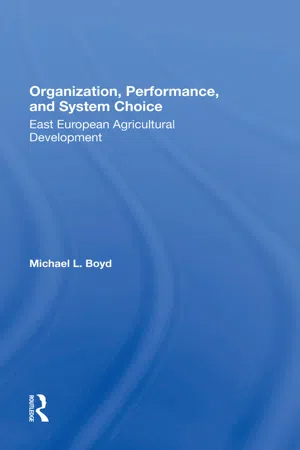
Organization, Performance, And System Choice
East European Agricultural Development
- 181 pages
- English
- ePUB (mobile friendly)
- Available on iOS & Android
eBook - ePub
About this book
When one has worked on a series of projects as long as I have on those that make up this book, one incurs a tremendous debt that can never be appropriately acknowledged. Nevertheless, I would be remiss if I did not make note of at least the largest and most obvious of contributions made by others. The oldest part of the work is the Yugoslav case study, which began as my doctoral dissertation. I received funding from the International Research and Exchanges Board (IREX), which allowed me to spend an all-too-brief but productive five months in z&greb in 1982. During this time, I was greatly aided by the advice and criticism of Professor Vladimir Stipetic of the University of Zagreb. As I worked on the dissertation, John Pencavel and Evsey Domar taught me much about critical thinking and clear writing, as well as economics. To them I owe a special debt of gratitude for the often difficult task they undertook of simply keeping track of my whereabouts. In addition, the Yugoslav study benefited from the critical contributions of Paul David and members of the development and history seminars at Stanford and the comments of Tim Bates and two anonymous referees and the editor at the Review of Economics and Statistics, where the core material was first published as •The Performance of Private and Cooperative Socialist Organimtion: Postwar Yugoslav Agriculture; 69, 2 (May 1987): 205-214, copyright 1987 by Elsevier Science Publishers. I would like to thank Elsevier Science Publishers for kind permission to reprint portions of this article in chapter 3.
Information
ONE
Economic Organization and System Performance: The Options for System Choice
1. Introduction
We live in a world dominated by competition among different political, social, and economic systems. Although the actual differences among systems are often blurred by the rhetoric of ideological competition, the various existing systems represent alternative visions of how the world works, or how it ought to work. Because the outcome of this competition affects the lives of everyone, it is extremely important to increase our understanding of the differences among economic (and their accompanying political) systems -- in particular, differences in performance. Current debate about and active pursuit of systemic change in the Soviet Union, Eastern Europe, and China show vividly that these issues are of more than academic interest. In addition, many of the world's developing countries are in a position consciously to choose one or another system. In all of these situations, the need to understand as completely and accurately as possible the comparative characteristics of different economic and related political systems is clear and compelling.
In order to produce informed evaluations of the strengths and weaknesses of different economic systems, it is first necessary to confront a set of complex and confounding questions that center on system definition and description. These questions involve issues that, although familiar, must be carefully considered in order to define clearly both the objects of and the context for comparison. Suitable opportunities for empirical investigation which allow one to assess the relative merits and drawbacks of different types of economic organization can be identified by considering these issues. I make this overly simplified description in order to emphasize that such measuring and comparing must be carried out and evaluated in full recognition of their inherent limitations. Nevertheless, only by conducting such exercises can we accumulate sufficient evidence to reach even tentative conclusions about the controversial and important questions of relative system performance.
In this work, I present the results of three case studies of East European agriculture. These cases were chosen because they allow me to compare the performance both of different types of organization and of economic systems. Also, because these cases describe the performance of different agricultural organizations in developing countries, I can and do use them to consider some key issues in agricultural development. In particular, I examine the relative performance of different types of agricultural organization (state farms of varying types, cooperatives, and private farms) in Yugoslavia, Poland, and Bulgaria. My first goal is to provide the kind of evidence required to evaluate the relative strengths and weaknesses of different systems of organization. Although I examine specific productive organizations in only one sector of these three economies, there is significant variation in organizational forms both among and within cases and these forms may also be evaluated within different systemic environments (i.e., centrally planned versus market socialist economies).
Given the numerous dimensions available for comparison, these cases are particularly well suited to an evaluation of the relative merits of system performance. Further, as mentioned previously, the focus on agriculture is of particular importance. Because improving agricultural productivity is a key element in all attempts to raise incomes and transform developing economies, understanding the relative performance of different types of organization in this sector is vital. I discuss more fully later my choice of the specific types of organization found in this sector, asserting here only that they are particularly useful cases for the type of empirical exercise explained previously.
Before I examine these issues, or even begin to describe the case studies themselves, I first consider several fundamental questions of system definition and description. In the next section I examine these issues with the goal of providing a description of the general framework within which the choice of cases and the measurement and evaluation of performance were conducted. I then consider some specific aspects of system performance and choice in the contexts of less-developed countries (LDCs) and of centrally planned economies. This discussion leads me to examine recent trends in system choice and reform in the Soviet Union, Eastern Europe, and China and to make specific reference to those issues of organization and performance that the case studies of Yugoslav, Polish and Bulgarian agricultures can be used to evaluate. In conclusion, I summarize the issues of relative system performance, comparison, and choice to which I return after presenting the case studies.
2. Defining and Evaluating Economic System Performance
In order to establish the appropriate context for comparing systemic performance, two fundamental questions must first be addressed: What is an economic system? And how can one compare the performance of different systems? I do not attempt to establish a definitive or exhaustive set of criteria for answering such questions, a job that has been taken up well in numerous basic texts on the subject (e.g., Gregory and Stuart 1985). Rather, I work to identify the basic points of contention in these questions and the particular choices I make in regard to them. Only within the framework of these choices can the case studies of Yugoslav, Polish, and Bulgarian agricultures be evaluated to draw inferences concerning relative system performance and to make informed choices regarding organization and systems.
Denning anything as complex and ambiguous as an economic system is exceedingly difficult. Traditional definitions focus on stylized economic systems such as feudalism, capitalism, socialism, fascism, and communism. The principal drawback of this "isms" approach is its failure to distinguish adequately the functional differences among systems, although it does clearly emphasize the important link between political and economic systems. Contemporary approaches to system comparison (following, e.g., Montias 1976a and Neuberger and Duffy 1976) attempt to identify specific characteristics, such as property rights, the mechanisms employed to generate and transmit information, and the organization of decision-making and of incentives, and to use these to define economic systems. Yet another approach identifies an economic system as "a set of mechanisms and institutions for decision-making and the implementation of decisions concerning production, income, and consumption in a given geographic area" (Lindbeck, 1977, as modified by Gregory and Stuart, 1985, p. 12). This approach combines a focus on the basic problems of economics (choice and distribution) with an emphasis on the institutional forms within which such activities occur. Numerous other definitions can be identified, but in general all can be reduced to variants of these three.
Simply enumerating alternative definitions demonstrates clearly the complexity of the problem. I identify my preferred definition by describing two extreme points of view that I reject. The first is that an economic system can be completely defined only in reference to the entirety of its historical, political, social, and cultural context. This matrix of factors defines the setting within which economic systems operate and as such does constrain the performance and structure of any system. Moreover, in many instances these factors play a critical role in determining specific characteristics of the form of a particular economic system.1 But they do not represent a system's substance, by which I mean the fundamental institutional arrangements governing economic interrelations. This substance can be similar across widely different historical, geographic, social, and cultural contexts, each with its own particular forms of behavior.
The second perspective I reject is one that defines an economic system as a constrained optimization process. Although I accept that an economic system does embody a set of fundamental interrelations and agree that all societies face the equivalent of a constrained optimization problem, it is obvious that not all societies produce the same solution to that problem, even when facing constraints that are substantially the same. It is precisely these differences in solution mechanisms that constitute substantial differences in economic systems. The significant differences among economic systems lie not in outcomes resulting from differences in basic resource endowments or other constraints on a society's optimization problem, that is, in differences in form. Rather, the substance of an economic system lies in the set of institutions devised to resolve the constrained optimization problem faced by a society. Thus, my preferred definition of an economic system focuses on the distinction between differences arising out of the constraints of situation (i.e., of form) and differences in the underlying solution mechanisms embodied in institutions (i.e., of substance).
Like all definitions, thus one has advantages and disadvantages. Its principal advantage lies in the distinction between form and substance. By focusing on the institutional interrelations for resolving the basic "economic" problem of optimization subject to constraints, this definition provides a framework for separating the economic system per se from factors influencing it (i.e., the matrix of historical, political, social, and cultural forces), that alter form but not substance. The primary disadvantage is that this definition does not specify the source of differences in economic systems, that is, in institutional solution mechanisms chosen. Although it could be argued that such differences arise from differences in history or society, this argument would reduce the definition to a tautology. That there can be no logical refutation of such an approach shows only that the sources of differences in economic systems cannot be discovered through abstract generalization but rather by consideration of particular case studies. Furthermore, this weakness (if such it is) inheres in all attempts to explain where systems come from in terms of their own basse principles.2 Thus, this definition commends itself primarily because its focus on the institutional mechanisms by which production is organized provides a clear way to characterize the different types of agricultural organization as representative of different systemic variants.
Although not definitive, this approach to economic systems can be used to consider comparative system performance. The central goal of system comparison is to increase our understanding of the potentials and problems of alternative modes of organization. This is important because the relative performance of the alternative institutional mechanisms used to resolve society's economic problems is an urgent, practical issue in many societies. For countries in a position to make a choice of economic system, it is vital to have more and better information about which arrangements solve particular problems well or poorly and to know whether these outcomes are inherent in a system or can be altered. Only then can one identify viable alternatives for economic organization, the choice of which can affect the lives and futures of millions.
As we turn from general issues to the consideration of key technical details, it becomes clear that measuring and evaluating the performance of economic systems is almost as complex as defining a system. It is relatively simple to list the indicators used most frequently to measure performance: levels and growth rates of output or income per capita; the distribution of income; allocative (i.e., Pareto) efficiency; and factor productivity growth. This is not an exhaustive list, but it shows clearly the nature of the standard measures used to capture system performance. The first point to note is that focusing on these (or any other) particular outcomes as standards of performance limits the scope of comparison. Although each of these measures captures an important aspect of those fundamental interrelationships that constitute the performance of an economic system, to focus on outcomes alone implies that these measures of performance adequately capture the differences in the systems themselves.
Because economic systems are fundamentally distinguished by differences in their mechanisms for solving problems of scarcity and choice, comparisons that focus solely on the outcomes produced by these mechanisms are incomplete. If different systems were to produce comparable performance in terms of output, choice of production techniques, and income distribution, there would still be the potential for differences in systemic evaluation. Such a potential would lie in evaluation of so-called "noneconomic" aspects of systems. It is possible to define these noneconomic aspects as differences in form and not substance, but this merely begs the issue. However, if one accepts such measurable differences as substantial and not merely formal, then it becomes clear that evaluating relative performance differences is inherently subjective, an admission that introduces the unresolvable problem of interpersonal comparability of values. Fortunately, although these problems are unresolvable, they are also largely irrelevant -- not to an individual weighing the social and moral consequences of actions designed to change economic systems, but to the study of cases that provide the information needed to make that kind of evaluation. Although in any particular case either noneconomic or economic factors may be more important in influencing outcomes, establishing their relative importance is logically distinct from evaluating the performance of economic organization.
Potential problems associated with subjectivity arise also In the choice of which measure or measures to use. Measures other than those listed could be included, and their omission indicates that they have been arbitrarily assigned a weight of zero in contributing to system performance. Although the relevance of any specific set of criteria can be questioned, no general principle can be applied to avoid having to make a choice. Once a choice of indicators has been made, the next problem is how to combine or assign weights to the included measures. In general, the various performance indicators do not have comparable units of measurement and must be aggregated subjectively.
This discussion of problems is not exhaustive, but it is more than adequate to establish the essential point: Any specific comparison based on a particular set of measures and weights inevitably reflects the assumptions and biases of the investigator. Thus, conclusions drawn from comparisons are subject to variation as fundamental assumptions vary. Little more beyond impressing this observation on the reader's attention can be done, a simple fact that should always be borne in mind.
Finally, even after a set of comparison measures has been selected and subjective weights to combine them have been set, further problems of measurement comparability remain. The most familiar of these involves construction of index numbers of production (for use in output or productivity measures); but similar problems arise in the construction of any aggregate index, of inputs or output. For the case of production indices, depending on which prices are used to construct the indices (e.g., those of one country or another in intercountry comparisons, or of one time period or another in a given country), different systems can show significantly different levels of relative performance.3 This results not from any subjectivity of the investigator but from the potential for systematic biases inherent in the construction of these measures. The only satisfactory resolution of this problem involves empirical examination of the extent of these biases and explicit assessment of their implications for comparing relative performance, where data permit. Although the precise mechanisms differ, a similar set of problems arises in comparing income distributions or allocative efficiency. The method chosen to construct comparable measures of these aspects of system performance can also impart biases. Again, these biases are inherent in the mechanics of computation and must be explicitly recognized and evaluated whenever possible. The importance of these problems for comparing the performance of economic systems can only be established in reference to specific observations. By accumulating information from numerous case studies, such as those presented here, investigators might eventually be able to determine the practical importance of these general theoretical problems as they affect conclusions regarding the comparative performance of different economic systems.
3. System Choice in Less-developed Countries: The Dimension of Flexibility
The general theoretical problems I discussed in the preceding section show clearly the need to examine particular cases in order to work toward general conclusions. Although it is necessary to identify and evaluate such theoretical issues, emphasizing theoretical problems must not obscure the fact that choices regarding economic systems are being and must be made continuously. Particularly in developing countries, these decisions have a direct impact on the well-being of billions of the world's poorest inhabitants. In LDCs, decisions about how to organize production or the economy are not made in the context of an academic debate about incremental differences in well-being for those already well off. Rather they are made face-to-face with a harsh reality that imposes the cruel choice between sacrifice today (the only certainty) and unknown, potential gains for future generations. For those already committed to a system, either socialist or capitalist, the goal of comparing is often to justify the substance of ideology and to establish the long-term viability of a system. For those not already committed to a particular point of view, it is essential to have information concerning how successfully different systems provide rapid growth in material well-being and accommodate the unavoidable stresses associated with such growth. A principal objective of the studies presented here is to provide precisely the kind of information needed to make such choices.
In this context, I consider one aspect of comparing system performance that is particularly relevant to evaluating system choice in developing countries and on which the cases that follow can shed light: the relation between system flexibility or rigidity and system choice. In the case studies, I focus on the kinds of performance measures described in the preceding section. However, combining and comparing the results of the studies makes it possible to consider how the relative flexibility of each system affected its ability to adapt to the accumulating changes that characterize development. This ability is clearly an important determinant of a system's appropriateness for LDCs. In order to elaborate the issues involved in comparing relative flexibility of systems at a general level, in the following discussion I compare two idealized alternative economic systems, identical in all aspects of performance except that one is less well able to adapt to constantly accumulating changes and can thus be identified as less flexible than the other.
A system may be defined as rigid (or flexible) if its internal rules of operation strongly resist (or readily accept) change.4 The internal rules of operation of a system are in part defined by its fundamental objectives, institutions, and policies, but are at root determined by the willingness of the individuals or groups who formulate and implement system features to promote change. Pressures for change may arise outside the system (e.g., from changes in external environment) or from within (e.g., from growing recognition of a system's failures). The source of pressure for change can make a difference in the willingness or resistance of the relevant actors to promote change. An approach that focuses on the willingness of particular individuals or interest groups to implement change is particularly suitable for evaluating the applicability of systems to LDC problems as well as for evaluating the question of reform in exis...
Table of contents
- Cover
- Half Title
- Title
- Copyright
- Contents
- List of Tables
- List of Figures
- Acknowledgments
- 1 Economic Organization and System Performance: The Options for System Choice
- 2 Agriculture in Development: The Effect of Organization on Performance
- 3 Policy, Organization, and the Performance of Yugoslav Agriculture: 1956-1979
- 4 Policy, Organization, and the Performance of Polish Agriculture: 1960-1982
- 5 Policy, Organization, and the Performance of Bulgarian Agriculture: 1960-1985
- 6 Agricultural Organization and Economic Development: Lessons from Eastern Europe
- 7 Organization, Performance, and System Choice: Implications of the Cases
- Appendix A: Data Sources and Construction
- Appendix B: Supplementary Statistical Materials
- References and Bibliography
- Index
Trusted by 375,005 students
Access to over 1.5 million titles for a fair monthly price.
Study more efficiently using our study tools.
Frequently asked questions
Yes, you can cancel anytime from the Subscription tab in your account settings on the Perlego website. Your subscription will stay active until the end of your current billing period. Learn how to cancel your subscription
No, books cannot be downloaded as external files, such as PDFs, for use outside of Perlego. However, you can download books within the Perlego app for offline reading on mobile or tablet. Learn how to download books offline
Perlego offers two plans: Essential and Complete
- Essential is ideal for learners and professionals who enjoy exploring a wide range of subjects. Access the Essential Library with 800,000+ trusted titles and best-sellers across business, personal growth, and the humanities. Includes unlimited reading time and Standard Read Aloud voice.
- Complete: Perfect for advanced learners and researchers needing full, unrestricted access. Unlock 1.5M+ books across hundreds of subjects, including academic and specialized titles. The Complete Plan also includes advanced features like Premium Read Aloud and Research Assistant.
We are an online textbook subscription service, where you can get access to an entire online library for less than the price of a single book per month. With over 1.5 million books across 990+ topics, we’ve got you covered! Learn about our mission
Look out for the read-aloud symbol on your next book to see if you can listen to it. The read-aloud tool reads text aloud for you, highlighting the text as it is being read. You can pause it, speed it up and slow it down. Learn more about Read Aloud
Yes! You can use the Perlego app on both iOS and Android devices to read anytime, anywhere — even offline. Perfect for commutes or when you’re on the go.
Please note we cannot support devices running on iOS 13 and Android 7 or earlier. Learn more about using the app
Please note we cannot support devices running on iOS 13 and Android 7 or earlier. Learn more about using the app
Yes, you can access Organization, Performance, And System Choice by Michael L Boyd in PDF and/or ePUB format, as well as other popular books in Politics & International Relations & International Relations. We have over 1.5 million books available in our catalogue for you to explore.