Originally published in 1979. This book is a study of the problems of functional and ideological adaptation of the curriculum in response to social change, based on a close investigation of a particular significant curriculum innovation, set up in 1962: the Nuffield Foundation Science Teaching Project. The book focuses particularly on the development of the O-level chemistry curriculum, which was one of the three founding projects.
If sensible decisions are to be made about curriculum development, now and in the future, it is vitally important that we take account of the history of influential curriculum projects. This book deals thoroughly with the various political, social and educational factors influencing the setting up of the Nuffield Foundation Science Teaching Project, the details of its execution (methods, the influence of pressure groups, and of particular individuals) and its outcomes. The content of the secondary curriculum is a perennial topic of interest and this book is a stimulating aid to clear thinking not only as history.
eBook - ePub
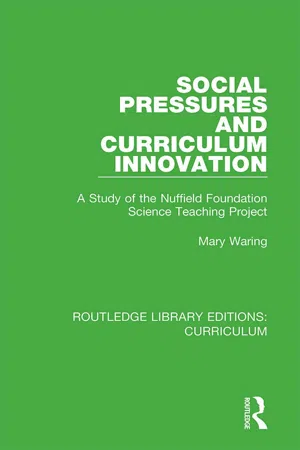
Social Pressures and Curriculum Innovation
A Study of the Nuffield Foundation Science Teaching Project
- 270 pages
- English
- ePUB (mobile friendly)
- Available on iOS & Android
eBook - ePub
Social Pressures and Curriculum Innovation
A Study of the Nuffield Foundation Science Teaching Project
About this book
Information
1
Introduction: society and the functional curriculum
This book is about processes of change and of changing. In particular, it is about the problems of functional and ideological adaptation of the curriculum in response to social change, about individuals and groups who have sought to effect curriculum change and about the problems they have encountered and the strategies they have employed.
In an examination-orientated system in which power has become more and more diffuse and effective power increasingly difficult to identify, and in which there is no statutory, centralized control of the curriculum, the problem of effecting change is formidable. This is particularly so where teaching approach is involved and where it requires role change for teachers and pupils. Over time, various solutions have been proposed and two major innovatory responses made. The establishment of the Nuffield Foundation Science Teaching Project was one response; that of the Curriculum Study Group by the Ministry of Education the other. The final outcome of both was the Schools Council. Inherent in these approaches was a belief in the autonomy of the teacher, a belief manifested in various ways but most noticeably in the provision, by teachers, of ‘resources, not courses’ for intelligent selection, modification and adaptation in individual classrooms. Such resources are, then, merely on offer, though a number of pressures for at least partial adoption may influence teachers’ decision making. Nevertheless, the freedom of choice that does exist means that widespread change requires widespread dissemination, persuasion, conviction and conversion — all of which may be extremely difficult. Although studies of diffusion, of summative evaluation and of the extent of change have been undertaken, there are still vast areas of ignorance, and considerably more research is necessary.
It was clearly completely beyond the scope of this study to examine all aspects of curriculum change, and attention has been focused upon the origins and antecedents, and the machinery- in-action of the Nuffield Foundation Science Teaching Project and, within it, Nuffield O level chemistry. In the last chapter, hindsight is used to try to extract some more general lessons for the future.
On 4 April 1962, in reply to a Parliamentary Question in the House of Commons about the steps being taken by the new Curriculum Study Group to improve the teaching of science and mathematics, the Minister of Education, Sir David Eccles, announced the setting up of the Nuffield Foundation Science Teaching Project.
I am pleased to announce that the Nuffield Foundation has decided to make available £250,000 towards the cost of a long-term development programme to improve teaching in these subjects. The programme will be supervised by the Director of the Foundation, Dr Farrer-Brown, in association with the Curriculum Study Group, and with the help of advisory committees, but the detailed work will be carried out by practising teachers under the guidance of specially appointed full-time Nuffield Fellows. I am sure that the House will wish me to thank the Nuffield Foundation for the help they are so generously giving the schools.[1]
A simultaneous press release gave organizational details, as well as stressing the cooperative nature of the venture, for besides the Curriculum Study Group it would involve all branches of the educational service, professional scientific institutions, industry, the Science Masters’ Association and Association of Women Science Teachers, Her Majesty’s Inspectorate, the Scottish Education Department, the Gulbenkian Foundation and the American curriculum reform movement. The statement also gave some account of progress so far and of plans for the future.
The Science Teaching Project was to be designed ‘for teachers by teachers’, and it was to concentrate, in the first instance, on five broad sections: physics, chemistry and biology for eleven to sixteen year olds in grammar schools and streams, secondary school mathematics, and primary and secondary school science for non-examination classes. Work on the latter two sections would, however, be deferred until further discussion and clarification had taken place.
In each section, the end product was envisaged as a ‘coordinated set of materials … to be used by individual teachers in any way they wish’. Such material was regarded as being most likely to be welcomed by experienced and inexperienced teachers alike. In the case of the former, it would form an efficient basis for putting across fundamental knowledge, while its usefulness to the latter was seen as being even greater, for the materials would, it was hoped, represent the best available knowledge and experience in school science.
O level projects were to offer to pupils entering for GCE O level (or Scottish O grade) examinations ‘some insight into scientific thought and method’. Courses were to be equally suitable for future science specialists and for those who might later specialize in other subjects, or who would leave school early and take up non-academic careers. The programme was not a totally new venture, for it would be based upon and consolidate the work that had already been done in Britain and elsewhere to revise science curricula.
Each Organizer, selected because he was considered to be ‘the man for the job’, would be backed by a small consultative committee, chaired in each case by an eminent scientist, and detailed work on the programmes would be undertaken by teams of school teachers, chosen for their ‘capacities for the task’[2].
The Science Teaching Project represents a major landmark in English[3] educational practice, namely, the development of an articulated and comprehensive set of tested teaching materials in an attempt to achieve coordinated and widespread reform in science and mathematics. In this, it reflected the intentions of the American curriculum development movement of the 1950s and 1960s. Fundamentally, however, its character was unique, for not only was it funded by a charitable trust, the Nuffield Foundation, and directed and controlled by Trust personnel, but it was based squarely upon a set of assumptions which, in part at least, reflected a history of science education peculiarly ‘English’. It was thus essentially ‘British’ in spite of some similarity with corresponding ventures in America and elsewhere. Although some sixteen years have elapsed since its inception, a documented history is only now coming into being. There exists, however, an extensive and varied mythology, and this book is a first step towards placing on record something of the background to the Project and of the machinery of curriculum development.
The dynamics of change are very complex and impossible to grasp in anything like entirety. Any act can be explained only in relation to all the events of which it is a part, for changes and events are all linked in time and space with other changes and events. This two-dimensional web of interaction — sideways, as well as forwards in time — adds a further complicating factor, for it means that it is impossible to establish sequences of cause and effect except at the simplest level, and then only with caution and at the risk of error. For at every stage the many contingent factors make possible a variety of outcomes — even no outcome at all — and introduce the element of chance into change.
The Nuffield Project needs exploring, therefore, from a number of different perspectives: as a means to an end; as a response to social, economic, educational and ideological change; as a study in the history of ideas; as a study of decision making and action (including pressure group and individual initiative), and as a demonstration of a philanthropic institution, the Nuffield Foundation, becoming involved in education and, ultimately, curriculum change. To try to do so much is to run the risk of bastardizing history; yet to avoid it is to risk gross oversimplification, seen at its worst in the case of Nuffield in the ‘Sputnik syndrome’, the ascription of the curriculum development movement here and in America to this point source. While Sputnik certainly underlined the climate of concern about scientific and technological manpower in the West, it did not engender it nor did it prompt the curriculum development movement either here or in America. It is true that funding of curriculum projects on a massive scale came from the National Science Foundation in the United States only after October 1957, but mathematics projects had been on the go there since the early 1950s, and the Physical Sciences Study Committee’s physics project was already established.
The changes that take place in any society are, inevitably, closely interconnected. There are many different areas of change — politics, the economy, population, culture (in its widest sense of beliefs, values and norms), scientific knowledge, education, military activities, transport and other forms of communication, technology; indeed, the whole way of life of the people. Since all are interdependent, it is impossible, without distorting the picture, to isolate any one area in an attempt to show how it has led to, or resulted from changes in others. This distortion must be kept in mind when any attempt is made to trace the growing importance and ramifications of the effects of scientific and technological change in the development of our complex modern society, and to discuss the web of interaction with other aspects of society, and in particular with educational provision.
The curriculum of formal educational institutions is intended to be functional, fitting each individual for his place in society. As society has changed over time, so pressures for curriculum change have developed. Whatever their roots, cultural, ideological or economic, these pressures have generally been fairly specific in nature and the change largely remedial and piecemeal, so that, inevitably, the curriculum has always contained a fairly sizeable traditional element. Our own curriculum, with its roots in ancient Athens and Rome, has a very long tradition, and the result has been a curious and monumental accretion, the product of centuries of borrowing and modification, of gradual and partial adaptation to change and, however it may have been rationalized, of resistance to change by powerful vested interest. Nevertheless, as long as education remained the province of church and aristocracy, it was essentially functional until, with the gradual yet radical religious, political, economic and intellectual changes of the sixteenth and seventeenth centuries, the gap between social change and educational adaptation began to widen.
Towards the end of the eighteenth century social change became recognizably continuous and widespread. As with all social change, a complex of factors was involved. Many of them were economic, but change also encompassed not just the types of adult work available and the requisite social characteristics of workers, but the total way of life of the people. All changes reflected the growth of industrialization, in which, too, were the roots of the growth of democracy — significantly, a word whose meaning changed at this time. Industrialization greatly speeded up the rate of social change, increasing the division of labour, affecting social mobility, attenuating the boundaries between sub-groups in society and throwing new burdens upon education: burdens of mass literacy, of the promotion of scientific and technological advance, of occupational recruitment, of the provision of opportunities for social mobility, of social selection (by acting as a giant ‘sieve’) and of providing a common education for children in an increasingly stratified system, between whose sub-groups little consensus may be apparent in terms of norms, attitudes and values. Then, as now, the complexities of adaptation were made still more formidable because of large areas of ignorance about the processes of learning and teaching, because of conservatism and vested interest, because in a class-ridden society some kinds of knowledge are accorded greater value and status (hence desirability) than others due to their association with an elitist ‘high culture’ and with privilege, and because of the intricacy of relationships.
In the last hundred or so years, the image of the race-track engendered by the word ‘curriculum’ has reflected not only the race of the swift for academic success and, through it, social mobility, but also the vying for a place in the curriculum by protagonists for an ever-growing number of subjects, who plead on the grounds of ‘utility’, ‘relevance’, ‘culture’, ‘academic excellence’ or the ‘development of mind, of rational autonomy’. It is hardly surprising that the last decade has seen growing concern — and not only among the radical fringe — that educational dysfunction may now have reached a stage at which, for the first time, really large-scale change may be necessary, change confined not simply to institutional structure or curriculum content, but change involving the restructuring in time as well as content of the whole of education.
Cardwell has drawn attention to a striking fact. Many societies in the past have made considerable achievements in music, sculpture, art, drama and literature, or have evolved complex legal and philosophical systems. Some have been technologically developed. Yet only one — our own Western society — has ‘possessed those vital elements that made possible the systematic and widespread development of the advanced sciences and has succeeded, moreover, in utilizing science to solve problems in industry and the arts’[4]. Various suggestions have been put forward to account for the burgeoning of modern science in Western Europe during the sixteenth and seventeenth centuries, and for its continuing, exponential growth thereafter. Whatever the underlying causes, the growth of modern science has contributed, directly and indirectly, to a transformation of man’s view of himself and of his world, and of the place of both in the universe; of attitudes, values and social relationships, of industry, of the rate of social change, and of his whole way of life. Clearly, the benefits have not been unalloyed. The power that modern science has given man has been matched by a corresponding growth in the size of the problems that have resulted, including some of the most critical that exist for our society today, problems that cannot be solved by science alone, problems that raise fundamental questions about issues of choice and responsibility, and about the role, the responsibilities and the capabilities of education in a democratically orientated technological society.
It took some three centuries to establish a place for science in the curriculum of all pupils, and during that period there were major changes in society, changes so considerable that Raymond Williams has described them as ‘revolutions’. He has identified three such ‘revolutions’, all of them interrelated: in literacy, in attitudes to social justice, and in science and its place in society[5]. All produced pressures for change in schools, all produced pioneering ventures, all engendered and fostered (rarely attenuated) pressure group or individual activity and ideology, all influenced decision making, creating, in the process, a history of science education which can only be fully understood in a context which is still very largely unexplored.
In this book I am focusing strictly on those decisions that determined the trend of science education in secondary schools, and on the debate that has continued throughout this century and has informed the intellectual climate of the men and women who participated in the science teaching projects in the 1960s and 1970s. The book is about change and changing in relation to the curriculum, rather than about the history of science education per se. It allows current beliefs and assumptions and practices to ‘exercise a censorship on the past’[6] which, as Webster has so cogently argued, provides the sort of distorted perspective that is so often found in histories of science, where historians have treated experimental investigations and conceptual advances very selectively, placing the greatest value on the history of ‘subjects which are familiar in terms of contemporary priorities’[7].
Social changes and social pressures are not entities, but the products of the interaction of men and women, with distinct and differing attitudes and interests, who perceive and select from the milieu not only what is the case, but what they take to be the case[8]. The motive power of any pressure group lies in a shared belief in their perception of what is wrong or lacking in the current situation, and of what can be done about it, and in the ability of the leadership to canalize the dissatisfaction of the group, and of others, into line with these beliefs, by crystallizing, defining and focusing it in such a way as to create a widely shared frame of reference. But the ideas embodied in this frame of reference will be ineffective unless they reflect ideas already inchoate in society, and so have meaning and relevance for others, and unless they are legitimated by authority, personal and/or intellectual. And since men act as they do for a variety of reasons, the question of motives must be raised, for ideas can be used as political weapons as well as social or educational levers.
Pressures for curriculum change at any given time may be rooted in one or several areas as, for example, ideology, politics, economics, or professional knowledge and theory. Whatever the roots, such pressures generate expressions of growing concern that the curriculum, or part of it, is no longer serving its purpose, however that is viewed. Dissatisfaction is expressed more and more widely and diagnosis and prescription offered, at first by isolated individuals. This situation may obtain for many years, after which the need may disappear before the weight of new and different pressures. Alternatively, there may be an apparent crystallization of attitudes and ideas, frequently but not necessarily as a result of social and economic crisis.
The more general awareness and sense of urgency that is now occasioned creates an ‘unfreezing’ situation, in which assumptions and current practices are re-examined, and attitudes become open to change. But dissatisfaction tends to be impotent, because randomly orientated, and it is at this point that pressure groups can operate most effectively, first, because they are able to canalize the dissatisfaction to their own particular interests, and second, because they can bring more effective pressures to bear on decision makers, with a view to effecting change.
Arguments for promoting science, and to that end, science education, fall into two broad categories. First, there are those that stress the value of scientific knowledge as a part of man’s intellectual heritage and, within it, the value of scientific activity, so-called ‘scientific method’, as a means to effective problem-solving and to the building up of testable knowledge and understanding, as well as to the development of its inherent intellectual and manipulative skills, values and attitudes. Arguments that stress the value of a subject per se form part of the armoury of group pressur...
Table of contents
- Cover
- Half Title
- Title Page
- Copyright Page
- Original Title Page
- Original Copyright Page
- Contents
- Acknowledgements
- 1 Introduction: society and the functional curriculum
- 2 More and better science, better taught
- 3 More and better science teachers
- 4 Background to the Nuffield Foundation Science Teaching Project
- 5 Nuffield Chemistry: establishing the framework
- 6 Nuffield chemistry: curriculum development in action
- 7 Coordination, communication and dissemination
- 8 Changing the curriculum
- Appendix
- Notes and references
- Index
Trusted by 375,005 students
Access to over 1.5 million titles for a fair monthly price.
Study more efficiently using our study tools.
Frequently asked questions
Yes, you can cancel anytime from the Subscription tab in your account settings on the Perlego website. Your subscription will stay active until the end of your current billing period. Learn how to cancel your subscription
No, books cannot be downloaded as external files, such as PDFs, for use outside of Perlego. However, you can download books within the Perlego app for offline reading on mobile or tablet. Learn how to download books offline
Perlego offers two plans: Essential and Complete
- Essential is ideal for learners and professionals who enjoy exploring a wide range of subjects. Access the Essential Library with 800,000+ trusted titles and best-sellers across business, personal growth, and the humanities. Includes unlimited reading time and Standard Read Aloud voice.
- Complete: Perfect for advanced learners and researchers needing full, unrestricted access. Unlock 1.5M+ books across hundreds of subjects, including academic and specialized titles. The Complete Plan also includes advanced features like Premium Read Aloud and Research Assistant.
We are an online textbook subscription service, where you can get access to an entire online library for less than the price of a single book per month. With over 1.5 million books across 990+ topics, we’ve got you covered! Learn about our mission
Look out for the read-aloud symbol on your next book to see if you can listen to it. The read-aloud tool reads text aloud for you, highlighting the text as it is being read. You can pause it, speed it up and slow it down. Learn more about Read Aloud
Yes! You can use the Perlego app on both iOS and Android devices to read anytime, anywhere — even offline. Perfect for commutes or when you’re on the go.
Please note we cannot support devices running on iOS 13 and Android 7 or earlier. Learn more about using the app
Please note we cannot support devices running on iOS 13 and Android 7 or earlier. Learn more about using the app
Yes, you can access Social Pressures and Curriculum Innovation by Mary Waring in PDF and/or ePUB format, as well as other popular books in Education & Education General. We have over 1.5 million books available in our catalogue for you to explore.