eBook - ePub
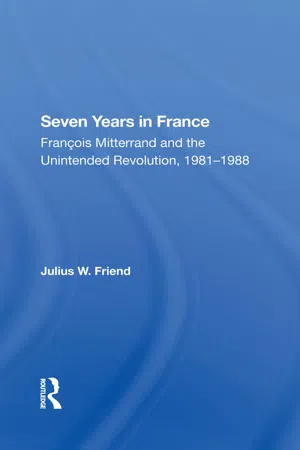
Seven Years In France
Francois Mitterrand And The Unintended Revolution, 19811988
- 249 pages
- English
- ePUB (mobile friendly)
- Available on iOS & Android
eBook - ePub
About this book
A chronological look at French Politics. Politics in action is such a confused battleground that political analysis runs the risk of over-clarification. Confusion was not lacking in French politics between 1981 and 1988, and the author thought it useful to describe the manner in which events happened before attempting to sort out their meaning. T
1
Genesis
Prologue: "On a Gagné!"
In the morning of May 10, 1981 Valéry Giscard d'Estaing cast his ballot in an election he hoped would give him seven more years as president of the French republic. A hard rain fell as Giscard emerged from the city hall of the Auvergne village of Chanonat, entered his car and regained his nearby chateau.
Giscard's antagonist François Mitterrand voted in another small country town, Château-Chinon in the high Morvan country of western Burgundy. The Socialist party candidate for the presidency had been mayor of the town for twenty-two years and was deputy for the local department, the Nièvre. He had just ended his third presidential campaign, first against Charles de Gaulle in 1965, then against Giscard in 1974.
In this third race Mitterrand was optimistic. Two weeks earlier he had won 7,500,000 votes in the first round of the two-stage elections — 700,000 fewer than Giscard, but enough to place him well for the second round. There he could hope to draw heavily from candidates knocked out of the race in the first round.
Much the most important of these was Georges Marchais, secretary general of the powerful French Communist party (PCF), and Mitterrand's quarrelsome ally throughout most of the 1970s. Marchais had hoped to equal or surpass the twenty percent vote the PCF had received in recent elections. Instead, a quarter of the Communist vote had deserted to Mitterrand on the first round. Mitterrand expected to gain most of the Communist vote on the second round, but with the PCF thus weakened he hoped also to win uncertain voters worried about voting for a Socialist who owed too much to a Communist alliance.
Giscard still had reasons for hope on election morning. When his own experts had begun to warn him in December that polls both public and private indicated potential trouble, he was not at first alarmed. Scandals and constantly mounting unemployment had undermined his popularity, but he was sure the French would never elect Mitterrand.
In 1977, when opposed by a seemingly solid Socialist-Communist Union of the Left, Giscard had expected to lose the 1978 parliamentary elections. When in September 1977 the Communists backed away from a victory they feared would leave them junior partners, the Left alliance collapsed. Poils continued to predict a Left victory, and the vote for all parties of a now disunited Left in the first round of the 1978 elections was 50.2 percent. In the second round a week later, French voters fell back in seeming revulsion from what they had almost done, and produced a solid majority for the Center-Right.
Thereafter the Socialists and Communists had continued to quarrel. Giscard knew that Georges Marchais' scarcely hidden aim in 1981 was to ensure Mitterrand's defeat in the second round. Marchais' Soviet friends, with whom the French Communists had recently patched up their Eurocommunist quarrel, had endorsed Giscard in Pravda in mid-March, praising him as "a consequent and prudent political personality."1
Washington and Bonn expected and welcomed Giscard's re-election. In November 1980, sixty percent of poll respondents expected to vote for him; even after the gap between the candidates narrowed few believed at first in Mitterrand's victory.2 After the first round, Giscard may have been reassured to learn that the total left-wing vote in the first round was smaller than it had been in 1978.13 Conservative winds were blowing in the world: witness the elections of Margaret Thatcher in 1979 and of Ronald Reagan in 1980. If the French Left had crested in 1978, why should it — how could it—win in 1981?
The candidates remained in the country to await the count; Giscard in his chateau, Mitterrand in the Hotel du Vieux Morvan, his local headquarters over the years. The polls closed at six except in the big cities, where voting continued until eight. Computer extrapolations based on results from sample districts rapidly indicated a swing toward Mitterrand. At 6:28 an excited journalist approached the Socialist candidate, who was phlegmatically expounding the reasons for the Morvan's bad weather to the group around him. "Monsieur Mitterrand, you have won; you have between fifty-two and fifty-three percent!" Ostentatiously calm, Mitterrand continued his meteorological conversation. "What will you do tomorrow morning?" demanded a journalist. "I will get up."
At eight, exactly as the voting ended, the evening television news announced the computer projections made by all polling organizations. They were unanimous. The excited crowd at the Vieux Morvan began to sing the Marseillaise, while Mitterrand slipped off to his room to draft the victory statement he had postponed till this moment. The journalists at the gates of Valéry Giscard d'Estaing's chateau found them locked. Giscard too had heard the projections; he knew that his presidency had ended. At eight-fifteen, the television announced his concession and congratulations to the victor.
In Paris, the Socialists had optimistically organized a victory celebration in the vast and evocative Place de la Bastille. Quickly, the word spread. Thousands of excited Socialists and Communists, political militants and ordinary citizens streamed toward the Bastille to share in a common intoxication. Still half-incredulous of the long hoped-for, forever-deferred victory, they cried "on a gagné, on a gagné" — we won, we won!
Socialist (and opportunistic Communist) speakers harangued the crowd. Mitterrand was still on his way to Paris. As his automobile arrived at the tollgate entrance to the super-highway leading to Paris, it was met by a motorcycle escort of security police. Power, which had slipped from Valéry Giscard d'Estaing that day, was descending upon François Mitterrand.4
History and Mythology
In 1981 France had been governed by conservatives for twenty-three years — a whole political generation, as long as the uninterrupted Republican party ascendancy in the United States from Abraham Lincoln to Grover Cleveland. Divided and dispirited even before de Gaulle's return in 1958, the Socialists had had more than enough time to meditate on their complex party history. Some of it had passed into mythology, a series of latter-day chansons de geste telling, like most such legends, largely of glorious defeats.
Mitterrand's Parti Socialiste (PS) descended from French socialist parties founded as early as 1882. In 1905 they had merged into the Section Française de l'Internationale Ouvrière (French Section of the Workers' International), or SFIO. Forged into painful unity under two very different leaders, the bureaucratic Marxist Jules Guesde and the great humanist tribune Jean Jaurès, the SFIO split in 1920. A majority followed left-wing leaders who wished to affiliate French socialism with Lenin's new revolutionary workers' international, creating the new French Communist Party.
Under the leadership of the brilliant journalist Léon Blum, the defeated rump SFIO was speedily rebuilt. In the 1920s and 1930s it consistently won more votes than the PCF. Mutual hostility was magnified by PCF obedience to Stalin's anti-Socialist policy of 1928, which changed only when the Soviet dictator began to see a special menace in Nazi Germany. In 1935 the two parties formed a "Popular Front against war and fascism."
The Popular Front alliance (including the then-powerful Radical Socialists) won the 1936 elections. The SFIO emerged as the strongest coalition party, and Léon Bium became prime minister. Except for the World War I years, Socialists had never before participated in a government, much less led one. The Communists supported the government in parliament, but chose to remain outside.
Blum took office in a profoundly disunited France, sundered by class hatred, battered by depression, fearful for the future. The failures and the successes of Blum's government entered the mythology of the French Left. For some leftists, Blum was a symbol of lost revolutionary opportunity and betrayal to the forces of capitalism. For the Socialists of the 1970s the Popular Front was a symbol of important milestones —the forty-hour week and paid vacations for workers.
Blum's ministry lasted only thirteen months. His rapid loss of momentum, his defeat in a key Senate vote and resignation in June 1937 also became part of Socialist mythology. He had battered in vain against "the wall of money." Though Blum became vice-premier in the next government and again briefly headed a government in March-April 1938, the Chamber of Deputies that had ushered in the Popular Front slid rapidly to the right.
In July 1940, after the defeat of the French armies, this same chamber voted overwhelmingly to give full powers to Marshal Philippe Pétain, thereby dissolving the republic. Of the eighty deputies and senators who voted no (out of 569), thirty-six were SFIO, thirteen Radicals, and the others from the Center and Right. Ninety SFIO senators and deputies voted for Pétain's authoritarian rule. A few leading personalities of the SFIO sided with Pétain, notably long-time secretary general Paul Faure.
The Communists submitted to Moscow's orders in late September 1939 to condemn a war of no interest to the working class as a struggle between rival imperialisms. They survived their shameful compliance to Moscow by taking the lead in a resistance which was still in its earliest phases when they joined it after Hitler's attack on the Soviet Union. When the Allies landed in June 1944 the PCF had become a major force to be reckoned with in postwar France. Its new weight became apparent in the first postwar elections in October 1945, when the PCF took 26.2 percent of the vote, the SFIO only 23.4 percent. In two national elections the next year the gap between the two parties widened rapidly. In elections for a second constituent assembly the PCF had 25.91 percent, the SFIO only 21.1. In the November 1946 voting for the first National Assembly of the Fourth Republic the PCF rose to 28.3 percent (its all-time high); the SFIO sank to 17.8 percent.
Popular Front enthusiasm had led to reunification in 1936 of the major French union, the Confédération Générale du Travail (CGT). After the 1920 split it had been fairly close to the SFIO, but was by no means its labor wing. The Communists had founded a "Unified CGT" (CGTU), their Leninist transmission belt to the workers. In the unification period the Communists were able to organize a sudden influx of new unionists, especially among metal and chemical workers, railroadmen, and in the building trades. After World War II Communists dominated the major organization of French labor.
The Communists vaunted their Resistance record (forgetting September 1939-June 1941). The SFIO had its individual Resistance heroes, but the party itself had not played a distinctive role in the anti-Hitler struggle. While the Communist party incited in its young adepts the notion that Communism and the Resistance were one large generous movement, the Socialists evoked a kind of party patriotism tainted with a musty smell of bureaucracy.
Léon Blum had miraculously returned safe from Nazi captivity. But he and the new first secretary Daniel Mayer, a leading SFIO Resistance figure, were disavowed in August 1946 by a leftist majority which thought Blum's postwar views too far right and believed that only vociferous leftism would allow the SFIO to compete with the Communists for the votes of post- Resistance France. The new first secretary was the young deputy and mayor of Arras, Guy Mollet.
Mollet's catastrophic reign over the SFIO lasted for twenty-three years. The leftist and anticlerical rhetoric which brought him to power could not have been worse timed. The anticlerical SFIO was a coalition partner with the Catholic Mouvement Républicain Populaire (MRP) in most of the postwar governments. The party which talked proletarian internationalism furnished leading ministers to governments which integrated France into the Atlantic Alliance. Antimilitarist and anticolonialist, the SFIO backed repression in Madagascar, Vietnam, and then in Algeria. Government after 1947 meant the Third Force — denying power both to the Communists and the Gaullists. Corseted in these Third Force governments, the SFIO found its hot rhetoric flagrantly at odds with its daily conduct. Small wonder that its vote steadily diminished, dropping to 14.6 percent in the parliamentary elections of 1951. In the last elections of the Fourth Republic in 1956, the SFIO's 15.2 percent of the votes made it the strongest single governmental party in a badly fractionized Assembly. Mollet became prime minister (François Mitterrand was his justice minister) in the government which sent draftees to fight in Algeria and conspired with Great Britain and Israel in the disastrous Suez expedition.
Mollet backed de Gaulle in May 1958, and did not break with him until 1962. The result of this long record of ideological incoherence was to disgust many within the party and repel the young people who regarded the SFIO as a party of opportunist bureaucrats. The SFIO had always had leftist factions, but from 1956 on fissile tendencies increased. The most important was a movement calling itself the Parti Socialiste Autonome which later merged into the Parti Socialiste Unifié (PSU). One of its leaders was a young technocrat named Michel Rocard, who had been the secretary general of the SFIO student organization.
The Fifth Republic posed new problems for an SFIO which had grown fiercely anti-Communist during the years of the Fourth Republic; General de Gaulle's new regime was more anti-Communist still, and intent on leaving no viable forces between itself and the Communist party. Faced with the prospect of heavy losses in the 1962 parliamentary elections, Mollet mitigated his anti-Communism to negotiate a partial alliance with the PCF leaders. SFIO candidates would withdraw in favor of better placed Communists in the second round, and vice-versa.
The presidential election of 1965 was the first held under universal suffrage. A group of young publicists and intellectuals, most of them admirers of Fourth Republic prime minister Pierre Mendes France, were seeking the ideal candidate to oppose de Gaulle. Mendès, who rejected the institutions of the Fifth Republic, was not available. They opted instead for Gaston Defferre, the moderate Socialist mayor of Marseilles, whom they built up in a press campaign as the "Monsieur X" who could beat de Gaulle. Guy Mollet was not enthusiastic. Defferre's plan was to re-federate the French Center-Left and non-Communist Left, in other words to regroup the battered and divided troops of the old Third Force of the Fourth Republic. To win, however, he needed a Communist vote he was unwilling to bargain for. If the PCF followed him, very well. But he was not going to negotiate with it. He did not have to. Defferre's candidacy collapsed under the blandly malevolent eye of Guy Mollet by trying to reach too far right and not far enough left.
After Defferre's failure, no one in France supposed that any candidate could defeat Charles de Gaulle. The only question seemed to be what symbolic candidacies would be advanced, how many, and how poor their scores would be. In this unpromising situation one far-sighted and adventurous politician glimpsed real opportunity. His name was François Mitterrand.5
The New Leader of the Left
The Mitterrand who ran for president in 1965 was very far from being the Socialist leader of 1981. At forty-nine, he was a veteran of eleven coalition cabinets of the Fourth Republic, in which he represented the small, mildly left Union Démocratique et Socialiste de la Résistance. Leftists knew that he came from the well-to-do middle class, that his background was Catholic and that his education until university level was entirely in Catholic schools. To many Frenchmen on the Left he was an improbable standard bearer. They wante...
Table of contents
- Cover
- Half Title
- Title
- Copyright
- Dedication
- Contents
- List of Acronyms
- Acknowledgments
- Introduction
- 1 Genesis
- 2 Twenty-one Months on the Left
- 3 Thirty-six Months at the Center
- 4 What the Socialists Accomplished
- 5 From Confrontation to Cohabitation
- 6 Foreign Policy in the Septennat
- 7 Mitterrand II
- Bibliography
- Index
Trusted by 375,005 students
Access to over 1.5 million titles for a fair monthly price.
Study more efficiently using our study tools.
Frequently asked questions
Yes, you can cancel anytime from the Subscription tab in your account settings on the Perlego website. Your subscription will stay active until the end of your current billing period. Learn how to cancel your subscription
No, books cannot be downloaded as external files, such as PDFs, for use outside of Perlego. However, you can download books within the Perlego app for offline reading on mobile or tablet. Learn how to download books offline
Perlego offers two plans: Essential and Complete
- Essential is ideal for learners and professionals who enjoy exploring a wide range of subjects. Access the Essential Library with 800,000+ trusted titles and best-sellers across business, personal growth, and the humanities. Includes unlimited reading time and Standard Read Aloud voice.
- Complete: Perfect for advanced learners and researchers needing full, unrestricted access. Unlock 1.5M+ books across hundreds of subjects, including academic and specialized titles. The Complete Plan also includes advanced features like Premium Read Aloud and Research Assistant.
We are an online textbook subscription service, where you can get access to an entire online library for less than the price of a single book per month. With over 1.5 million books across 990+ topics, we’ve got you covered! Learn about our mission
Look out for the read-aloud symbol on your next book to see if you can listen to it. The read-aloud tool reads text aloud for you, highlighting the text as it is being read. You can pause it, speed it up and slow it down. Learn more about Read Aloud
Yes! You can use the Perlego app on both iOS and Android devices to read anytime, anywhere — even offline. Perfect for commutes or when you’re on the go.
Please note we cannot support devices running on iOS 13 and Android 7 or earlier. Learn more about using the app
Please note we cannot support devices running on iOS 13 and Android 7 or earlier. Learn more about using the app
Yes, you can access Seven Years In France by Julius W Friend in PDF and/or ePUB format, as well as other popular books in History & World History. We have over 1.5 million books available in our catalogue for you to explore.