This book brings together cutting edge work by Brazilian researchers on multilingualism in Brazil for an English-speaking readership in one comprehensive volume. Divided into five sections, each with its own introduction, tying together the themes of the book, the volume charts a course for a new sociolinguistics of multilingualism, challenging long-held perceptions about a monolingual Brazil by exploring the different policies, language resources, ideologies and social identities that have emerged in the country's contemporary multilingual landscape. The book elucidates the country's linguistic history to demonstrate its evolution to its present state, a country shaped by political, economic, and cultural forces both locally and globally, and explores different facets of today's multilingual Brazil, including youth on the margins and their cultural and linguistic practices; the educational challenges of socially marginalized groups; and minority groups' efforts to strengthen languages of identity and belonging. In addition to assembling linguistic research done in Brazil previously little known to an English-speaking readership, the book incorporates theoretical frameworks from other disciplines to provide a comprehensive picture of the social, political, and cultural dynamics at play in multilingual Brazil. This volume is key reading for researchers in linguistic anthropology, sociolinguistics, applied linguistics, cultural studies, and Latin American studies.
eBook - ePub
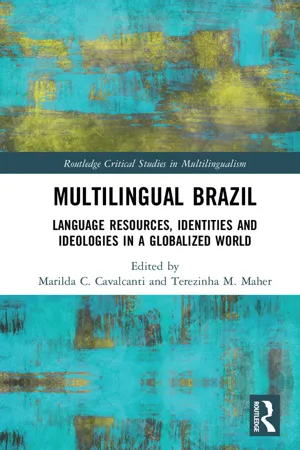
Multilingual Brazil
Language Resources, Identities and Ideologies in a Globalized World
- 260 pages
- English
- ePUB (mobile friendly)
- Available on iOS & Android
eBook - ePub
Multilingual Brazil
Language Resources, Identities and Ideologies in a Globalized World
About this book
Information
1 Contemporary Brazilian Perspectives on Multilingualism
An Introduction
The development of postmodern and poststructuralist thought has led us to reflect more closely upon a number of key concepts that have guided our research agendas in the past. The impact of these epistemological shifts has been felt in the field of critical applied linguistics (Pennycook, 2001; Moita Lopes, 2006) and in critical sociolinguistic research on multilingualism (Martin-Jones et al., 2012:1). The very notion of ‘language’ has also been interrogated in both these fields. Once thought of as an abstract, ready-made entity, made up of fixed structures and clear boundaries, it is now viewed as a resource that people draw on and constantly recreate, together with other semiotic resources, in order to achieve their communicative purposes. This view was first put forward by Makoni and Pennycook (2007, 2012) and it is one that guides many of the contributions to this volume. Languages do not preexist human actions and interactions; they are generated and shaped by them. Fluid, dynamic forms of communication have been created over the millennia of human experience, and have then been shaped and reshaped through the communicative practices that people engage in (Hanks, 1996; Jacquemet, 2005; Blackledge et al., 2014). Put another way, it is not that we are capable of communicating because we have languages, it is because people interact socially that languages end up coming into being, that languages were, and still are, being ‘invented’ (Severo and Makoni, 2015).
As May (2014:9) has pointed out, adopting this anti-essentialist notion of language means viewing multilingualism as a significantly “complex, dynamic and porous phenomenon”, involving “multiple discursive practices”, in different modalities. From this perspective, multilingualism can no longer be construed as the simple coexistence of a set of languages, in a static, harmonious and homogeneous locus. Instead, as Heller (2012:32) has put it, multilingualism is “a set of ideologically-loaded communicative resources, always unequally distributed, on an always uneven playing field”. This means that it is potentially a site of turbulence and conflicting identities. As Blackledge et al. (2014:191) have noted, the core concepts in the study of language in social life should be “mobility, mixing, political dynamics, and historical embedding”.
In contrast to views of language that predominate in national and regional language policies and in institutions, such as education (e.g. the distinction between good, appropriate or legitimate language), we see language as multifaceted and, following Cesar and Cavalcanti (2007), as a kaleidoscope of resources. Even ‘single languages’ can be thought of as comprising multiple resources, including styles, genres and registers and diverse ways of speaking and writing. In this volume, we see examples of sociolinguistic situations where a range of styles and language resources are in play in local actions and interactions (see, for instance, the chapters by Moita-Lopes, Rojo and Almeida, and Pires-Santos, this volume).
Our main purposes in putting together this volume were to present to a wide international readership the wealth of recent research on multilingualism in Brazil and to make more visible the voices and viewpoints of Brazilian researchers. A significant proportion of the chapters in the volume incorporate poststructuralist and/or postmodern perspectives and research of an ethnographic nature predominates. The volume also brings together researchers working in a range of different research sites, in the north, northeast, south and southeast of the country and on the western frontiers with Argentina, Paraguay and Bolivia. It includes research with Indigenous peoples; with users of Língua Brasileira de Sinais (Libras), the Brazilian Sign Language; with groups of immigrant origin who have now been established for generations in the southern states of Brazil; and with people whose life trajectories have involved border crossing between Paraguay and Brazil, the so-called Brasiguaios (Braziguayans).1 It also includes research on multilingualism online and in rap music lyrics. And, taking account of globalization and contemporary mobilities, the volume includes two chapters relating to the internationalization and cooperation policies of universities in Brazil and to research with different participants in these programs. Together, the chapters provide rich insights into contemporary linguistic diversities in Brazil, into situated uses of different constellations of language resources, into local identity politics, into the histories of different linguistic minority groups and into ongoing changes specific to each group, e.g. rapidly developing transnational connectedness. At the same time, the chapters build a broad picture of the ways in which national language ideologies and language policies, and now globalized ideologies, have shaped the sociolinguistic trajectories of different groups.
In the next three sections of the Introduction to the volume, we provide an account of the political and ideological contexts in which different national language policies have been forged. We trace three broad historical periods, from the colonial period to the present, and we chart the significant ideological shifts that have taken place. Further details regarding the impact of different language policies on particular populations in Brazil are then given in some of the individual chapters that follow. In the fourth and final section of this Introduction, we chart out the overall organization of the volume and we introduce each of the chapters in turn, pointing to the theoretical framing of each one and the specific nature of the research being presented.
Brazilian Language Policies, Identity Politics and an Enduring Monolingual Ideology
Brazil has always been a multilingual country although, throughout its history, it has systematically attempted to eradicate the linguistic diversity within the population or make it invisible (Cavalcanti, 1999; Oliveira, 2003). Over the centuries, three types of repressive language policies have contributed, in significant ways, to the embedding of a grand narrative about Brazil being monolingual, in the collective memory of its citizens.
We turn first to the Portuguese colonial era. In 1758, the Marquis de Pombal decreed that all Indigenous languages, including the Tupi-based lingua franca, Nheengatu, were to be replaced by Portuguese in all public domains (see Freire, this volume).2 Nheengatu was spoken by a significant number of Indigenous peoples and by a substantial proportion of the non-Indigenous population of the Portuguese Colony of Brazil. During this same period of Brazilian history, the Portuguese colonialists also adopted repressive approaches to the languages spoken by enslaved Africans who were brought to the colony from different regions of the African continent to work in sugar and coffee plantations. Members of the same family were separated and measures were taken to avoid the concentration of Africans with same regional origins in the same area (Petters, 2006). This strictly enforced strategy amounted to a language eradication policy although it was never written into law.
The second type of policy emerged during the post-independence period—the period of the history of Brazil known as the Estado Novo.3 This was a period of populism and nationalist politics and there were increasing concerns about securing the border with Argentina (another rising power in Latin America). The then President of the Republic, Getúlio Vargas, sought closer alliance with the United States. Thus, during the Second World War, Brazil played a role in the international conflict of the times and, in 1942, Vargas proclaimed that the national languages of ‘enemy countries’—Germany, Japan and Italy—should be forbidden in schools and banned everywhere else in society. These were languages that were still being widely used in immigrant communities in southern Brazil (see Oliveira, this volume; see Morales, Akamine and Suzuki, this volume).4 Once again, legislation was introduced to ensure that Portuguese would be the only legitimate language of Brazilian institutions.
The third policy was in place from the colonial period onwards, until the late 1980s, although it never had official legislative status. It took the form of an educational policy, related to Deaf groups in Brazil, which promoted monolingualism in Portuguese. For almost two centuries, the schooling of Deaf students in the country was guided by the view that the Deaf had to learn to communicate in oral Portuguese. This policy forbade the use of Sign Languages at school arguing that this practice would hinder the development of speaking ability or the ability to write in Portuguese (Cavalcanti and Silva, 2007).
Along with previous repressive language-related legislation and language eradication strategies, this policy contributed to the reinforcement of the status of Portuguese and the symbolic ‘invention’ of a Brazilian national language (Berenblum, 2003). All three of the repressive language policies we have outlined here were informed by specific language ideologies, that is, by particular “sets of beliefs used to rationalize and justify the way languages are perceived” (Silverstein, 1979:193). They all had a lasting legacy. They not only shaped the landscape of sociolinguistic diversity in Brazil, but also the ways in which the individual and collective identities of speakers of immigrant languages, Indigenous languages and Sign Language were represented in the country. As Silva (2000) has indicated, identities only gain meaning within the particular signifying or representational systems in which they are constructed. Thus, in this volume, language policy-making is not viewed as a neutral, apolitical or conflict-free process. Decisions regarding language policies are seen as being embedded in power relations, symbolic domination and language ideologies and these aspects of the social context need to be taken into account in research narratives (Tollefson, 2006; Hornberger, 2006; Maher, 2010; McCarty, 2011, Johnson, 2013; Tollefson and Pérez-Milans, 2017, among many others). At the same time, we acknowledge that language policies that deny legal protection to linguistic minorities do not necessarily prevent these languages from being used or reproduced. As Stroud and Heugh (2004:191) have put it, national language policies rarely succeed in preventing languages from being “productively appropriated by minority speakers into local multilingual repertoires to serve a range of local functions”.
A Shift in Language Ideologies with the Advent of More Democratic Processes
Major official changes in the way that Brazil thought of and dealt with its minority languages only began to occur with the introduction of a new Constitution, in 1988, after the end of a military dictatorship that had lasted for 20 years (1964–1984). In this Constitution, the Indigenous peoples’ languages and cultures were finally acknowledged and valued as part of the national patrimony. This strengthened the position of existing bilingual education programs that were sponsored by Non-Governmental Organizations (NGOs) and encouraged the development of new bilingual education programs and language revitalization5 projects in Indigenous communities. At the same time, bilingual education programs were also established by various communities of immigrant origin (German, Italian, Polish, Ukrainian and others) in the southern region of the country, although they were not explicitly endorsed by the new Constitution. The aim of these programs was to support the learning of heritage languages by the descendants of the original migrants.6 Demand for bilingual education programs for Deaf people (Cavalcanti and Silva, 2007) also emerged alongside an already existing movement in favor of Brazilian Sign Language (Libras). This movement then gathered strength and succeeded in getting approval for new laws, including the acknowledgement of Libras as a second official Brazilian language and its inclusion as part of the syllabus of university teacher education courses.
The significant changes in language policies and educational practices described above were only possible because of a broader shift that had taken place in the country towards greater awareness of its cultural diversity. This shift had started with the opening up to democracy but it was also the outcome of sustained pressure from activists from several fields. The ripple effect was still being felt in the first decade of the new millennium. For example, in 2003, a significant new law called for the mandatory inclusion of Afro-Brazilian History and Culture in school syllabuses. A similar law concerning the Indigenous peoples of Brazil was passed in 2008. However, while social and cultural diversities are now being foregrounded in public policies, the country’s linguistic diversities have not received the same kind of attention. Moreover, the ideological shift towards a more positive view of minority languages in Brazil has not been fully translated into school language policies and educational practices.
In fact, the National Curricular Guidelines (PCNs—Parâmetros Curriculares Nacionais) (Brazil, 1998a) for middle and secondary schooling, published in 1998, did not pay much attention to Brazil’s linguistic diversity, although it did make mention of the country’s cultural diversity, suggesting it should be reflected in the teaching of all curriculum subjects. One key exception to this trend can be found in the Indigenous Schools’ Curricular Guidelines (RCNEI—Referencial Curricular Nacional para as Escolas Indígenas) also published that same year (Brazil, 1998). For the very first time, the languages and cultures of Indigenous peoples were made visible in an official curricular guideline. Thus, at least in theory, both legislation and pedagogical guidelines have given some favorable consideration to linguistic and cultural diversity in Indigenous contexts.
Multilingualism in the Context of Change: Globalization and Contemporary Mobilities
To understand the multilingual nature of contemporary Brazil, we must take account of its recent history and of the fact that the country has been embedded in complex and changing global relations of a political, economic and cultural nature. In this section, we address Brazil’s history and its embedding in the increasingly multi-polar world of the 21st century. However, before we begin this part of our narrative, we need to point out that the country is particularly vulnerable to the contradictions that capitalism generates, including increases in social-economic inequality. Brazil is seen as having a tendency to be economically unstable, while at the same time being perceived as particularly open to social change and experimentation (Santos, 1995). In fact, during the decade from 2000 to 2010, the country was open to more progressive policies. However, this now seems to be over due to recent political and ideological changes, which have resulted in severe cuts in the budget for social services, with a focus on education (and also health and safety). Right now, there is no way to foresee what awaits Brazilians in the near or distant future.
In fact, since the 1970s, Brazil has gone in and out of global/local economic crises. As different economic shifts took place, from the 1970s onwards, we witnessed a number of significant migration movements in and out of the country: firstly, some 30 years ago, there was outward migration, mainly to Japan and to the US (Margolis, 2013). Secondly, in the 1970s and the 1980s, there was a steady flow of inward migration, from China and South Korea. In the first decade of the 21st century and in the early part of the second decade, while the major economies in the world were undergoing a severe economic crisis, Brazil—one of the so-called BRICS—experienced a brief economic boom, along with other countries such as Russia, India, China and South Africa. Due to this 21st century economic boom there were new transnational migration flows to Brazil from neighboring South American countries (mainly from Bolivia, but also from Peru and Ecuador) and, to a lesser extent, from countries such as Angola, Bangladesh, the Democratic Republic of Congo, Nigeria, Senegal and Sierra Leone (Lesser, 2013, 2015). This favorable economic condition also led to the return of some Brazilians w...
Table of contents
- Cover
- Title
- Copyright
- Contents
- List of illustrations
- Acknowledgments
- 1 Contemporary Brazilian Perspectives on Multilingualism: An Introduction
- Section I Politics, Language Ideologies and the Changing Shape of Language Policy Processes
- Section II Language-In-Education: A Dominant Monolingual Ideology in Tension With Multilingual Practices
- Section III Local/Global Trajectories
- Section IV Representation/Performance of Diversities
- Section V Internationalization and New Diversities in Higher Education: Policies and Practices ‘On the Ground’
- Afterword: Policies, Identities, Trajectories and Practices of Multilingual Brazil
- Contributors
- Index
Trusted by 375,005 students
Access to over 1.5 million titles for a fair monthly price.
Study more efficiently using our study tools.
Frequently asked questions
Yes, you can cancel anytime from the Subscription tab in your account settings on the Perlego website. Your subscription will stay active until the end of your current billing period. Learn how to cancel your subscription
No, books cannot be downloaded as external files, such as PDFs, for use outside of Perlego. However, you can download books within the Perlego app for offline reading on mobile or tablet. Learn how to download books offline
Perlego offers two plans: Essential and Complete
- Essential is ideal for learners and professionals who enjoy exploring a wide range of subjects. Access the Essential Library with 800,000+ trusted titles and best-sellers across business, personal growth, and the humanities. Includes unlimited reading time and Standard Read Aloud voice.
- Complete: Perfect for advanced learners and researchers needing full, unrestricted access. Unlock 1.5M+ books across hundreds of subjects, including academic and specialized titles. The Complete Plan also includes advanced features like Premium Read Aloud and Research Assistant.
We are an online textbook subscription service, where you can get access to an entire online library for less than the price of a single book per month. With over 1.5 million books across 990+ topics, we’ve got you covered! Learn about our mission
Look out for the read-aloud symbol on your next book to see if you can listen to it. The read-aloud tool reads text aloud for you, highlighting the text as it is being read. You can pause it, speed it up and slow it down. Learn more about Read Aloud
Yes! You can use the Perlego app on both iOS and Android devices to read anytime, anywhere — even offline. Perfect for commutes or when you’re on the go.
Please note we cannot support devices running on iOS 13 and Android 7 or earlier. Learn more about using the app
Please note we cannot support devices running on iOS 13 and Android 7 or earlier. Learn more about using the app
Yes, you can access Multilingual Brazil by Marilda C. Cavalcanti,Terezinha M. Maher in PDF and/or ePUB format, as well as other popular books in Languages & Linguistics & Linguistics. We have over 1.5 million books available in our catalogue for you to explore.