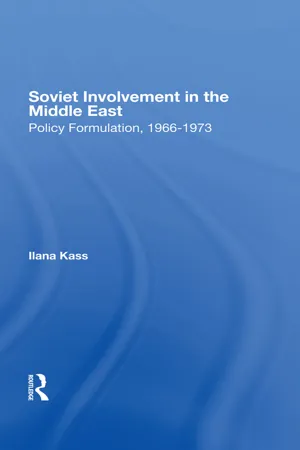
- 273 pages
- English
- ePUB (mobile friendly)
- Available on iOS & Android
eBook - ePub
About this book
Most books ongmate as essays of limited scope or as doctoral dissertations whose findings await a receptive audience. Although this study passed through both these metamorphoses, it owes its birth to a mere coincidence. As a graduate student in the Political Science Department of The Hebrew University and a junior research fellow at the university's Soviet and East European Research Centre, I was responsible for documenting pronouncements relevant to the USSR's Middle Eastern policy that appeared in the CPSU organ Pravda. Within a few months I was assigned the task of analyzing excerpts from the Trade Union's organ Trud, only to discover that the two newspapers adopted diametrically differing attitudes toward some crucial issues. Trained as I was to view the Soviet system as a totalitarian, cohesive entity and the Russian media as a centrally controlled, monolithic means of mass manipulation, I was rather bewildered by my findings. An attempt to assess and rationalize this empirical reality resulted in two essays, each dedicated to the analysis of a policy group as represented by the press organ officially declared to be its platform. Special thanks are due to Professor Roger Kanet of the University of Illinois, editor of the journal Soviet Union, and to the editorial board of Soviet Studies, whose valuable suggestions and probing queries helped transform these crude attempts at systematic analysis into publishable papers, unwittingly laying the foundation for a doctoral thesis and, subsequently, for this book.
1.
Introduction: A Framework for Analysis
The Soviet Political System: From Totalitarianism to Creeping Pluralism
Analysts have vacillated between two major explanations of foreign policy behavior. Theorists of international politics have generally adopted a macroanalytic approach, in which the internal dynamics of a state’s behavior—including such factors as the particular political structure of the polity, the perspectives and personalities of the decision makers, and the articulated attitudes and demands of the citizenry—are “black boxed” in the name of analytic parsimony. These scholars anthropomorphize the state, treating it as a unitary, rational decision maker whose behavior is explained largely as a response (1) to the anarchic quality of politics in an international arena devoid of international government, (2) to changes in the structure of the international system, or (3) to calculated moves by rival states.
In contrast, those whose interest in international politics has developed out of a comparative politics or area studies concern, have shown themselves more prone to adopt micro-analytic approaches to foreign policy analysis. These scholars view foreign policy as the result of the interplay of phenomena particular to the state in question. According to these analysts, policy attributes may grow out of entirely non-human factors, such as the state’s geopolitical position or its natural resources endowment. Or they may stem from domestic forces, such as the state’s national character, “modal personality,” political culture, belief system or ideology, or social structure. Or they may originate in factors that shape the effective structure of a state, factors ranging from the state’s formal constitutional framework on the one hand to structural impacts on information flows within the state on the other. Finally, according to the microanalysts, foreign policy attributes may be thought to originate in the idiosyncrasies of particular decision makers—their anxieties, their aspirations, and their perceptions. In short, the microanalysts have tended to regard the nature of the individual components of a polity, rather than the situationally induced general propensities of a state, as providing the most important clues to a proper understanding of any state’s foreign policy. This has been particularly true in Western analysis of Soviet foreign policy.1
The Cold War created an atmosphere conducive to stressing the extent to which Soviet policy differed from that of other states in its conduct, goals, and instrumentalities. Until the early 1960s, Soviet studies remained somewhat divorced, conceptually and methodologically, from the mainstream of comparative politics and international relations inquiry.2 Students of Soviet affairs developed a unique form of “black-box” approach, perceiving the Soviet “leadership” as a homogenous entity and denying the existence of conflict—usually regarded as the central feature of all political systems—within the Soviet regime. The totalitarian model set forth by Brzezinski and Friedrich emerged as the only valid means of analysis of the Soviet political system.
Although there has been by no means general agreement on the meaning of totalitarianism, it has been common in the West to treat it as a phenomenon unique in world history, sharply distinguished not only from Western democracies, but also from traditional authoritarian regimes. It has usually been accepted that totalitarianism involves the widest possible extension of state power over society, thus tending to annihilate all boundaries between the two and destroying any associations or groups between the individual and the state.3 It has been further argued that totalitarianism entails an unavoidable compulsion on the part of the ruling elite to absorb or destroy all social groups obstructing its complete control of society.4
The concept of totalitarianism that has dominated the analysis of communist systems in the West, at least until the late 1950s, has seemed to preclude the possibility that interest groups could challenge or affect the single ruling party as the fount of all power. The uniqueness of the totalitarian system has been deemed to lie in the very totality of its power, excluding, as if by definition, any area of autonomous behavior by groups other than the party and, still more, preventing serious influence by them on the process of decision making.5
The totalitarian concept also often implied a certain changelessness in the nature of communist politics. Even after the death of Stalin, the likelihood of a decline of totalitarianism was doubted by some; if anything, argued Friedrich and Brzezinski, communist societies would become more totalitarian.6
The model of communist politics implicit in most Western analyses appeared to be exclusively concerned with “outputs,” i.e., the imposition of binding decisions, and to be entirely lacking in “inputs.” Unlike all other systems, the Soviet system was depicted as one in which struggles over ideas and interests, or conflicts among rival groups, are absent. Issues requiring decisions are raised not by society or social groups, but presumably by the party, or better, by its topmost leaders, without regard for the values and interests of other entities. The monolithic party has been regarded as the only interest group, itself undifferentiated in its thinking and behavior.7
Interestingly enough, the totalitarian concept of a single, monolithic party claiming and exercising absolute authority was corroborated by communist theory. Marxist theorists have assumed that the single ruling party, the organization of the proletariat, best knew the “real” interests of the people as a whole and they have thus denied the possibility of fundamental conflict of interest within the working class. Conflict within and among other social classes and between them and the proletariat was depicted in terms of “class struggle,” from which the proletariat was historically determined to emerge victorious. Thus, Soviet theory (and practice, at least under Stalin) regarded any aggregation or articulation of particular-istic interests as an antisystemic, and therefore illegitimate, challenge to the hegemony of the proletariat and the party ruling in its name.
Even under the inhibiting burden of Stalinist dictatorship, however, the Soviet Union was being transformed into a complex industrial society, one that was divided into a number of functional groupings and that was developing a vast bureaucracy. It came to include several institutions with strong loyalties and parochial interests. After Stalin’s death, an accelerated loosening of political controls over society took place, and the divergent institutional claims, hitherto suppressed, became publicly articulated and advocated with various degrees of vigor.8 Perhaps the best analysis of this process is Alexander Dallin’s:
Creeping pluralism invades totalitarian life as it must invade all developing politics. The growing complexity of society and economy are bound to produce greater functional specialization, greater multiplicity of role conflicts, a greater awareness of divergent group interests, and at least their incipient aggregation. At the same time, political articulation and participation tend to increase while the pressures of forcible social, political and economic mobilization are somewhat relaxed; while the system has more material resources to spare from its all-out mobilization and survival needs; and as important choices among alternative strategies need to be made. Different elite elements tend to opt for different priorities in resource allocation, reflecting different values with different political implications. As terror tends to recede at this stage, dissenting voices may be heard with greater impunity, precisely at a time when the regime must make great efforts to manufacture a genuine consensus. The more modernized society must rely more heavily on “experts” who in turn tend to press for better information and greater rationality and often seek access to policy-makers, thus introducing notes which clash with the repetitive refrains of the ideologues and the timid, conservative bureaucrats.9
In addition, the fear of a return to one-man rule supports “collective” decision making at the highest level, which requires the adjustment of conflicting opinions and preferences—or else stalemate and inaction. Collective leadership invariably creates a situation in which outside influences can more effectively be brought to bear on the narrow circle of decision-makers.10 Conversely, in a collective leadership in which no individual is automatically assured of predominance, each person must secure his position by first winning and then maintaining the support of a combination of sociopolitical groups. Actual and potential rivals, on the other hand, can build their own power bases by identifying themselves with elements discontented with current policy. Under conditions of leadership conflict, unresolved disputes may lead some of the participants to broaden the conflict by involving political groupings that may shift the balance in their favor.11
As a result of the changes that occurred since Stalin’s death and the shifting perspectives of both Western and communist analysts, a new version of communist politics slowly began to emerge. “The concept of a totalitarian system in which a single party, itself free of internal conflict, imposes its will on society, and on all social groups, was challenged by an approach that took account of the conflicting groups that exert an influence on the making of policy by the party.”12
There is a marked controversy in the standard texts as to the functioning of Soviet interest groups.13 Differences of interpretation center on (1) the kinds of groupings that do exist, (2) the rules of the game governing the articulation of their interest, and (3) the degree of influence groups may have on policy outcomes. Brzezinski and Huntington,14 Azrael,15 Kolkowicz,16 Erickson,17 and others see policy relevant groups as forming principally along occupational lines, such as the military, the state bureaucracy, and party apparatchiki. Meyer,18 cautioning against any attempt at an a priori listing, suggests that interest groups may form around issues or individual leaders in addition to occupations. Barghoom19 and Leonhard20 argue that the major policy groups do not form along occupational lines but cut across these to coalesce around issues, namely, modernizers versus conservatives, revisionists versus dogmatists, and the like. Skilling and Griffiths similarly conclude that groupings most frequently form around issues, but, unlike Barghoorn and Leonhard, they see a greater multiplicity of viewpoints.21
Writers appear to divide roughly into two camps when assessing the informal rules governing group activity. Though all tend to agree that some kind of articulation of perceived group interests can and does occur in the USSR, differences arise over the limits imposed on such activity. One line of interpretation stresses the illegitimacy of group action and the high risks involved in crossing the line from “advocacy to pressure.”22 The others tend to emphasize the much greater freedom of discussion, even on “vital” issues, that in their view came to characterize Soviet political life after Stalin’s death.23
Assessments of the extent of group influence on policy outcomes are as diverse as those on the rules of the game. Brzezinski, Azrael, and Barghoorn stress the Party’s formal monopoly over decision making and the weakness of interest groups. At the same time, they suggest that groups having a relatively high institutional cohesion may occasionally act as “veto groups,” successfully resisting Kremlin pressures.24 Meyer, while pointing out our serious lack of knowledge of Soviet policy processes, suggests that the interests of a wide variety of groups are considered by the Soviet decision-makers. At the same time, he concludes, such interests usually “do not count very heavily.”25 Griffiths, Skilling, and Meissner, on the other hand, argue that certain kinds of “strategic” groupings may indeed count heavily in Soviet decision making.26
The foregoing summary clearly suggests that the issue is by no means resolved. Moreover, systematic empirical research on this problem is still in embryonic form. Perhaps the main reason for this “state of affairs” is the fact that “the style of interest groups is always strongly influenced by the entire political culture within which they operate.”27
Thus, in a system in which decision making is highly centralized, where several parties or genuine elections do not exist, where the communication media are controlled, and where unity of action is considered the supreme principle, policy groups will take on forms appropriate to this setting. Specifically, in the USSR, public articulation of dissenting opinion and aggregation of “constituencies” may be carried out only in a veiled, almost clandestine, manner.
The tediousness and frustration involved in attempts to penetrate the elaborate smoke screen around the inner workings of the Soviet political processes may account for the somewhat elusive character of most Western commentary on Soviet decision making and the activity of policy groups.
With the exception of one pathbreaking research project, sponsored and edited by Skilling and Griffiths, the main thrust of Western research has centered in recent years upon analysis of individual institutional groups, their makeup, career patterns, professional attitudes, and role in Soviet society.28 Addressing themselves to the problem of the role these groups may play in the decision-making process, these analyses pointed to the formal points of contact between the various institutional hierarchies, assuming that “these institutional arrangements serve as channels of input into policy.”29
To give but one example: the military has access to the decision-makers through the Defense Council (formerly referred to as the Higher Military Council), composed of military leaders and Politburo members; through the Council of Ministers, of which the Minister of Defense is of course a member; and through the Central Committee (CC) of the Communist Party of the Soviet Union (CPSU), on which thirty-six military officers at present serve as full or candidate members. In May 1973, with the promotion of Marshal Grechko to the Politburo, the military gained direct access to the highest decision-making body. By the same token, other political interest groups may attempt to impress their opinion upon the decision-makers through direct approaches at the key points of authority.
Here, however, a seemingly insurmountable difficulty is encountered. The activity of Soviet policy groups in the decision-making forums is an unknown quantity to the student of Soviet affairs. We have no direct evidence about the relative effectiveness of the formal channels of communication and means of access. We do not know what opinion was argued, whether it was unanimously presented by the representatives of a given group, and, perhaps most crucially, whether it was heeded and acted upon by the decision-makers. Equally obscure to the Western observer is the p...
Table of contents
- Cover
- Half Title
- Dedication
- Title
- Copyright
- Contents
- Preface
- 1. Introduction: A Framework for Analysis
- Part 1 At the Crossroads
- Part 2 Divergences Intensify within the Framework of Involvement
- Part 3 Convergence and Polarization within the Soviet Leadership
- Notes
Trusted by 375,005 students
Access to over 1.5 million titles for a fair monthly price.
Study more efficiently using our study tools.
Frequently asked questions
Yes, you can cancel anytime from the Subscription tab in your account settings on the Perlego website. Your subscription will stay active until the end of your current billing period. Learn how to cancel your subscription
No, books cannot be downloaded as external files, such as PDFs, for use outside of Perlego. However, you can download books within the Perlego app for offline reading on mobile or tablet. Learn how to download books offline
Perlego offers two plans: Essential and Complete
- Essential is ideal for learners and professionals who enjoy exploring a wide range of subjects. Access the Essential Library with 800,000+ trusted titles and best-sellers across business, personal growth, and the humanities. Includes unlimited reading time and Standard Read Aloud voice.
- Complete: Perfect for advanced learners and researchers needing full, unrestricted access. Unlock 1.5M+ books across hundreds of subjects, including academic and specialized titles. The Complete Plan also includes advanced features like Premium Read Aloud and Research Assistant.
We are an online textbook subscription service, where you can get access to an entire online library for less than the price of a single book per month. With over 1.5 million books across 990+ topics, we’ve got you covered! Learn about our mission
Look out for the read-aloud symbol on your next book to see if you can listen to it. The read-aloud tool reads text aloud for you, highlighting the text as it is being read. You can pause it, speed it up and slow it down. Learn more about Read Aloud
Yes! You can use the Perlego app on both iOS and Android devices to read anytime, anywhere — even offline. Perfect for commutes or when you’re on the go.
Please note we cannot support devices running on iOS 13 and Android 7 or earlier. Learn more about using the app
Please note we cannot support devices running on iOS 13 and Android 7 or earlier. Learn more about using the app
Yes, you can access Soviet Involvement In The Middle East by Ilana Kass in PDF and/or ePUB format, as well as other popular books in History & World History. We have over 1.5 million books available in our catalogue for you to explore.