- 240 pages
- English
- ePUB (mobile friendly)
- Available on iOS & Android
eBook - ePub
About this book
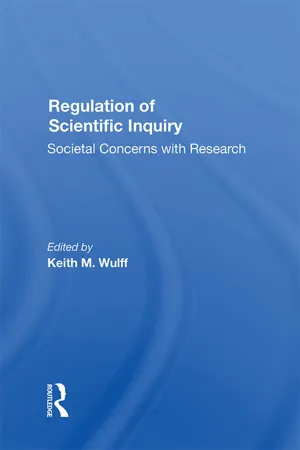
The increase in regulations affecting the conduct of scientific research, and the debate about their appropriateness and effectiveness, reflect societal concerns with fundamental questions raised by certain types of scientific inquiry. This book addresses issues of ethics, accountability, and conflict as they relate to the rights of inquiry, the rights of citizens, and the role of government in a research-oriented society.
Information
Part I
Regulation of Scientific Inquiry
1
The Ethical Dilemmas of Medical Research
Andre E. Hellegers
From the program of this meeting it is clear to me that I should not restrict my comments today to dilemmas in medical research alone, for this program is about scientific research in a much broader context than medicine alone. As a consequence I propose simply to use medical research as a paradigm in a much broader setting. What I perceive this program to be about is the subject of freedom of scientific inquiry in general and I see myself as charged to approach the broader subject from the narrower perspective.
It seems to me to be odd that we should hear mumbles, if not cries, of anguish from some quarters in science, as if freedom of inquiry is in peril in these United States. To me that is an absurd posture. Never in the history of mankind has any research endeavor been as royally funded as has the endeavor of scientific inquiry in the U.S. If we take only the funds available for scientific inquiry through the medical establishment, the physical sciences establishment and the military establishment, the generation of scientists preceeding us would find them mind boggling.
It is of course a fact that research and development money is no longer subject to those automatic increases of 15 years ago and it may be true that it may only barely be keeping pace with the inflation rate, but what endeavors do better? It is surely unseemly that we should expect to be supported at a constantly increasing rate, sight unseen, when all other aspects of public expenditures are under increasing scrutiny, to the point of insisting on zero based budgeting. I sometimes think we are assuming the posture of the medieval clergy, who would insist that they should not be scrutinized because their product was eternal life and truth (albeit in the hereafter). Similarly, some insist that we are the custodians of eternal life and verities (in the here and now), so that we should also be immune to inquiry, while we insist on our own freedom of inquiry.
I draw this parallel between religion formerly and science today, because I was struck by a recent comment made by Gerard Piel, publisher of the Scientific American. In a comment on an article by Hans Jonas on freedom of scientific inquiry and the public interest, in the Hastings Center Report of August, 1976, Mr. Piel asserted that the peer review system is a mechanism to ensure a democratic process in science. He holds that this system makes it possible for the enormous financial power of the federal government and all the other kinds of authority attached to it, to be decoupled from the support of science. He states that "the peer review group removes an authority external to science from the decisions that are made about its ongoing work." He calls this peer review system a "new invention in self government." It is not clear to me how Mr. Piel defines the term "peer review." Does he mean only fellow scientists or does he mean all citizens? I read him to mean the former, while I hold government still to be the most representative body of the citizenry in a democracy.
If I read him aright I am struck by the parallels with religious notions of the past. I am reminded of the days when the clergy could only be judged by clerical courts and not by civil ones. This notion that only the clergy can judge clergy, only the military the military and only scientists the scientists, strikes me as a notion which can only harm these enterprises. About a decade ago, the then Senator, now Vice President, Mondale suggested the establishment of a commission to study the impact of medical science on people. He was strongly supported by witnesses, mainly lawyers, who believed such a study commission necessary to protect patients. He was opposed by other witnesses, mainly medical scientists, who asserted that medicine could do the job of assessment on its own. I was asked to testify at that hearing and favored the establishment of the study group, not because I thought that patients urgently needed protection but because I thought that medicine, as a profession, did. I suggested that only if we allowed ourselves to be exposed to public scrutiny could we expect to receive that level of public support which our enterprise, in my opinion, deserves.
In brief: I think it is a fatal strategy and tactic to assume that the public will support science, sight unseen, just because we think we are "the good guys," as indeed we are. When the cost of maintaining freedom is a question asked of the military and when the cost of proclaiming the word of God is asked from the clergy, we would be utterly naive to believe that the public will assent to our being the only arbiters of what should happen in science and medicine regardless of cost. When the American public increasingly calls the Pentagon to account and the Catholic public increasingly calls the Papacy to account, the time will surely come when science shall be asked to account for itself too. To suggest, as Mr. Piel seems to do, that this can be done through the peer review process is like suggesting that the public will be satisfied by having the Joint Chiefs of Staff be the accounting body for Pentagon activities or the College of Cardinals for Papal activities. Those days are gone and we would be fools to plead for analogous privileges already denied those who claim the fiefdoms of patriotism, freedom and eternal life in the hereafter.
How do these brief remarks, relate, concretely, to the subject matter of this symposium? Let me attempt to construct a framework for our thoughts. No one questions the right of individuals to contruct a theology or a philosophy of life. No one questions the right of individuals, to construct a definition of freedom or patriotism. No one questions the right of individuals to construct a definition of God. No one questions the right of individuals to assert what they perceive to be facts or scientific truths.
The only issues in science, increasingly under public scrutiny, are twofold:
- Given finite resources, how much should the public invest in an enterprise such as science?
- In how far (if at all) should any enterprises, in the name of freedom of inquiry, be allowed to infringe on the freedom of others?
To ask the first question, that of investments, is simply to say that while there surely is a freedom to inquire there is nothing which says that it must be paid for by others than the inquirer. That becomes an issue of priorities in achieving the common good. In such a decision the scientists can surely plead his cause as being the common cause, but, like the military, a slice of the pie will be assigned which shall be determined by total needs of the country and those needs are rightly determined at the level of the public rather than by interest groups.
The second question is a question about the means by which science is done. Obviously no one will hold that one may investigate how far the average 20 year-old can throw the javelin, by doing the experiment on a crowded beach. That seems like a simple conclusion. Not so simple is the answer to the question as to precisely what may be inquired into that may affect others than the inquirers. That brings us to such questions as the doing of research on those who can not give consent, such as the mentally retarded. In general it is held that subjects of inquiry must give consent if they are to be inquired into and, if they cannot, then proxy consent must be given by someone who has the wellbeing of the research subject as much at heart as the subject would have himself or herself. It is here that most of the public debate arises. Should not the scientist, given the importance of the enterprise, be allowed to invade a subject's privacy without consent? It is the old question of means and ends. I know scientists who, on the grounds of the common good, would plead that some experiments should be done even without consent because of the importance to all of the information to be gained. Some of these same scientists would violently object if the F.B.I, or C.I.A., claiming the same common good, would plead the same privilege.
Hans Jonas has argued that the notion of freedom of inquiry has come to us from pre-modern times and therefore dates from times when inquiry involved only the inquirer. Astronomy is given as the perfect example of doing science which affects none other than the inquirer—although one might still argue whether a telescope must be funded by the public. I think there can be no doubt, however, that where, in the doing of the scientific inquiry, the good (including the privacy) of others may be affected, those others are entitled to a say in whether the inquiry shall be done. It simply will not do to make that determination by a so-called peer group, as Piel suggests, for just as there may be a peer group of the inquirers, so there can be peer groups of those on whom inquiry is done.
It is sometimes said that science is now so complex that only scientists can understand it and hence the value of doing experiments to foster it. I would reject such a notion with the simple comment that, if you cannot communicate to others what it is that you are doing, you probably do not know what you are doing yourself. I think it is this inability (or unwillingness) to communicate what we are doing and why we are doing it which contributes to an increasing questioning of our enterprise.
In brief then, there is no warranty for the misuse of money or of people in scientific inquiry and the public, rather than the scientific community, should be the judge of that.
One final matter must be discussed. Are there some areas of knowledge which should not be inquired into, because of the danger of knowledge itself? Robert Sinsheimer seems to think so. He asks the question: what would be the effect of finding extraterrestrial forms of life to which we are as chimpanzees are to man? Those who believe in a God and even in angels have surely lived with that burden, if burden it be, for centuries, and I cannot see that it has done them irrevocable harm. While I can agree with Sinsheimer that there can be knowledge which it is dangerous to have (Shakespeare allowed as much) I must confess that any knowledge can be dangerous. It is however the human condition to know and I cannot see the prohibiting of inquiry on the grounds of knowing being dangerous.
More cogent I find Hans Jonas' concern when he claims that the doing of science and the doing of technology are now so inseparably intertwined that it is not possible to separate them. There is then no such thing as pure knowledge which will be unused. I agree with his position but I do not know what to conclude from it. It does not to me constitute a warranty for prohibiting the acquisition of the knowledge. It merely tells me that to such inquiry as does not, in the inquiry, harm nature, but which may be dangerous in its consequence, I would assign a very low priority. I am therefore quite in favor of those who ask that science as an enterprise provide possible impact statements for its work. That inquiry which may have adverse impacts need not be supported.
What is at bottom at stake is not the freedom to inquire but the right to be supported in all inquiry. Let me then summarize my own position: I think there should be an absolute freedom to inquire if, in the process of the inquiry, the freedom of others is not infringed upon. As to there being a right to inquiry which others are obligated to support, I think there is none such. It is at that point that science must make a case for its activities and it is that which we seem increasingly to be done badly. It is very unhelpful, in that process of communicating with the wider public on whose support we depend, to assert that a right of inquiry is the same as its entitlement. Relating what I have said to medical research I shall only add that where the subject of inquiry is the human rather than inanimate objects it is to be expected that all scientific inquiry will be scrutinized even more closely. I hold however that the principles I have outlined govern all scientific inquiry.
2
Value Conflicts in Restricting Scientific Inquiry
Barry M. Casper
I'll begin by identifying two good reasons why our society and its institutions might wish to limit scientific inquiry:
(A) anticipated deleterious consequences of the inquiry itself; and (B) anticipated deleterious consequences of applications of knowledge obtained by the inquiry. Examples of the first include possible release of toxic substances to the biosphere as in the case of certain kinds of recombinant DNA research or chemical and biological weapons development or nuclear weapons testing or possible adverse psychological effects as in the case of certain kinds of experiments on human subjects. Examples of the second include possible misuse of tools that grow out of research as in the case of genetic engineering resulting from recombinant DNA research or proliferation of nuclear weapons resulting from a technique I'll discuss that would use lasers to separate the isotopes of uranium.
Value judgments are obviously crucial in the decisions that are made as to whether to proceed with such inquiries or to limit them. Each such inquiry has many potential consequences, some desirable, some undesirable, and at the time decisions have to be made about proceeding to invest large sums of money in a project, there is usually significant uncertainty about what its consequences will be. Weighing potential risks and benefits is like weighing apples and oranges--they are incommensurable. How they are to be weighted is a value judgment. Similarly, the policy implications of uncertainty--should one, for example, assume the worst case or some more probable outcome--involve value judgments.
What weight is applied to the apples and what to the oranges and what stance is taken on the implications of uncertainty is resolved in practice by who makes the decisions and what their values are. And what often counts is not individuals and personal values, but rather institutions and institutional values. What's good for General Motors or Exxon or the Department of Energy or the House Science and Technology Committee may not be good for Nader's Raiders or the Sierra Club or the Arms Control and Disarmament Agency or the Senate Foreign Relations Committee.
Few would disagree, in principle at least, with the need to limit scientific inquiry when the inquiry itself has potentially serious adverse consequences. Limitation of certain kinds of research to specialized facilities designed to prevent the release of toxic substances, restrictions on the storage and transfer of toxic or radioactive materials, and even outlawing certain kinds of research on human subjects are accepted practices in the U.S. today.
To be sure, there is plenty of controversy when one gets down to the specifics--when it comes to assessing risks and benefits and weighing them to establish policy. This is well illustrated in the current dispute over recombinant DNA research. With significant disagreement over the potential health and safety hazards, the key question has become who, that is what institutions, should decide what policies to adopt. There is clearly a tension between the community of scientists, which has evinced a strong desire to police itself, and other interests in our society--notably politicians. Each institution has its own policy biases. In the case of DNA research the molecular biologists, proclaiming the primary value of freedom of scientific inquiry, are inclined to continue research on a relatively unrestricted basis. The politicians, responsive to the health and safety concerns of their constituents, don't want to be held responsible if something crawls out of the lab before the next election. They are more inclined to limit research or, better yet, to pass the responsibility along to someone else.
Such limitations on research seem to follow a pattern. There first develops a widespread public perception of an immediate threat from the research. Frequently scientists themselves contribute to arousing the public. In this way an organized political constituency favoring limitations on the research develops. For example, in the controversy over nuclear weapons testing in the early 1960's, through the efforts of Linus Pauling and other scientists, mothers began to fear the effects of Sr90 in babies' milk. The value of free scientific inquiry (unrestricted testing) was seen to threaten other social values, such as personal health and safety, in the minds of a politically potent constituency; as a consequence, certain limitations on nuclear testsrestricting them to underground--were eventually invoked. Those institutions that favored unlimited testing--notably the Atomic Energy Commission, the Joint Committee on Atomic Energy, and the Joint Chiefs of Staff--were forced to modify their position.
This reason for limiting research--its direct consequences--raises many important and difficult issues' but not the ones I wish to focus on today. Instead, I shall concentrate on the possibility of limiting scientific inquiry because of anticipated applications of knowledge that might be obtained by the inquiry.
Here the threat is more distant and its dimensions less clear. As a consequence, there is less likelihood that political backing will develop in favor of limiting scientific inquiry on this account. Since the future has no constituency, the politics of such limitations must be quite different. If one is concerned with value conflicts in limiting scientific inquiry, then a central question has to be how intellectually astute and politically potent value can be attached to the interests of future generations when science and technology p...
Table of contents
- Cover
- Half Title
- Title
- Copyright
- About the Book
- About the Series
- Contents
- About the Editor and Authors
- Introduction
- PART I: REGULATION OF SCIENTIFIC INQUIRY
- PART II: REGULATION OF SCIENTIFIC INQUIRY IN THE CONTEXT OF RECOMBINANT DNA RESEARCH
- PART III: REGULATION OF SCIENTIFIC INQUIRY AND THE FIRST AMENDMENT
Trusted by 375,005 students
Access to over 1.5 million titles for a fair monthly price.
Study more efficiently using our study tools.
Frequently asked questions
Yes, you can cancel anytime from the Subscription tab in your account settings on the Perlego website. Your subscription will stay active until the end of your current billing period. Learn how to cancel your subscription
No, books cannot be downloaded as external files, such as PDFs, for use outside of Perlego. However, you can download books within the Perlego app for offline reading on mobile or tablet. Learn how to download books offline
Perlego offers two plans: Essential and Complete
- Essential is ideal for learners and professionals who enjoy exploring a wide range of subjects. Access the Essential Library with 800,000+ trusted titles and best-sellers across business, personal growth, and the humanities. Includes unlimited reading time and Standard Read Aloud voice.
- Complete: Perfect for advanced learners and researchers needing full, unrestricted access. Unlock 1.5M+ books across hundreds of subjects, including academic and specialized titles. The Complete Plan also includes advanced features like Premium Read Aloud and Research Assistant.
We are an online textbook subscription service, where you can get access to an entire online library for less than the price of a single book per month. With over 1.5 million books across 990+ topics, we’ve got you covered! Learn about our mission
Look out for the read-aloud symbol on your next book to see if you can listen to it. The read-aloud tool reads text aloud for you, highlighting the text as it is being read. You can pause it, speed it up and slow it down. Learn more about Read Aloud
Yes! You can use the Perlego app on both iOS and Android devices to read anytime, anywhere — even offline. Perfect for commutes or when you’re on the go.
Please note we cannot support devices running on iOS 13 and Android 7 or earlier. Learn more about using the app
Please note we cannot support devices running on iOS 13 and Android 7 or earlier. Learn more about using the app
Yes, you can access Regulation Of Scientific Inquiry by Keith Wulff in PDF and/or ePUB format, as well as other popular books in Social Sciences & Sociology. We have over 1.5 million books available in our catalogue for you to explore.