eBook - ePub
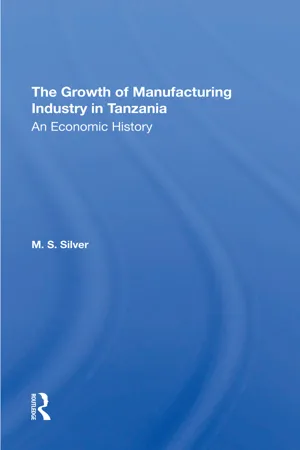
The Growth Of The Manufacturing Industry In Tanzania
An Economic History
- 323 pages
- English
- ePUB (mobile friendly)
- Available on iOS & Android
eBook - ePub
About this book
Tracing the evolution of the Tanzanian manufacturing industry since the beginning of colonial rule, this book focuses on the period since independence and especially on the effects of socialist policies resulting from the 1967 Arusha Declaration. Dr. Silver develops volume indices of production for Tanzanian industry as a whole and for individual sectors. He also examines in detail changes in labor productivity, earnings, unit labor costs, investments, and the prices of manufactured goods, paying special attention to the role of government-controlled parastatals, the regional distribution of manufacturing industries, and income inequality. The rapid growth in production and employment and the changing structure of the manufacturing industry, he concludes, is due to high rates of investment in a small number of relatively large establishments, primarily in the parastatal sector.
Information
1
The Development of the Economy in the Colonial Period: 1884 to 1961
German rule was established in Tanzania during the period 1884 to 1898 and lasted until 1918 when, at the end of the First World War under a Mandate agreed by the Allies, Britain (by then in de facto control of the territory) replaced Germany as the colonial power. British rule then lasted until December 1961 when Tanzania gained its Independence.
During the colonial period there was a considerable amount of economic development, albeit of a rather lopsided sort. The pre-colonial economy was largely one of subsistence agriculture based on bulrush millet (pennisetum typhoides) and sorghum (sorghum vulgare) grown in a system of shifting cultivation to maintain soil fertility. Plots were cultivated for two to three years and then left fallow for six to twelve years to recover. In the better watered areas, such as Kilimanjaro, Buhaya, and Usambara, farming relied on perennial banana crops or on livestock. [1]
Before the colonial period, changes in crops had taken place, especially with the introduction of maize in the early nineteenth century and its spreading through the agency of Nyamwezi traders. Rice had also been introduced by the 1860s and in 1893 exports of 878,000 lbs of maize, 2,400 lbs of unhusked rice and 5,074 lbs of husked rice were recorded. [2]
Thus there was something of an agricultural base at the start of the colonial period, and it is arguable that the agricultural economy might have been even stronger had it not been for the effects of the slave trade in the nineteenth century. Estimates of the number of slaves removed from Tanzania in the forty-three year period, 1830 to 1873, range from 6.5 million to 21 million; on average 151 thousand to 488 thousand a year. The point is that the slave trade was sufficiently large to have had a significant adverse effect on the traditional economy. [3] However, the slave trade was gradually to be abolished by the German colonisation, although that brought further, changes into the lives of the ordinary Tanzanians.
In 1884, Dr Carl Peters founded the Society for German Colonisation, the aim of the Society being to acquire land to sell to colonists. In November of that year he embarked on a four-month expedition during which he signed six Treaties giving the Society nominal "control" of more than 60,000 square miles of Tanzania. [4] There is some doubt as to whether the tribal chiefs fully understood the contents of the Treaties, or had the power to grant them, or even whether they thought Peters could e...
Table of contents
- Cover
- Half Title
- Title
- Copyright
- Dedication
- Contents
- Acknowledgments
- Introduction
- Author's Note
- 1. THE DEVELOPMENT OF THE ECONOMY IN THE COLONIAL PERIOD: 1884 to 1961
- 2. INDUSTRY IN TANGANYIKA ON THE EVE OF INDEPENDENCE
- 3. THE GROWTH IN PRODUCTION OF MANUFACTURING INDUSTRY AFTER INDEPENDENCE
- 4. THE GROWTH IN EMPLOYMENT AND LABOUR PRODUCTIVITY AFTER INDEPENDENCE
- 5. WAGES AND EARNINGS IN TANZANIAN MANUFACTURING INDUSTRY AFTER INDEPENDENCE AND THE RELATIONSHIP BETWEEN MANUFACTURING EMPLOYEES' INCOME AND OUTPUT
- 6. CAPITAL FORMATION IN TANZANIA'S MANUFACTURING INDUSTRY
- 7. THE OWNERSHIP OF MANUFACTURING PRODUCTION
- 8. THE REGIONAL DISTRIBUTION OF MANUFACTURING INDUSTRY
- 9. CONCLUSION
- Index
Trusted by 375,005 students
Access to over 1.5 million titles for a fair monthly price.
Study more efficiently using our study tools.
Frequently asked questions
Yes, you can cancel anytime from the Subscription tab in your account settings on the Perlego website. Your subscription will stay active until the end of your current billing period. Learn how to cancel your subscription
No, books cannot be downloaded as external files, such as PDFs, for use outside of Perlego. However, you can download books within the Perlego app for offline reading on mobile or tablet. Learn how to download books offline
Perlego offers two plans: Essential and Complete
- Essential is ideal for learners and professionals who enjoy exploring a wide range of subjects. Access the Essential Library with 800,000+ trusted titles and best-sellers across business, personal growth, and the humanities. Includes unlimited reading time and Standard Read Aloud voice.
- Complete: Perfect for advanced learners and researchers needing full, unrestricted access. Unlock 1.5M+ books across hundreds of subjects, including academic and specialized titles. The Complete Plan also includes advanced features like Premium Read Aloud and Research Assistant.
We are an online textbook subscription service, where you can get access to an entire online library for less than the price of a single book per month. With over 1.5 million books across 990+ topics, we’ve got you covered! Learn about our mission
Look out for the read-aloud symbol on your next book to see if you can listen to it. The read-aloud tool reads text aloud for you, highlighting the text as it is being read. You can pause it, speed it up and slow it down. Learn more about Read Aloud
Yes! You can use the Perlego app on both iOS and Android devices to read anytime, anywhere — even offline. Perfect for commutes or when you’re on the go.
Please note we cannot support devices running on iOS 13 and Android 7 or earlier. Learn more about using the app
Please note we cannot support devices running on iOS 13 and Android 7 or earlier. Learn more about using the app
Yes, you can access The Growth Of The Manufacturing Industry In Tanzania by M. S. Silver,M S Silver in PDF and/or ePUB format, as well as other popular books in Social Sciences & Sociology. We have over 1.5 million books available in our catalogue for you to explore.