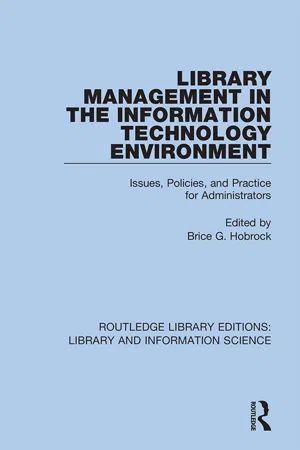
This book, first published in 1992, equips library managers in all types of libraries to make the administrative changes necessary to deal with new information technologies. Despite financial difficulties due to inflation and declining budgets, electronic/optical information formats and the hardware and software to support them are a reality for many libraries. Libraries are designing and implementing prototypes of the 'electronic library' and are introducing new technologies as a growing adjunct to traditional text formats and services. It analyses administrative adjustments to the new technological information culture. Chapters in this resource that deal with issues not easily grasped by non-computing specialists are distilled to basic components, making them easy for busy managers to comprehend and immediately useful to library administrators.
eBook - ePub
Library Management in the Information Technology Environment
Issues, Policies, and Practice for Administrators
- 162 pages
- English
- ePUB (mobile friendly)
- Available on iOS & Android
eBook - ePub
Library Management in the Information Technology Environment
Issues, Policies, and Practice for Administrators
About this book
Information
Developing a Library Microcomputing Profile: 101 Spectra to Be Used in Analysis by Microcomputer Managers
Charlene Grass
INTRODUCTION
E. B. White wrote, “There’s no limit to how complicated things can get, on account of one thing always leading to another,” Certainly, when a manager reflects on administrative issues relating to library microcomputer operations, “one thing” always seems to lead to several “things” in a complex sea of interconnected relationships. This paper provides a framework for analyzing the many factors relevant to library microcomputer management. Each relevant factor is identified and analyzed in terms of a scale or spectrum between a pair of extremes. These extremes may represent limits for variation in competencies, experience, or environmental elements. For example, there is a spectrum between extremes for the factor: funding available to send staff to microcomputing workshops outside the library. At one extreme, there may be no money available; at the other end of the scale there may be funding sufficient to fill all requests for extramural microcomputer training. In general, spectra are presented going from less complexity toward more complexity, from less competency toward more competency. We herein discuss the various spectra in groups which will profile large segments of the microcomputing environment.
After a particular library’s position on each of the spectra is assessed, a composite profile of the library’s microcomputing situation can be developed. Successful microcomputer management decisions can be based on a holistic consideration of the library’s composite profile. Toward the end of the paper an example of decision-making is discussed based on a hypothetical institution’s profile. Spectra 1–101 will be numbered consecutively from profile to profile.
Charlene Grass is Associate Dean of Libraries, Collections and Technical Services, Kansas State University, Manhattan, KS.
The Institutional Profile
Few libraries are “stand-alone” institutions. As a starting point, the library microcomputer manager should look at the profile of the library’s parent organization. The city government, the university, the corporation, school system, or other parent body will probably have a complex of attitudes, history, and experience related to automation in general and to microcomputing in particular. Spectra follow:
- The parent organization has no automation experience and expertise – it has extensive experience.
- The parent organization’s automation experiences have been harrowing – experiences have been very positive.
- The parent organization has no computing department – it has a strong computing department with a good service concept and staff to back it up.
- There is no networking in the parent organization – the parent organization is fully networked.
- The parent organization’s image seems to be anti-technology – the image projects leadership in technology.
- The parent organization’s mission is not evident – the organization has a clear and accepted mission statement.
If the parent organization has an automation history, there will probably be experienced staff to which the library microcomputer manager can turn for practical assistance. If the parent organization has had problems automating, the library may face an organizational obstacle to library automation plans. Conversely, if organizational automation experiences were positive, the library may find strong support at this level. However, positive automation experience in the larger organization could also have unwelcome consequences for the library. Suggestions that the library use the same software, the same hardware, or share systems with the parent body may surface. Such “imposed solutions” can pose a real challenge for the library microcomputer manager who may be seeking technology to fit unique needs in the library. The library micro manager will have to decide which is the most practical stance – resistance or acceptance – and work from there. Shared expertise may be an advantage of shared solutions. Otherwise, the library may want to look to sister libraries to find different software/hardware better suited to library needs.
If the parent organization is networked, the library microcomputer manager may be impelled to network the library. Remote access of library information systems – for example, wide area network access to CD ROMs – may become an issue. Networked users may expect services from the library such as reference or interli-brary loan via electronic mail. On the other hand, the library may find itself with systems which could easily be broadly distributed via a network, but with no net in place. The lack of a network may even weaken the library’s argument for installing new information systems. The library may find itself pioneering the use of new telecommunications technology in the organization.
When an image of leadership in technology is a broad organizational goal, the library may be thrust toward new systems more quickly than desired. For example, putting a public microcomputer laboratory in the library may be an organizational commitment which is not in line with library space utilization priorities. The library administration and the microcomputer manager will have to adopt a response to such external pressures. In organizations at the other end of the spectrum, the library may find itself facing actual fear and loathing in suggesting that public access tools be automated. Plans to implement, for example, a CD ROM library catalog or CD-based periodical indexes may require justification. In such a context, the technologically knowledgeable library staff will have to demonstrate concretely the benefits of automated library systems. Staff will have to plan on a heavy time investment to interpret public access systems for end-users.
The presence or absence of an acceptable organizational mission, as well as a close or distant relationship to library activities, may well effect the library microcomputer manager’s ability to procure funds and positions to support library microcomputing. In an organization with no clear overall mission, deciding on priorities among microcomputer projects within the library will be difficult.
The Library Profile
7. The library is tiny-it is large.
8. The library’s organizational structure is rigid – it is flexible and responsive.
9. The library’s organization is managed from the top down – it is managed by committee and consensus.
10. The library is very conservative about committing resources to new undertakings – it supports experimentation.
11. The library is very much a stand-alone operation vis-a-vis other libraries – it is committed to many cooperative ventures.
12. The library has a poor physical plant and a severe lack of space – it has excellent physical environment with lots of space.
13. The library has many security problems and concerns – there are few security problems or concerns.
14. The library’s image seems to be anti-technology – the image projects leadership in technology.
15. The library organization has no clear vision and no well enunciated mission – both are apparent.
The very basic element of size will drastically effect the course which the library microcomputer manager charts. Even the one-person library can benefit from good management in procuring and using just the right microcomputer technology. However, a larger library usually means larger headaches for microcomputer management, but it also provides a relative richness of expertise and a variety of resources to draw on for support.
The microcomputer manager is often in the position of introducing new problems and issues, and may cross established boundaries within the library organization. Within a flexible library organization, micro management can move ahead more quickly, not having to worry about territoriality and undue bureaucratic hassles. For example, the staff member who knows the most about PC’s in a particular library department would be the logical choice to be designated “microcomputer contact person,” working with a central microcomputer support unit and acting as the department’s microcomputer coordinator. This person might not be the department head. A rigid organization may not be able to cope with such a situation. Even solving the most minor issues may require a disproportionate effort in a rigid organization. For example, procuring copies of user-friendly third-party software manuals (as opposed to the manuals supplied with the software) can be difficult in a rigidly-organized library where books can only be purchased in a standard collection development/acquisitions process. Of course, a structured organization may have its benefits – it may cut down on the kind of independent experimentation by users which can give a library microcomputer manager migraines.
If library management decisions are made mostly from on high, micro management must educate the administration as a prelude to getting budget and staffing support. Once they are convinced, the microcomputer manager may be able to procure and implement micros according to a definite plan. Selling the staff, however, may be more difficult, with microcomputing perceived as imposed from above. In an organization where decision-making is widely shared, the microcomputer manager would have to address the most influential groups within the library, working to achieve attention to and consensus about microcomputing issues. Staff support in such an organization would be expected to arise from staff consensus with administrative support following.
In a conservative library, the micro manager may have to concentrate on proven microcomputing applications, working slowly to fully integrate these into library operations. If risk-taking is not encouraged, the library microcomputer manager will have to go slowly, devoting time to software evaluation, carefully examining equipment before recommending purchase, and calculating optimal purchase time to coincide with stable product availability. In a situation where risk-taking is encouraged, the manager might be able to implement the latest devices and software, fully aware that next year something better might be on the market. Of course, attitudes about experimentation are probably related to the availability of funds in the library as well as to the organizational style.
If the library is committed to cooperative ventures, especially with other institutions which are technologically progressive, the manager may find many decisions already made. Which software and hardware is to be supported, which library units must receive upgraded software, and who among the staff needs training first may already be decided by commitment to joint projects. As in other things, the go-it-alone library will have more control of its microcomputing. Then again, cooperative projects can be the impetus propelling a lethargic library to new adventures in microcomputing.
A spacious and high quality physical environment (along with some good planning and considerable financial support for furniture and accessories) will allow the library to set up efficient and aesthetically pleasing microcomputer work areas. A different kind of planning is needed in a library where microcomputer equipment is perceived as encroaching on already short space. Considerations regarding equipment maintenance are also different at the extremes of the spectrum. For example, seemingly minor items like cleaning screens or vacuuming keyboards may be more significant in a dusty environment. Poor physical environment thus affects microcomputer hardware choices and decisions to subscribe to maintenance agreements.
If one can predict that micro equipment will be stolen unless it is bolted down, security will be an important issue for planners. Plans for secure rooms or special locking workstations may be necessary. For patrons with engineering inclinations, measures that preclude tampering with the library’s machines may have to be taken. Some organizations may be particularly concerned that software not be copied and taken home by employees or, conversely, that potentially infected software not be introduced into systems by users. The reality of security problems may also differ from the level of security concerns – the library microcomputer manager will have to deal with both reality and perception.
As with the parent organization, the image of the library in relation to technology may facilitate or impede the library’s microcomputing implementation. For example, if the introduction or expansion of information systems is perceived as counter to the “high touch” personal character on which the library prides itself, introduction of such systems may be slower and require considerable discussion and attitude adjustment. Such conflicts are more visible in situations of elevated competition for scarce resources where the choice may be betwee...
Table of contents
- Cover
- Half Title
- Title Page
- Copyright Page
- Original Title Page
- Original Copyright Page
- Contents
- Acknowledgement
- Introduction
- A Vision of the Library of the 21st Century
- Internetworking Services and the Electronic Library
- Collection Development in the Cooperative Environment
- Access and Performance Measures in Research Libraries in the 1990’s
- How Will Libraries Pay for Electronic Information?
- Tailoring a Journal Article Database to Local Needs: Planning and Management Issues
- Item Level Access to Special Collections: A Prototype for an Integrated Automated Index
- Developing a Library Microcomputing Profile: 101 Spectra to Be Used in Analysis by Microcomputer Managers
Trusted by 375,005 students
Access to over 1.5 million titles for a fair monthly price.
Study more efficiently using our study tools.
Frequently asked questions
Yes, you can cancel anytime from the Subscription tab in your account settings on the Perlego website. Your subscription will stay active until the end of your current billing period. Learn how to cancel your subscription
No, books cannot be downloaded as external files, such as PDFs, for use outside of Perlego. However, you can download books within the Perlego app for offline reading on mobile or tablet. Learn how to download books offline
Perlego offers two plans: Essential and Complete
- Essential is ideal for learners and professionals who enjoy exploring a wide range of subjects. Access the Essential Library with 800,000+ trusted titles and best-sellers across business, personal growth, and the humanities. Includes unlimited reading time and Standard Read Aloud voice.
- Complete: Perfect for advanced learners and researchers needing full, unrestricted access. Unlock 1.5M+ books across hundreds of subjects, including academic and specialized titles. The Complete Plan also includes advanced features like Premium Read Aloud and Research Assistant.
We are an online textbook subscription service, where you can get access to an entire online library for less than the price of a single book per month. With over 1.5 million books across 990+ topics, we’ve got you covered! Learn about our mission
Look out for the read-aloud symbol on your next book to see if you can listen to it. The read-aloud tool reads text aloud for you, highlighting the text as it is being read. You can pause it, speed it up and slow it down. Learn more about Read Aloud
Yes! You can use the Perlego app on both iOS and Android devices to read anytime, anywhere — even offline. Perfect for commutes or when you’re on the go.
Please note we cannot support devices running on iOS 13 and Android 7 or earlier. Learn more about using the app
Please note we cannot support devices running on iOS 13 and Android 7 or earlier. Learn more about using the app
Yes, you can access Library Management in the Information Technology Environment by Brice G. Hobrock in PDF and/or ePUB format, as well as other popular books in Languages & Linguistics & Library & Information Science. We have over 1.5 million books available in our catalogue for you to explore.