First published in 1998, this timely volume features 30 specialists in civil engineering, economics, computer science, architecture, technology and infrastructure and revisits – theoretically, methodologically and empirically – the conventional concepts and measures of accessibility, and connectivity / functioning of the networks, accessibility and dynamic location effects.

- 373 pages
- English
- ePUB (mobile friendly)
- Available on iOS & Android
eBook - ePub
Accessibility, Trade and Locational Behaviour
About this book
Trusted by 375,005 students
Access to over 1.5 million titles for a fair monthly price.
Study more efficiently using our study tools.
Information
Topic
Negocios y empresaSubtopic
Negocios en general1 Accessibility, Trade and Locational Behaviour: An Introduction
1.1 The Accessibility Concept: A Brief Review
‘Accessibility’ is a well-known term used by scientists, experts and laymen, particularly in the literature of regional and transport research where the concept of accessibility has played a major role for several decades.
This concept came to the fore in the 1950s after the rigorous legitimation of gravity theory by Isard at the First Regional Science Meeting in 1954 (for an historical review of gravity theory/spatial interaction models, see Nijkamp and Reggiani 1992). One of the first foundation stones for the use of accessibility ‘theory’ can be found in Hansen (1959), who defined accessibility as the potential of opportunities for interaction (p. 73). The quantification as well as the formulation of a theoretical structure for this concept has assumed various forms in the course of its history (Martellato et al. 1998).
Table 1.1 shows the various formal definitions of accessibility – mainly used in the regional science literature – and implicitly underlines how accessibility has been related in the past to the concepts of nearness, proximity, ease of spatial interaction, potential of opportunities for interaction, or potentiality of contacts with activities or supplies (Weibull 1980, p. 54). In other words, accessibility was considered a property of configurations of opportunities for spatial interaction (Weibull 1980, p. 53).
In this context, it is evident that, despite the various theoretical formulations displayed in Table 1.1, accessibility always emerges – in its analytical form – as the potential of opportunities:
where Accj defines the accessibility of some reference point (origin i), Dj is a measure (or weight) of opportunities/activities in j, and f(cij) is the impedance function from i to j. Consequently this interpretation of accessibility has always governed the scientific literature.
Table 1.1 Conventional measures and formulations of accessibility: a concise review
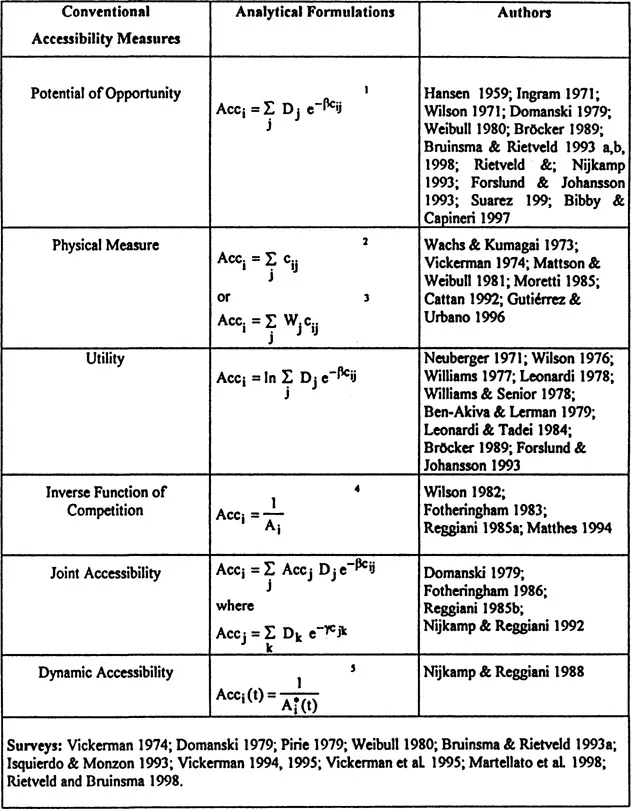
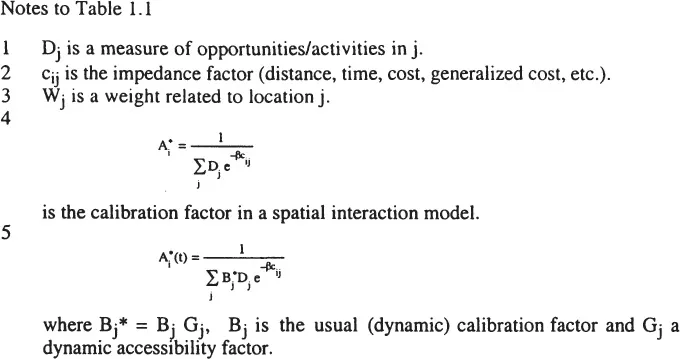
In 1979, Domanski (p. 1190) stated: ‘By accessibility I mean the possibilities of using the opportunities that the economic, social, cultural and political facilities and institutions provide.’ These opportunities may concern employment places, medical care centres, production places, shops, parks, etc., each particular type of opportunity having relevant attributes such as distance, mode of transport, travel time/cost, supply capacity, price, quality, congestion, queuing time, etc. According to model (1.1) the concept of ‘potential of opportunities’ includes a certain measurement of the opportunities at destination j, discounted (in relative or absolute value) by the spatial distance (travel/time/cost) of j from some reference point (origin) i (see again Martellato et al. 1998).
However, a closer examination of this conventional concept of accessibility shows how the concept of potential of opportunities could be better interpreted in the framework of the utility concept (the potential/expected utility of reaching (accessing) a certain place or a fixed amount of resources, or making a choice) on the basis of the fundamental works by Ben-Akiva and Lerman (1979), Domencich and McFadden (1975), and Leonardi (1978,1985) (see again Table 1.1 and Table 1.2).
It should be noted that Neuberger (1971), Williams and Senior (1978) and Wilson (1976) had already interpreted the inverse balancing factor of a spatial interaction model as an indicator of the economic benefit of facility size:
where
represents the net gain/benefit consisting of a component Vij (referring to the value of accessing i) minus communication costs cij (including also congestion/saturation costs), while β is a cost-sensitivity parameter.
In this framework the substitution of the words ‘potential utility’ for the word ‘possibilities’ in Domanski’s definition above could be the first relevant step towards bringing new perspectives to the accessibility concepts/theories/methodologies developed so far.
1.2 Accessibility and the New Space Economy
1.2.1 Introduction
In this era of globalization leading to important socio-economic and (geo)-political changes, the new position of transport/communication provokes many intriguing policy and research questions, which can roughly be interpreted under the broad umbrella of ‘transport sustainability’ (Nijkamp and Van Geenhuizen 1997; Reggiani 1997).
In this context, the new (physical and non-physical) accessibility flows and forms are coming to the fore as driving forces/trends behind globalization and the new spatial/environmental developments ranging from local to transnational scales (Van Veen-Groot et al. 1998).
It is well known that a strategic choice for reducing the economic/social/environmental/energy cost of the currently increasing mobility concerns the issue of intermodality (in both the passenger and freight transport sectors) at all levels of the transport/information organization. Intermodality – with a view to its related interoperability and interconnectivity factors – leads to what is known as the ‘Inter-transport Matrix’1, which also raises interesting research questions regarding new concepts and approaches in transport systems analysis and modelling efforts that are able to cope with future transport/economic/spatial problems (from both the demand and supply side) (see again Reggiani 1997).
1.2.2 New Concepts in the Space Economy
One of these new approaches is the network concept, embedding not only the physical morphological structure, but also the functioning of the network itself, connecting modal points in the underlying structure with a view to efficient operations via organized linkage patterns (see Dupuy 1993).
A related question is then whether – methodologically – the network dimension is ‘captured’ by the conventional accessibility concept displayed in formulation (1.1), or alternatively, how much the functioning of the network is influenced by the new forms of accessibility (e.g. the Internet, fast modes, etc.).
Another relevant concept which has recently attracted a great deal of attention is the dynamic complexity concept and hence the related ‘complex network’ concept.
Nijkamp and Reggiani (1998) show the potential/limitations of this approach, with reference to the methodologies and empirical applications actually available in the space-economy, where the evolutionary complex forms of networks need to be predicted and evaluated. In this context, accessibility certainly plays a crucial role in both slow dynamics, characteristic of the supply side (e.g. infrastructure, facilities/locational developments), and fast dynamics, typical of the user side (e.g. demand mobility/communication patterns).
It is then clear that the conventional approach of static accessibility used so far (see Section 1.1) is a sort of ‘operational’ instrument able to ‘decodify’ the dynamic development of accessibility in the spatial complex networks.
The emerging question is whether new measures of accessibility could be able to adjust or incorporate this ‘discrepancy’ between slow and fast network dynamics (i.e. supply/demand), as well as between slow and fast spatial economic networks (e.g. different market structures in the core/periphery), for the better functioning of these interdependent networks.
Starting from the above considerations, the present volume aims to present new ‘thoughts’ and ‘reflections’ in this field, from three main perspectives: theoretical, methodological, and empirical. The next section contains an overview of the book with reference to the general theoretical background already provided in Sections 1.1 and 1.2.
1.3 New Accessibility Measures and Aspects: Theories, Methodologies and Empirical Analyses
1.3.1 Introduction
Regional Science has always been marked by a strong quantitative and model orientation. In particular, ‘Location theory makes up the heart of regional science. Both theoretically and empirically, numerous contributions have been made in this framework in order to study the “where” and the “why there” of human activities, in regard to both firms and households. Theoretically, traditional location theory a la Weber and Losch has been developed much further, by investigating spatial synergies (e.g. industrial complexes), spatial dynamics (e.g. innovation behaviour of firms, mig...
Table of contents
- Cover
- Half Title
- Dedication
- Title Page
- Copyright Page
- Table of Contents
- Figures, maps and tables
- Contributors
- Preface
- 1 Accessibility, Trade and Locational Behaviour: An Introduction
- Part A Theoretical Frameworks: Measurements of Accessibility
- Part B Methodological Frameworks: Locational Behaviour and Trade
- Part C Empirical Frameworks: European Freight Transport Networks
Frequently asked questions
Yes, you can cancel anytime from the Subscription tab in your account settings on the Perlego website. Your subscription will stay active until the end of your current billing period. Learn how to cancel your subscription
No, books cannot be downloaded as external files, such as PDFs, for use outside of Perlego. However, you can download books within the Perlego app for offline reading on mobile or tablet. Learn how to download books offline
Perlego offers two plans: Essential and Complete
- Essential is ideal for learners and professionals who enjoy exploring a wide range of subjects. Access the Essential Library with 800,000+ trusted titles and best-sellers across business, personal growth, and the humanities. Includes unlimited reading time and Standard Read Aloud voice.
- Complete: Perfect for advanced learners and researchers needing full, unrestricted access. Unlock 1.5M+ books across hundreds of subjects, including academic and specialized titles. The Complete Plan also includes advanced features like Premium Read Aloud and Research Assistant.
We are an online textbook subscription service, where you can get access to an entire online library for less than the price of a single book per month. With over 1.5 million books across 990+ topics, we’ve got you covered! Learn about our mission
Look out for the read-aloud symbol on your next book to see if you can listen to it. The read-aloud tool reads text aloud for you, highlighting the text as it is being read. You can pause it, speed it up and slow it down. Learn more about Read Aloud
Yes! You can use the Perlego app on both iOS and Android devices to read anytime, anywhere — even offline. Perfect for commutes or when you’re on the go.
Please note we cannot support devices running on iOS 13 and Android 7 or earlier. Learn more about using the app
Please note we cannot support devices running on iOS 13 and Android 7 or earlier. Learn more about using the app
Yes, you can access Accessibility, Trade and Locational Behaviour by Aura Reggiani in PDF and/or ePUB format, as well as other popular books in Negocios y empresa & Negocios en general. We have over 1.5 million books available in our catalogue for you to explore.