With a focus on seven Jesuit university leaders emeriti and the late University of Notre Dame President Father Theodore Hesburgh, this book offers a critical analysis of the common values, philosophies, and leadership practices of Jesuit-Catholic university presidents within the broader higher education context. Looking at the impact of these leaders' spirituality on their leadership styles, The Hermeneutics of Jesuit Leadership illuminates the influence of their common perspectives and leadership styles on university policy and culture. Offering a clear framework for Jesuit-Catholic organizational culture in higher education, the author explores the key lessons and practices that can be derived from the presidents' similar leadership ideals and qualities.
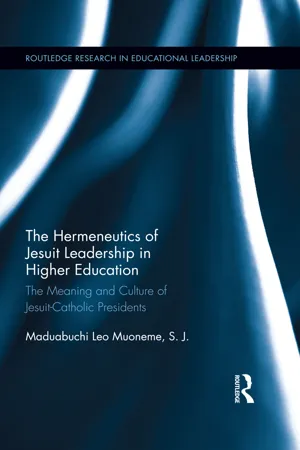
eBook - ePub
The Hermeneutics of Jesuit Leadership in Higher Education
The Meaning and Culture of Catholic-Jesuit Presidents
- 240 pages
- English
- ePUB (mobile friendly)
- Available on iOS & Android
eBook - ePub
The Hermeneutics of Jesuit Leadership in Higher Education
The Meaning and Culture of Catholic-Jesuit Presidents
About this book
Information
1
Introduction
The Idea of a Jesuit-Catholic University
The university organization has contributed immensely to the quality of life in the United States, including the technological, medical, agricultural, and social realms (Bringle, Games, & Malloy, 1999). Schools are major centers of influence and leadership, and the Jesuits have shaped a substantial section of higher education in the United States (Kelly, 1966). The Jesuits took the early lead to build a system of seminaries, colleges, and universities (Lucas, 1994). Brodrick (1986) asserted, “The early Jesuits had a passion for universities, those greatest creations of the medieval Catholic genius” (p. 182).
The university remains a center for the training of the minds of journalists, politicians, teachers, and leaders, even though the potential of higher education to promote service learning, leadership, and revitalization of democracy and citizenship is yet to be fully explored (Astin, 1999). Walshok (1999) stated that universities no longer enjoy the monopoly on knowledge because there are now emerging laboratories for learning in the forms of “practitioners applying research in industrial or medical settings, or urban planners dealing with diversity and the new economy” (p. 81). Rather than being a center of knowledge, a university is one of many centers of learning (Walshok, 1999). Even so, the post–World War II era witnessed the precipitous growth and proliferation of varying types of colleges and universities (Lucas, 1994).
These postwar universities began to emerge as corporate colleges or companies (Lucas, 1994). As society continues to mutate, many types of universities have proliferated in the past century: “the corporate university, the virtual university, global (or mega-) university, ‘boundary-less’ (or distributed) university, the perpetual learning university, and the metropolitan university” (Plater, 1999, p. 166). Federal funding for research, especially in scientific fields pertinent to the Cold War, changed the platform of university education, and Wilson (2000) argued, “Comparing higher education before World War II with its complexion at the end of the twentieth century highlights the dramatic reconfiguration that was wrought by this sustained government support for basic research” (p. 6).
There have been ongoing conversations about the identity and mission of a Catholic university. For example, many scholars have reflected on community engagement as a poignant component of the university’s mission. As an engaged organization, a university has the “opportunity to expand its agenda, enhance the quality of its work, and improve society” (Bringle et al., 1999, p. 193). Plater (1999) asserted, “Academic leaders must be able to relate their academic communities to their social communities, to serve as translators in making the language of the corporate and academic worlds comprehensible and tolerable to each other” (p. 167).
Furthermore, as an engaged academic institution, the university must also practice genuine dialogue with the community as equal parties (Walshok, 1999). Thus, the new type of relationship needed between an engaged university and community is one of collaboration rather than outreach. Walshok (1999) argued for a relationship that is more fluid and more interactive and in which the university also learns from the community. The leadership of a university is not to make it a sole fountain of knowledge but rather a confluence for “ongoing conversation and continuous dialogue with the public” (p. 85). In light of relating the academic environment to social communities, part of my quest in this anthology is to understand how university leaders engaged their communities and created meaningful experiences for faculty, staff, students, and the wider community.
Some core Catholic and Jesuit documents that I have used in this book include the Constitutions of the Society of Jesus, the Jesuit Ratio Studiorum, The Characteristics of Jesuit Education, and the Ex Corde Ecclesiae of John Paul II (1990). Ganss’ (1956) classical work that describes St. Ignatius’ idea of a Jesuit University is also a foremost work for my research. The Ratio Studiorum is the Jesuit plan of studies that guided Jesuit educational pedagogy and leadership from the sixteenth century. The Ex Corde Ecclesiae is the papal apostolic constitution that provides guidance for Catholic universities, in a similar manner that Sapientia Christiana (1979 Constitution) guided ecclesiastical institutions such as Catholic seminaries and Pontifical institutes. In Ex Corde Ecclesiae, Pope John Paul II outlined the indispensable characteristics of Catholic universities (Daoust, 2001). The most modern form of the Ratio is Ignatian pedagogy, which was articulated in two documents generated by the International Commission on the Apostolate of Jesuit Education (ICAJE) (Lynch, 2013). The Characteristics of Jesuit Education was also produced by ICAJE and authorized by the Superior General of the Jesuits.
All Jesuit universities are fully Catholic universities in their inspiration and identity (Daoust, 2001), but not all Catholic universities are Jesuit universities. Hence, the University of Notre Dame is a Catholic university but not a Jesuit university. The Jesuit university apostolate is of capital significance to the Society of Jesus and the Catholic Church (Arrupe, 1975). It is momentous to understand the concept of a Catholic university through the mind of Hesburgh, also a president emeritus of the International Federation of Catholic Universities (IFCU). The definition of a Catholic university remains a matter of intellectual discussion (Hesburgh, 2003, p. 1). As an academic institution, Notre Dame challenged the false assumption of George Bernard Shaw, who said that “a Catholic university is a contradiction in terms” (Lungren, 1987, p. 2; Roche, 2003, p. 1). Notre Dame is one of the Catholic universities that disproved this false assumption that an intellectual powerhouse cannot be both Catholic and a university.
Hesburgh (1994) wanted the recreation of Catholic university tradition through the University of Notre Dame (p. 2). He stated, “In fact, what we need most at this juncture of our history are all the qualities of the pioneer: vision, courage, confidence, a great hope inspired by faith and ever revivified by love and dedication” (Hesburgh, 1994, p. 1). For him, the idea of a Catholic university does not make the university the Church’s magisterium. Thus, the university should first exist as a community of scholars for teaching, learning, and service to humanity. A Catholic university, on the other hand, is a place for deeper examination of the nature and destiny of humanity through philosophical debates and theology in order to look at the horizon of the “total landscape of God, human beings, and the universe” (p. 6–7). John Paul II (1999), cognizant of the Church’s presence in the field of education, said that “many Catholic universities spread throughout the continent are a typical feature of Church life in America” (p. 35).
A Catholic university such as Notre Dame maintains its belief in God’s existence, salvation history, and the inalienable dignity of men and women (Hesburgh, 1994). A Latin axiom upon which Hesburgh often reflects is intellectus quaerens fidem et fides quarens intellectum— faith seeking understanding and understanding seeking faith. The problems addressed by Vatican II are reflected upon in Catholic universities, which are committed to human development and progress and march toward the ultimate goal of life—God (Hesburgh, 1994).
In the Land O’ Lakes Statement written by the IFCU’s conference in Wisconsin chaired and hosted by Hesburgh in 1967, the Catholic university is defined as a critical reflective intelligence of the society and the Church (Gallin, 1992). In this conference, a core group of twenty-six Catholic university leaders issued a philosophical statement that positioned Catholic university education along the path of academic freedom through greater autonomy from Church-sponsored leadership and also toward the context of academic development in the United States (Mazza, 2009). Hogan (2009) also noted that at the Land O’ Lakes conference, Hesburgh laid the decision to shift the power of the Board from an entirely clerical Board to a predominantly lay control.
Beyond the United States setting, during the popular and effective leadership of the IFCU by Hesburgh (Fitzgerald, 1984), the federation became an agent of change and revitalization of Catholic university education globally (Malloy, 2011). A famous document of the IFCU, Land O’ Lakes, had two key foci: academic freedom and institutional autonomy (p. 6). Land O’ Lakes wanted undergraduate education to concern itself with ultimate questions about life, human and spiritual development, civil rights, peace, poverty, and international development (p. 10). The IFCU’s definition of what made a Catholic university Catholic during the age of tremendous social transformation in the 1960s eventually formed the heart of the first part of Ex Corde Ecclesiae (Hellwig, 2004). Taking a title of a section of Ex Corde Ecclesiae— the Catholic university in the Church—Komonchak (1993) argued that the Catholic university is an institution inside an enormous and complex reality.
St. Ignatius’ Idea of Jesuit Education
St. Ignatius of Loyola (1491–1556), who was a towering figure in the Catholic Reformation, revolutionized education with his Jesuit companions. The pedigree of Jesuit education is therefore linked to St. Ignatius of Loyola. The term “Jesuit” is representative of the Society of Jesus, founded by St. Ignatius of Loyola in 1540. “Jesuit” was initially a disparaging term for members of this Catholic religious congregation (Whitehead, 2007). People used the name to mock earlier members of the Society of Jesus. The Jesuits are also known as the Companions of Jesus, and they are the largest religious order of men in the Catholic Church. In recent decades, the Companions of Jesus engage, under the standard of the Cross, in the crucial struggle of today: “the struggle for faith and that struggle for justice which it includes” (General Congregation 32, 1975, Decree 2, no. 12).
The founder of the Companions of Jesus, Ignatius of Loyola, studied at the University of Paris for seven years—1528 to 1535. Ignatius has been described as a noble knight and pragmatist and a knight of Christ. He spent a total of eleven years as a student, including his years at Barcelona and Alcala. His experience with his early companions at the University of Paris, where he first recruited the first Jesuits, influenced the development of the early colleges of the Jesuits. Consequently, the collegiate system of the sixteenth-century university was partly shaped by the education apostolate of the Society of Jesus (Whitehead, 2007).
Ignatius did not originally intend his members to be engaged in education of non-Jesuits. Kolvenbach (2001) stated, “The Society was born in a university environment, but not for the purpose of founding universities and colleges” (paragraph 6). Maher (2002) added that the Jesuits did not come to put loftier weight on education by accident because Ignatius knew the consequences of having ignorant clergy. Eventually, education of youths became one of the many ministries of the early Jesuits, but because of Jesuit Renaissance culture and humanism, education quickly became a dominant apostolate (Modras, 1995/2008). Being influenced by Aristotle at the University of Paris, Ignatius made “Aristotelian philosophy the main constituent of the entire program of arts in the universities he was to found” (Ganss, 1956, p. 15).
In addition, Ignatius was heavily influenced by the Thomistic theology taught by his Dominican professors at the Rue Saint-Jacques, and this influence manifested itself when Ignatius wrote the Jesuit constitution on education and designed the academic structure of the Jesuit universities (Ganss, 1956). Thomistic theology is based on the thoughts of St. Thomas Aquinas. Buckley (1998) argued that even though Ignatius gave explicit primacy to Thomistic theology, he was not fervidly attached to it. Consequently, the main emphasis is that Ignatius wanted an integration of scholastic theology with other disciplines in the curricula of a Jesuit-Catholic university.
Various studies, such as Ganss’ (1956) study in the history of Catholic education, Saint Ignatius’ concept of a Jesuit higher education, and LaCroix’s (1989) spirit of Jesuit education, attest to the importance of understanding the spirit of Ignatius in order to appreciate Jesuit education. The leitmotif of Jesuit education is rooted in Ignatius’ spirituality. Ignatius had two ideals that balanced his decisions regarding Jesuit education: one is the ideal of knightly service to God, and the other is the ideal of choosing the instrument of that service (LaCroix, 1989). LaCroix sees Ignatius’ spirituality flowering into service to others.
Ignatius viewed the work of education as a means to an end. He regarded formal education as an appropriate means of reaching the overall goal of the Jesuits (LaCroix, 1989) or an instrument of fostering “the salvation and perfection of the [lay] students, in the hope that they might vigorously and intelligently leaven their social environment with the doctrine and spirit of the kingdom of Christ” (Ganss, 1956, pp. 18, 191). This idea of being an intelligent leaven of society is mirrored in Newman’s (1873/1959) classic Idea of a University.
Newman was rector (1851–1858) of the newly established Catholic University of Ireland (now University College, Dublin). His experience at Oxford prepared him for the idea of a Catholic university (Shuster, 1959). In Cardinal Newman’s conception of a university, the training of the human mind and the inculcation of philosophical character serve as values to society. In Newman’s days, Oxford kept its medieval vestige, but it had a human-istic tenet comparative to that of the Jesuits (Shuster, 1959). However, there was a difference with the Jesuits. Newman wanted educated persons to be grounded in science, literature, and philosophy because the fundamental concerns were “literature and science, both fused by philosophic temper” (Shuster, 1959, p. 36). Shuster (1959) asserted that Newman “differs from the great Jesuits in his unwillingness to believe that Catholics can turn literature into effective apologetic in one mighty swoop” (p. 36).
Newman also upheld theological education as imperative in the academic ethos of the university. Newman (1873/1959) saw a bearing of theology on other knowledge, and he also viewed the sciences and arts of life as gifts from God. For Newman (1873/1959), removing theology from academics is similar to deleting the spring season from the annual calendar. He further argued that “religious truth is not only a portion but a condition of general knowledge” (p. 103). Newman (1873/1959) spoke of knowledge as its own end, and he made knowledge the scope of the university. Unlike Newman’s philosophical approach in defining the idea or essence of a university, Ignatius was practical in his definition of a university as a proper means of achieving the goal of the Society of Jesus (Ely, 1980), which is the greater glory and praise of God—the supernatural end of humans.
However, Ignatius’ initial idea of involvement with education was as a means of training young Jesuits in the classical humanistic tradition similar to the training that he and the early companions received at the University of Paris. In a letter to Father Lainez, Polanco (1547), Ignatius’ personal secretary, expressed the views of Ignatius by defending classical studies and the keeping of humanities as a foundation for Jesuits. A key idea to his educational principle was the ability to help others by adapting Jesuit education to the changing culture and needs of the environment.
Ignatius was inspired to help others because God helped him (Gray, 2000). As a result, this inspiration led him to view the Church as a helping community. The works of Cicero also influenced Ignatius while Ignatius was a student at Paris. Ignatius got insights from Cicero through Ars Rhetorica, but O’Malley (2008b) observed that the early Jesuits systematized education in form that Cicero and Quintilian did not know. As contemporaries of Michelangelo and da Vinci, Ignatius and his early Jesuits breathed the air of humanism at the University of Paris, and they spoke and read classical Latin (Modras, 1995/2008).
Cicero, Virgil, Horace, and Ovid were codified in the Ratio Studiorum or plan of studies (Modras, 1995/2008). O’Malley (2008b) nevertheless emphasized that Ignatius and the Jesuits developed their own unique style of Jesuit education rather than merely follow a Parisian style. Ignatius believed in the power of “good letters” or education (Modras, 1995/2008), and after he became convinced of the power of educational ministry in 1548, Jesuit schools s...
Table of contents
- Cover
- Title
- Copyright
- Dedication
- Contents
- List of Tables
- Foreword
- Acknowledgments
- 1 Introduction: The Idea of a Jesuit-Catholic University
- 2 Modus Operandi of This Hermeneutics of Leadership
- 3 Nurturing for Leadership
- 4 Leadership Behaviors and Styles
- 5 Translation of Values
- 6 Spirit of Jesuit-Catholic Leadership
- 7 Power and Jesuit-Catholic Leadership
- 8 Convergence Lens for University Leadership
- Bibliography
- Index
Trusted by 375,005 students
Access to over 1.5 million titles for a fair monthly price.
Study more efficiently using our study tools.
Frequently asked questions
Yes, you can cancel anytime from the Subscription tab in your account settings on the Perlego website. Your subscription will stay active until the end of your current billing period. Learn how to cancel your subscription
No, books cannot be downloaded as external files, such as PDFs, for use outside of Perlego. However, you can download books within the Perlego app for offline reading on mobile or tablet. Learn how to download books offline
Perlego offers two plans: Essential and Complete
- Essential is ideal for learners and professionals who enjoy exploring a wide range of subjects. Access the Essential Library with 800,000+ trusted titles and best-sellers across business, personal growth, and the humanities. Includes unlimited reading time and Standard Read Aloud voice.
- Complete: Perfect for advanced learners and researchers needing full, unrestricted access. Unlock 1.5M+ books across hundreds of subjects, including academic and specialized titles. The Complete Plan also includes advanced features like Premium Read Aloud and Research Assistant.
We are an online textbook subscription service, where you can get access to an entire online library for less than the price of a single book per month. With over 1.5 million books across 990+ topics, we’ve got you covered! Learn about our mission
Look out for the read-aloud symbol on your next book to see if you can listen to it. The read-aloud tool reads text aloud for you, highlighting the text as it is being read. You can pause it, speed it up and slow it down. Learn more about Read Aloud
Yes! You can use the Perlego app on both iOS and Android devices to read anytime, anywhere — even offline. Perfect for commutes or when you’re on the go.
Please note we cannot support devices running on iOS 13 and Android 7 or earlier. Learn more about using the app
Please note we cannot support devices running on iOS 13 and Android 7 or earlier. Learn more about using the app
Yes, you can access The Hermeneutics of Jesuit Leadership in Higher Education by Maduabuchi Muoneme, S.J. in PDF and/or ePUB format, as well as other popular books in Education & Education General. We have over 1.5 million books available in our catalogue for you to explore.