
- 488 pages
- English
- ePUB (mobile friendly)
- Available on iOS & Android
eBook - ePub
Principles of Electrical Measurement
About this book
The field of electrical measurement continues to grow, with new techniques developed each year. From the basic thermocouple to cutting-edge virtual instrumentation, it is also becoming an increasingly "digital" endeavor. Books that attempt to capture the state-of-the-art in electrical measurement are quickly outdated. Recognizing the need for a tex
1
Introduction to Measurements
The main person of the Molier’s comedy “The Bourgeois Gentleman1” Monsieur Jourdain states with amazement “By my faith! For more than forty years I have been speaking prose without knowing about it...”. Probably many of the readers would be also surprised by the information that they perform measurements almost all the time and everywhere without knowing about it. When we say “it is cold today” we describe the result of a measurement carried out by our senses (receptors). Such measurement is performed in a subjective way - another person could state in the same conditions that it is not cold. But generally we estimate the temperature by comparison with the temperature memorized as a reference one. Thus we performed the measurement.
Furthermore, when we say “I do not feel well today” we describe the results of the analysis of the state of our organism. Our receptors tested the parameters: blood pressure, body temperature, pulse, level of adrenaline, etc. as incorrect. The measuring system in our body operates very similarly to a computer measuring systems used for instance in the industry. The receptors (the sensors) determine the value of many quantities: light, sound, smell, temperature, etc. The results of the sensing are transmitted to the brain as the electrical signals by the interface consisting of billions of nervous fibers2. Our brain acts as a central computer unit - it controls the measuring system and processes all incoming signals. It is worth noting that the human organism is a very excellent temperature conditioner – it stabilizes the temperature of the body at 36.6°C with the precision of 0.1°C.
The Oxford Dictionary explains the term measure as “ascertain the size, amount or degree of (something) by using an instrument or device marked in standard units or by comparing it with an object of known size” (from the Latin mensurare – to measure)1.
For people working professionally in the measurement field this explanation is unacceptably incomplete. It contains two important terms, namely ascertainment or better (1) estimation and (2) standard unit. But there is a lack of a third, absolutely indispensable term – the accuracy of estimation, or better (3) uncertainty of estimation. Without the knowledge of the uncertainty of estimation the whole measurement process is worthless. More exact discussion of the main terms of measurement is presented in the next Chapter. However, in this Chapter we should assume the following intuitive definition: measurement is the estimation of the quantity of certain value (with known uncertainty) by comparison with the standard unit. This simplified definition given above emphasizes the important aspect of the measurement process – this action is always present in our lives.
Practically almost whole activity of our lives is related to measurements, because we constantly compare various objects, evaluate their properties, determine their quantities. We persistently discover surrounding us world. Where is the limitations of the term “measurements” in the sense of the title of this book? Consider following examples.
We pay in the supermarket with cash for the shopping. Is it the measurement? Theoretically all elements of given above definition are present. In the case of cash payment we estimate the value of the amount; there is a standard unit (quant) of amount – for example one cent or one penny. If we are absentminded or with poor eyesight our counting of money is with certain level of uncertainty.
The payment can be realized in traditional way. But it is forecasted that in the future the supermarket cashiers will be not necessary. All products can be marked (by for example the magnetic code signature) and the sensor in the gate can detect all items. The computer system determines the cost and withdraws necessary amount of money directly from our bank account. The reliability and accuracy of such system strongly depends on the quality of magnetic field sensors and magnetic signature detection.
And other situation. We choose the color for painting of the walls. Typically such choice is very subjective. But the colors are very precise described as the length of the light wave. In the case of mixture of colors (it can be for example RGB mixture – red, green and blue or CMYK mixture – cyan, magenta, yellow and black) we can precise describe the percents of every components. Moreover exist special measuring instruments for determination of color. We can describe the color with various precision, even we can use the fuzzy logic system for not precise color describing.
And other situation, seemingly far from the measurements - the rock concert. The singer produces the air pressure variations, which are sensed by the microphone (the transducer converting the air pressure into the electrical signals), next the electrical signals representing the sound (characterized by the frequency and the magnitude) are processed and converted back to the sounds, which we can hear. The recorded sound (electrical signals) we can further use for analysis of the acoustic characteristic of the concert hall.
We see that the distinguish of the everyday life activities and the measurement technique is very fluent and relative (depending on the purpose of this activity).
The difference between a measurement and an everyday routine activity lies in the goal of these actions. The measurement is the process of gathering information from the physical world (Sydenham et al 1989). This aspect of a measurement process is very important. Of course most of measurements serve simple practical purposes. For example, when a shop assistant weights our goods it helps us in assessment of the quantity (and price) of the shopping. When we look at the thermometer it helps us in decision what to wear. The sensors in factory help in control of the technological processes of manufacturing. But looking wider – the importance of measurements has crucial significance for human civilization. From beginning of our civilization people tried to understand and comprehend the surrounding world. And the science of measurements (metrology) offers still better tools and methods for these purposes. No wonder that such large number of the Nobel prizes were awarded for the measuring achievements (for example for accurate measurement of the resistance by means of the quant Hall effect – 1985, for the scanning tunneling microscope – 1986, for the cesium atomic clock – 1989 or for the magnetic resonance imaging – 2003).
It is also the formal aspect of the definition of measurement. It is called traceability of measurements. This term means that all results of measurement are traceable to the standards and standardized units. The standards are arranged in the form of the pyramid. On the top of this pyramid are the international standards (under supervision by the Bureau International Poids at Mesures BIPM – Paris). From this standards are traced back the National Standards, from that the standards in Accredited Laboratories and at the end is our measuring device. Similarly on the top of other pyramid there are seven main units of SI system (System Internationale). From this units are traced back all derived units of various quantities. All quantities and their units are collected in the ISO (International Standard Organization) standard.
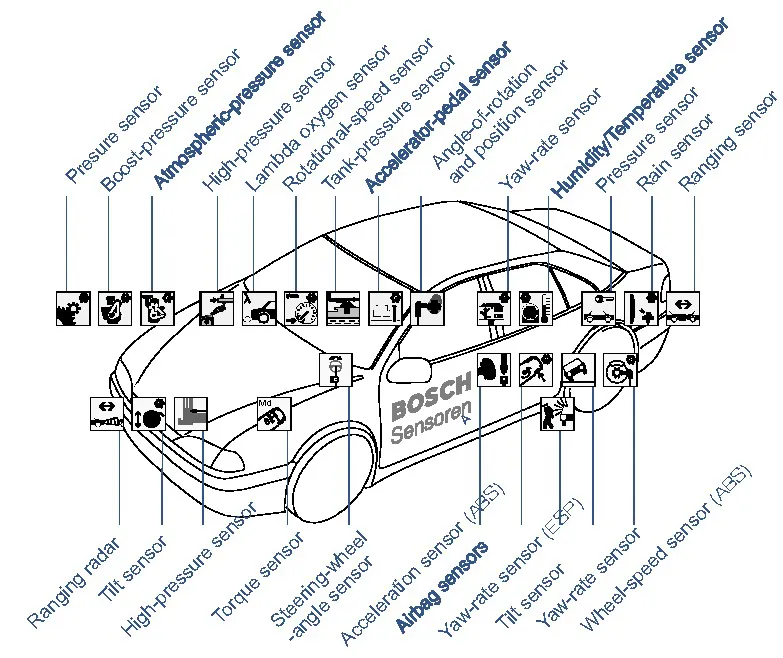
Figure 1.1 The typical Bosch sensors used for automotive application (from Bosch – Automotive Sensors 2002) (permission of Robert Bosch GmbH)
At present, the measuring devices are almost everywhere. Let us look at the cars. Some time ago a typical car was equipped with only several measuring instruments – for detecting the fuel level, speed of the vehicle, temperature of the engine. Today, dozens (or often hundreds) of various sensors are installed in any new car (fig. 1.1) – from sensors important for the security (testing the rotational speed of each wheel in the ABS system), through swanky sensors memorizing the positioning of the seats (Robert Bosch 2002, Jiri 2003). The action of the air-bags is controlled by the stress sensors. Often the windscreen wipers are controlled accordingly to the intensity of the rainfall. Many drivers do not know how to reverse without ultrasonic detectors of the evidence of barriers. It is not a surprise when the car is equipped with the satellite GPS system (Global Positioning System). The number of sensors is so large that there was a need for a special interface CAN (Controller Area Network) designed by Bosch for connecting of the intelligent sensors in automotive applications. Modern sensors (so called intelligent or smart sensors) are equipped with suitable interfaces (Ethernet, CAN, RS-232 interfaces) and it is possible to connect them directly to the network system. There are also available special microcontrollers equipped with CAN output.
The modern cars are additionally equipped with hundreds of sensors for the control of the engine performance. Starting from 1996 practically all cars are equipped with OBDII (On Board Diagnostics) system (Cox 2005, David P. 2002, David P. 2004, Delmar A. 2005). fig. 1.2 presents the example of the operator interface used in OBDII system.
At present the cars are tested and diagnosed continuously. When something wrong appears then special lamp indicates it to the driver that it is necessary to go as soon as possible to the service station. In the station a computer system is connected to the special standardized socket and it is possible to test practically all elements of the car. Moreover, some of the manufacturers equip the cars with the consumer versions of such systems. The OBDII helps drivers to connect the computer, or especially designed palm-top unit, to the car – even on the road. Probably in the nearest future such systems will be introduced to the typical cars.
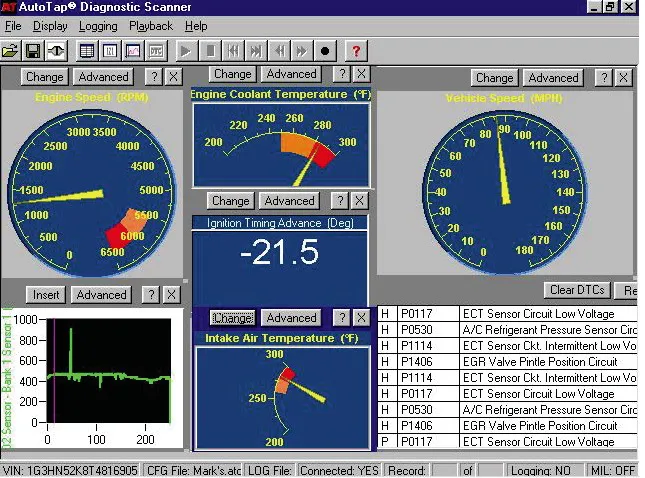
Figure 1.2. The example of On-board diagnostic system operator screen (from www.autotap.com) (permission of Autotap)
Recently the measuring techniques changed significantly. Due to the development of informatics, microelectronics and mechatronics we can observe the real revolution in measurements. Generally measuring devices are substituted by more flexible and universal computer measuring systems. The widespread of computer systems stimulated the development of sensor technology, interface systems, signal processing techniques, digital signal processors, measuring software (virtual instruments) and intelligent data analysis methods. Many of measuring devices disappeared from the market. In common applications only several devices remained as “measuring devices”, the examples being: digital multimeter, digital oscilloscope and arbitrary wave generator. Using these three devices and computer unit it is possible to design many various measuring systems. But is too simplified thinking that the modern measuring technique means only that the analogue measurements are substituted by the digital ones and the human activity is substituted by the computer. The whole philosophy of measurements has been changed – many traditional methods disappeared and many new methods are being developed.
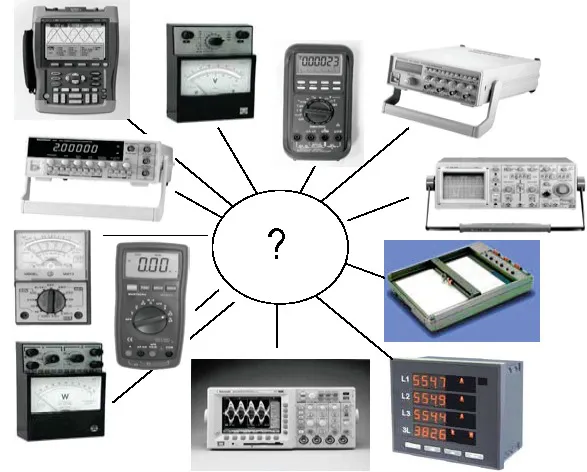
Figure 1.3. The structure of “traditional” measuring system
Figure 1.3 presents the structure of traditional measuring system used some time ago. Properties of the investigated object (for example technological process or physical phenomena) were determined by various measuring device...
Table of contents
- COVER PAGE
- TITLE PAGE
- COPYRIGHT PAGE
- PREFACE
- 1. INTRODUCTION TO MEASUREMENTS
- 2. FUNDAMENTALS OF ELECTRICAL MEASUREMENTS
- 3. CLASSIC ELECTRICAL MEASUREMENTS
- 4. PROCESSING OF THE ANALOGUE MEASUREMENT SIGNALS
- 5. DIGITAL PROCESSING OF THE MEASUREMENT SIGNALS
- 6. COMPUTER MEASURING SYSTEMS
- SYMBOLS USED IN THE BOOK
- ABBREVIATIONS USED IN THE BOOK
Trusted by 375,005 students
Access to over 1.5 million titles for a fair monthly price.
Study more efficiently using our study tools.
Frequently asked questions
Yes, you can cancel anytime from the Subscription tab in your account settings on the Perlego website. Your subscription will stay active until the end of your current billing period. Learn how to cancel your subscription
No, books cannot be downloaded as external files, such as PDFs, for use outside of Perlego. However, you can download books within the Perlego app for offline reading on mobile or tablet. Learn how to download books offline
Perlego offers two plans: Essential and Complete
- Essential is ideal for learners and professionals who enjoy exploring a wide range of subjects. Access the Essential Library with 800,000+ trusted titles and best-sellers across business, personal growth, and the humanities. Includes unlimited reading time and Standard Read Aloud voice.
- Complete: Perfect for advanced learners and researchers needing full, unrestricted access. Unlock 1.5M+ books across hundreds of subjects, including academic and specialized titles. The Complete Plan also includes advanced features like Premium Read Aloud and Research Assistant.
We are an online textbook subscription service, where you can get access to an entire online library for less than the price of a single book per month. With over 1.5 million books across 990+ topics, we’ve got you covered! Learn about our mission
Look out for the read-aloud symbol on your next book to see if you can listen to it. The read-aloud tool reads text aloud for you, highlighting the text as it is being read. You can pause it, speed it up and slow it down. Learn more about Read Aloud
Yes! You can use the Perlego app on both iOS and Android devices to read anytime, anywhere — even offline. Perfect for commutes or when you’re on the go.
Please note we cannot support devices running on iOS 13 and Android 7 or earlier. Learn more about using the app
Please note we cannot support devices running on iOS 13 and Android 7 or earlier. Learn more about using the app
Yes, you can access Principles of Electrical Measurement by Slawomir Tumanski in PDF and/or ePUB format, as well as other popular books in Technology & Engineering & Physics. We have over 1.5 million books available in our catalogue for you to explore.