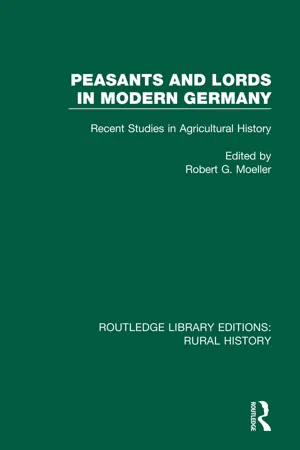
This collection of essays, first published in 1986, provides an exciting introduction to modern German agrarian history. The essays offer a revised account of the agricultural sector in an industrial Germany, and provide an extensive methodological, conceptual and thematic range. This collection challenges accepted interpretations, suggests some alternatives and at the same time offers a context in which new questions can be posed and answers can be sought.
eBook - ePub
Peasants and Lords in Modern Germany
Recent Studies in Agricultural History
- 272 pages
- English
- ePUB (mobile friendly)
- Available on iOS & Android
eBook - ePub
1 The Junkers: Notes on the Social and Historical Significance of the Agrarian Elite in Prussia
The Prussian Junkers were a ruling class for centuries – economically successful, politically powerful and socially dominant in equal measures.1 No one questions their influence on the history of Prussian Germany well into the twentieth century, an influence which is just as often the topic of historical idealization as of historical critique. It has frequently been noted that the Junkers were able not only to survive under changing circumstances but also to maintain their influence and power in an authoritative way, even when the currents were against them, as for example in the first years of the Prussian reforms or at the end of the nineteenth century. They are given credit for the rise of Prussian Germany and are also made to bear a large part of the responsibility for the destruction of the German Reich. It is a ‘fascination with historically momentous events’ which draws us to their collective history, the history of their successes and failures.2
When one attempts to determine the ‘historical significance’ of the Junkers, a multitude of questions present themselves. How did they successfully maintain their ruling position into the twentieth century? What factors determined their place in the social structure? What relationship did they have to other classes and social groups? How great was their ability to adapt to altered economic circumstances and conditions which threatened their position politically or economically? How, and through what means, were they able to maintain their estate-standing and social exclusivity? Industrialization and revolutions in the eighteenth and nineteenth centuries shook the economic basis of all European pre-industrial elites and threatened their claims to power and dominance. In what way and with what consequences, counter-strategies and attempts at consolidation did this process unfold for the Junkers? How did the Junkers as a social class experience and digest the rise and fall of their economic power? What role did the Junkers play in Germany’s often cited ‘Sonder-weg’, its divergence from the model of Western democracy? Were the Junkers an inherently conservative force? Can one specify the ways in which the Junkers can be held responsible for the failed attempts to democratize German society?
In order to reduce the complexity of the many problems presented here and to make them manageable in the context of this essay, the subject will be approached from two different perspectives. In the first section, basic aspects of the Junkers’ objective material conditions will be outlined. This will include a discussion of the preconditions and circumstances of their economic success and political dominance beginning in the sixteenth century. It will also investigate their reactions to attacks against that dominance through the Prussian reforms and the endangerment of their economic status beginning in the last third of the nineteenth century. The second section will attempt a comparison with the English aristocracy in order to illuminate and articulate the importance of the Junkers in Prusso-German history. In addition, it will critically approach certain basic frameworks which assume both the paradigmatic quality of English development and the peculiarity of Germany’s historical path.3
I
The success of the Junkers as a landed elite before the nineteenth century rests on a variety of factors, which can only be briefly noted here. They include the commercialization of east Elbian grain-based agriculture which, in the wake of economic differentiation between Eastern and Western Europe, had facilitated the expansion of noble enterprise since the fifteenth and sixteenth centuries; the combination of political and economic power in the system of Gutsherrschaft4 and Gutswirtschaft; and finally, the way in which the nobility was domesticated by Prussian absolutism and the place it assumed in the social fabric of the eighteenth century.5
In the course of the development of international trade relations, product specialization and the evolution of separate yet mutually intertwined and dependent economic zones in the sixteenth century, the countries of Eastern Europe became the principal grain-producers for the commercially and industrially more advanced regions of the West, especially England and Flanders.6 In the east Elbian regions, a specifically agrarian kind of growth was thus induced which depended on the world market, or more concretely, on the development of demand and on price fluctuations in Western European centres. The surge of commercialization had strong repercussions on the internal social structure of the eastern area which produced and exported grain. During this process of commercialization, a class of estate-owning entrepreneurs emerged which was oriented towards profits and based on export markets. At the same time, the peasant labour force was increasingly tied to the estates. Step by step, formerly free peasants lost their rights, were bound to the soil and were burdened with labour services and dues. In short, there developed what G.D.R. historians refer to as ‘the second serfdom’.7
Without a doubt, the thrust towards commercialization in the sixteenth century8 was the strongest force resulting in the confrontation between Junker estate-owners and a peasantry which was deprived of all rights, dependent and bound to the land. An explanation of this process, however, requires consideration of additional factors as well. The late medieval agrarian depression, poor harvests, famines and epidemics had brought about a decline in population, and with it an expansion of unused land.9 Manorial income decreased sharply, an indirect result of the agrarian depression and a direct result of population decline, falling prices for agricultural products, loss of purchasing power and a general depreciation. In comparison to the time around 1300, the nobles in Lausitz, for example, had lost four–fifths of their rental income by the sixteenth century.10 The result was a compelling drive to find new revenues. The historical response to this challenge was the replacement of property management based on rent (Rentengrundherrschaft)11 with direct control (Gutsherrschaft), and the creation of new sources of income by strengthening personal direction and replacing peasant rent with labour services and dues. The sixteenth century was, to use Hans Rosenberg’s words, ‘the era of consolidation of Junker power’.12 In this period, the expansion of the manorial economy took place in full force. What followed was ‘the repressive solidification of social control mechanisms’ as, so to speak, ‘the social costs of production gains in a market economy’.13 The main characteristic of the Junker’s Gutsherrschaft was the instrumentalization of sovereign rights for economic purposes. This also was behind the particular harshness of noble–peasant power relations and the ambiguity of these relations in the Age of Enlightenment, economic liberalism and citizen emancipation.14 Until well into the eighteenth century, the state authority did not impede the Junkers from expanding their estates. On the contrary, in East Prussia the state itself was a motivating force in this process.15 In addition, the rulers continually sanctioned the Junkers’ noble privileges, and in particular never interfered with seigneurial rights on their estates. This is part of what one could call ‘chronic political horse trading’.16 It served to domesticate the nobility which was made responsible for giving the expanding state financial backing. The state, thus assured of necessary financial support, gave the nobility a free hand on their estates in return.17
It was only in the eighteenth century, however, that the Gutsherrschaft and the Junkers’ power entered their true ‘classical age’. Although the Junkers’ battle with the peasantry in the sixteenth century was, for the most part, victorious, and the peasants were successfully forced into submission, a struggle with Prussian absolutism was still to come.18 From the Junkers’ perspective, this altercation was characterized by a struggle against any encroachment on their estate-based power and against the expanding state system. From the perspective of the prince and later the Prussian king, the struggle was to attain a general peace within the state, to pacify the feuding nobility and the robber knights, and later to finance and personally recruit a viable standing army. Friedrich Wilhelm I could still utter his famous sentence, ‘I will ruin the Junkers’ authority and establish my sovereignty like a rock of bronze’,19 when the East Prussian nobility opposed the introduction of a general military tax. But under Friedrich II, the relationship between the nobility and the absolute monarchy changed in a truly dramatic fashion.
In the course of the eighteenth century, the aggressive, rebellious nobility became the mainstay of the Prussian state. The transformation, which was hardly a victory on all fronts for absolutism, contained all the elements of a compromise. The nobility made concessions on the issue of estate-based taxation, which made the development of the Prussian army financially possible. After decades of opposition, it let itself be integrated into the officer corps of the king’s army. In the process, the nobility gave up its spirit of estate-based separatism and developed its own form of loyalty to the state, or rather to the king as the supreme military commander. The list of concessions and privileges which the absolute monarchy offered the nobility as its part of this compromise is a long one. It granted the nobility preferential treatment in the state bureaucracy and military. It allowed it to further expand the Gutsherrschaft (with the exception of the state’s own laws protecting the peasantry).20 Finally, it gave the nobility secure control of their property, which guaranteed their monopoly over estate ownership, offered them a chance to transform their land into entailed estates and provided them with exclusive credit institutions backed by state subsidies, the Landschaften.
Slightly altering the language of the modern ‘military industrial complex’, one might best describe the conditions of Junker power in the eighteenth century as a ‘military agrarian complex’. This reciprocal relationship, so brilliantly analysed and described by Otto Büsch,21 manifested itself on two levels. In society, monarchical absolutism gave the nobles free rein to expand their estates...
Table of contents
- Cover
- Half Title
- Title Page
- Copyright Page
- Title Page
- Dedication
- Table of Contents
- Acknowledgements
- Introduction: Locating Peasants and Lords in Modern German Historiography by Robert G. Moeller
- 1 The Junkers: Notes on the Social and Historical Significance of the Agrarian Elite in Prussia by Hanna Schissler
- 2 Property and Wood Theft: Agrarian Capitalism and Social Conflict in Rural Society, 1800–50. A Westphalian Case Study by Josef Mooser
- 3 Lords and Peasants in the Kaiserreich by Hans-Jürgen Puhle
- 4 Peasant Protest in the Empire – the Bavarian Example by Ian Farr
- 5 Economic Dimensions of Peasant Protest in the Transition from Kaiserreich to Weimar by Robert G. Moeller
- 6 A Second Agrarian Mobilization? Peasant Associations in South and West Germany, 1918–24 by Jonathan Osmond
- 7 Crisis and Realignment: Agrarian Splinter Parties in the Late Weimar Republic, 1928–33 by Larry Eugene Jones
- 8 The Agrarian Policy of National Socialist Germany by J. E. Farquharson
- Notes on Contributors
- Index
Trusted by 375,005 students
Access to over 1.5 million titles for a fair monthly price.
Study more efficiently using our study tools.
Frequently asked questions
Yes, you can cancel anytime from the Subscription tab in your account settings on the Perlego website. Your subscription will stay active until the end of your current billing period. Learn how to cancel your subscription
No, books cannot be downloaded as external files, such as PDFs, for use outside of Perlego. However, you can download books within the Perlego app for offline reading on mobile or tablet. Learn how to download books offline
Perlego offers two plans: Essential and Complete
- Essential is ideal for learners and professionals who enjoy exploring a wide range of subjects. Access the Essential Library with 800,000+ trusted titles and best-sellers across business, personal growth, and the humanities. Includes unlimited reading time and Standard Read Aloud voice.
- Complete: Perfect for advanced learners and researchers needing full, unrestricted access. Unlock 1.5M+ books across hundreds of subjects, including academic and specialized titles. The Complete Plan also includes advanced features like Premium Read Aloud and Research Assistant.
We are an online textbook subscription service, where you can get access to an entire online library for less than the price of a single book per month. With over 1.5 million books across 990+ topics, we’ve got you covered! Learn about our mission
Look out for the read-aloud symbol on your next book to see if you can listen to it. The read-aloud tool reads text aloud for you, highlighting the text as it is being read. You can pause it, speed it up and slow it down. Learn more about Read Aloud
Yes! You can use the Perlego app on both iOS and Android devices to read anytime, anywhere — even offline. Perfect for commutes or when you’re on the go.
Please note we cannot support devices running on iOS 13 and Android 7 or earlier. Learn more about using the app
Please note we cannot support devices running on iOS 13 and Android 7 or earlier. Learn more about using the app
Yes, you can access Peasants and Lords in Modern Germany by Robert G. Moeller in PDF and/or ePUB format, as well as other popular books in History & 19th Century History. We have over 1.5 million books available in our catalogue for you to explore.