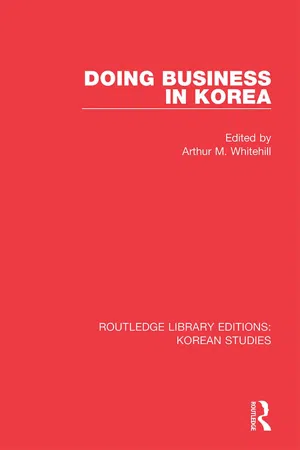
The South Korean economy was a spectacularly successful twentieth century story. This book, first published in 1987, examines many important aspects of the Korean way of doing business, and provides a valuable guide not only to the business practices of South Korea, but also to the attitudes of western potential business partners.
- 132 pages
- English
- ePUB (mobile friendly)
- Available on iOS & Android
eBook - ePub
Doing Business in Korea
About this book
Information
1
Doing Business with Koreans
Dr Whang Il Chung
SUMMARY
Dr Whang presents a guide to foreign businesses wishing to establish joint venture or other business relationships with Korean partners. He raises ten questions often faced by foreign managers, and suggests how to work with Korean partners.
For example, Whom do you contact first ina Korean firm? How do you reach the right person? How are decisions made? What do Koreans understand by contractual obligations? And how can you deal with the language barrier?
As Korean business expands rapidly, the number of foreign businessmen in Korea has also increased tremendously in the last 20 years. While many have achieved a good deal of success, some have not found it easy to do business in Korea, and are constantly trying to find better ways to adapt themselves to local business manners.
Those who have just started up with Korean partners tend to experience perplexing cultural differences — not only differences in language and manners, but more fundamental differences in attitudes and social nqrms, that make it difficult for foreign visitors to understand the Korean way of doing business. Because little is published, this chapter will attempt to provide elementary guidelines.
The views expressed are personal. They are not based on research, nor on generally accepted views of Korean business society. I have drawn on my experience as a university professor and many years as a management consultant to industrial firms in Korea, to reply to questions commonly raised by foreign businessmen who want to do business with Koreans.
- Whom do you contact first?
- How do you reach the right person?
- How should you initiate a business deal?
- Who is likely to be the key person?
- How are decisions usually made in standard Korean firms?
- Are Koreans as rational as Westerners?
- Contracts as a symbol of goodwill, not as firm agreements.
- Will your partners keep their word?
- How do you get to know your partners?
- Whose language barrier: theirs or yours?
1. Whom do you contact first?
In the large firms, a visitor is usually advised to contact someone higher up, even though it is those below who will be directly responsible for the deal you have in mind. Start with the president or some other top-level executive in charge of the company.
One reason is that foreign sellers normally bring in big deals. Another is that subordinates are seldom in a position to make decisions on buying but invariably consult with their superiors. Because, in many cases, decisions are made jointly, sellers would be well advised to meet several executives in general management, procurement, plant operations or finance and to talk to them one by one.
2. How do you reach the right person?
Direct contact is less effective than mediation through a third person. Koreans feel more comfortable when they are introduced by a well-known third party. Sudden appearances are to be discouraged.
If a visitor has former business partners, he should keep these relationships alive as possible mediators for negotiations in the future, as well as for present needs. Good mediators can also be found through an alumni association, family ties, or other connections.
A prior introduction or a good mediator play such an important role that a visitor may need no appointment. He is certain to be welcomed warmly because he is already known. Self introductions or appointments made by telephone should be conducted carefully. Talking to foreigners over the phone can be highly embarrassing to a Korean, even though the language barrier has been reduced in recent years. The problem is especially severe in most small firms.
3. How should you initiate a business deal?
‘Small talk’ seems to be a universal phenomenon before opening up a discussion, but western visitors should take more time than they normally do and introduce themselves first. These preliminaries should reflect respect for the social distance represented by the other person’s age, position and background. Social distances are more valued in Korea than in the West.
Still more care is necessary until the visitor is accepted as a friend. From the Korean businessman’s viewpoint, a hurried, straightforward negotiation is usually considered impolite, and it tends to cause strain. Visitors should start with ‘grounding’ conversations with local executives and their mediator.
When the visitor meets a younger man in the position of director or president, the same modesty is advised. Modesty translates into respect and open-mindedness which tend to lead to success in opening a business discussion. The prevailing paternalistic ethos in business practices in Korea demand Korean manners and etiquette from the visitor. Any thinly disguised contempt, however slight, may complicate business deals.
4. Who is likely to be the key person?
When a visitor makes contact with a Korean business firm, he should look for a person who is the decision-maker. Power is exercised most strongly by owner-managers, or family-related managers, who frequently form an informal power group which is difficult for the foreigner to identify.
In most of the Korean firms employees do not, irrespective of their positions, openly resist decisions made by the owner-manager and his family. Even if such leaders make decisions beyond their formal authority, the decisions will be accepted without serious questioning.
5. How are decisions usually made in Korean firms?
The decision-making process is often shared. In Korean firms, the ‘Pummi’ system, which is an equivalent form of consensus decision making to Japan’s ‘Ringi’ system, is widely adopted, though the practices may differ slightly. Pummi processes proposals from the lower to the upper levels of management — a vertical rather than a horizontal decision-making process. The Ringi system is designed to circulate proposals not only to superiors but for lateral approval and coordination among different departments.
Pummi may be used to diffuse responsibility. When documentation is the only formal evidence of jointly-made decisions, the system has been observed in form but not in substance. It is not a simple matter to define the decision-making process in general, but one-sided, top-down decision making predominates in the majority of firms in Korea.
6. Are Koreans as rational as westerners?
It is often said that the tradesmen from Kaesung, a city located just north-west of the demilitarized zone, are the only truly shrewd Korean businessmen. That implies that ordinary Korean businessmen do not understand economics, are not rational, and are not truly business minded. They are energetic and active in exploring and developing business opportunities, yet most would agree they are more intuitive than analytical, more psychological than logical.
Although such generalizations cannot be justified in all cases, the attitude of Korean managers or entrepreneurs gives ample justification in business practice for the generalization. This is particularly so in comparison with Westerners.
In most Korean firms, a higher priority is placed on the employees’ loyalty and hard work than on their problem-solving ability. Behavioural factors are valued more highly than analytical skills. For example, in hiring, more weight is generally given to overall impressions than to school records.
It is important for foreign visitors to be careful not to hurt a Korean’s feelings with unnecessary (in the Korean context) actions or discussion. Misunderstandings may cause far-reaching damage to an otherwise successful business relationship. However misunderstandings, when they do happen, can also be resolved through intimate gatherings, arranged possibly with the help of a mediator.
7. Contracts as a symbol of goodwill
International business is mainly based on standardized practices which contain most of the rules governing the parties involved. A fundamental concept is the contract, which has to be honoured by all parties for business to continue. With some exceptions, Korean firms have generally been able to honour the contracts arranged with their foreign partners.
The Korean word contract is sometimes associated with an unpleasant connotation, because it implies some distrust in the opposite party. Traditionally, the integrity of a person carries more weight than a contractual promise. In such cases, a contract serves as a symbol of integrity; it is not the major element in what has been agreed upon, but an additional one. It follows that, when a contract is dishonoured, it may mean that inevitable circumstances caused it to be broken. This means that Koreans will not consider a contract as legally binding. Recontracting is a daily form of business activity and, all in all, there are fewer legal disputes than the Westerner might imagine.
Koreans’ fundamentally ingrained over-optimism, and Buddhist doctrines of mercy and tolerance sometimes impair international recognition of the credibility of Korean businessmen.
8. Will your partners keep their word?
Because a contract is primarily a symbol of goodwill, it is important to help Korean partners to keep the contract. Close contact between business partners is vital. The need for extra care is not necessarily based on an assumption of lack of credibility or competence in the Korean. It is largely needed because of his inherent attitudes of excessive optimism and over-expansionism, which have been the fundamental driving forces behind the actions of Korean businessmen.
9. How do you get to know your partners
To maintain a long-lasting partnership, frequent informal gatherings between the two parties are recommended. The language barrier does not matter much. What matters is warmth and a feeling of friendship. Sometimes a surprise invitation may trigger an intimate relationship better than an expensive set dinner. The most important thing is that the two parties enjoy a family-type open-mindedness. Emotional attachment plays an important role in building up the friendship that eases the true job of doing business.
10. Whose language barrier: theirs or yours?
Even though many Korean executives receive more than six years of English teaching, only a small number actually speak it well. This language barrier raises tensions which suppress ideas, and cause Koreans to keep away.
The language barrier is not limited to vocabulary. It includes basic differences in understanding. Inadequate training in logical and analytical reasoning is a further barrier. Even differences in lifestyle. It is recommended that foreign visitors share the burden of communication and understanding in order to ease the tensions.
2
Koreans: Who are They?
Dr Kim Kyong Dong
SUMMARY
In explaining the role played by the human element and social organisation in Korea’s economic success Professor Kim concludes that Korea’s achievement is due to adaptability to change, supported by non-rational forces, such as the quality of human resources, to motivation and organisation.
Professor Kim does not reject the ‘Confucian work ethic’ explanation for Korea’s technological and managerial progress but feels that education, mass communication, and other channels of information have been more important. Some Korean scholars have even stressed the negative effects of Confucian doctrines and development.
Professor Kim sees Hahn as an important psychic force in Korean behaviour — the psychological state that is caused by feelings of rancor, regret, remorse, revenge, grievances, grudge and grief
In order to explain the unique performance of South Korea in the economic sphere ove...
Table of contents
- Cover
- Half Title
- Title Page
- Copyright Page
- Original Title Page
- Original Copyright Page
- Contents
- List of Figures and Tables
- Foreword
- Preface
- 1 Doing Business with Koreans
- 2 Koreans: Who are They?
- 3 Banking and Finance
- 4 Trade Policy
- 5 Labour and Employment
- 6 Laws Governing Business
- 7 Government, Entrepreneurs and Competition
- 8 Economic Policy
- 9 Korean-American Economic Relations
- Index
Trusted by 375,005 students
Access to over 1.5 million titles for a fair monthly price.
Study more efficiently using our study tools.
Frequently asked questions
Yes, you can cancel anytime from the Subscription tab in your account settings on the Perlego website. Your subscription will stay active until the end of your current billing period. Learn how to cancel your subscription
No, books cannot be downloaded as external files, such as PDFs, for use outside of Perlego. However, you can download books within the Perlego app for offline reading on mobile or tablet. Learn how to download books offline
Perlego offers two plans: Essential and Complete
- Essential is ideal for learners and professionals who enjoy exploring a wide range of subjects. Access the Essential Library with 800,000+ trusted titles and best-sellers across business, personal growth, and the humanities. Includes unlimited reading time and Standard Read Aloud voice.
- Complete: Perfect for advanced learners and researchers needing full, unrestricted access. Unlock 1.5M+ books across hundreds of subjects, including academic and specialized titles. The Complete Plan also includes advanced features like Premium Read Aloud and Research Assistant.
We are an online textbook subscription service, where you can get access to an entire online library for less than the price of a single book per month. With over 1.5 million books across 990+ topics, we’ve got you covered! Learn about our mission
Look out for the read-aloud symbol on your next book to see if you can listen to it. The read-aloud tool reads text aloud for you, highlighting the text as it is being read. You can pause it, speed it up and slow it down. Learn more about Read Aloud
Yes! You can use the Perlego app on both iOS and Android devices to read anytime, anywhere — even offline. Perfect for commutes or when you’re on the go.
Please note we cannot support devices running on iOS 13 and Android 7 or earlier. Learn more about using the app
Please note we cannot support devices running on iOS 13 and Android 7 or earlier. Learn more about using the app
Yes, you can access Doing Business in Korea by Arthur M. Whitehill in PDF and/or ePUB format, as well as other popular books in Social Sciences & Regional Studies. We have over 1.5 million books available in our catalogue for you to explore.