First published in 1990. Liberalism and the Good is a collection of critical essays by an inter-disciplinary group of American and English scholars that seeks to address the long-standing problem of the good in light of the most recent developments in liberal theory. With contributions from both liberal apologists and critics who pursue arguments informed by sources as disparate as Nietzsche and Aristotle, it breaks fresh ground in a number of different directions and offers proposals for the future of the discussion.
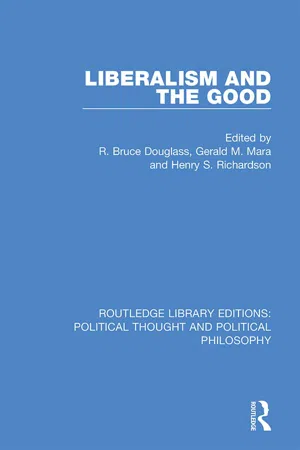
eBook - ePub
Liberalism and the Good
- 294 pages
- English
- ePUB (mobile friendly)
- Available on iOS & Android
eBook - ePub
Liberalism and the Good
About this book
Information
1
The Problem of Liberalism and the Good
Henry S. Richardson
Section 1 What is Liberalism For?
As a normative theory about the justification and ideals of political institutions—which is how we are thinking of it here—liberalism is imperiled by its successes. To the extent that liberalism has triumphed against feudalism, aristocracy, intolerance, and repression, it has lost the original historical opponents that served, by making concrete what it was that liberalism was against, to help one infer what liberalism was for. Liberalism has stood, in part, for equality; but if equality as an ideal can no longer mean an end to aristocratic privilege and feudal homage, then the question, “equality of what?” is forced to the fore.1 Similarly, if the call for toleration can no longer merely mean an end to Test Oaths and other forms of state-enforced religious uniformity, the question of its further concrete content cannot be evaded. And where the banner of liberty no longer is needed to rally citizens in defense of basic rights of association and movement, then the question of its proper use is open to debate.2 Indeed, on all fronts, liberalism can be seen as having unleashed social forces that undercut it. Joseph Schumpeter’s characterization of capitalism might be taken to apply equally to liberalism:
[It] creates a critical frame of mind which, after having destroyed the moral authority of so many other institutions, in the end turns against its own; the bourgeois finds to his amazement that the rationalist attitude does not stop at the credentials of kings and popes but goes on to attack private property and the whole scheme of bourgeois values.3
While mainly focusing more on the general value of toleration and the traditional liberties of speech and association than on anything specifically capitalist or bourgeois, the essays in this volume will ask whether, in fact, the kind of “rationalist” justification typical of liberalism can limit itself—can find a way of stopping at some values taken as fundamental—or rather is doomed to erode its own basis of legitimacy.
I am grateful to Peter de Mameffe and to my co-editors for many helpful comments on earlier drafts of this essay.
This question can be asked in a practical, institutional way or more abstractly and philosophically. That is, attention could be directed to what Rawls has called the question of “stability”—whether liberal institutions can generate and maintain their own support—or rather to the conceptual coherence and theoretical grounding of the principles that define a liberal polity.4 As befits a collection of essays mainly directed to exploring constructive ways to get beyond recent polemics between liberals and their communitarian critics, most of our contributors focus more on the conceptual obstacles to imagining a coherent liberalism than on the practical difficulties of realizing one. This introductory essay will do the same, addressing itself mainly to the dilemmas that apparently arise when liberal theorists attempt to explain how their commitment to toleration can avoid logically undercutting the grounds on which their justification of liberalism rests or, conversely, how those grounds can avoid displacing their concrete commitment to toleration.5
I have two aims in this introductory essay. The first is to survey the conceptual terrain of these apparent dilemmas, developing distinctions helpful in locating each of our contributors’ positions therein. Along the way, I will discuss relevant portions of the background literature. Since John Rawls’s theory of justice looms so large in the background, and since so many of our contributors discuss it, its contours will frequently be noticed. To be sure, none of our contributors is restricted simply to the common horizon to be scanned in this introductory essay. Although each offers a valuable perspective on the core problems of liberalism and the good, each also presents a distinctive insight into other related difficulties and explores regions of the central problem that I will be unable to treat. Nonetheless, each also does bring a perspective to bear on the central problem generated by that strand of liberalism that would promote toleration for a wide range of commitments and ways of life—a toleration given minimal institutional force by certain traditional liberties of expression, association, and worship. My second aim in this introductory essay is to argue that the terrain of the good must be explored by the liberal; that, indeed, liberals (like their opponents)6 must grapple with the difficulties of defending a conception of the good under conditions of pluralism.
To show that the liberal must take a stand in favor of some good, however political and non-metaphysical, however procedural or higher-order it may be, I will begin in the next section by setting out the dilemma of liberal toleration more fully. In Section 3, I will examine what it means to claim that a conception of the good is metaphysically grounded, and will argue that requiring a general metaphysical basis for a political theory is unnecessary and misguided, in part because of what I will call “the depth of pluralism.” This notion, and the nature of the contemporary plurality of seemingly irreconcilable conceptions of the good, will be examined in Section 4, where various theoretical strategies for coping with pluralism will be canvassed. To assess different versions of these strategies, we will also need to have in mind the different ways in which the notion of a “conception of the good” may be understood. I set out important variations of this idea, central to our study, in Section 5. In Section 6 I examine the role within liberal theory for the idea of neutrality among conceptions of the good, arguing that while it may have an important place, its function is not to address the central dilemma of toleration. Alternative liberal stances of detachment from conceptions of the good, more promising for this purpose, are assessed in Section 7. Finally, Section 8 takes up the possibility that liberals can lay to rest worries about the coherence of toleration more straightforwardly by articulating a conception of the good that expresses what they stand for in terms that are comprehensive enough to be compelling, yet vague enough to allow room for substantial variation and disagreement as to details.
Section 2 Beyond Sophistication: The Dilemma of Liberal Toleration
Michael Sandel has recently contrasted “naive” and “sophisticated” styles of political argument. A naive view holds that the justice of laws depends largely upon the moral goodness or badness of the conduct it regulates. A sophisticated view holds that the justice of laws depends not upon this but upon considerations less specific to the context, having to do with the balance between individual liberty and the claims of the democratic majority. Sandel shows in effective detail how the “sophisticated” tendencies of recent U.S. Supreme Court decisions have distorted the presentation of some substantive concerns and crippled others. For instance, he documents how advocates of homosexual rights, attempting to meet the constraints of sophistication, have cast their arguments largely in terms of the rights of individuals to “choose” whatever life-style they desire, thereby foregoing the potentially stronger claims about the substantive goods realized in a loving, long-term relationship between two persons of whatever sex.7 In thus defending what is true about the naive view—the inescapability in politics of a discussion oriented by context-specific substantive goods—without exactly suggesting a return to naivete, Sandel is urging us to go beyond “sophistication.”
Everyone should agree with that broad recommendation, for both the naive and the sophisticated views are hopelessly oversimplified. The justice—and more generally the moral acceptability—of laws depends not just upon the goodness or badness of the conduct regulated nor solely upon an abstractly defended balance between individual and majority rights, but upon both. The challenge for any political theory worth considering is to go “beyond sophistication” by finding a coherent way to combine the grain of truth in naivete with what is indispensable in sophistication. In this volume, the focus is on whether liberals can achieve this—that is, whether they can progress beyond the sophomoric relativism of some without returning to a pre-liberal dogmatism devoid of recognition of human rights or individual liberties.
This task is a delicate one for liberal theory. Toleration is realized in particular freedoms of expression, liberties of action, and rights of participation that are kept invariant, within certain limits, with respect to the content of the views being expressed or furthered. Instituting these freedoms, liberties, or rights will always offend against some who hold that some of the views tolerated—in favor of a woman’s right to choose an abortion, say, or against public religious displays—are evil. In a society as diverse as the United States, to borrow the language of Senator Helms’s proposed restriction on the National Endowment for the Arts, it will be hard to avoid measures that “denigrate the objects or beliefs of the adherents of a particular religion or non-religion.”8 Importantly, some of those offended will hold normative political views that (expressly or implicitly) condemn liberal toleration.
To be sure, few liberals would put forward toleration as an absolute. That there must be some boundaries to a commitment to toleration is shown, on the practical level, by the impossibility of tolerating the militantly intolerant.9 In addition, the liberal will also undoubtedly want to recognize and to justify certain other concrete limits upon toleration. I have in mind not flag-burning, specifically, but rather the more general point made above that toleration is realized in a range of concrete rights and liberties. As the American constitutional jurisprudence of libel and of the separation of church and state makes plain, there are many difficult political choices to be made at the boundaries of these freedoms. Even if a maximum of liberty were well-defined in each of these cases, few liberals would hold out for it.
Nonetheless, a liberal theory clearly claims to start from normative assumptions that rule out giving full political sway to the conceptions of the good of its illiberal citizens. Accordingly, an apparent dilemma arises.10 On the one hand, if these assumptions are really so strong, then how is it that they could fail to give rise to their own account of the highest good, or moral perfection, that would in the end swamp toleration by requiring adherence to a “liberal” ideal? On the other hand, if the liberal refuses to own up to such strong normative assumptions, and instead rests on a skeptical rejection of “absolutes,” then on what reasonable grounds are illiberal conceptions of the good held to be false? Since the self-defeating nature of such a skeptical stance is now well known, most of the essays here concentrate on the first horn of the dilemma.11
This dilemma may be illustrated by reference to a familiar tension in the political philosophy of John Stuart Mill. Mill held that once he had identified happiness as the highest good, the utilitarian standard followed as a fairly straightforward consequence; but he also claimed that a scheme of liberty allowing wide scope for toleration followed from his quite complicated notion of that in which happiness consists. Interpreters have long struggled with how to reconcile these two aspects of Mill’s view, for it seems that the utilitarian standard threatens to squeeze out the liberty by requiring that one act to maximize the happiness of all.12 This tension in Mill’s theory illustrates the first horn’s general challenge for the liberal: how to articulate normative premises powerful enough to rein in the expression of illiberality without thereby implying a conception of the good that will, in the end, drastically narrow the scope of toleration.
This apparent “dilemma of liberal toleration” can also be concretely illustrated by the stances of two institutions toward the good. Threatened more by the second, skeptical horn was the American Civil Liberties Union when its members split over whether its lawyers should support the right of Nazis to march in Skokie, Illinois. If the ACLU were truly committed to a basic set of beliefs about the value of liberty, could these really be consistent with tolerating Nazis? How is doing so not to fall into a self-defeating relativism? Courting more the first, perfectionist horn of the dilemma is the Roman Catholic church, as interpreted by John Langan in Chapter 6. Arguing here that the church can accommodate itself to a considerable degree to liberal principles, Langan is nonetheless quite sensitive to the concern this horn of the dilemma poses. He quotes official church pronouncements to the effect that there is a right to freedom of expression, but that it is conditioned upon remaining “within the limits laid down by the moral order and the common good.” The question is whether these limits imply that this commitment to freedom is as illusory as Henry Ford’s commitment to choice (“any color you like, so long as it’s black”).
For liberal theory to respond adequately to the dilemma of toleration, it must meet three subordinate challenges. First, the liberal’s way out of the dilemma will presumably depend either upon drawing some distinction between types of normative premises or upon some limitation to the confidence with which these premises are to be held. This central conceptual task we may call the challenge of articulating limits. The liberal theorist may sympathize with the following lines from President Bush’s...
Table of contents
- Cover
- Half Title
- Title Page
- Copyright Page
- Original Title Page
- Original Copyright Page
- Contents
- Acknowledgments
- Original Half Title
- 1. The Problem of Liberalism and the Good
- 2. Neutralities
- 3. How Not to Defend Liberal Institutions
- 4. Identity and Difference in Liberalism
- 5. Is Liberalism Good Enough?
- 6. Catholicism and Liberalism—200 Years of Contest and Consensus
- 7. Moral Conflict and Political Consensus
- 8. Bringing the Good Back In
- 9. “Lopp’d and Bound”: How Liberal Theory Obscures the Goods of Liberal Practices
- 10. Aristotelian Social Democracy
- 11. The Search for a Defensible Good: The Emerging Dilemma of Liberalism
- Index
Trusted by 375,005 students
Access to over 1.5 million titles for a fair monthly price.
Study more efficiently using our study tools.
Frequently asked questions
Yes, you can cancel anytime from the Subscription tab in your account settings on the Perlego website. Your subscription will stay active until the end of your current billing period. Learn how to cancel your subscription
No, books cannot be downloaded as external files, such as PDFs, for use outside of Perlego. However, you can download books within the Perlego app for offline reading on mobile or tablet. Learn how to download books offline
Perlego offers two plans: Essential and Complete
- Essential is ideal for learners and professionals who enjoy exploring a wide range of subjects. Access the Essential Library with 800,000+ trusted titles and best-sellers across business, personal growth, and the humanities. Includes unlimited reading time and Standard Read Aloud voice.
- Complete: Perfect for advanced learners and researchers needing full, unrestricted access. Unlock 1.5M+ books across hundreds of subjects, including academic and specialized titles. The Complete Plan also includes advanced features like Premium Read Aloud and Research Assistant.
We are an online textbook subscription service, where you can get access to an entire online library for less than the price of a single book per month. With over 1.5 million books across 990+ topics, we’ve got you covered! Learn about our mission
Look out for the read-aloud symbol on your next book to see if you can listen to it. The read-aloud tool reads text aloud for you, highlighting the text as it is being read. You can pause it, speed it up and slow it down. Learn more about Read Aloud
Yes! You can use the Perlego app on both iOS and Android devices to read anytime, anywhere — even offline. Perfect for commutes or when you’re on the go.
Please note we cannot support devices running on iOS 13 and Android 7 or earlier. Learn more about using the app
Please note we cannot support devices running on iOS 13 and Android 7 or earlier. Learn more about using the app
Yes, you can access Liberalism and the Good by R. Bruce Douglass, Gerald M. Mara, Henry S. Richardson, R. Bruce Douglass,Gerald M. Mara,Henry S. Richardson in PDF and/or ePUB format, as well as other popular books in Política y relaciones internacionales & Conservadurismo y liberalismo. We have over 1.5 million books available in our catalogue for you to explore.