- 414 pages
- English
- ePUB (mobile friendly)
- Available on iOS & Android
eBook - ePub
Religion And Modernization In The Soviet Union
About this book
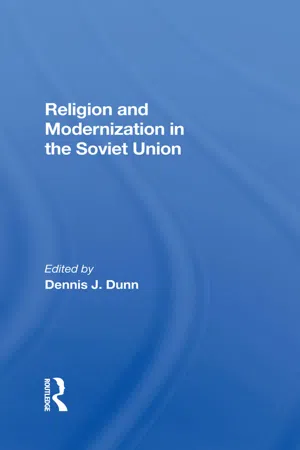
To the surprise of many students of the Soviet Union, religion has shown itself to be a force still powerful in Soviet society. In contrast, the impact of religion in developed Western societies has declined. Dr. Dunn points out that the study of this antinomy can shed light on the entire concept of "modernization" in the U.S.S.R. The study of the
Part I Religion and Soviet Society
Chapter 2
Toward the End of the Old Regime: The State, Church, and Duma
Alfred Levin
On October 25, 1910, in the Fourth Session of the Third Duma, Ivan Semenovich Kliuzhov, Octobrist Deputy from Samara, rose to speak in defense of the section of bill offered by the Committee on Public Education removing parochial schools of the Orthodox Church from the jurisdiction of the Holy Synod to that of the Ministry of Public Education--a delicate matter indeed. The debate was fierce, the atmosphere tense, and the speaker worthy of no little attention. He was the grandson of one of the chief figures who had engineered the major educational reforms of the 1860s. He had dedicated some thirty-five years to the question of reform and development of the primary school system as a village teacher, an inspector of public schools, and had sat as a member of school committees in uiezd and guberniia zemstvos and in the city councils. His folksy, salty manner and his clarity and simplicity of delivery caught and held the attention of all elements in the Imperial Duma.1 For he was more familiar with the problems and day-to-day functioning of the primary schools than any of his fellow deputies. He was, at the moment, explaining with a sense of shock, that one village priest had divided primary school pupils into "ours" and "theirs." He had blessed the "ours" and referred to the "theirs" as "nemtsy" (foreigners). Kliuzhev knew that under pressure from the upper hierarchy priests had to attack zemstvo schools and after hearing through the sermon, a bit too vituperative for his tastes, he inquired of the priest, "How is it not a sin for you to censure one school or another here?" The clergyman replied somewhat diffidently, "I'm sorry Ivan Semenovich, I didn't know you were here."2 Then Kliuzhev remembered that when he was about to leave the village of Khoroshenko he was appalled by the request of a local priest. "Ivan Semenovich, insist in the school council that all girls study in our schools and the boys in your zemstvo schools." The deputies giggled. In reply Kliuzhev asked him how on earth he or the school council could require a peasant to send his daughter where he had no heart to send her.3 Kliuzhev was reflecting on matters that were common knowledge to the deputies: the deep divisions and hostilities in Russian society that had developed around the zemstvo and church schools in the last two decades of the Old Regime; the intense pressure on the lower clergy from their hierarchical and official superiors; and their parochialism and general level of ignorance.
I shall not dwell here on the condition of the Orthodox Church at the end of the Old Regime: the complete centralization of control over matters of faith and administration in the Holy synod; the unconscionable overburdening of the provincial bishops with bureaucratic paper and red tape; their frequent and arbitrary transfer from province to province; the virtual control over their decisions by their consistories; their impersonal, frequently harsh, attitude toward the generally semi-literate village clergy whose small remuneration was supplemented by charges, for sacramental duties, considered exhorbitant by the peasantry; the lifeless formalism of their services and the spirit of much of the hierarchy. These have been documented more than adequately by intensive studies in the past four decades. I will concern myself here with the attitudes toward the Orthodox hierarchy and its faith as they are reflected in the Duma debates by elements of Russian society who had a significant influence on the course of its development--the state, representatives of church officialdom, their supporters and the Duma opposition. I have always felt that the chief significance of the Duma lay not in its accomplishments--these were relatively limited in its brief existence--but in its reflection of the Russian mind, Russian civilization, at the beginning of the twentieth century. It was far from representative, but the most influential elements had their spokesmen in it. And it is in that context that I will consider the debates on the church. Keep in mind that the extreme left was a miniscule element in the Third and Fourth Dumas when major issues concerning religion were debated. The Social Revolutionaries boycotted the Duma. The Marxists were a relatively minor quantity and their attitudes have been too well scouted to be considered here.
While the Duma's efforts in the area of religious reform were not inconsiderable, its successes were not particularly great. The Russian constitution of 1906 and the statutes on the Duma and Imperial Council, modelled largely on German and Austrian systems, limited parliamentary activities on budgetary matters relating to the armed forces and the royal family and in foreign affairs. But more seriously, the Duma faced the veto of the semi-appointive, conservative, sometimes unregenerated upper house, the Imperial Council, as well as that of the tsar, always oversensitive about his prerogatives. Two Weltanschauungen confronted each other and the powerful "autocracy" and chin proved remarkably heedless and myopic. Serious proposals for change were well nigh equated with revolution or the threat thereof. Hence, badly needed renovation of the church from within, in a universal council, was postponed and the Duma's major efforts were rejected by the upper house and the tsar. The state strove to retain a maximum of its heretofore unlimited prerogatives in the traditional statist concept while the Duma majority, the opposition in the debates on religious matters, sought to broaden the rights of the Orthodox clergy and non-Orthodox faiths in the name of the civil rights of the individual. The state applied the strictest interpretation to older laws and the concessions it yielded in the post-1905 period, while the Duma saw broader implications in the meaning of the laws and did its utmost to keep the regime to its original promises.
The Duma's chief successes lay in its efforts to improve the salaries of the clergy--from about twelve and a half million rubles in 1908 to almost nineteen million rubles in 1915--and it raised the appropriations for the parish schools from about nine and a half million rubles in 1908 to twenty two and a quarter million in 1914.4 But in most key ventures its endeavors proved frustrating and fruitless. The "establishment" was unyielding when faced with the loss of some power to the lower hierarchy or of the favored position of the established church.
It is not my purpose to follow the weary and repetitive debates on all questions concerning religion but rather to concentrate on those which best reflect the attitudes of the major socio-political elements in the Duma to provide some inkling of the intellectual environment--or lack of it, as the case may be--for the condition of the church and religion in the few years immediately preceding the revolutionary and Soviet periods and which did indeed influence the philosophy of the church under the Soviet regime. The Imperial Council expunged some amendments liberalizing the right to change from one faith to another and efforts at compromise in a joint committee failed.5 Changes by the Duma in a measure issued under Article 87 of the Fundamental Laws to facilitate the rights of Old Believers to form congregations, worship and preach were rejected by the Imperial Council and the matter rested.6 No agreement could be reached between the two houses on uniting all schools funded by the government, including the parochial, under the uiezd school councils with a budget assigned to the Ministry of Public Education.7
The measures concerned were considered and their fate determined in the course of the Third Duma, 1907-1912, heavily weighted by the constitutionally questionable Electoral Law of June 3, 1907 in favor of aristocratic, propertied and Russian elements. Yet this was the most productive of the Russian parliaments largely because it operated under relatively normal circumstances. Under the aegis of the Premier and Minister of the Interior Peter Arkad'evich Stolypin, behaving for all the world like a right wing Octobrist, the administration introduced a series of bills to guarantee the freedom of religious conscience promised under the law of April 17, 1905 and the more general Manifesto of October 17, 1905 guaranteeing religious liberty. Even the Kadets acknowledged that the bills had a liberal ring and were acceptable enough. But efforts by the Duma Committees on Religious Affairs, Old Believer Affairs, Affairs of the Orthodox Church, and Public Education to further liberalize the measures brought irreconcilable splits in these committees and in the Duma.8
The most significant bill, on the right to change one's faith, was introduced early in the Third Duma, on November 11, 1907. It proceeded naturally from the law of April 17, 1905 and was based on that decree. It sought to define more exactly the conditions permitted for those who would leave Orthodoxy for a non-Orthodox faith or forsake one non-Orthodox confession for another. Briefly, the bill provided that any Christian reaching the age of 21 might transfer to any other Christian faith without restriction. Those Christians over 21 who had converted to Christianity and whose parents and grandparents were non-Christian could revert to their original faith and all mutual obligations between them and the church they left were considered cancelled. The Committee on Religious Affairs, reporting April 10, 1909, made some significant revisions. It allowed any person over 21 to transfer from any religion to any other provided it was not outlawed. A minor reaching 14 was allowed the same rights if he had permission from his parents or guardians to transfer, and these determined his faith if under 14 years of age. All changes had to be registered by the police within 40 days after submission of a petition therefor. Persons gravely ill were excluded.9
Stolypin defended his measure succinctly and forcefully and he thought primarily in terms of the legal relations of church and society to the state and the privileged position of the Orthodox Church under the Fundamental Laws.10 He warned the Duma of the complexity of the problem since civil and religious relationships of the state with the Orthodox Church were not clearly demarked by law yet they were closely interwoven. The higher the position of the church the more it entered into the state organism, and he fell back on the classic caesaropapist concept. The church had given the state spiritual strength and this had, in turn, lent strength to the church. The state left to the church the right to regulate its dogma and internal affairs, but it had the right to define the political, property, civil and criminal norms arising from the religious conditions of its subjects. The state should strive to bring about a balance between the various interests of religious freedom and the predominant church. And the Duma should ponder its legislation with these considerations in mind. Here Stolypin's characteristic, innate Great Russian nationalism colored his argument. The demand that the church run its own affairs apart from the state arose from the suspicion of the state--and only when non-Orthodox elements began to pa...
Table of contents
- Cover
- Half Title
- Title
- Copyright
- Contents
- PREFACE
- PART I: RELIGION AND SOVIET SOCIETY
- PART II: RELIGIOUS GROUPS IN THE SOVIET UNION
- INDEX
- ABOUT THE CONTRIBUTORS
Trusted by 375,005 students
Access to over 1.5 million titles for a fair monthly price.
Study more efficiently using our study tools.
Frequently asked questions
Yes, you can cancel anytime from the Subscription tab in your account settings on the Perlego website. Your subscription will stay active until the end of your current billing period. Learn how to cancel your subscription
No, books cannot be downloaded as external files, such as PDFs, for use outside of Perlego. However, you can download books within the Perlego app for offline reading on mobile or tablet. Learn how to download books offline
Perlego offers two plans: Essential and Complete
- Essential is ideal for learners and professionals who enjoy exploring a wide range of subjects. Access the Essential Library with 800,000+ trusted titles and best-sellers across business, personal growth, and the humanities. Includes unlimited reading time and Standard Read Aloud voice.
- Complete: Perfect for advanced learners and researchers needing full, unrestricted access. Unlock 1.5M+ books across hundreds of subjects, including academic and specialized titles. The Complete Plan also includes advanced features like Premium Read Aloud and Research Assistant.
We are an online textbook subscription service, where you can get access to an entire online library for less than the price of a single book per month. With over 1.5 million books across 990+ topics, we’ve got you covered! Learn about our mission
Look out for the read-aloud symbol on your next book to see if you can listen to it. The read-aloud tool reads text aloud for you, highlighting the text as it is being read. You can pause it, speed it up and slow it down. Learn more about Read Aloud
Yes! You can use the Perlego app on both iOS and Android devices to read anytime, anywhere — even offline. Perfect for commutes or when you’re on the go.
Please note we cannot support devices running on iOS 13 and Android 7 or earlier. Learn more about using the app
Please note we cannot support devices running on iOS 13 and Android 7 or earlier. Learn more about using the app
Yes, you can access Religion And Modernization In The Soviet Union by Dennis J. Dunn,Dennis J Dunn in PDF and/or ePUB format, as well as other popular books in History & World History. We have over 1.5 million books available in our catalogue for you to explore.