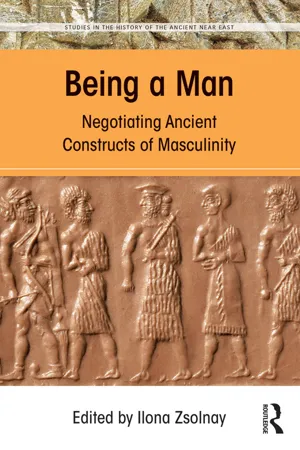
Being a Man is a formative work which reveals the myriad and complex negotiations for constructions of masculine identities in the greater ancient Near East and beyond. Through a juxtaposition of studies into Neo-Assyrian artistic representations and omens, biblical hymns and narrative, Hittite, Akkadian, and Indian epic, as well as detailed linguistic studies on gender and sex in the Sumerian and Hebrew languages, the book challenges traditional understandings and assumed homogeneity for what it meant "to be a man" in antiquity. Being a Man is an indispensable resource for students of the ancient Near East, and a fascinating study for anyone with an interest in gender and sexuality throughout history.
Biological sex and social gender are categories that we, in Western culture, assign to human beings. Traditionally, Male mortals perform masculine activities, modes of dress, behaviors, while female mortals perform feminine activities, modes of dress, behaviors, et cetera. These performances allocated to, adopted by, or, in some cases, forced upon, individuals can be identical (e.g., family driver) or different (e.g., men tend not to wear dresses). Western culture also expects certain activities, modes of dress, behaviors, and the like to be performed during certain stages in a man’s or woman’s life. Both sexes are thought to pass through culturally defined chronological stages: infancy, childhood, adolescence, “prime of life,” middle age, and old age. The chronological parameters of these stages have changed through the decades, centuries, indeed, even, millennia. When once there was no childhood, in the United States, it has become common for adult “children” to remain dependent upon their parents well into their twenties and even thirties. Middle age, stereotypically defined as the time when one settles down into a chosen life, may occur in one’s early thirties or late fifties. Conversely, a person may pass through this stage chronologically, but never actually perform it.
Today, men are categorized by age, racial and ethnic background, class, or financial status. In this chapter, we investigate if, how, and when men were designated by sex and/or gender in Sumerian administrative, lexical, and “literary” texts. We begin by identifying, defining, and contextualizing those pictographs (logograms) which signified categories of men in texts which date to the Archaic period (c. 3350–3000 BCE). We then review the later attestations of the Sumerian terms these logograms came to represent. Less an analysis of social characteristics, here we survey the most basic categories to which a man could be assigned (not choose to enter). Many of the classifications discussed are familiar to the Sumerologist: dependent, independent, worker, and upper class “person.” What is exposed by this survey is that there seems to have been no true generic category “male human,” that is, one devoid of social status with an accompanying generic construct of masculinity. From the Archaic period onward, the southern Mesopotamian writing system demonstrates a complex system for designating men that is dependent upon social class, age, text type (e.g., lexical versus ration list), and period in which it was written.2
Categorizing by sex and gender
In the Archaic sign repertoire, mammals are first divided according to their more general categories, for example, ovicapridae, bovidae, cervidae, suidae, felidae, and hominidae.3 In order to indicate a more specific class, the sign that indicated the general category was either modified or supplemented. For example, the generic sign for goat is a simple cross (MAŠ) and the generic sign for sheep is an encircled cross (UDU).4 In order to specify a fat-tailed sheep, a “fat” tail was amended to the UDU sign. In order to mark the sex of either a sheep or a goat, the sign HI (ŠIR?), which represented a testicular sac, was added to the more general pictograph (e.g., MAŠ or UDU) to indicate a male, while teats (no independent sign) were added to indicate a female.5 The sex of nonovicaprids is otherwise indicated. Cows and bulls were each designated by slightly modified versions of a triangle (i.e., cows were depicted with floppy ears [AB2] and bulls with upright horns [GU4]).6 For young animals of all types (including calves, kids, and lambs), and adult cervidae, suidae, and felidae, an additional pictograph was inscribed next to the generic-family sign to designate sex. If the animal was female, the additional pictograph is the image of a pubic triangle (SAL); if the animal was male, the pictograph was either the image of an ejaculating erect penis (UŠ) or a set of mountains (KURa):7
SAL
female; woman8
UŠ
male; independent man9
KURa
male/subjugated; subjugated man; mountains10
Hominidae – that is, humans – could also be designated as either UŠ, KURa, or SAL. When substantivized, UŠ and SAL referred to seemingly nondescript people, for example, ATU5 W7024 lists a man (UŠ) and woman (SAL) together; ATU5 W7227,a lists 11 men (UŠ) and six subordinate? men (UŠ RU); and ATU5 W9311,q lists an old man (UŠ GI4).11 Substantivized KURa was used to refer specifically to a subjugated man. Because KUR could also be used adjectivally with an ever morphing signification, it will be dealt with extensively in the following discussion.
The independent, dependent, and subjugated
The pictograph for “person/individual” was SAG, an unmarked hairless head:
.12 As a generic sign, SAG could be modified in a numerous of ways. It could be marked to indicate various facial features (e.g., teeth, mouth, or nose) or accompanied by additional signs to indicate actions (e.g., drinking or eating) or certain objects (e.g., rations). In much later Ur III (c. 2112–2004 BCE) sale documents, SAG refers to a particular social class and is qualified by sex. The terms SAG UŠ “individual man” and SAG SAL “individual woman” refer to people who had not yet been sold or were in the process of being purchased.13 In his study of the Ur III corpus, Piotr Steinkeller refers to these individuals as independent (versus the dependent arad2 and geme2, discussed below), persons designated by the SAG sign were independent in so far as they were in a transitional state. The SAG individual would become dependent once purchased. In these administrative texts, unmodified/unqualified SAG is employed when people were treated as countable entities or objects, just as we would speak of a head count and not of a person count, as pointed out by Gertrud Farber.14 Eventually, SAG came to reference people in both the subjugated and quasi-independent working classes (e.g., farmer and baker), when saĝ-hi-a “assorted head(s)” became the collective term that includes men, women, and children.15
The generic and unisex nature of SAG is emphasized in the Archaic corpus.16 One does not find lists that include or total a number of male and/or female SAG, and it is difficult to assesses its full range of meaning and function during the Uruk period.17 In Archaic texts, a single SAG, or several, are mentioned alongside animals (e.g., ATU7 W19948,37 and ATU5 W7227,d) or in a group listed with various officials, perhaps receivin...
Table of contents
Cover
Title
Copyright
Contents
Preface
List of contributors
Introduction
1 Categorizing men and masculinity in Sumer
2 Men looking at men: the homoerotics of power in the state arts of Assyria
3 Wisdom of former days: the manly Hittite king and foolish Kumarbi, father of the gods
4 Female trouble and troubled males: roiled seas, decadent royals, and Mesopotamian masculinities in myth and practice
5 Mapping masculinities in the Sanskrit Mahābhārata and Rāmāyaṇa
6 Mesopotamia before and after Sodom: colleagues, crack troops, comrades-in-arms
7 Shaved beards and bared buttocks: shame and the undermining of masculine performance in biblical texts
8 Happy is the man who fills his quiver with them (Ps. 127:5): constructions of masculinities in the Psalms
9 Relative masculinities in the Hebrew Bible/Old Testament
10 The masculinity of male angels on the make: Genesis 6:1–4 in early nineteenth-century Gothic imagination
General index
Terms index
Texts index
Trusted by 375,005 students
Access to over 1.5 million titles for a fair monthly price.
Study more efficiently using our study tools.
Frequently asked questions
Yes, you can cancel anytime from the Subscription tab in your account settings on the Perlego website. Your subscription will stay active until the end of your current billing period. Learn how to cancel your subscription
No, books cannot be downloaded as external files, such as PDFs, for use outside of Perlego. However, you can download books within the Perlego app for offline reading on mobile or tablet. Learn how to download books offline
Perlego offers two plans: Essential and Complete
Essential is ideal for learners and professionals who enjoy exploring a wide range of subjects. Access the Essential Library with 800,000+ trusted titles and best-sellers across business, personal growth, and the humanities. Includes unlimited reading time and Standard Read Aloud voice.
Complete: Perfect for advanced learners and researchers needing full, unrestricted access. Unlock 1.5M+ books across hundreds of subjects, including academic and specialized titles. The Complete Plan also includes advanced features like Premium Read Aloud and Research Assistant.
Both plans are available with monthly, semester, or annual billing cycles.
We are an online textbook subscription service, where you can get access to an entire online library for less than the price of a single book per month. With over 1.5 million books across 990+ topics, we’ve got you covered! Learn about our mission
Look out for the read-aloud symbol on your next book to see if you can listen to it. The read-aloud tool reads text aloud for you, highlighting the text as it is being read. You can pause it, speed it up and slow it down. Learn more about Read Aloud
Yes! You can use the Perlego app on both iOS and Android devices to read anytime, anywhere — even offline. Perfect for commutes or when you’re on the go. Please note we cannot support devices running on iOS 13 and Android 7 or earlier. Learn more about using the app
Yes, you can access Being a Man by Ilona Zsolnay in PDF and/or ePUB format, as well as other popular books in History & Ancient History. We have over 1.5 million books available in our catalogue for you to explore.