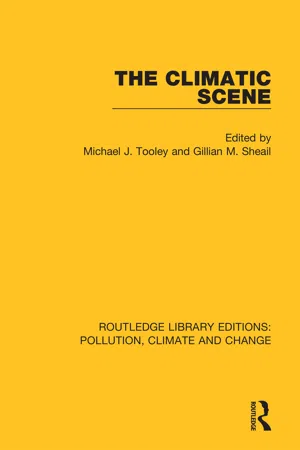
Originally published in 1985, this volume of essays was compiled in honour of Gordon Manley, a major and distinctive twentieth-century figure in climatology. The range and scope of the topics covered reflect the eclectic interests of Manley, whose orientation was always towards the importance of climate and its impact on mankind. The state of the art of climatic change is considered at different scales by the contributors: from instrumental records on a local scale from Durham and Manchester to discussions on the regional and continental scale. Methodological problems relating to climatic change are treated. The effects of climate and climatic change on plant distribution, disease vectors and agricultural pests are also considered.
- 326 pages
- English
- ePUB (mobile friendly)
- Available on iOS & Android
eBook - ePub
The Climatic Scene
About this book
Information
1
The life and work of Gordon Manley
This account of the career and academic achievements of Gordon Manley sets out some of his aspirations for the future of environmental studies and climatic research, and indicates the way in which he hoped his later work might be presented. An article by Manley on British weather originally published in Anglia (1963, in Russian) is reproduced.
1.1 Introduction
Gordon Manley had a very rich academic life, as evidenced in the papers by Lamb (1980, 1981) and others (Anon. 1980, Aitken 1981, Vollans 1979–80), which have served as a basis for the present description and evaluation. The present authors experienced his enthusiasm briefly at Lancaster, where they were, respectively, a research student and a lecturer in the Department of Environmental Sciences in the 1960s. Discussions with colleagues and friends have disclosed the range of Manley’s interests and abilities, as well as his compassion, intellectual humility and quixotic sentiments. He pursued his research doggedly and cheerfully, and received international accolades as a scientist for his work on the range of variation of British climate. All this was done frugally and thriftily, without munificent research grants or the aid of continuous research assistance. He worked alone, but his output of scientifically sound papers was enormous: reference to his bibliography shows that he wrote 182 papers in the period spanning more than 40 years from 1927 until 1981. His book Climate and the British Scene still stands as a worthy monument to his ability as a writer of scientific prose, but at the same time it is an eminently readable volume. Manley’s wit, his apposite turns of phrase, his joy of learning and of music, and his infectious enthusiasm for his subject were characteristics from which all his students benefited. Disappointments were seldom shared, but the disenchantment with the subject he had chosen at Cambridge and the lack of enthusiastic, strongly motivated students to continue his research occasionally emerged in conversation.
An outline of his career is given in the following sections, and the developments and directions of his research are described. One section is devoted to the reproduction of an article by Manley on British weather that was published in Anglia in 1963, because it epitomises in style and content Manley’s prowess as a writer of scientific prose. It is redolent of the writings that emanated from the gatherings of great scientists in the provinces in Manchester, Birmingham and Edinburgh, to which Manley liked to refer as ‘the “outlying foci” of early scientific progress’.
1.2 Early life and work, 1902–47
Gordon Manley was born on 3 January 1902, at Douglas in the Isle of Man, the son of Valentine Manley, a chartered accountant. He was brought up in Blackburn, and educated at Queen Elizabeth’s Grammar School. Professor Fisher (1980) has recounted that his origins were ‘the cold north-western shoulder of the Rossendale uplands of Lancashire, where annual rainfall can and often does exceed 60 inches and peaty streams coalesce to form a black burn and a black pool’. From the age of 12, Manley took meteorological readings on the hills around his home, and showed the same precocious interest in natural phenomena that characterised the Elton brothers (William and Sir Charles) in their record of the plants, animals and weather on the Ainsdale Dunes of the Lancashire coast. In October 1918, he went up to Manchester University, where he read for an honours degree in engineering under the Beyer Professor of Engineering and Director of the Whitworth Laboratory, a post first held by Sir Joseph Ernest Petavel (who became Director of the National Physical Laboratory) and then by Professor Arnold Hartley Gibson (who specialised in hydroelectric engineering). Manley graduated in July 1921.
From Manchester, Manley went on to Gonville and Caius College, Cambridge, where he became an affiliated student and took geography shortly after the tripos had been established. He showed considerable aptitude for geography, and gained a double first in 1923. He was an exhibitioner of the college in 1922–3. At Cambridge, he met Mr (later Professor) Frank Debenham, who was a Fellow of Caius College from 1919, a lecturer in surveying, and, from 1923, tutor. Subsequently Debenham became Reader in Geography in 1928, and Professor of Geography from 1930 to 1949. Debenham had been the geologist on the British Antarctic Expedition from 1910–13 under the command of Captain Robert Falcon Scott, and he founded the Scott Polar Institute at Cambridge, being a Founder Director from 1925 to 1946. Debenham’s inspiring teaching had a profound effect on Manley, and his interest in polar and high-altitude environments stems from this influential period at Cambridge. Many years later, (in 1947), when he was awarded the Murchison Grant by the council of the Royal Geographical Society, Manley acknowledged his debt to Debenham ‘for putting me on to the polar track’.
The early training that Manley received at Manchester in a practical and applied science, and the introduction to polar and high-altitude environments at Cambridge provided the firm foundation upon which he built his academic career. Measurement, primary data and field experience, particularly of high altitudes and latitudes, together constituted his lodestone.
In 1925, he entered the Meteorological Office, and was stationed at Kew Observatory, where there was a long meteorological record which had been taken irregularly from 1773, and where he had training in the use and maintenance of meteorological instruments.
Manley quit the Meteorological Office in 1926 to take up an assistant lectureship in geography at the University of Birmingham. Between these two posts, in the summer of 1926, he joined the Cambridge Expedition to East Greenland under Mr (later Sir) James M. Wordie, who was to become the Honorary Secretary and President of the Royal Geographical Society. Manley worked with Sir Gerald Lenox-Conyngham (lately retired from the Indian Survey) on Sabine Island, where they undertook survey work, gravitational measurements and meteorological readings. The results were written up by Manley as appendices to the expedition report published in the Geographical Journal. The gravitational measurements that Manley made were, at that time, the northernmost record, and these were published in 1932 in Meddelelser om Grønland.
In 1927, Manley became a Fellow of the Royal Geographical Society. He was appointed Lecturer in Geography at the University of Durham from October 1928. The establishment of geography at Durham had been mooted two years earlier by Canon Braley, the Principal of Bede College. Manley was required to organise and conduct the teaching of geography at Durham in the Faculties of Arts and Science, and to co-operate with Professor Arthur Holmes in the Department of Geology. Notwithstanding a small operating budget, and small staff and student numbers, Manley pursued an active teaching and research programme. He taught classes in physical geography, including climatology and biogeography, and the regional geography of North America, in which he was no doubt helped by visits to Pittsburgh as a boy, when he had accompanied his father on business trips. Important aspects of the honours and pass degree courses were practical mapping and fieldwork.
Manley was appointed Curator of Durham University Observatory in 1931, and he began his work on standardising the long temperature record by adjusting the values for exposure, changes in the position of the instruments and inadequate recorders, as Miss J. M. Kenworthy recounts in Chapter 2. In addition, from 1932, he began to collect data at Moor House on the climate of the northern Pennines, particularly the helm wind of Crossfell. Manley’s empirical study led to theoretical work on standing waves in the atmosphere in the lee of mountain ranges by such meteorologists as R. S. Scorer. In 1937, he received a grant for meteorological research from the Leverhulme Trust that enabled him to establish a meteorological station adjacent to the summit of Dun Fell at 2780 ft (847.3 m), and maintain with others a record at three-hourly intervals of weather conditions for three years from 1938 to 1940. This was the first series of mountain observations to become available in England; it remains the longest unbroken mountain record to this day. These investigations led to more than a dozen papers on the weather of the northern Pennines and adjacent areas, published between 1932 and 1947.
At the same time, Manley’s eclectic interests carried him into other areas, and he published papers on antiquarian maps, atlases, the geography of Durham City and on snowfall and transport problems. In 1938, he was successful as an external candidate for the degree of MSc in the Faculty of Science at the University of Manchester; and in the following year he gave up his post as Senior Lecturer in Geography and Head of Department at Durham to take up a demonstratorship in Geography at the University of Cambridge. He retained a great affection for Durham throughout his life, and it was during his time there that he met and married (in 1930) Audrey Fairfax Robinson, with whom he shared almost 50 years of his life. Audrey Manley was the daughter of Dr Arthur Robinson, who was Master of Hatfield College until 1940 and who previously had been a Lecturer in Classics from 1899, Professor of Logic and Psychology from 1910, and Vice-Chancellor of the University of Durham.
At Cambridge, Manley renewed his contact with Professor Debenham, and found a department in which Steers, Lewis and later Peel were members. At this time, physical geography played a leading rôle at Cambridge, and its exponents were practical field scientists concerned with measurement in the field as a sound basis for interpretation and explanation. Nearby, Dr (later Professor Sir) Harry Godwin had begun his seminal and stimulating work on the postglacial history of British vegetation, and Debenham continued as Director of the Scott Polar Institute. Manley was greatly interested in all these topics, which he enhanced by his scholarship, and was in turn enhanced by them.
From 1942 to 1945, he was a Flight-Lieutenant in the Cambridge University Air Squadron, but he still carried on his research and maintained a miscellaneous teaching programme not only for Cambridge undergraduates, but also for undergraduates from Bedford College, University of London, who had been evacuated there.
While at Durham, Manley had been elected a Fellow of the Royal Meteorological Society, on 16 November 1932. In 1943, he was awarded the Buchan Prize, jointly with Dr T. E. W. Schuman, for three papers which he had published in the Quarterly Journal: the first was on the analysis of meteorological observations taken during the British East Greenland Expedition at Kanger-dlugssuak; the second was on the occurrence of snow cover in Great Britain; and the third was on the Durham meteorological record, 1847–1940. The following year, on 19 April 1944, he gave the G. J. Symons Memorial Lecture, and he chose as his topic recent contributions to the study of climatic change. This was undoubtedly inspired by the work of H. W. Alhmann of Stockholm on glacier variations. In 1945, he became President of the Royal Meteorological Society, a post he held for two years; this was a signal honour for a geographer, and was in recognition of his outstanding research in meteorology. During the period of his presidency, Manley helped to organise (and gave a paper at) a joint meeting with the British Ecological Society, chaired by Sir Harry Godwin, on ‘Ecology and the study of climate’. It is no coincidence that Weather was founded in May 1946 during Manley’s presidency. It was subtitled, ‘a monthly magazine for all interested in meteorology’, and its objective was to make contemporary developments in meteorology available to a wider public.
1.3 Later life and work, 1948–80
In 1948, Manley became Professor of Geography in the University of London at Bedford College for Women, and he stayed there for 16 years. Lamb (1981) described this period in Manley’s career as probably one of his happiest. He was no longer in one of the Outlying foci’ of scientific progress, and had access to the richest resources (in terms of people and material) that were available in the capital. He was a committed, enthusiastic Head of Department, cherishing his students and giving entertaining lectures and tutorials. The department was pervaded with his genial personality and friendly manner.
In the pre-Robbins period, there was little opportunity for university expansion, and, while Manley preferred a slow growth of student numbers and the maintenance of high standards, it effectively prevented the enlargement and diversification of the research interests of his staff. Nevertheless, Manley was not slow to grasp the opportunity provided by the creation of a small number of tutorial fellowships by the college. During Manley’s tenure the tutorial fellows were the late Michael Holland, Jane Soons, Joan Kenworthy and Brenda Turner, and Elizabeth Shaw became his research assistant. Manley also appointed to the staff of the geography department Michael Chisholm, Clifford Embleton, Jean Grove and Eleanor Vollans (Eleanor Vollans, personal communication 1984).
Manley maintained his links with Cambridge while at Bedford College, one of the results of which was the joint participation of Bedford and Cambridge undergraduates in expeditions to Norway and Iceland (Vollans 1979–80).
In 1949, he gave his inaugural lecture, ‘Degrees of freedom’ (Manley 1950), which is replete with aphorisms for the intending geography undergraduates and professional colleagues. Some of the definitions are perhaps worthy of recall: ‘If British geographers are to be productive and not merely clerkly, they must gain experience in the field. The country is our laboratory’; ‘I feel strongly that we could fittingly pay regard to the work of such men as Ahlmann of Stockholm, Werenskiold of Oslo and Nielson of Copenhagen, animated as it is by the inspiration of an exploratory tradition, painstaking and energetic field work with a massive power of integration of material, by an immense fertility in by-products and by no heedless drawing of frontiers between subjects’; ‘the geographer can and should carry his capacity for integrating observed material to that of integrating results derived from the peripheral sciences’.
In 1952, Collins published Climate and the British scene, in the New Naturalist series. It drew together all the strands of Manley’s research interests and presented them in a clear, concise way. Lamb (1981) described it as ‘a feast of his most attractive writing’. This flair for writing equipped Manley to write a long series of articles for The Manchester Guardian between 1952 and 1961. Mean-while, his output of research papers and monographs continued unabated as he consolidated and extended his earlier work on variations of British climate, upland climates, climatic change, snow cover and early meteorological observers.
While at Bedford College, he became a member of the Council of the Royal Geographical Society (1952–4), and served on four national committees of the Royal Society. He was the UK national correspondent for glaciology, appointed by the British National Committee for the International Geophysical Year, from 1955 to 1961. He was a member of the Air Ministry subcommittee for meteorological research from 1958 to 1962, and he served on the Commission for Snow and Ice of L’Association d’Hydrologie Scientifique of the UGGI whose biennial assemblies he attended in 1936 and from 1948 onwards, publishing reports on their proceedings.
In 1953, Manley became a member of the ‘Exploration Group at Brathay’ at Windermere. The establishment of the group in 1947 arose from W. Vaughan Lewis’ interest in glaciology and the depths of mountain tarns in the Lake District; Lewis had been with Manley in the Department of Geography at Cambridge. In 1966, a committee was set up to advise on the establishment and running of the Field Study Centre at Brathay; together with Professors Steers, Clapham, and Newbould and Dr Winifred Tutin, Manley served on this committee (Campbell & Campbell 1972).
His university commitments continued, and he played his part in establishing and maintaining examination standards in the greatly enlarged departments of geography in the UK by serving as an external examiner at the universities of Bristol (1958–61) and St Andrews (1962–5). At the same time, he gained a DSc degree at the University of Manchester, which was conferred in July 1958.
In 1964, at the age of 62, Manley could have retired from university life and continued his eclectic and stimulating scientific research from his home, supported by a personal research award from Shell. However, it was entirely characteristic of him that instead he rose to the challenge of founding a new department in the equally new University of Lancaster, at the behest of the Vice-Chancellor, Professor (later Sir) Charles Carter, who had been a lecturer at Cambridge and a professor at Manchester.
Manley drew to him a group of like-minded, energetic colleagues and research students, as well as lively groups of undergraduates, and from an elegant 18th-century house in St Leonard’s Gate, and later the converted furniture workshop of Gillows of Lancaster, he presided over the new interdisciplinary subject that he called environmental studies. It is well worth recalling the hopes and expec...
Table of contents
- Cover
- Half Title Page
- Title Page
- Copyright Page
- Original Title Page
- Frontispiece
- Original Copyright Page
- Foreword
- Editors’ preface
- Wastwater, May 1967
- Acknowledgements
- Table of Contents
- List of tables
- List of contributors
- 1 The life and work of Gordon Manley
- 2 The Durham University Observatory record and Gordon Manley’s work on a longer temperature series for north-east England
- 3 Variations in the Durham rainfall and temperature record, 1847–1981
- 4 Some aspects of rainfall records with selected computational examples from northern England
- 5 A critical assessment of proxy data for climatic reconstruction
- 6 The Little Ice Age period and the great storms within it
- 7 The timing of the Little Ice Age in Scandinavia
- 8 Snow cover, snow-lines and glaciers in Central Europe since the 16th century
- 9 Peat stratigraphy and climatic change: some speculations
- 10 Geomagnetism and alaeoclimate
- 11 Climate, sea-level and coastal changes
- 12 The effect of climate on plant distributions
- 13 Climate and the diseases and pests of agriculture
- Bibliography of papers by Professor Gordon Manley
- List of articles by Gordon Manley in The Manchester Guardian
- Author index
- Subject and place index
Trusted by 375,005 students
Access to over 1.5 million titles for a fair monthly price.
Study more efficiently using our study tools.
Frequently asked questions
Yes, you can cancel anytime from the Subscription tab in your account settings on the Perlego website. Your subscription will stay active until the end of your current billing period. Learn how to cancel your subscription
No, books cannot be downloaded as external files, such as PDFs, for use outside of Perlego. However, you can download books within the Perlego app for offline reading on mobile or tablet. Learn how to download books offline
Perlego offers two plans: Essential and Complete
- Essential is ideal for learners and professionals who enjoy exploring a wide range of subjects. Access the Essential Library with 800,000+ trusted titles and best-sellers across business, personal growth, and the humanities. Includes unlimited reading time and Standard Read Aloud voice.
- Complete: Perfect for advanced learners and researchers needing full, unrestricted access. Unlock 1.5M+ books across hundreds of subjects, including academic and specialized titles. The Complete Plan also includes advanced features like Premium Read Aloud and Research Assistant.
We are an online textbook subscription service, where you can get access to an entire online library for less than the price of a single book per month. With over 1.5 million books across 990+ topics, we’ve got you covered! Learn about our mission
Look out for the read-aloud symbol on your next book to see if you can listen to it. The read-aloud tool reads text aloud for you, highlighting the text as it is being read. You can pause it, speed it up and slow it down. Learn more about Read Aloud
Yes! You can use the Perlego app on both iOS and Android devices to read anytime, anywhere — even offline. Perfect for commutes or when you’re on the go.
Please note we cannot support devices running on iOS 13 and Android 7 or earlier. Learn more about using the app
Please note we cannot support devices running on iOS 13 and Android 7 or earlier. Learn more about using the app
Yes, you can access The Climatic Scene by Michael J. Tooley,Gillian M. Sheail in PDF and/or ePUB format, as well as other popular books in Biological Sciences & Business General. We have over 1.5 million books available in our catalogue for you to explore.