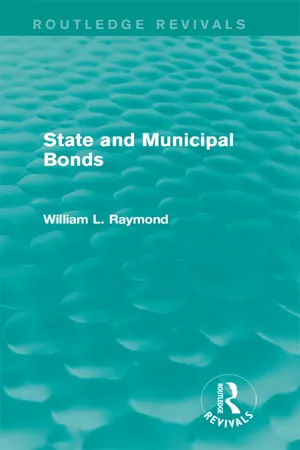
With twenty-one years' experience in the investment bond business, Raymond uses his experience in this study to demonstrate the key issues related to state, county, municipal and district bonds through the use of the most recent data of the time. Originally published in 1923, this version was republished in 1936 to ensure that all figures and arguments were up-to-date. This title will be of interest to students of Business, Economics and Finance.
- 398 pages
- English
- ePUB (mobile friendly)
- Available on iOS & Android
eBook - ePub
State and Municipal Bonds
CHAPTER I
General Status of State, County, Municipal and District Bonds
DESIRABILITY OF STATE, COUNTY, MUNICIPAL AND DISTRICT BONDS. It is not wise to make assertions too sweeping in regard to the safety of any bonds as a class. At the same time, it is fair to say that, under present conditions, the bonds of our States and of our counties, cities and towns — and we may include as a class incorporated districts — rank on the whole next in safety to the bonds of our National Government. Furthermore, State, county, municipal and district bonds have certain features in regard to taxation which make them even more attractive to large numbers of investors than are many of the issues of the National Government.
ARE PUBLIC SECURITIES. State, county, municipal and district bonds, like Liberty Bonds, belong to the great group of so-called public securities as distinguished from private or corporation securities. For their payment, the good faith of the people residing within the State, county, city, town or district issuing the bonds is pledged. Such securities ordinarily are payable out of some form of public taxes or revenue, or sometimes out of public property.
RELATION OF STATES AND LOCAL UNITS TO FEDERAL GOVERNMENT
Perhaps it may be just as well, before going further, to fix in mind the historical and fundamental relations between our States — and their creatures, the counties, cities, towns and districts — on the one hand, and our National Government on the other. As indicated in the Introduction to this book, the thirteen original Colonies were settled and had their own separate and more or less varied forms of government long before the existence of the Federal Union. Not only that, but the various settlements and colonies each had a strong and, after a time, deep-rooted sense of independence and self-sufficiency. While often acting more or less together in the face of common danger, or with a common purpose to accomplish, each colony reserved practically complete freedom of action. The activities of the Continental Congress during the War for Independence were of an emergency and more or less incoherent nature. Likewise, the loose Confederation (1781), preceding the adoption of our Federal Constitution, impaired so little the sovereignty of the States as against each other that it failed to serve effectively the purpose for which it was formed — that is, to create a union under which the various States could act for a common purpose.1 The Federal2 Constitution of 1789, on the other hand, did create a strong central government. By the Tenth Amendment (1790) to the Constitution, however, the powers not delegated by the Constitution to the United States nor prohibited by it to the States are reserved to the States respectively or to the people. Thus the Constitution confirmed in the States of our Federal Union the status and attributes of sovereign states.
STATES SOVEREIGN IN DEBT MATTERS. One of the rights of a sovereign state is the right to create debt and to arrange for the payment of such debt in any manner that it sees fit. It can even arrange not to pay the debt. There is no legal method of forcing a sovereign state to pay its debts against its will.3 None of our States can be sued without its own consent4 except by another state.5 No State can be made, except possibly by force, to make payments it is unwilling to make. The legislature, acting within the limitations of the State Constitution, and with the approval of the Governor, can take or withhold any action that it sees fit in regard to State debts. Failure of the legislature to act means failure to pay.
Unfortunately, some of our States — in debt matters sovereign powers — have taken advantage of this situation to the discomfiture of investors. This subject we shall take up later in this book.
LOCAL UNITS CREATURES OF THE STATES. Our counties, cities, towns and incorporated districts are creatures of the State in which they exist. From a legal point of view, they derive their very existence from the State; and, within certain limitations, they continue their legal existence on the sufferance of the State. Even the charter of a municipal corporation, unlike that of a private corporation, can be amended or repealed by the State — whether or not power to do so expressly has been reserved at the time of granting the charter.1 Unlike the States, therefore, the counties, cities, towns and districts occupy, from a legal point of view, a subordinate and dependent position.
LEGAL REMEDIES AGAINST LOCAL UNITS. This leads to another difference between the States and the local sub-divisions — a difference which works to the benefit of investors when buying public securities issued by local units. Counties, cities, towns and incorporated districts can be sued without their own consent. They are not sovereign in any sense. In case of default of interest or principal of bonds issued by counties, municipalities and districts, bondholders or their representatives can bring suit in the proper court to establish their claim and can apply for a writ of mandamus ordering a levy of taxes to pay interest and principal of the bonds in default.2 Furthermore, in Maine,3 New Hampshire,4 Vermont,5 Massachusetts6 and Connecticut,1 bondholders have the legal right to seize the property of any or all the inhabitants in execution of the judgment of a court ordering payment of defaulted county, municipal or district bonds. In Massachusetts, the doctrine never has been applied to cities.2 It is stated by the Supreme Court (in Hill v. Boston, 122 Mass. 344, 349) as follows:
“By the common law of Massachusetts and of other New England states derived from immemorial usage, the estate of any inhabitant of a county, town, territorial parish or school district, is liable to be taken on execution and judgment against the corporation.”
The doctrine was applied as against a county in Hawkes v. Kennebec County (7 Mass. 461); against a town in Brewer v. New Gloucester (14 Mass. 215); against a territorial parish in Chase v. Merrimac Bank (19 Pickering 564); and against a school district in Gaskill v. Dudley (6 Metcalf 546). In Maine,3 New Hampshire4 and Vermont,5 the doctrine is made by statute applicable to cities as well as to towns; and in Connecticut,6 the doctrine applies to both cities and towns.
In New Hampshire, when a judgment is obtained against a city, town or school district, the execution must be levied first on the property of the corporations. If none is found, a copy may be left with one of the aldermen, selectmen or prudential committee, who must pay it or take steps to raise the money by taxation. If not paid within sixty days, it may be levied on the property of the mayor, aldermen or selectmen (or prudential committee in case of a school district) and then, if sufficient property of theirs is not found, upon the property of any inhabitant.
Outside the New England states cited above, the property of the inhabitants of a municipal corporation cannot be seized for the payment of its debts.1 The general remedy is application to the proper court for a mandamus requiring the proper officials to levy and collect a tax sufficient to pay the judgment.
In New York State, however, municipal property not devoted to a public use may be taken on execution against the corporation2; and in Minnesota, the execution may after a certain time be levied on the public property of the corporation.3 In Indiana, the public property of counties may be taken on execution,4 and probably the same remedy exists against cities and towns. In Nebraska, the officers whose duty it is to levy and collect the necessary tax, if they fail to do so, become personally liable on the judgment and may be sued upon it.5
Furthermore, the Constitution of the United States (Art I, Sec. 10)6 prohibits any State from passing any law “impairing the obligation of contracts.” In other words, if when the bonds are issued there is power to levy taxes for their payment, the Legislature may not destroy or limit this power.
Such is not the case in Canada, where some of the Provinces reserve by statute the right to change or amend the debt contract between a municipality and its bondholders.7
The above summary does not cover all the legal remedies in all the States; but it gives a good general idea of the situation in this respect. It shows how strong is the legal position of holders of county, municipal and district bonds in this country.
TAXATION OF STATE AND LOCAL SECURITIES. Aside from the question of the creation and payment of debt, the relations existing between our States and our National Government, on the one hand, and between our States and our local government units, on the other, have led to important consequences in another field — that of taxation. Just as no State and no county, city, town or district has the right to tax the obligations or securities of the National Government, so in turn the National Government has no right — without a constitutional amendment1 — to tax the obligations or securities of our States or of the States’ creatures — the counties, cities, towns and incorporated districts. In view of the heavy Federal taxation on incomes which has prevailed since 1917, and which is likely to prevail to a greater or less degree for some years to come, this is a point of great importance.
PRICES OF STATE AND LOCAL BONDS
There is one more point that is worth making in this general discussion of State, county, municipal and district bonds. The prices of these bonds, like the prices of all fixed income-bearing securities as a class, have been recently (June 1, 1932) at or near their lowest for a long series of years. This is probably due mainly to the general loss of confidence, or condition of semi-panic, which prevails throughout the world. Yet the great body of State, county, municipal and district bonds in the United States is likely to prove among the safest of all investment securities.
COMMODITY PRICES AND BOND PRICES. Normally the greatest factor in the long swing of bond prices — a swing likely to occupy from fifteen to twenty years — is the commodity price movement. Always entering into the values and the prices of fixed income-beari...
Table of contents
- Cover
- Half Title
- Title Page
- Copyright Page
- Original Copyright
- Table of Contents
- INTRODUCTION
- CHAPTER I General Status of State, County, Municipal and District Bonds
- CHAPTER II State Bonds
- CHAPTER III Summaries by States of Leading Factors in State Credit
- CHAPTER IV County, Municipal and District Bonds
- CHAPTER V County, Municipal and District Bonds (Continued)
- CHAPTER VI Taxation of State and Local Public Securities
- CONCLUSION
- APPENDIX
- INDEX
Trusted by 375,005 students
Access to over 1.5 million titles for a fair monthly price.
Study more efficiently using our study tools.
Frequently asked questions
Yes, you can cancel anytime from the Subscription tab in your account settings on the Perlego website. Your subscription will stay active until the end of your current billing period. Learn how to cancel your subscription
No, books cannot be downloaded as external files, such as PDFs, for use outside of Perlego. However, you can download books within the Perlego app for offline reading on mobile or tablet. Learn how to download books offline
We are an online textbook subscription service, where you can get access to an entire online library for less than the price of a single book per month. With over 1.5 million books across 990+ topics, we’ve got you covered! Learn about our mission
Look out for the read-aloud symbol on your next book to see if you can listen to it. The read-aloud tool reads text aloud for you, highlighting the text as it is being read. You can pause it, speed it up and slow it down. Learn more about Read Aloud
Yes! You can use the Perlego app on both iOS and Android devices to read anytime, anywhere — even offline. Perfect for commutes or when you’re on the go.
Please note we cannot support devices running on iOS 13 and Android 7 or earlier. Learn more about using the app
Please note we cannot support devices running on iOS 13 and Android 7 or earlier. Learn more about using the app
Yes, you can access State and Municipal Bonds by William L. Raymond in PDF and/or ePUB format, as well as other popular books in Business & Business General. We have over 1.5 million books available in our catalogue for you to explore.