eBook - ePub
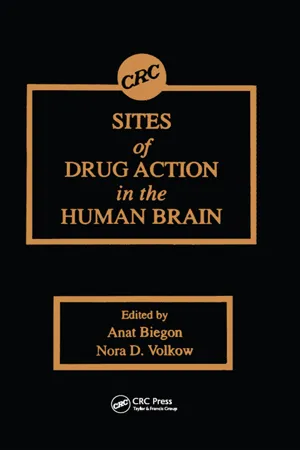
Sites of Drug Action in the Human Brain
- 192 pages
- English
- ePUB (mobile friendly)
- Available on iOS & Android
eBook - ePub
Sites of Drug Action in the Human Brain
About this book
Sites of Drug Action in the Human Brain uses the results of recent analyses of the regional brain distribution and binding pattern of drugs in the human brain. This new book specifically addresses drugs of abuse and treats the effects of various drugs on behavior and mood, as well as on metabolism and blood flow in the human brain. It also presents the methodological aspects of investigating the sites of drug action in the human brain.
Because it focuses on the living human brain, this book differs from other books on the subject, which primarily use the results of postmortem studies. Sites of Drug Action in the Human Brain therefore provides valuable information on the clinical aspects of drug intoxification, addiction, and toxicity.
Information
Chapter 1
LOCALIZATION AND CHARACTERIZATION OF DRUG BINDING SITES IN THE HUMAN BRAIN: METHODOLOGICAL CONSIDERATIONS
Anat Biegon
Center for Functional Imaging
Lawrence Berkeley Laboratory
Berkeley, CA 94720
Nora D. Volkow
Medical Department
Brookhaven National Laboratory
Upton, NY 11973
INTRODUCTION
A drug enters the body. Where does it go and what happens next? When dealing with drugs which primarily affect behavior, the assumption is that the drugs in question are capable of penetrating the blood brain barrier and interacting directly with the brain. Presumably, different drugs interact with specific sites located in particular brain regions in order to exert their action. In this chapter, we shall provide a concise description of the most common methodologies employed to localize and characterize sites of drug action in the brain: quantitative in vitro autoradiography (QAR) and positron emission tomography (PET). Both techniques rely on detection and quantification of the levels of a radioactively labeled drug in the tissue, and extensive reviews of QAR and PET applications in basic and clinical research are available (e.g., 1, 2, 3, 4, 5). We shall limit ourselves to a discussion of the principles and applications of these techniques, as well as their advantages and disadvantages, in the context of studying drug actions in the human brain.
QUANTITATIVE AUTORADIOGRAPHY (QAR)
PRINCIPLES AND APPLICATIONS OF QAR
Autoradiography is a relatively old technique permitting qualitative localization of radioactivity in tissues through the use of radiation sensitive detectors such as emulsion or film (6,7). Quantitative autoradiography is a relatively recent development, made possible by several theoretical and technical advances; namely, the incorporation of standards, the invention of tritium sensitive film, and the availability of computerized image analysis systems (1,8,9). An impressive number of neurotransmitter receptors, drug binding sites, as well as other important brain molecules (enzymes, ion channels, etc.) have been localized and characterized by QAR over the last decade (e.g., 1). Most of this work was performed in experimental animals; but the technique has been found to be readily adaptable to the human brain as well (1,10,11,12).
Human brains are generally collected at autopsy, sliced, frozen, and stored at -70 to -80° C. Thin (20 to 40 µm) sections of brain tissue blocks or, preferably, whole hemispheres are produced at -20° C using a cryostat. Sections are mounted on gelatin-coated glass slides and stored at -20°C (e.g., 11,13).
Generally, autoradiographic localization of drug binding sites in the human brain is attempted after the biochemical/pharmacological nature of the sites and optimal conditions for their labeling have been identified in animal and/or human brain homogenates. Thus, optimal labeling conditions (e.g. concentration of radioactive drug, incubation temperature and length, ionic composition of incubation buffer) specific for various drugs are used in the labeling protocols. The two most common radioisotopes used with QAR are tritium and iodine-125, although other radioisotopes can be used as well. The radioactive brain sections are washed to reduce nonspecific labeling of tissue components, dried, and apposed to radiation sensitive film. Slides carrying radioactive standards (both tritium and I-125 calibrated standards are now available commercially) are included with each experiment. Brain sections and standards are exposed to film for varying lengths of time (from a few hours to a few months, depending on the isotope, its specific activity, and the concentration of the drug binding sites in the brain) and developed using standard procedures. Following film development, the sections are stained with cresyl violet to help identify neuroanatomical structures.
Quantitation of autoradiograms is accomplished using a computerized image analysis system. A video camera, densitometer, or scanner can be used to input the image data into the computer. Regions of interest are traced on the screen image of the brain section and the concentration of radioactivity in the region computed by reference to a standard curve derived from the internal standards coexposed with the experiment. Thus concentrations of radioactivity in tissue can be expressed in the same units used in biochemical assays, facilitating cross comparisons of values obtained by various techniques.
The amount of non-specifically bound drug can be assessed by coincubation of radiolabeled drug with a large excess of an unlabeled drug. Specific binding is calculated as the difference between the two images.
The pharmacological identity of binding sites in various brain regions can be studied on brain sections by coincubation of consecutive sections from the same brain with various drugs and chemicals of known selectivity. Again, the amount of radioactivity associated with various sites in different brain regions is calculated by the difference between total binding and binding in the presence of specific competitors.
STRENGTHS AND WEAKNESSES OF QAR
The major strengths of QAR are its sensitivity and spatial resolution, and the ability to obtain binding site density information simultaneously with the relevant neuroanatomical information. Since there is hardly a limit (besides patience) on the amount of time a section can be exposed to film or emulsion, the technique affords a sensitivity up to several orders of magnitude better than that available by most biochemical assays. The resolution of radiation sensitive film (which is considerably lower than the resolution of emulsion) is less than 100 µm - quite sufficient to resolve a single human cortical layer. Resolution at the cellular (light microscopy) and subcellular (EM) levels can be achieved with emulsion but these approaches are usually used to answer different kinds of questions (6,7).
The limitations of QAR in the analysis of sites of drug action in the human brain are mostly conceptual, rather than technical, in nature. The main one stems from the fact that in vitro autoradiography is carried out on frozen brain tissue obtained post-mortem. This precludes dynamic experiments in which changes in drug binding sites can be followed over time, in the presence or absence of particular pathological or physiological states or in prospective studies of aging, addiction, or disease. Similarly, the functional (e.g., metabolic or behavioral) correlates of drug action can not be studied in frozen brains. QAR use is also limited by the post-mortem stability of the brain sites under investigation. While many brain receptors, enzymes and drug binding sites (especially membrane-bound) are surprisingly stable post-mortem and can be measured without appreciable loss up to 48 hours post-mortem, other sites such as intracellular (e.g., steroid) receptors are considerably less stable. However, these weaknesses of QAR are the strengths of the other methodology described in these pages, namely positron emission tomography (PET).
POSITRON EMISSION TOMOGRAPHY (PET)
PRINCIPLES AND APPLICATIONS OF PET
PET takes its principles from autoradiography and expands them to the investigation of the living human brain (4,14). Like autoradiography, PET measures the regional concentration of radioisotopes within the tissue. What have made PET feasible and unique are the characteristics of the positron emitters.
The short half life of the positron emitters utilized for PET (e.g., 150=120 seconds, 13N=10 minutes, 11C = 20 minutes, 18F=110 minutes) facilitate repeated studies of the same individual without excessive radiation risks (see 15 for a review of positron emitters and positron labeled compounds). The decay properties of positron emitters enable detection without the need of collimators and the consequent loss of sensitivity. Positron emitters decay by liberating a positron from the nucleus which travels a short distance (positron range or mean free path, average 2 mm) before it loses its energy and collides with an electron. Such a collision results in two annihilation gamma ray photons with 511 keV energy. The annihilation photons are liberated simultaneously in nearly opposite directions (with a slight deviation from a 180° angle). The PET scanner will register an event only when two gamma rays reach two detectors (made coincident with each other) simultaneously (coincidence time window). The coincidence detection of the gamma rays locates the annihilation within the region covered by the field of view of the two detectors where the event was registered. Events occurring outside the region delineated by the two coincident detectors are not registered. Events arriving at two coincident detectors at different times (outside the coincidence time window) are not registered.
Coincident detection of positron emitters by an individual pair of detectors is very inefficient. In order to optimize detection, each detector in a PET camera is made coincident with many other detectors simultaneously. For this purpose detectors are arranged around the head or body in a ring or multiple-ring system to image the whole organ at one time. The detectors used for the PET camera are scintillation crystals coupled to photomultiplier tubes. The scintillation crystals fluoresce when interacting with the ionizing radiation and the scintillation generated by this interaction is converted into an electrical signal by the photomultiplier tube. These signals are then integrated and transformed by a computer to create images on a screen (e.g., 14,16). Neuroanatomical regions of interest can be traced and quantified in a manner similar to the one described above for autoradiography.
PET has been used for the in vivo localization of numerous neurotransmitter receptors in the human brain and in the study of functional correlates of various neurological and psychiatric disorders (17). As for the localization and characterization of sites of drug action in the human brain, PET provides information that relates the neuroanatomical, functional, and neurochemical interactions of the drug.
A suitably labeled drug injected intravenously can be followed over time in the brain, and regions of high drug concentration visualized directly and quantified. This approach supplies distribution maps which are similar in nature, although of a lower resolution, to those generated by QAR. However, PET can also be used to localize and characterize the regional distribution of brain function, i.e., metabolic, changes produced by drugs. Most of the functional studies done with PET involve the utilization of 18-fluoro-2-deoxy glucose (FDG) to measure regional brain glucose utilization (18). A comparison of the subjects’ metabolic map ...
Table of contents
- Cover
- Title Page
- Copyright Page
- The Editors
- Contributors
- Acknowledgements
- Table of Contents
- Chapter 1. Localization and Characterization of Drug Binding Sites in the Human Brain: Methodological Considerations
- Chapter 2. Autoradiographic Localization of Benzodiazepine Receptor in the Human Brain Post-Mortem
- Chapter 3. In Vivo Imaging of Benzodiazepine Receptors with Positron Emission Tomography
- Chapter 4. Effects of Benzodiazepine on Behavior, Mood, and Regional Cerebral Metabolism
- Chapter 5. Quantitative Autoradiography and Cannabinoid Receptors in the Human Brain Post-Mortem
- Chapter 6. The Effects of Marihuana in the Human Brain Measured with Regional Brain Glucose Metabolism
- Chapter 7. Quantitative Autoradiographic Localization and Characterization of Cocaine Binding Sites in the Human Brain Post-Mortem
- Chapter 8. PET Studies of Cocaine in Human Brain
- Chapter 9. Autoradiographic Distribution of Multiple Opioid, Sigma, and Phencyclidine Receptor Binding Sites in the Human Brain
- Chapter 10. Imaging Opiate Receptor In Vivo
- Chapter 11. The Use of Positron Emission Tomography to Study the Acute Effects of Addictive Drugs on Cerebral Metabolism
- Discussion
- Index
Trusted by 375,005 students
Access to over 1.5 million titles for a fair monthly price.
Study more efficiently using our study tools.
Frequently asked questions
Yes, you can cancel anytime from the Subscription tab in your account settings on the Perlego website. Your subscription will stay active until the end of your current billing period. Learn how to cancel your subscription
No, books cannot be downloaded as external files, such as PDFs, for use outside of Perlego. However, you can download books within the Perlego app for offline reading on mobile or tablet. Learn how to download books offline
Perlego offers two plans: Essential and Complete
- Essential is ideal for learners and professionals who enjoy exploring a wide range of subjects. Access the Essential Library with 800,000+ trusted titles and best-sellers across business, personal growth, and the humanities. Includes unlimited reading time and Standard Read Aloud voice.
- Complete: Perfect for advanced learners and researchers needing full, unrestricted access. Unlock 1.5M+ books across hundreds of subjects, including academic and specialized titles. The Complete Plan also includes advanced features like Premium Read Aloud and Research Assistant.
We are an online textbook subscription service, where you can get access to an entire online library for less than the price of a single book per month. With over 1.5 million books across 990+ topics, we’ve got you covered! Learn about our mission
Look out for the read-aloud symbol on your next book to see if you can listen to it. The read-aloud tool reads text aloud for you, highlighting the text as it is being read. You can pause it, speed it up and slow it down. Learn more about Read Aloud
Yes! You can use the Perlego app on both iOS and Android devices to read anytime, anywhere — even offline. Perfect for commutes or when you’re on the go.
Please note we cannot support devices running on iOS 13 and Android 7 or earlier. Learn more about using the app
Please note we cannot support devices running on iOS 13 and Android 7 or earlier. Learn more about using the app
Yes, you can access Sites of Drug Action in the Human Brain by Anat Biegon, Nora D. Volkow, Anat Biegon,Nora D. Volkow in PDF and/or ePUB format, as well as other popular books in Medicina & Farmacología. We have over 1.5 million books available in our catalogue for you to explore.