- 258 pages
- English
- ePUB (mobile friendly)
- Available on iOS & Android
eBook - ePub
About this book
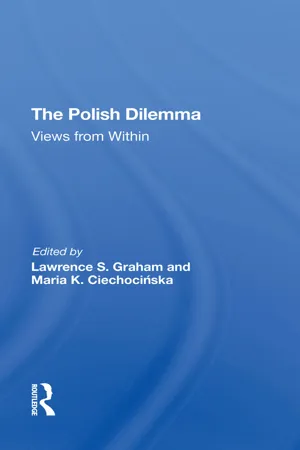
Although much has been written about contemporary Poland, discussions that provide a balanced assessment of the current situation are in short supply. To correct that problem, this book offers a cross-section of intellectual opinion within Poland, including original research and works of synthesis that draw on Polish research and writing that have been, for the most part, inaccessible to scholars outside Poland. The contributors' views avoid the extremes of condemnation or defense of the system and make possible a more complete understanding of present-day realities. Their perspectives are moderated by the fact that, although the authors recognize the need for reform and change, they also take into consideration the great constraints facing all who would confront serious national issues. The discussions range from examinations of social structure and class to evaluations of the significance of the state apparatus in the analysis of policy and assessments of economic performance.
Information
Part One
Politics and the State
The intent of this first section is to lay out for the reader the current structure of the Polish state and the forces that have given shape to it, as understood by those working within the system. Crucial to the structuring of a socialist state in postwar Poland is the leading role played by its reconstituted Communist party—the Polish United Workers' party (the PZPR). For this reason, before the book deals with the state apparatus per se, the first chapter provides an overview of how the political party system now dominant in Poland took form, of the framework within which all subsequent political involvement has operated, and of the patterns of collective political leadership.
Jerzy Wiatr is eminently qualified to provide an overview of the postwar Polish political party system. A prolific writer on Polish parties and political behavior, he agreed to prepare for this volume a chapter that would synthesize his previous scholarship and establish an overview of the Polish political party system. The crucial concept that he introduces here is that of a hegemonic party system in which one party clearly dominates and exercises a leading role. Of course, in a socialist state that political organization is the Communist party. But whereas in other socialist states the only legitimate party is the duly constituted national Communist party (which is, in turn, frequently matched by some form of a socialist unity front designed to mobilize mass sectors of society), in the Polish case, mobilization of a mass constituency has taken the form of reshaping the historic parties and granting them the exclusive right of representing the various recognized sectors of Polish society.
There are four major party groupings. The official organization for representing the peasant sector is the United Peasant Alliance (ZSL). That representing urban labor is the Polish United Workers' party (PZPR), which because of its vanguard role as a national Communist party, dominates and sets the parameters for the actions of the other party organizations. The third is the Democratic Alliance (SD); its roots lie in the liberal-democratic movement of the prewar era, and it is the official organ representing the middle sectors of Polish society. The fourth alignment consists of the Catholic associations; these number three—the PAX Association, the Christian Social Association (ChSS), and the Polish Union of Lay Catholics (PZKS, sometimes referred to as ZNAK. Attention to the performance of these Catholic associations and their relationship to the Catholic community, however, should not lead one to conclude necessarily that they are representative organizations. The same could also be said of the SD and the degree to which it really gives representation of the middle sectors of Polish society. The more appropriate organizing concept, one that comes from nonsocialist systems, is that of corporatism, whereby the state organizes and sanctions the official organizations representing the various interests in society. It is here that the concept introduced later in this book, of "the system of exercising power," becomes most appropriate. These organizations are an extension of the state and must be viewed as distinct from any one particular social sector that may be identified in the larger society.
With this political party background set, Wojciech Sokolewicz's discussion of the functions and the structures of the contemporary Polish state becomes most appropriate. Generally speaking, most Western political scientists— especially those trained in the traditions of comparative politics—accord minimal importance to the state apparatus. Likewise, those trained in political science in Eastern Europe rarely consider the category "public bureaucracy" to be an appropriate part of the political domain. Yet no discussion of Polish politics aimed at an assessment of the consequences of political action can ignore the presence of the state and organizational structures that clearly define the limits of action. My own way of dealing with this phenomenon comparatively is to speak of the division between state and society and of the alignment between prosystem and antisystem forces.
The Sokolewicz chapter, then, offers a detailed account of the state apparatus, subdivided according to its major components. It is these components, in turn, that define the arenas in which the government of Poland acts and implements its policies. In order to deal with the administrative state phenomenon, which is such an important part of the evolution of all modern governments, one frequently has to go to those trained in law for understanding the continental systems, in Eastern as well as Western Europe. A major part of the Sokolewicz chapter concerns the Polish parliament, the Sejm. In order to place this discussion in proper context, I would like to suggest that the richness of detail contained here is best understood as a problem in the analysis of the administrative state under socialism, in the context of prior practices centered around executive supremacy (in which political and governmental control has been fused in the person of the premier and the first party secretary) and present desires to bring about political reform by revitalizing the legislature. This, then, is the setting in which one finds discussion taking place of how to achieve a greater amount of pluralism within socialism as a corrective to bureaucratism and reliance on single-person leadership. There is likewise preoccupation with legalism and constitutionalism in recognition of the power vacuum that has emerged as the consequence of major sectors of society regarding the current state as illegitimate. Many argue that to achieve legitimacy it is essential to permit the Sejm to reemerge as the decision-making center of the governmental system. Whether or not that will come to pass cannot be determined here, but what I would suggest is that the Sokolewicz chapter can be read with profit by anyone interested in understanding the structure within which policy is made and implemented in contemporary Poland as well as the current dilemmas of power and authority.
1
The Party System, Involvement in Politics, and Political Leadership
Jerzy J. Wiatr
The political system of People's Poland, shaped after World War II, has been based on a durable system of cooperation among political parties, which nevertheless has undergone change from time to time. This system is an expression of the political involvement of the citizenry and serves as the means for the selection of both national and local political leadership. The stability of the whole political and socioeconomic leadership depends in a great measure on the extent to which the actual functioning of the party system corresponds to its theoretical assumptions. The political events of 1980 and 1981 demonstrated powerfully how a weakening of a party system brings in its wake profound disturbances in the functioning of the state as a whole, including the economic area. The reconstruction of the system, embarked upon after the imposition of martial law in December 1981, signified also the reconstruction of the party system, a process that did not amount to a return to the past but was a critical continuation instead, containing as it did a germ of political reform.
In this chapter, which refers to my earlier publications on the subject, albeit enriched by more recent experience and ideas, it is my intention to
- give a synthesis in outline form of the historical evolution of the party system in postwar Poland, from 1944 to 1980;
- trace back the ideological assumptions legitimizing that system in the period in question;
- consider the mechanisms and effects of political mobilization within the political system in force then and now against this background, the essential features of which involve the selection and operations of the political leadership;
- present those aspects of the sociopolitical crises of 1980-1981 that are directly related to the operation of the party system and analyze the new processes of political mobilization and selection of leadership groups in that period;
- outline the direction of the essential political reforms of 1982-1983 in regard to the operation of the party system, the mechanisms of political involvement, and the selection of leadership groups.1
The only way such a broad range of objectives can be fulfilled is by presenting a synthesis of the conclusions that follow from sociological-political studies, including ones I carried out myself and ones I carried out with the help of my associates, as well as the conclusions coming from observations while participating in the political life of People's Poland. Detailed empirical material can be found in the literature mentioned in the notes.
The Evolution of the Party System in 1944-1980
The party system of People's Poland is based on the cooperation of the workers' party, the peasant party, and the party representing the intermediate urban classes, as well as political groups that combine a Christian philosophical orientation with the political option of participation in the building of a socialist system. The party system is the consequence of history, especially the history of the Polish people's struggle for liberation during World War II. It took root in the alliance of radical left-wing forces in a country occupied by Nazi Germany. The emergence of this alliance signified the abandonment of the "historical parties" of the prewar Second Republic, which had their political successors in the emigre groups supporting the Polish government in London (led by General Wladyslaw Sikorski until his death in July 1943 and afterward by the leader of the Peasant Alliance [Stronnictwo Ludowe—SL], Stanislaw Mikolajczyk). The Polish government-in-exile enjoyed, in contrast, the support of underground political organizations operating in Polish territory, which claimed to be heirs to the prewar political parties; it also controlled the biggest military organization of the Polish political underground, the Home Army (AK).
The split between the Left and the historical parties did not occur all at once. Until 1942 the radical Left existed only in the form of scattered underground groups set up by Communists and radical Polish socialists, especially the "Hammer and Sickle" group, the Association of Friends of the USSR, and the Union of Liberation Struggle. This was so because the Communist Party of Poland (KPP) had been dissolved by the leadership of the Communist International, with which it was affiliated, on the basis of false accusations that were not rescinded until 1956. Despite the absence of a Communist party, the radical left nevertheless joined the struggle; the Left combined a program of national resistance against Nazism with slopns of a revolutionary social reconstruction in postwar Poland.
The Polish Workers' party (PPR) was formed underground on January 1, 1942, by members of the left-wing organizations listed above. Its military arm, set up at the same time, was the People's Guard (GL), later renamed the People's Army. The PPR was headed by Communist activists of prewar times: Marceli Nowotko, Pawel Finder, Malgorzata Fornalska, Wladyslaw Gomulka, Boleslaw Bierut, and others. The party attracted the youth in particular; a major part of its members during the war were people who were too young to have acquired any political experience before the war. This was political mobilization through underground armed struggle, which made the PPR a new party, with a membership and experience distinctly different from that of its predecessor, the KPP. As for ideology, the PPR pointed to its Communist heritage and accepted Marxism-Leninism as its ideology.
The foundation of the PPR accelerated the radicalization of other leftwing parties. At the time, Poland's socialists acted through two clandestine parties, one of which—the more radical one—sought deeper revolutionary transformations (the Polish Socialists, founded in September 1941 and renamed the Workers' Party of Polish Socialists [RPPS] in April 1943). The left wing within the RPPS was inclined to establish close cooperation with the PPR, up to the point of forming a joint political representation of the whole Polish Left. The same path was taken by the leftist group of peasant activists associated with the underground bulletin Wola Ludu (The Will of the People), who later formed the Wola Ludu Peasant Alliance. Finally, the road of cooperation with the PPR was taken by the activists of the progressive-liberal group set up in 1937 and known as the Democratic Alliance (Stronnictwo Demokratyczne—SD).
Initially, the PPR sought to build a broad national front for the anti-Nazi struggle and did not rule out cooperation with the government-in-exile. However, negotiations on such proposals produced no results in view of the London-camp historical parties' decidedly negative attitude toward the PPR. This led to the decision to set up the underground National Home Council (Krajowa Rada Narodowa—KRN). Established on December 31, 1943, it was made up of representatives of the PPR, radical socialists, peasant leaders, and nonparty patriotic activists cooperating with all the others. At a time when the first bits of Polish land were being liberated by the Soviet army and the Polish socialist armed forces set up in the USSR in 1943, the KRN assumed the responsibilities of an interim parliament and established the Polish Committee of National Liberation (PKWN), whose July Manifesto (issued in Chelm on July 22, 1944) laid the cornerstone for the building of a new state system in the liberated country. The PKWN was headed by one of the leaders of the RPPS left wing, Edward Osobka-Morawski.
The reactivation of the political parties of the radical Left occurred between August and September of that year; they then became legally acting elements of the new party system. The RPPS congress held on September 10-11, 1944, revived the Polish Socialist party (PPS) under its traditional name, albeit without a majority of the activists who, whether in exile or at home, supported the London government-in-exile. The Wola Ludu group started to act as the revived Peasant Alliance (SL), and the Democratic Alliance (SD) resumed activity on September 24, 1944, selecting its delegates to the National Home Council. In this way, the rebuilt party system became a system of cooperation of four parties and alliances: the PPR, PPS, SL, and SD.
This alliance of four parties took up the challenge of organizing the state authorities, building the armed forces, and representing Poland in its relations with the anti-Nazi coalition countries. By taking the reins of power, the alliance of the Left departed from constitutional legalism on which the existence of the London government was based. From the formal and legal point of view, this departure took place in the form of the rejection, as null and void, of the April 1935 constitution, whose adoption shortly before the death of Marshal Josef Pilsudski was the constitutional culmination of the military coup d'etat of May 1926 and whose legality was debated from the very beginning.
The situation of the left-wing alliance and of the state authorities established by it was extremely difficult. A considerable part of Polish society supported the London government and its underground structures. After it was set up in July 1944, the PKWN enjoyed the support of only a minority of Poles and had to overcome the distrust or often simply the passiveness of the majority. The PKWN sought to attain that goal through radical socioeconomic reforms (beginning with the September 1944 agrarian reform in which large landed estates were divided among small landholders and farm laborers), the organization of the armed forces (at the end of the war, Poland had the fourth largest armed force of all the countries of the anti-Nazi coalition in Europe), and the reconstruction of the economy, culture, and education. The success of those undertakings is attested to by the fast growth in membersh...
Table of contents
- Cover
- Half Title
- Title
- Copyright
- Contents
- List of Illustrations
- Preface
- Introduction
- Part One Politics and the State
- Part Two Social Structures and Attitudes
- Part Three Socioeconomic Change and Dislocations
- Part Four The Sources of Tension Within the System
- Part Five A Reassessment of the Polish Dilemma
- About the Contributors
- Index
Trusted by 375,005 students
Access to over 1.5 million titles for a fair monthly price.
Study more efficiently using our study tools.
Frequently asked questions
Yes, you can cancel anytime from the Subscription tab in your account settings on the Perlego website. Your subscription will stay active until the end of your current billing period. Learn how to cancel your subscription
No, books cannot be downloaded as external files, such as PDFs, for use outside of Perlego. However, you can download books within the Perlego app for offline reading on mobile or tablet. Learn how to download books offline
We are an online textbook subscription service, where you can get access to an entire online library for less than the price of a single book per month. With over 1.5 million books across 990+ topics, we’ve got you covered! Learn about our mission
Look out for the read-aloud symbol on your next book to see if you can listen to it. The read-aloud tool reads text aloud for you, highlighting the text as it is being read. You can pause it, speed it up and slow it down. Learn more about Read Aloud
Yes! You can use the Perlego app on both iOS and Android devices to read anytime, anywhere — even offline. Perfect for commutes or when you’re on the go.
Please note we cannot support devices running on iOS 13 and Android 7 or earlier. Learn more about using the app
Please note we cannot support devices running on iOS 13 and Android 7 or earlier. Learn more about using the app
Yes, you can access The Polish Dilemma by Lawrence S Graham,Maria K Ciechocinska in PDF and/or ePUB format, as well as other popular books in Politics & International Relations & Political Economy. We have over 1.5 million books available in our catalogue for you to explore.