First published in 1931. This study was written by various officials of the International Labour Office, and provides an overview of the work of this institution as it was in the years after its initial formation. The authors provide a full and systematic description of the activities within the organisation, and will be of great interest to scholars and students of political and labour history.
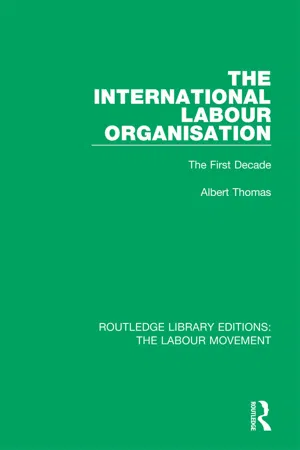
- 382 pages
- English
- ePUB (mobile friendly)
- Available on iOS & Android
eBook - ePub
PART I
STRUCTURE AND FUNCTIONS
ON October 29th, 1919, the First Session of the International Labour Conference opened in Washington. In the same city a few weeks later the Governing Body met to take the necessary steps for organising the International Labour Office and appointed as its first Director Albert Thomas, former Minister of Armaments in France. Thus barely a year after the Armistice, five months after the signature of the Treaty of Versailles which contained its constitution, three months before that Treaty came into force and more than a year before the first meeting of the Assembly of the League of Nations, to which it was constitutionally attached, the International Labour Organisation came into active existence.
Nothing could show better than this simple comparison of dates the importance and the urgency which the international social problem had in the eyes of the post-War Governments. It is generally difficult for contemporaries to estimate the true importance of an event. Those who lived through the troubled months immediately following the War were impressed chiefly by the impassioned discussions at the preliminary Peace Conference and in the various countries on the vexatious questions of frontiers and reparations. The great eddies in which the world was still swirling after the storm of the War years had too strong a hold on the attention of the public to enable it to give due heed to the first tentative efforts at international organisation which were being made in the background. The apparently lukewarm interest shown in these attempts even by certain of the statesmen on whom their success depended and the seeming disproportion between the overwhelming problems of the hour and the proposed institutions whose possible stability could not be gauged by any past experience obscured the fact that the texts drafted in Paris would, after the painful task of winding up the past, prove the foundation on which, patiently and stone by stone, the new organisation of the world was to be built up.
It is true that the action taken by the statesmen was determined by the general longing for peace and the great dream of international reconciliation and social justice cherished by the peoples during the dark days of the War. But for this unanimous desire, deep-rooted in every country, there would have been at the Peace Conference no Commission for the League of Nations and no Commission on International Labour Legislation. But the masses had difficulty in recognising the objects of their hope behind the often lifeless formulae of legal texts submitted to them. They were faced with machinery, with a starting point the great daring of which escaped them, because they compared it with the ideal of which they had dreamt and not with the past on which they were deliberately turning their backs.
Ten years have passed. The institution has lived. It has survived the early struggles, and although it has not done more than begin to carry out its programme it has at least shown enough of the possibilities of realisation to make clear the boldness of the solutions imagined in 1919. We are beginning to see that the historian who a century later may analyse the facts of this memorable year will lay by far the greatest stress on the creation of the international institutions. What he will find it necessary to explain will not be the timidity but the boldness of their constitutions, not the hesitations of certain States but the rapidity with which an organisation was set up which in many respects ran counter to the traditional conceptions of the law of nations. This daring and this urgency can be seen even more clearly in Part XIII than in Part I of the Treaty. The constitution laid down by Part XIII establishes an entirely new type of international organisation on account of the representation of interests in the composition of the Conference and the Governing Body, the system of individual voting by delegates, the two-thirds majority in place of the rule of unanimity for the adoption of Conventions and Recommendations, the obligations which this adoption involves for the States Members and finally the measures taken for supervising the application of Conventions. The position which its constitution occupies in the Peace Treaties and the autonomy which the Organisation enjoys within the League of Nations are proof of the special importance with which its founders wished to endow it. Finally, the date of October 1919 fixed in the Treaty for the opening of the first International Labour Conference, the agenda laid down in an additional protocol and the decision of the Peace Conference to give the constitution of the new Organisation executive force without waiting for the signature of the Peace Treaty, reveal the urgent desire of Governments to give the workers a pledge of their good will and their sincerity.
CHAPTER I
ORIGINS AND PRINCIPLES
Paving the Way: The Current of Thought in the Nineteenth Century
The special treatment accorded to the social problem by the peace-makers of 1919 can be understood only in the light of the past. In the history of institutions thought has always preceded action. For a century, indeed, the movement of ideas had paved the way for the new organisation and had even before the War taken concrete form and provided lessons for the future.
Every work which has analysed the constitution of the International Labour Organisation has devoted a chapter to this movement. At the beginning there were a certain number of striking individuals, the precursors, who at the very dawn of labour legislation asked that the social problems raised by large-scale industry should be dealt with by international collaboration. In 1818, Robert Owen submitted to the Congress of the Holy Alliance at Aix-la-Chapelle two memoranda asking the powers to introduce in every country measures for protecting the workers against the ignorance and exploitation to which they were exposed and inviting them to appoint a labour commission. From 1838 to 1859, Daniel Legrand, a Mulhausen manufacturer, sent innumerable memoranda and petitions to Parliaments and Governments “with a view to the adoption,” as one petition says, “of national laws and also international legislation for the protection of the working class against work excessive in amount and at too early an age, the primary and principal cause of its physical deterioration, its moral degradation and its deprivation of the blessings of family life.”
Interesting as these declarations are in the history of ideas, their real value must not be over-estimated. They do honour to the foresight of their authors, but they had no direct influence on later developments. The idea of international collaboration for labour legislation could not become strong enough to lead to positive results until the movement for labour legislation itself had gained strength in each country and had proved victorious over the doctrine of economic liberalism which had previously opposed its progress.
This is what happened in the second half of the century. Under the influence of the growing social movement and the humanitarian ideas propagated by the revolution of 1848, the theory of laisser-faire lost some of its power. Legislation for the protection of the workers became more frequent, the demands for such legislation grew more urgent and the idea of international labour legislation received a fresh impulse. In France, Germany, Switzerland, in the universities as well as in Parliament, men of various shades of opinion expounded the idea that the progress already made in the social sphere could be consolidated and further progress made only by eliminating the disadvantages which such progress and the consequent rise in production costs could have for the industries of the more advanced countries in international competition.
First Practical Results: The Berlin and Berne Conferences
This current of ideas, which insisted chiefly on the economic justification for international labour legislation, was to reach its first very modest practical results at the end of the century. In 1889, the Swiss Government proposed for the first time to convene an international labour conference. The idea was taken up by the German Government, and a conference was held in Berlin in 1890, attended by representatives of fourteen countries. The results were limited and were not followed up. The conference merely adopted a certain number of resolutions on the limitation of the work of women and children, work in mines and the weekly rest.
This first experiment had at least one salutary effect. It brought to light the defects of the method and showed that no progress could be made without careful technical preparation and continuous and regular action.
The credit for drawing the correct conclusion from the experience of the Berlin Conference lies with a group of scholars and economists who in 1900 founded the International Association for the Legal Protection of the Workers in Paris. While official circles hesitated and failed to act, private initiative stepped in and undertook to convene international labour conferences, to prepare their agenda and by constant propaganda to have the texts adopted incorporated in national legislation. An international office was set up in Basle to centralise the research work and the collection of information. The Association had national sections through which it could get into touch with official circles. Support was asked from the various Governments. Finally, when the ground seemed to have been sufficiently prepared, the Swiss Government convened a conference at Berne in 1905, which was attended by experts and technicians from about twenty countries. Two sets of texts were adopted, one dealing with the use of white phosphorus in the match industry and the other with the night work of women. Next year a further conference was held in the same city, consisting this time of plenipotentiaries, which adopted the texts in question in the form of international conventions. Two successive conferences, the first technical and the second diplomatic—such was the method invented to get round the double difficulty arising from the fact that the experts were not empowered to sign conventions and the diplomats lacked the technical knowledge to draft them.
The encouraging results of this step decided the Association to prepare for a new conference of experts, which was held at Berne in 1913; texts were adopted on the limitation of hours of work for women and young persons and the prohibition of night work for children, but the outbreak of hostilities prevented the meeting of the diplomatic conference which was to have transformed these texts into conventions in the following year.
The Workers’ Demands
Although the War interrupted the activities of the Association, in another way it won for international labour legislation new and indispensable support: that of the organised proletariat. Up to that time the masses of the workers had remained rather in the background. It is true that the progress of trade union action had always exerted an influence by drawing attention to the social problem. It is true also that certain of the workers’ leaders had expressed their sympathy for the aims of the international movement for the legal protection of the workers. But the masses had appeared unwilling to commit themselves until they saw positive and effective results. The Berlin Conference and its pious resolutions had aroused their distrust rather than confidence. The work of the Berne Conference seemed to them doomed to be slow and uncertain so long as the initiative lay entirely with a private association which could count only on the personal authority of its members and its propaganda to obtain the support of Governments and the application of the Conventions. They considered that this new international legislation dealing with the questions they had most at heart should not be made for them but with their collaboration and thus savour less of philanthropy. In place of the somewhat narrow idea of legal protection, they would have preferred that of a code of workers’ rights, which they hoped to win from Governments as a recognition of their just due and not as a favour obtained by the generous and altruistic intervention of a group of intellectuals. They hoped also that the application of international legislation would not be left to the good will and good faith of States but would be guaranteed by a system of supervision and sanctions.
Before the War, however, the workers’ organisations had hardly attempted to define their attitude to these problems. The courageous but modest efforts of the International Association had brought to light the obstacles in the way of any attempt at infringing the sovereign rights of States. Efforts had been made, as in 1905 for example, to arrive at an agreement to set up an international supervisory commission for the application of the conventions ratified, but this proposal was rejected, even though the commission was only to be of an advisory nature, and all that could be done was to adopt a resolution on the subject. The War, by the change it wrought in men’s minds and the tremendous increase in the power of the trade unions which followed, brought within the workers’ grasp possibilities which a few years earlier had seemed unattainable. The appeal which was made by Governments in every country to the working class not only developed in it a consciousness of its solidarity, but also turned the attention of the whole nation to that class and to the necessity for raising it to a higher material and moral standard of life.
Thus, when the delegates of the workers of the allied countries, and later of the neutral countries, met at Leeds in 1916, at Stockholm in 1917 and at Berne in 1918, and demanded that the terms of peace should “safeguard the working class of all countries from the attacks of international capitalist competition and assure it a minimum guarantee of moral and material order as regards labour legislation, trade union rights, migration, social insurance, hours of work and industrial hygiene and safety,” their demands met with the support of public opinion and a sympathetic hearing from Governments. The sufferings of the War had developed in every stratum of society a feeling that peace must mean something more than a return to the conditions of 1914. A new order must be created which would guarantee the peace of the world and give to everyone the just reward of his labour.
The Labour Problem at the Peace Conference
This vague idealism, sustained by the promises of statesmen who were indeed not a little troubled by the agitation among the workers, ensured the triumph of these claims. The League of Nations, which was intended to safeguard the peace of the world, seemed the natural institution for achieving that social justice without which peace would be meaningless. But there could be no waiting for the ratification of the Peace Treaties or the beginning of the activities of the League of Nations before deciding what form the international organisation should take which was to deal with labour questions within the framework of the League. Festina lente might be a suitable motto in other fields, but the social problem required rapid and bold decisions. Any delay, any indecision might have destroyed the confidence of the working class and turned it against those who had encouraged it with promises. Moreover, the ground was less new than in other spheres. It had to a great extent been cleared by the Berne Labour Conferences, and their work, interrupted by the War, had merely to be taken up again in a manner which would meet the workers’ wishes.
All these circumstances explain why the Peace Conference decided at its sitting of January 25th, 1919, to set up a Commission of fifteen members “to enquire into the conditions of employment from the international aspect and to consider the international means necessary to secure common action on matters affecting conditions of employment, and to recommend the form of a permanent agency to continue such enquiry and consideration in co-operation with and under the direction of the League of Nations.” Thus the Conference, before it knew what form the League itself might take, began to study the creation of one of the institutions which was to be attached to it.
The Commission for International Labour Legislation began its work on February 1st. Its composition recalled its double origin: what may be called the “scientific” movement for the legal protection of the workers and the great urge towards social reform after the War. The Governments saw to it that the delegates on this Commission should include not only important figures like Messrs. Ernest Mahaim and Arthur Fontaine and Sir Malcolm Delevingne, the moving spirits of the Berne Conferences, but also men more intimately connected with labour and sometimes directly appointed by the workers: Samuel Gompers for the United States, E. Yandervelde for Belgium, G. N. Barnes for Great Britain, Léon Jouhaux for France and A. Cabrini for Italy.
The Commission worked for almost two months under the chairmanship of Samuel Gompers. Its task was no easy one. From the outset it accepted as a basis for its discussions a draft put forward by the British delegation after having been submitted to the workers’ and employers’ organisations in Great Britain for their examination. It was not long before very divergent views began to appear as to the nature of the institution which was to be set up. The question of the powers which should be granted to it was the subject of a long battle between the United States delegation and the other delegations and might indeed have endangered the whole work of the Commission but for the fact that all the members were conscious of the great disappointment which such a failure would cause to the world.
Finally, on April 11th, after thirty-five sittings, the Reporter, Mr. G. N. Barnes, was able to submit to the Peace Conference the first results of the work of the Commission—a Draft Convention creating a permanent organisation for the international regulation of labour questions. This Draft was immediately approved, subject to amendments in detail which might be thought necessary by the Drafting Committee in order to bring it into harmony with the Pact of the League of Nations. At the same time, measures were taken to constitute as soon as possible the Preparatory Committee for the First Session of the International Labour Conference, which was to be held at Washington in the following October, so that it could set to work without waiting either for the ratification or even for the signature of the Treaty of Peace. On April 28th the Peace Conference met again and adopted, with certain formal amendments, the second part of the Report of the Commission on International Labour Legislation, which took the form of a draft declaration to be inserted in the Peace Treaty. These two documents, the Convention and the declaration, have, under the title “Labour,” become Sections I and II of Part XIII of the Treaty of Versailles, and were later inserted in corresponding positions in the o...
Table of contents
- Cover
- Half Title
- Title Page
- Copyright Page
- Table of Contents
- Preface
- Part I: Structure and Functions
- Chapter I. Origins and Principles
- Chapter II. The States Members
- Chapter III. Structure of the Organisation
- Chapter IV. Functions and Methods
- Chapter V. The Competence of the Organisation
- Part II: The Work
- Chapter I. Conditions of Work
- Chapter II. Social Insurance
- Chapter III. Labour Statistics and Wages
- Chapter IV. Employment
- Chapter V. Special Classes of Workers
- Chapter VI. The Workers’ Living Conditions
- Chapter VII. The Workers’ General Rights
- Chapter VIII. The International Labour Organisation and Economic Problems
- Part III: Results
- Chapter I. Ratification of Conventions
- Chapter II. The Effective Results of the Conventions
- Chapter III. The Recommendations
- Part IV: Relations
- Chapter I. Relations with States
- Chapter II. Relations with Workers’ Organisations
- Chapter III. Relations with Employers’ Organisations
- Chapter IV. The International Labour Organisation and Various Social Institutions
- Conclusion
- Appendix. Part XIII (Labour) of the Treaty of Versailles of June 28, 1919
Trusted by 375,005 students
Access to over 1.5 million titles for a fair monthly price.
Study more efficiently using our study tools.
Frequently asked questions
Yes, you can cancel anytime from the Subscription tab in your account settings on the Perlego website. Your subscription will stay active until the end of your current billing period. Learn how to cancel your subscription
No, books cannot be downloaded as external files, such as PDFs, for use outside of Perlego. However, you can download books within the Perlego app for offline reading on mobile or tablet. Learn how to download books offline
Perlego offers two plans: Essential and Complete
- Essential is ideal for learners and professionals who enjoy exploring a wide range of subjects. Access the Essential Library with 800,000+ trusted titles and best-sellers across business, personal growth, and the humanities. Includes unlimited reading time and Standard Read Aloud voice.
- Complete: Perfect for advanced learners and researchers needing full, unrestricted access. Unlock 1.5M+ books across hundreds of subjects, including academic and specialized titles. The Complete Plan also includes advanced features like Premium Read Aloud and Research Assistant.
We are an online textbook subscription service, where you can get access to an entire online library for less than the price of a single book per month. With over 1.5 million books across 990+ topics, we’ve got you covered! Learn about our mission
Look out for the read-aloud symbol on your next book to see if you can listen to it. The read-aloud tool reads text aloud for you, highlighting the text as it is being read. You can pause it, speed it up and slow it down. Learn more about Read Aloud
Yes! You can use the Perlego app on both iOS and Android devices to read anytime, anywhere — even offline. Perfect for commutes or when you’re on the go.
Please note we cannot support devices running on iOS 13 and Android 7 or earlier. Learn more about using the app
Please note we cannot support devices running on iOS 13 and Android 7 or earlier. Learn more about using the app
Yes, you can access The International Labour Organisation by Albert Thomas in PDF and/or ePUB format, as well as other popular books in Economics & Labour Economics. We have over 1.5 million books available in our catalogue for you to explore.