eBook - ePub
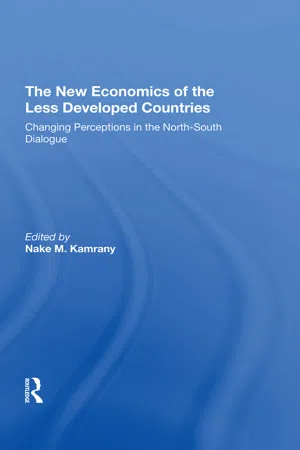
The New Economics Of The Less Developed Countries
Changing Perceptions In The North-south Dialogue
- 346 pages
- English
- ePUB (mobile friendly)
- Available on iOS & Android
eBook - ePub
The New Economics Of The Less Developed Countries
Changing Perceptions In The North-south Dialogue
About this book
After a quarter-century of experimentation with economic development in the poorer countries, the disarray, and in some cases the calamitous results, are so obvious that a fresh look at and reexamination of traditional assumptions, methodologies, theories, and policies is needed. The contributors to this volume explore—with supporting theoretical frameworks and emipirical evidence—the new perceptions concerning the development of the poor countries, providing clear and sophisticated treatments of North-South bargaining, commodity power, indexation, the theory of power and the international distribution of rights and resources, and the effectiveness of international organizations as vehicles for conflict resolution. The authors discuss the position and prospects of the non-oil-producing, less developed countries, focusing on measurements of the quality of life in these countries, growth and income distribution policies, and the effectiveness of public expenditures to enhance social welfare.
Trusted by 375,005 students
Access to over 1.5 million titles for a fair monthly price.
Study more efficiently using our study tools.
Information
Subtopic
Development EconomicsIndex
EconomicsIV
Comparative Quality of Life
Southern Illinois University
Historically, well-being of mankind has been closely related to trends in the production of goods and services. But as the size of population grows and the finite capacities of the earth are hard pressed, shrinking natural amenities per capita and the indirect effects of economic growth have begun to markedly affect our daily lives. In some situations, social disintegration and political repression are greatly diminishing the quality of life.
Generally speaking, there are three important factors affecting the quality of life—per capita goods and services, per capita natural amenities, and social and political improvements. While our system of economic accounting measures rather well the goods and services produced by man, we have no comparable techniques for collectively measuring the amenities provided by nature or the indirect effects of growth.1 Nor can we successfully combine these three factors into a single indicator.
The purpose of this paper is rather modest. We focus on analyzing the well defined and quantifiable aspects of the total life situation—the levels of living.
The main objectives of this paper are threefold: 1) to develop a unitary index of “measurable welfare” in natural units of goods and services for approximately 88 countries during the decade 1960–70, 2) to analyze the possible interrelationships between the “welfare” or “levels of living index” and the development strategies and structures of these countries, and 3) to draw the policy implications and suggestions with respect to the international issues concerning trade and development, and the levels of living.
Welfare Indicators
Is the “welfare” or the “levels-of-living” gap between rich and poor countries increasing? The answer is frequently affirmative, although no precise measurement of the gap has been effected. This paper attempts to measure the gap between industrialized (rich) and less developed countries using the composite indices.
As defined internationally, levels of living refers to the satisfaction of needs or wants in certain well defined and quantifiable aspects of the total life situation (UN, 1961; UNRISD, 1970). This conception is much wider than the one-dimensional notion of Gross National Product (GNP) which is based on productivity. Such variables as GNP or consumption per head do not measure the satisfaction of needs but the market values of the means that could be (but not necessarily are) used for satisfaction of these needs.2 However, constructing an aggregate welfare index is not without problems. The main problems arise in defining the notion of welfare; in determining, on theoretical and/or prgamatic grounds, the structure of the index (and, in particular, selecting and assigning weights to its components); in selecting and operationalizing the component indicators; and in the actual process of ...
Table of contents
- Cover
- Half Title
- Title
- Copyright
- TABLE OF CONTENTS
- Foreword
- The Authors
- I THE NORTH-SOUTH DIALOGUE
- II THE OUTLOOK FOR DEVELOPING COUNTRIES
- III THE CASE OF THE LEAST DEVELOPED OF THE UNDERDEVELOPED COUNTRIES: THE SAHEL-SUDAN REGION OF WEST AFRICA
- IV COMPARATIVE QUALITY OF LIFE
- V ECONOMIC GROWTH, POLICY AND INCOME DISTRIBUTION
- VI EFFECTIVENESS OF SOCIAL WELFARE EXPENDITURES IN SOUTH AMERICAN COUNTRIES: SOME COMPARATIVE ISSUES
- VII COMMODITY POWER AND THE INTERNATIONAL COMMUNITY
- VIII INTERNATIONAL INTERDEPENDENCY AND WORLD WELFARE
- IX INTERNATIONAL POWER AND THE DISTRIBUTION OF WORLD WEALTH
- X INTERNATIONAL INSTITUTIONS AND INTERNATIONAL PROGRESS
Frequently asked questions
Yes, you can cancel anytime from the Subscription tab in your account settings on the Perlego website. Your subscription will stay active until the end of your current billing period. Learn how to cancel your subscription
No, books cannot be downloaded as external files, such as PDFs, for use outside of Perlego. However, you can download books within the Perlego app for offline reading on mobile or tablet. Learn how to download books offline
Perlego offers two plans: Essential and Complete
- Essential is ideal for learners and professionals who enjoy exploring a wide range of subjects. Access the Essential Library with 800,000+ trusted titles and best-sellers across business, personal growth, and the humanities. Includes unlimited reading time and Standard Read Aloud voice.
- Complete: Perfect for advanced learners and researchers needing full, unrestricted access. Unlock 1.5M+ books across hundreds of subjects, including academic and specialized titles. The Complete Plan also includes advanced features like Premium Read Aloud and Research Assistant.
We are an online textbook subscription service, where you can get access to an entire online library for less than the price of a single book per month. With over 1.5 million books across 990+ topics, we’ve got you covered! Learn about our mission
Look out for the read-aloud symbol on your next book to see if you can listen to it. The read-aloud tool reads text aloud for you, highlighting the text as it is being read. You can pause it, speed it up and slow it down. Learn more about Read Aloud
Yes! You can use the Perlego app on both iOS and Android devices to read anytime, anywhere — even offline. Perfect for commutes or when you’re on the go.
Please note we cannot support devices running on iOS 13 and Android 7 or earlier. Learn more about using the app
Please note we cannot support devices running on iOS 13 and Android 7 or earlier. Learn more about using the app
Yes, you can access The New Economics Of The Less Developed Countries by Nake Kamrany in PDF and/or ePUB format, as well as other popular books in Economics & Development Economics. We have over 1.5 million books available in our catalogue for you to explore.