- 298 pages
- English
- ePUB (mobile friendly)
- Available on iOS & Android
eBook - ePub
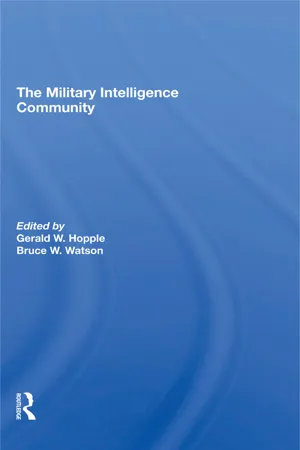
The Military Intelligence Community
About this book
The military intelligence co11111unity is one of the most misunderstood and maligned facets of the U.S. government. To much of the American public, intelligence means an organization of James Bonds, sophisticated, super-individualists, John Waynes who live slightly beyond the law. To others, military intelligence is considered as a constant threat to American democracy, a danger that must be contained and minimized.
Information
Part 1
The Organization
1
The Intelligence Community
Jack E. Thomas
What Is the Intelligence Community?
What in recent years has come to be formally designated the "intelligence community" embraces most of the military intelligence activities conducted by components of the Department of Defense. This means that the intelligence function, to the extent that it involves "national intelligence," is treated differently within the Defense Department than are other functions related to national security.1
The Director of Central Intelligence (DCI)--not the Secretary of Defense--approves the programs and budgets of Defense Department components that are part of the intelligence community and thereby come within the National Foreign Intelligence Program. The Director tasks and sets the priorities for those components that collect national intelligence; if they are intelligence producers whose analysis contributes to national intelligence, the Director can task them and insure that any judgments contained in the resulting estimates are those with which he agrees.
In terms of both personnel and resources, Defense Department components represent the bulk of the intelligence community, which is defined in President Reagan's Executive Order 123332 as including:
| Defense Department Components | Non-Defense Components |
|---|---|
| The National Security Agency (NSA) | The Central Intelligence Agency (CIA) |
| The Defense Intelligence Agency (DIA) | The Bureau of Intelligence and Research of the Department of State |
| The offices within the Department of Defense for the collection of specialized national foreign intelligence through reconnaissance programs | |
| The intelligence elements of: | |
| The Federal Bureau of Investigation (FBI) | |
| The Department of the Treasury | |
| The intelligence elements of the Army, Navy, Air Force, and Marine Corps | |
| The Department of Energy | |
| The staff elements of the Director of Central Intel-liqence |
All Defense Department intelligence components, except for the Marine Corps intelligence elements, utilize sizeable numbers of personnel and major funding. Aside from the CIA, none of the non-Defense components is large in numbers of personnel or funding. The FBI component is only that relatively small part of the bureau that is concerned with foreign intelligence and counterintelligence; the law enforcement elements of the FBI are not part of the intelligence community.
Various national intelligence activities are conducted on a community-wide basis in that they are handled jointly, or are fully coordinated, or are executed by one organization as a "service of common concern" on behalf of the entire community.3 Among the functions dealt with on a community basis are indications and warning, review of research and development needs, security standards, intelligence aspects of technology transfer, use of computers for information handling, and so on. The flavor of matters that come under intelligence community cognizance can be illustrated by a brief consideration of three major aspects of community interaction: intelligence collection; national intelligence production; and development of the National Foreign Intelligence Program and its budget.
The Community Role in Collection
In the years following World War II, components of the Defense Department and the CIA developed collection capabilities that could support the intelligence needs of the entire government—not merely the requirements of a single department or organization. Signals intelligence and overhead reconnaissance systems are the prime examples. This led to intelligence community actions to define and prioritize requirements for the information that was needed, to levy tasks on collectors, and to coordinate activities where appropriate. In each case, the actual collection operations remained under the control of the relevant collection organization.
Over the years, the community role has been handled in considerable part by Director of Central Intelligence committees, composed of representatives of the various organizations of the community.4 in collection, these committees have played an important role in reviewing and validating requirements, coordinating collection activities where an overlap or conflict could occur, and working directly with collectors to facilitate the effectiveness of operations. Of the committees directly associated with collection, the Signals Intelligence (SIGINT) Committee has been functioning since 1946, a committee to coordinate the handling of defectors since 1948, the Committee on Imagery Requirements and Exploitation (COMIREX) and its predecessors since 1955, and the Human Resources Committee since 1974.
Recognition of a common need spurred the activities of the committees, but it was not until 1978 that the Director was formally assigned a collection tasking mission. In Executive Order 12036, President Carter directed him to establish a National Intelligence Tasking Center (NITC) under his "direction, control and management" for coordinating and tasking national foreign intelligence collection activities.5 Then-Director Stansfield Turner divided his intelligence community staff into a Collection Tasking Staff (CTS) and a Resource Management Staff (RMS).6 A major portion of the CTS manning came from the full-time staff of the COMIREX, the Human Resources Committee, and the SIGINT Committee, which had been assigned to the intelligence community staff. There were two other interesting aspects of the Executive Order's provision concerning collection tasking. The first was that the NITC was to be the means by which the Director provided "advisory tasking" for collecting national foreign intelligence by departments and agencies that had information collection capabilities or intelligence assets but were not part of the National Foreign Intelligence Program for which the DCI was responsible.7 The second was the charge to the Director to "maintain readiness" for transferring control of the NITC and the Director's tasking authorities to the Secretary of Defense "upon the express direction of the President" (presumably during a major crisis or wartime).8
President Reagan's Executive Order 12333 made no mention of a NITC--and the Director melded his collection tasking and resource management staffs into a single intelligence community staff--but the order reaffirmed the Director's tasking authority. He was specifically made responsible for establishing mechanisms which translate national foreign intelligence objectives and priorities approved by the National Security Council into specific guidance for the intelligence community; resolving conflicts in tasking priority; providing departments and agencies having information collection capabilities that are not part of the National Foreign Intelligence Program advisory tasking concerning the collection of national foreign intelligence; and providing for the development of plans and arrangements for transferring required collection tasking authority to the Secretary of Defense when directed by the President.9
Executive Order 12333 charges the Secretary of Defense to "collect national foreign intelligence and be responsive to collection tasking by the Director of Central Intelligence,"10 but the Secretary of Defense is also given responsibility to "collect, produce and disseminate military and military-related foreign intelligence and counterintelligence as required for execution of the Secretary's responsibilities."11 The potentiality for conflict between the responsibilities of the Secretary of Defense and the Director in time of crisis, contingency action, or wartime is obvious, which is why Executive Order 12333 makes provision for transferring the Director's tasking role to the Secretary when the President considers that appropriate.
A substantial part of the National Foreign Intelligence Program budget is devoted to collecting and processing intelligence data acquired by technical systems. The Director's role in collection, therefore, goes far beyond his authority to task existing assets. He has the major additional functions of providing program guidance to the collection organizations, including those within the Defense Department, and he is responsible for approving the NFIP budget submitted to the President. This budget reflects what new or improved collection capabilities are to be made available in the future through investment included in the current budget.
The Community Role in Production
One of the basic pressures leading to today's intelligence community was a desire at policy levels of the government that intelligence "speak with one voice." Senior national intelligence users did not want to deal with estimates on the same subject from different production organizations.
World War II had barely ended when the Intelligence Advisory Board (IAB) was formed in 1946 and the heads of the then-existing U.S. intelligence organizations began meeting with the Director (then head of the Central Intelligence Group, predecessor to the CIA) to review and coordinate on substantive estimates. In 1947 the IAB became the Intelligence Advisory Committee (IAC), which in 1958 became the United States Intelligence Board (USIB) and in 1975 the National Foreign Intelligence Board (NFIB). The heads of all components of the intelligence community attend the NFIB, although since 1963 (shortly after establishment of the Defense Intelligence Agency), the senior intelligence officers of the Military Services have participated as observers rather than members. The primary function of the NFIB is to advise with and make recommendations to the Director concerning producing, reviewing, and coordinating national foreign intelligence--and particularly the National Intelligence Estimates (NIEs) and Special NIEs. Thus, the senior role of the Director in the community's national intelligence production was established early.
In 1951 the Director, General Walter Bedell Smith, who was disturbed at the production organizations' failure to provide warning of the Korean War, established the Board of National Estimates (BNE) to take the lead in the production of national estimates. Smith made it clear that the judgments expressed in such estimates would be those with which he agreed. Other members of what was then the IAC could disagree and take footnote positions, but the judgments were the Director's and would not be determined by majority vote. To this day, directors have held to this position.
The BNE functioned as the community focal point for national estimate production until William Colby abolished the Board in 1973 and replaced it with a dozen National Intelligence Officers (NIOs), each of whom was directly responsible to the Director for production relating to his assigned region or topic, such as conventional military forces (for which the NIO always has been an active duty flag or general officer). The extent to which each NIO worked in a community milieu or dealt essentially with CIA varied markedly.
In 1980, Admiral Stansfield Turner organized the NIOs into a National Intelligence Council, established positions for several "general" NIOs, and in effect recreated an organization comparable to the former Board of National Estimates.
National Security Council Intelligence Directive No. 1, "Basic Duties and Responsibilities," effective February 17, 1972, listed "producing national intelligence required by the President and other national consumers" as one of the Director's four major responsibilities.12
President Ford, in his 1976 Executive Order 11905, charged the DCI to "supervise production and dissemination of national intelligence" and to provide the President and other Executive Branch officials with foreign intelligence "including national intelligence estimates."13
In Executive Order 12036 (1978), President Carter gave the Director "full responsibility for production and dissemination of national foreign intelligence" and additionally gave him authority to "levy analytic tasks on departmental intelligence production organizations, in consultation with those organizations." The President further charged the Director to "ensure that diverse points of view are considered fully and that differences in judgment within the Intelligence Community are brought to the attention of national policymakers."14
When he promulgated Executive Order 12333, President Reagan repeated the production and task-levying responsibilities and authorities assigned to the Director in Executive Order 12036, and reaffirmed that he was to ensure that ''appropriate mechanisms for competitive analysis are developed" so that diverse points of view would be made apparent.15
Overall, intelligence production is a manpower intensive operation and only a small portion of the personnel and funding of the intelligence community is devoted to the analysis and production effort. Yet, understandably, since finished intelligence is what users see, the analytic quality, timeliness, and accuracy of intelligence products provide the primary basis upon which the effectiveness of the entire intelligence effort is judged.
The record since World War II has been mixed. Basic intelligence on problems of important interest has usually been good. Some estimative forecasts have been good; others have been wide of the mark. Production devoted to indications and warning has been marked by both successes and failures. For the past twenty years, with the improvement of technical collection capabilities, production on orders of battle and foreign weapons development has been quite good.
The Community's analytic personnel declined in both numbers and experience level during the 1970s, but a rebuilding process is underway. Increased attention is being given to strengthening and improving the analytical capabilities of the individual production organizations within the Community, Procedures and mechanisms for community coordination and review are already well established.
Most of the for...
Table of contents
- Cover
- Half Title
- Dedication
- Title
- Copyright
- Contents
- List of Tables and Figures
- Preface
- Acknowledgments
- PART 1 - THE ORGANIZATION
- PART 2 - COLLECTION
- PART 3 - ANALYSIS
- PART 4 - THE ISSUES
- PART 5 - SUMMARY
- About the Editors and Contributors
Trusted by 375,005 students
Access to over 1.5 million titles for a fair monthly price.
Study more efficiently using our study tools.
Frequently asked questions
Yes, you can cancel anytime from the Subscription tab in your account settings on the Perlego website. Your subscription will stay active until the end of your current billing period. Learn how to cancel your subscription
No, books cannot be downloaded as external files, such as PDFs, for use outside of Perlego. However, you can download books within the Perlego app for offline reading on mobile or tablet. Learn how to download books offline
Perlego offers two plans: Essential and Complete
- Essential is ideal for learners and professionals who enjoy exploring a wide range of subjects. Access the Essential Library with 800,000+ trusted titles and best-sellers across business, personal growth, and the humanities. Includes unlimited reading time and Standard Read Aloud voice.
- Complete: Perfect for advanced learners and researchers needing full, unrestricted access. Unlock 1.5M+ books across hundreds of subjects, including academic and specialized titles. The Complete Plan also includes advanced features like Premium Read Aloud and Research Assistant.
We are an online textbook subscription service, where you can get access to an entire online library for less than the price of a single book per month. With over 1.5 million books across 990+ topics, we’ve got you covered! Learn about our mission
Look out for the read-aloud symbol on your next book to see if you can listen to it. The read-aloud tool reads text aloud for you, highlighting the text as it is being read. You can pause it, speed it up and slow it down. Learn more about Read Aloud
Yes! You can use the Perlego app on both iOS and Android devices to read anytime, anywhere — even offline. Perfect for commutes or when you’re on the go.
Please note we cannot support devices running on iOS 13 and Android 7 or earlier. Learn more about using the app
Please note we cannot support devices running on iOS 13 and Android 7 or earlier. Learn more about using the app
Yes, you can access The Military Intelligence Community by Gerald W. Hopple,Bruce W. Watson in PDF and/or ePUB format, as well as other popular books in Politics & International Relations & Politics. We have over 1.5 million books available in our catalogue for you to explore.