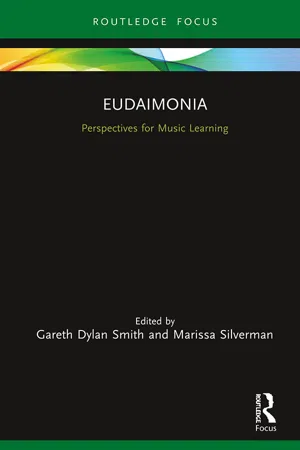
Eudaimonia: Perspectives for Music Learning asserts the fertile applications of eudaimonia—an Aristotelian concept of human flourishing intended to explain the nature of a life well lived—for work in music learning and teaching in the 21st century. Drawing insights from within and beyond the field of music education, contributors reflect on what the "good life" means in music, highlighting issues at the core of the human experience and the heart of schooling and other educational settings. This pursuit of personal fulfillment through active engagement is considered in relation to music education as well as broader social, political, spiritual, psychological, and environmental contexts. Especially pertinent in today's complicated and contradictory world, Eudaimonia: Perspectives for Music Learning is a concise compendium on this oft-overlooked concept, providing musicians with an understanding of an ethically-guided and socially-meaningful music-learning paradigm.
eBook - ePub
Eudaimonia
Perspectives for Music Learning
- 126 pages
- English
- ePUB (mobile friendly)
- Available on iOS & Android
eBook - ePub
Eudaimonia
Perspectives for Music Learning
About this book
Information
1 Eudaimonia
Flourishing through Music Learning
Gareth Dylan Smith and Marissa Silverman
What is “Eudaimonia”?
In After virtue, philosopher Alasdair MacIntyre (2007) draws our attention to a potential, fictional world in which our planet experiences “catastrophic” environmental disasters, the cause of which are blamed on all scientists. The result of such catastrophe is not only “riots,” but also the “laboratories are burnt down, physicists are lynched, books and instruments are destroyed” (p. 1). Furthermore, in MacIntyre’s “imaginary” world, “a Know-Nothing political movement takes power” and removes science from the curriculum in schools and universities, and imprisons and executes any scientists left in the world (p. 1). MacIntyre continues to imagine further results of this, including but not limited to an eventual reimagining of science based on half-truths which, in turn, would promote pseudoscience and a language that is as imprecise as it is harmful. This is not a wholly original premise. Dystopian writers have created similar-sounding spaces (e.g., Brave new world, 1984, The handmaid’s tale).
Still, MacIntyre’s thought experiment reveals how easy it is to lose “our comprehension, both theoretical and practical,” and, most importantly perhaps, our morality (p. 2). And what might the more pernicious result of this be? According to MacIntyre, in the end, unless we rightly understand the world in which we live, and make value judgements that are ethically and truthfully sound, we cannot have any hope of living humanistically or purposefully, or, in others words, virtuously. Where do we learn how to live virtuously? According to MacIntyre—who interprets and expands upon Aristotle and Thomas Aquinas—“it is always through the engagement” in “a variety of practices, including those of making and sustaining families and households, schools, clinics, and local forms of political community” that we can reflect critically on what matters and determine how best to live (p. xv). Furthermore, without living “virtuously”—living in a way that engenders generosity of spirit and person—we run the risk of dismantling the importance of asking truly essential questions: “Why?” Why live? Why make music? Why teach and learn anything?
In offering some potential answers to these questions, this volume rests on the premise that the purpose of engagement in/with/through music making—and music teaching and learning—widely seen across a variety of community music sites, programs, and formal school environments—is to engage and pursue lifelong fulfillment and flourishing and, in doing so, to live a “good life,” a life of meaningfulness and significance (Silverman, 2013). But what does it mean to live a “good life”?
As some of the chapters in this volume propose, the answer to this question involves the concept of eudaimonia. This Greek term derives from “eu,” meaning “good” or “well,” and “daimon” meaning “a spirit,” or “one’s personal fortune.” Literally, then, it means something like “having a good guardian spirit,” or “a good divine power,” or “good fortune.” Time and again, eudaimonia is translated as “happiness.” But, as Gordon Graham (2011) notes, this translation is not very helpful (p. 47). Moreover, interpreting Aristotle, Graham explains that well-being is often “misconceived as mere contentment.” Rather, he states, a sense of well-being in this context is exercising “healthy appetites, imaginative and productive use of one’s mental faculties, and the establishment of good personal, professional, and public relationships” (pp. 47–48). “Eudaimonia,” then, is most often translated as “human flourishing,” which requires deeper consideration (Elliott & Silverman, 2014, 2015).
According to Aristotelian ethics, human flourishing and self-reflective happiness are the rewards of a life of virtue. Aristotle states, “The human good turns out to be the soul’s activity that expresses virtue, and if there is more than one virtue … it will be in a complete life” (Nicomachean Ethics, pp. 1098a2, 12–21). As Graham continues, eudaimonia helps to explain the nature of a person’s life filled with “active engagement, rather than passive experience” (p. 47). For Aristotle, eudaimonia describes people possessing “excellence,” meaning those who live for the betterment of themselves and their community, thus maintaining a feeling of contentment, well-being, and comfort. Human flourishing and, thereby, well-being can be achieved when one lives for the betterment of oneself and one’s community. This notion of the “good life” and, therefore, “well-being” is at the heart of “artistry” and what it means to rightly live in the world with others (e.g., Wiles, 2016).
Still, commonplace interpretations of eudaimonia—e.g., first-person “happiness” and self-centered flourishing—denote “arguably an ideologically liberal and, indeed, neoliberal stance inherent in [a] eudaimonic lifestyle and philosophy” (Smith, 2016, p. 162). Understanding eudaimonism as concerned only or primarily with seeking purpose and meaning in one’s own life (Dierendonck & Mohan, 2006; Norton, 1976; Waterman, 1992), while consistent with an ideology pervading certainly the USA and increasingly in other contemporary Western nation states, “contradicts Aristotle’s definition of eudaimonia as the fulfillment of one’s deepest nature in harmony with the collective welfare” (Della Fave, Brdar, Friere, Vella-Brodrick, & Wissing, 2011, p. 204). Therefore, it is eudaimonism in its fuller, most generous form, for which the authors in this volume advocate. Why? Increased emphasis on individualism and isolation, instead of community and collaboration, can lead to the death of democracy and the rise of narcissists and ignorant populists whose hunger for power threatens to harm millions of people, almost indiscriminately (Levitsky & Ziblatt, 2018). The current fashion for selfishness, myopia, and willful ignorance threatens to undermine the chances of human civilization—in anything like its current forms—surviving at all (Orr, this volume). These pernicious ideologies perpetuated by a powerful few (Giroux, this volume; Sachs, 2019; Wilson & Pickett, 2019) are incredibly challenging, but hopefully not insurmountable obstacles to realizing a more utopian vision for a world guided more by compassion and eudaimonic thriving.
Eudaimonia, Music, and Learning
A belief in the value and pursuit of eudaimonia is called eudaimonism, and we are eudaimonists. We are not advocating for the more selfish version of eudaimonia. Instead, we wish to underline the potential dangers of such a narrow reading and advocate for a more balanced understanding of eudaimonia. We are reminded of bell hooks’ (1994) words: that teachers “who embrace the challenge of self-actualization will be better able to create pedagogical practice so that engage students, providing them with ways of knowing that enhance their capacity to live fully and deeply” (p. 22). This seems to strike at the core of the symbiotic eudaimonic dyad—flourishing of oneself and of others.
In the contemporary United States where we both reside, such an ideal as that to which Aristotle aspired seems almost unthinkable. People actually flourishing—outside of a consumerist, neoliberal capitalist ideology—is a narrative that runs counter to everything on which contemporary Western societies and national and international power structures are premised. Runaway neoliberalism is defined by the ideas that there is no greater good than the “free” market, and that relentless buying and selling and consuming are the primary purposes of the populace—despite obvious and demonstrated fallacies of “trickle-down” economics and the idea that a few wealthy people will create wealth and better lives for everyone else too, just so long as we all work long and hard enough for them (Chomsky, 1999).
Hannah Arendt (1958) describes market-oriented instrumentalism as meaning that “whatever we do, we are supposed to do for the sake of ‘making a living’” (p. 126), and that “not even the ‘work’ of the artist” is exempt from this logic; “it is dissolved into play and has lost its worldly meaning. The playfulness of the artist is felt to fulfill the same function in the laboring life process of society as the playing of tennis or the pursuit of a hobby fulfills in the life of an individual” (p. 128). Arendt assumes here that the “worldly meaning” of artistry is reification—that art-making, including music-making, somehow transcends the commonplace, the ordinary, the hobby. Such a perspective, however, is at odds with a more holistic eudaimonic view of music(k)ing in which the value of making music is largely in the fulfillment derived from the doing, the process—not in any external value that may be placed on the output (Elliott & Silverman, 2015). Smith (2019), for instance, noted that “rock drumming for me is a particularly autotelic experience. I do it because I need to feel that autotelic experience as part of a meaningful life being me. I do it because it is intrinsically valuable in and of itself” (p. 284). Flourishing in music is possible beyond the canon of “great works” and commercial success.
Since 2012, the United Nations has published several World Happiness Reports, looking at “happiness” in ways that align with a eudaimonic notion of well-being as flourishing. One of the 2019 report’s authors, Jeffrey D. Sachs, recalls the Easterlin Paradox, noting a negative correlation between GDP increase per capita and reduced subjective well-being among adults in the United States (Easterlin, 1974; Sachs, 2019). He points to three factors likely contributing this situation:
1 “A discrepancy between our evolutionary heritage and our current life conditions” (Sachs, 2019, p. 128), inasmuch as humans have evolved to crave and over-indulge in food when it is available; the over-abundance of foodstuffs today means obesity and associated health risks are very high (Goldman, 2015; Sachs, 2019, p. 128);
2 “High and rising income inequality in high-income societies leads to stress,” addiction, and other dysfunctional coping behaviors (Wilkinson & Pickett, 2019); and
3 “A core design feature of a market economy: addictive products boost the bottom line. Americans are being drugged, stimulated, and aroused by the work of advertisers, marketers, app designers, and others who know how to hook people on brands and product lines” (Sachs, 2019, p. 128).
This third hypothesis is supported by another contributing author in the 2019 World Happiness Report. Jean M. Twenge discusses a decline in well-being among US American adolescents, which she attributes in large part to massively increased addictive use of digital technologies, primarily via smart phones, and the concomitant reduction in time that people spend together socially, face to face in leisure time. Arendt (1958) also urges us to be wary of finding ourselves with too much leisure time, warning that, left unchecked, humans would greedily fill our free time with endless consumption, leading to a dearth of fulfillment for people and destruction of our planet’s resources (p. 133). We are inclined to be more optimistic than Arendt, though, seeing music(k)ing as a way to flourish without falling prey to the innately human desire to consume.
Active involvement in music-making plays a vital role in many people’s leisure time, providing deep fulfillment for people of all ages and abilities, across styles, demographics, and geographies (Mantie & Smith, 2016; Stebbins, 2014). Individuals flourish though personal and communal music making with others who also flourish through these communal activities in contexts that include extreme metal music (Riches, 2016), university marching bands (Weren, Kornienko, Hill, & Yee, 2016), recording studios (Ward & Watson, 2016), Indigenous music-dance (Fox, 2016), video games (O’Leary & Tobias, 2016), YouTube (Cayari, 2016), social media (Trobia & Lo Verde, 2016), and sacred harp singing (Malone, 2016). Active participation in making music can provide “pleasure, relaxation, and an opportunity for self-expression” along with “structure to life … friendships … and spiritual fulfillment” (Hallam, Creech, & Varvarigou, 2016, p. 41). Other manifest benefits of making music include “social networks, a sense of belonging, pride in progress made … with a subsequent impact of self-concept, cognitive, and health benefits” (Hallam, Creech, & Varvarigou, 2016, p. 50); the authors duly note also that any such benefits arising in learning contexts will depend on the quality and qualities of particular teaching and learning experiences.
Not everyone has the luxury or free time in which to undertake leisure activity; the very notion of “leisure” implies privilege. Full-time carers, incarcerated populations, and others may not have time to dedicate to what may seem like frivolous or extraneous activity such as making music. Howell, Higgins, and Bartleet (2016) write about collaborative music-making that is distinct from “more general music-as-leisure.” They construe community music as an “‘interventionist’ mode” of communal music making that works “to enable musical and reflexive responses to the social or health needs of a particular target group, and through this action to cultivate some kind of change or transformation” (p. 605). The ends of such “interventionist” community music, then, align with eudaimonism, especially when we consider that in these settings, skilled facilitators “consciously engage with people to find pathways through which making music might allow them to personally flourish” (p. 605). Furthermore, Lee Higgins (2007) draws on the philosophy of Jacques Derrida to explain how community musicians approach facilitated music-making opportunities as places of “unconditional hospitality” (p. 87). This is a demanding outlook that challenges some assumptions about and approaches to music learning. Without and within formal institutional settings, in music learning contexts of all kinds, teachers, mentors, and facilitators of learning can turn classrooms, studios, rehearsal rooms, and other spaces into liminal places of eudaimonic potential for all present (Smith & Shafighian, 2013; Tuan, 1977).
Wealthy countries of the West and the global North provide many of their citizens with ample opportunities to flourish beyond meeting their most basic needs. The financial and material abundance of these dominant nations that affords their inhabitants these life chances, comes at the expense of much poorer countries and the people living in them. Those populations are held in servitude by world powers and the Euro-American businesses that boom in those countries. Indeed, it is precisely such inequity of abundance that means we authors have the luxury of writing this essay and co-editing this volume on a niche philosophical topic in music learning, for a publisher to distribute at a high price-point to a tiny market of people studying for graduate and postgraduate degrees in pedagogy and the arts. Curating this collection has been eudaimonic for us both, but flo...
Table of contents
- Cover
- Half Title
- Series Page
- Title Page
- Copyright Page
- Table of Contents
- Series Foreword
- Preface
- 1 Eudaimonia: Flourishing through Music Learning
- 2 Music Education and the Continuity of Mind and Life
- 3 The Hull House: A Case Study in Eudaimonia for Music Learning
- 4 The Happy Basket
- 5 Musicophilia, Biophilia, and the Human Prospect
- 6 Weaponizing Racism in the Age of Trump
- 7 An Ecology of Eudaimonia and its Implications for Music Education
- 8 Listening and the Happiness of the Musician
- 9 Eudaimonia and Well-Doing: Implications for Music Education
- Notes on Contributors
- Index
Trusted by 375,005 students
Access to over 1.5 million titles for a fair monthly price.
Study more efficiently using our study tools.
Frequently asked questions
Yes, you can cancel anytime from the Subscription tab in your account settings on the Perlego website. Your subscription will stay active until the end of your current billing period. Learn how to cancel your subscription
No, books cannot be downloaded as external files, such as PDFs, for use outside of Perlego. However, you can download books within the Perlego app for offline reading on mobile or tablet. Learn how to download books offline
Perlego offers two plans: Essential and Complete
- Essential is ideal for learners and professionals who enjoy exploring a wide range of subjects. Access the Essential Library with 800,000+ trusted titles and best-sellers across business, personal growth, and the humanities. Includes unlimited reading time and Standard Read Aloud voice.
- Complete: Perfect for advanced learners and researchers needing full, unrestricted access. Unlock 1.5M+ books across hundreds of subjects, including academic and specialized titles. The Complete Plan also includes advanced features like Premium Read Aloud and Research Assistant.
We are an online textbook subscription service, where you can get access to an entire online library for less than the price of a single book per month. With over 1.5 million books across 990+ topics, we’ve got you covered! Learn about our mission
Look out for the read-aloud symbol on your next book to see if you can listen to it. The read-aloud tool reads text aloud for you, highlighting the text as it is being read. You can pause it, speed it up and slow it down. Learn more about Read Aloud
Yes! You can use the Perlego app on both iOS and Android devices to read anytime, anywhere — even offline. Perfect for commutes or when you’re on the go.
Please note we cannot support devices running on iOS 13 and Android 7 or earlier. Learn more about using the app
Please note we cannot support devices running on iOS 13 and Android 7 or earlier. Learn more about using the app
Yes, you can access Eudaimonia by Gareth Dylan Smith, Marissa Silverman, Gareth Dylan Smith,Marissa Silverman in PDF and/or ePUB format, as well as other popular books in Education & Education Theory & Practice. We have over 1.5 million books available in our catalogue for you to explore.