eBook - ePub
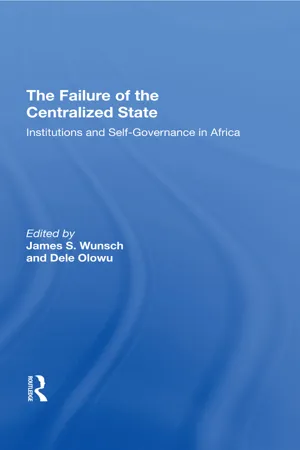
The Failure Of The Centralized State
Institutions And Selfgovernance In Africa
- 334 pages
- English
- ePUB (mobile friendly)
- Available on iOS & Android
eBook - ePub
The Failure Of The Centralized State
Institutions And Selfgovernance In Africa
About this book
This book is an outcome of the workshop on Political Theory and Policy Analysis, held in Indiana, during the 1985/86. It seeks to explains why the centralized African state has failed and discusses the breakdown of social processes indirectly caused by the policies of the centralized state.
Information
1
The Failure of the Centralized African State
Introduction
Nearly thirty years ago in Accra, Ghana, Africa’s march to independence began. With substantial cash reserves, a strong domestic agricultural economy, a skilled and professionalized civil service, a popular leader, and an apparently well-functioning, competitive-party, parliamentary system, hope for the future was bright.
Today, these hopes have faded. The economy is at present only beginning a recovery from collapse and near bankruptcy. Its GNP declined at an average of 1.3 percent each year from 1960 to 1982, and its average inflation rate was 34.8 percent annually over the same period (World Bank 1984b). Five military coups have buffeted Ghanaians’ political hopes, which had twice risen since the first coup in 1966 on the backs of two now-discarded constitutions. The civil service has been demoralized by political instability and military intervention, and the economy has been devastated by incredible inflation rates. Many of the best trained and skilled personnel have left the country. One wonders, why?
Ghana is not alone. Of Africa’s 54 independent states, only 18 have avoided successful military coups. Of these 18, at least 6 have experienced serious coup attempts, military revolts, or sustained civil conflicts. Coups by generals have given way to coups by colonels, captains, flight lieutenants and, finally, sergeants and corporals. A weary sameness sets in: each regime denounces the previous one and promises an early return to civilian government after it “cleans up” and “reforms” the government. Too often the military regime has indeed “cleaned up,” but not in the way it promised. Samuel Decalo, in his book on the military, shows quite graphically how the struggle for power within regimes intensifies once constitutional rules are discarded, and how factionalism, mutual distrust, fear, and countercoup are the most usual consequences (Decalo 1976). Uganda, Congo-Brazaville, and Benin, as well as Ghana, seem exemplary cases of this process. In too many cases, military regimes have turned their guns, or at least their rifle butts, on their own people, stifling dissent and repressing the opposition. In Liberia, Ethiopia, Central African Republic, Uganda, Sudan, and others this has happened. Bloody civil wars have been fought in seven countries (Nigeria, Sudan, Chad, Ethiopia, Angola, Zaire, Uganda), ethnic programs have tom through several (Nigeria, Uganda, Rwanda, Burundi), and corruption is so deep in Zaire that there are, according to David Gould, over eighty different nouns to describe its various distinguishable manifestations (Gould 1977).
Economically, Africa has fared no better. While all developing countries grew at a 3.5 percent rate (GNP) from 1960 to 1970 and at a 2.7 percent rate from 1970 to 1979, Africa’s record was only 1.3 percent and 0.8 percent over those same time periods. Food sufficiency has generally declined since independence, rural per capita income has on average declined, and few sheltered, infant industries have grown up. In fact, 10 sub-Saharan African countries had average negative growth (GNP) from 1960–1982, 10 were stagnant or near stagnant (0.1 to 1.5 percent), and excluding South African client states and oil exporters, only 8 had rates of growth of more than 1.5 percent during that time period (World Bank 1984b). More disconcerting because it suggests future stagnant growth, is the continuity of pricing and currency exchange systems biased against agriculture which continues to employ the vast majority of Africa’s peoples and produces between 30–60 percent of African GNP. Partially as a result of this, an index of per capita food production shows only four sub-Saharan African countries were producing more food per capita in 1982 than they were in 1969 (Rwanda, Central African Republic, Cameroon, Ivory Coast). Fifteen were producing 80–89 percent of their 1969 per capita, three at 70–79 percent, and two at 60–69 percent (Angola, Mauritania, Ghana; Somalia and Mozambique)! As a whole, from 1960–1970, African agriculture increased its per capita production by only .2 percent. From 1970–1980 it declined by an average of 1.1 percent per year (World Bank 1984a; 1984b).1
These figures are indeed grim, and justify considering much of Africa to be at a point of crisis. Still, some states have fared better.2 These, however, are most often states with substantial petroleum reserves or states which have had to sacrifice a substantial amount of autonomy to what are commonly regarded as neo-colonial or “dependency” relationships with developed states, and are based on a single, key leader or “strong man.” Furthermore, when one looks behind their impressive GNP rates, one finds broader social indicators such as literacy, life-expectancy, caloric intake, and food production are not distinctly better in these countries than in the others (World Bank 1984b). Finally, recent events have suggested that the apparent political stability of these countries may be ephemeral, with coups or violent coup attempts occurring in several of them (Nigeria, Kenya, Cameroon). It has become an accepted hypothesis in contemporary social science that the processes of economic development and social change carry with them forces promoting political instability. However, the performance of many other third world nations and the theory we will discuss below lead us to argue that critical flaws in the fundamental political structures of African states have made this instability far worse and have made economic development far slower than ought to have been expected.
Many factors have contributed to Africa’s problems. We have no doubt, for example, that changes in the international economic system would dramatically improve the African situation, particularly changes in pricing structures for agricultural and mineral products (Independent Commission 1980). South African adventurism has severely damaged several African states. Furthermore, the scale of recent natural disasters such as drought and famine will continue to require international assistance. These international and natural problems have contributed to Africa’s current problems. Certainly the literature on dependency provides an important, even if controversial, body of theory regarding the international roots of Africa’s problems. But these external sources of Africa’s crisis can be exaggerated, and may preclude an objective appraisal and analysis of the domestic aspects of the African predicament: what Africans do have control over and can do something to improve. A preoccupation with external/environmental problems sidesteps something long understood in human affairs: social development has always been premised on a people’s ability to effectively manipulate their environment to advantage over a period of time in spite of odds imposed by that environment (Mabogunje 1980; Riggs 1976).
Many would agree with the position of the Independent Commission on International Development headed by Willy Brandt which, even though quite sympathetic to the environmental constraints on countries of the South, submitted that:
The government and people of the South (Africa, Asia and Latin America) have the primary responsibility for many of their own problems; they will have to continue to generate most of their resources by their own efforts, and to plan and manage their own economies. Only they can ensure that the fruits of development are fairly distributed inside their countries and that greater justice and equity in the world are matched by appropriate reforms at home (Independent Commission 1980: 41–42, parenthesis and emphasis added).
Our argument in this book derives from a body of theory implicit in the burgeoning research on domestic African institutions, that suggests there is a vast reservoir of energy and potential untapped at Africa’s grass roots. This literature is complemented by other research on national politics that underscores the critical role played by domestic political processes and policies in ethnic conflict, political instability, and economic performance. We will argue in this book that ethnic conflict, political inefficacy, administrative weaknesses, and economic stagnation can be understood in part as caused by attempts over the last two decades to impose a high level of centralization in contemporary African states, and that these explanations argue forcefully for changes in political structure and development strategy.
Centralization in Africa
Measures of centralization pose conceptual and statistical problems given problems already identified in delineating between state and society (Nisbet 1962; 1975), private and public sectors (Hood 1986), and in measuring the public sector or its growth (Ozgediz 1983; Grunow 1986; Grestchmann 1986). The problem is compounded in Africa where reliable cross-national data are hard to find. Nevertheless, the contemporary African state can be characterized as centralized through a variety of measures. The proportion of public revenues expended by national as opposed to local governments, the taxes raised by national vs. local governments, the proportion of GNP expended by government, the juridical weakness of sub-national governments, and the absence of competitive political parties or contested elections are all conventional indicators.
It is easier to demonstrate that the African state is centralized in qualitative rather than in quantitative terms. Some African central governments spend a high percentage of their country’s gross national product (Mali 69%, Botswana 45%, Congo 44%), but the average is just under 30%. While this might be high for the level of industrialization and urbanization in these countries, it is relatively comparable to those of several other developing and industrialized countries: Panama 40%, Nicaragua 49%, Mexico 28%, Netherlands 59%, Ireland 58% and Sweden 47%. Still, it is worth noting that while the number of public sector employees in less developed countries is not dramatically higher per capita than in OECD countries, their cost is a far higher proportion of non-agricultural employment (OECD = 24%; LDC = 44%). Thus, governmental function seems to include a rather high portion of the modern sector of the economy (Heller and Tait 1982: 47).
The critical difference between African states and most others across the world, however, lies in the qualitative dimension, specifically in the distribution of authority, responsibility and resources available to central vs. local governments. In virtually no African countries have local governments any independent juridical authority. Even in states where local governments are largely arms of national governments, the percentage of total budgetary resources allocated by them is far greater than in Africa. For example, from France at the lower ranges (17%) to Sweden at the higher (66%), local level institutions are major partners in the delivery of public services. Equivalent African figures are as low as 2%.
The percentage distribution of personnel at the local levels also reflects this pattern. African countries as a whole have the least of their modern sector employees at the local level (2.1%). This figure is low compared with Asia (8.0%), Latin America (4.2%) and the Organization for Economic Cooperation and Development (OECD) states (12%) (Heller and Tait 1982). Generally in Africa there has been a shift of power from the provinces to the capital. In virtually every African country, local self-governing institutions have been supplemented with or replaced by field administrative agencies (Mawhood 1983; Hyden 1983; Smith 1985). Even within the central government there is a disproportionate share of manpower and financial resources (in quantitative and qualitative terms) located at the headquarters compared with field agencies. The most senior trained and experienced officials live and work at the headquarters. The result is that inexperienced and junior officers located in the more populated countryside have to wait for instructions even on routine matters (Moris 1981), and focus most of their attention on what they must do to gain a posting at the center (Rondinelli 1979).
This pattern, finally, can also be seen in the area of non-governmental and private organizations such as unions, churches, cooperatives, universities, benevolent associations and the like, which have almost everywhere come under close governmental control. In a few cases they have been eradicated. Private bases for collective action have been carefully destroyed. Within the political realm, competing political parties have been legislated out of existence (with the exception of a few countries notably, Gambia, Botswana, Mauritania and Nigeria) while voluntary associations, labor unions, etc., are kept under close surveillance nearly everywhere (Zolberg 1966; Young 1982; Liebenow 1986). Powers have been stripped from the judiciary and the legislature in almost all African countries in favor of concentrating these powers in an executive presidency (Selassie 1974; Tordoff 1984; Jackson and Rosberg 1982). Some commentators refer to this situation as one of personal rule (Hyden 1983; Sandbrook 1985), and such presidents are often leaders of a single-party or of a military regime: in neither situation is opposition institutionalized or tolerated.
It is important, furthermore, to underscore a point made by other scholars: the centralization of the formal institutions of government has been futile as well as destructive. It has been destructive because it has preempted negotiation with and real cooperation by elements of the society whose willing commitment and efforts were needed for development. It has been futile in that the African states did not have enough power to compel key elements of the society to act as the state demanded (Riggs 1964; Hyden 1980; 1983; Bunker 1987; Mawhood and Davey 1980). The result has been characterized as the “disengaged” or “soft” state (Hyden 1983; Rothchild 1985). In trying to do and be too much, it ended up too little.
In general, what might be called “civic capacity” has been reduced, and “constitutional concentration” has been increased. The first refers to the legal capacity of the populace to engage in diverse collective action; and the second refers to the tendency to concentrate constitutional power in the hands of one or very few persons. We will argue in this book that these two tendencies have slowed economic growth and weakened the political capacity of Africa’s peoples.
As we shall argue and develop throughout this volume, this multi-faceted centralization process requires an equally multi-faceted process of decentralization. It would include such changes as:
- (1) devolution of real responsibility and authority to choose and provide social services and development projects to local governments (see C...
Table of contents
- Cover
- Half Title
- Title
- Copyright
- Contents
- Preface
- 1 The Failure of the Centralized African State
- 2 Foundations of Centralization: The Colonial Experience and the African Context
- 3 Centralization and Development in Post-Independence Africa
- 4 The Failure of Current Decentralization Programs in Africa
- 5 African Economic Performance: Current Programs and Future Failures
- 6 State Tutelage vs. Self-Governance: The Rhetoric and Reality of Decentralization in Senegal
- 7 Proprietary Authority and Local Administration in Liberia
- 8 Centralization and Development in Eastern Africa
- 9 Centralization, Self-Governance, and Development in Nigeria
- 10 The Problem of Sovereignty in Human Affairs
- 11 Reciprocity and Governance in Africa
- 12 Beyond the Failure of the Centralized State: Toward Self-Governance and an Alternative Institutional Paradigm
- 13 Conclusion: Self-Governance and African Development
- About the Contributors
- Index
Trusted by 375,005 students
Access to over 1.5 million titles for a fair monthly price.
Study more efficiently using our study tools.
Frequently asked questions
Yes, you can cancel anytime from the Subscription tab in your account settings on the Perlego website. Your subscription will stay active until the end of your current billing period. Learn how to cancel your subscription
No, books cannot be downloaded as external files, such as PDFs, for use outside of Perlego. However, you can download books within the Perlego app for offline reading on mobile or tablet. Learn how to download books offline
Perlego offers two plans: Essential and Complete
- Essential is ideal for learners and professionals who enjoy exploring a wide range of subjects. Access the Essential Library with 800,000+ trusted titles and best-sellers across business, personal growth, and the humanities. Includes unlimited reading time and Standard Read Aloud voice.
- Complete: Perfect for advanced learners and researchers needing full, unrestricted access. Unlock 1.5M+ books across hundreds of subjects, including academic and specialized titles. The Complete Plan also includes advanced features like Premium Read Aloud and Research Assistant.
We are an online textbook subscription service, where you can get access to an entire online library for less than the price of a single book per month. With over 1.5 million books across 990+ topics, we’ve got you covered! Learn about our mission
Look out for the read-aloud symbol on your next book to see if you can listen to it. The read-aloud tool reads text aloud for you, highlighting the text as it is being read. You can pause it, speed it up and slow it down. Learn more about Read Aloud
Yes! You can use the Perlego app on both iOS and Android devices to read anytime, anywhere — even offline. Perfect for commutes or when you’re on the go.
Please note we cannot support devices running on iOS 13 and Android 7 or earlier. Learn more about using the app
Please note we cannot support devices running on iOS 13 and Android 7 or earlier. Learn more about using the app
Yes, you can access The Failure Of The Centralized State by James Wunsch,Dele Olowu,John W Harbeson,Vincent Ostrom in PDF and/or ePUB format, as well as other popular books in Política y relaciones internacionales & Política africana. We have over 1.5 million books available in our catalogue for you to explore.