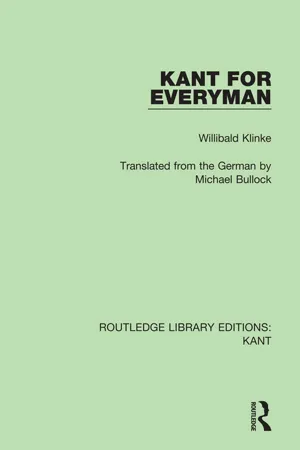
First published in 1951. This title aims to familiarise the reader with the ideas of the sometimes difficult philosopher Immanuel Kant by presenting them in a more comprehensible form. Kant for Everyman provides an overview of the different stages in Kant's life, and delivers a breakdown of his philosophical ideology. This title will be of interest to students of philosophy.
- 154 pages
- English
- ePUB (mobile friendly)
- Available on iOS & Android
eBook - ePub
Kant for Everyman
About this book
Information
KANT’S PHILOSOPHY
1
Philosophy as a Science
PHILOSOPHY SEEKS to co-ordinate the general results of thought and of the individual sciences into a unified view of the world and of life, and to examine the presuppositions of all sciences, in so far as these he within man himself. Such investigations have been carried out since time immemorial and are always being undertaken afresh. For this reason it was not so much Kant’s intention to teach his hearers philosophy, as how to philosophize, i.e. the procedure and methods which must be employed in order to arrive at a unified view of the world and of life. But it is a toilsome and difficult path which leads to the apprehension of such ultimate associations of facts; many embark upon it, but far from all of them pursue it to the end. Their strength soon fails and soon their patience and their persistence.
‘Philosophy is a high Alpine track’, wrote Schopenhauer on the 8th September 1811 during his journey across the Harz mountains, ‘its only approach is a steep path over sharp stones and piercing thorns: It is lonely, and the higher one goes the more barren it becomes; whoever follows it must know no dread, but leave everything behind him and confidently blaze his own trail through the cold snow. Time and again he will suddenly find himself on the brink of an abyss, looking down upon the green valley below: vertigo will seize him and drag him down towards it; but he must hold himself back, even if he has to stick the soles of his feet to the rocks with his own blood. In return he will soon see the world beneath him, its deserts and morasses will vanish, its unevennesses will be smoothed out, its discordant sounds will not reach him, its curved outline will be revealed. He himself will stand continually in pure, cool Alpine air and will see the sun while black night still lies below.…’
Philosophy deals, above all, with three major problems: Truth, Goodness and Beauty.
Truth: Does true cognition exist? How is true, correct and universally valid cognition achieved? Where do its boundaries He?
Goodness: What are the principles governing good, ethically right conduct? What are the guiding lines for human conduct, and by what criteria is ethical volition to be valued?
Beauty: Are there laws of aesthetic disposition and conditions which objects of nature and art must satisfy in order to be beautiful, i.e. aesthetically valuable? What is the nature of the beautiful, the aesthetic?
Kant made a detailed analysis of all these problems in his major works, founded a new philosophy and gained himself a lasting reputation in the scientific world.
Kant’s creative activity is contained in his ‘critical works’, and these are the source of his influence, which extends into the present:
| 1781 | Critique of Pure Reason1 (theory of cognition). |
| 1783 | Prolegomena2 to Any Future Metaphysics. |
| 1785 | Fundamental Principles of the Metaphysic of Morals. |
| 1788 | Critique of Practical Reason (ethics). |
| 1790 | Critique of Judgment (aesthetics). |
| 1793 | Religion within the Limits of Reason Alone (religious philosophy). |
| 1795 | Perpetual Peace; a Philosophical Project. |
| 1797 | Metaphysical First Principles of Jurisprudence. Metaphysical First Principles of Moral Philosophy. |
Notes
1 Philo, Greek friend; sophia, wisdom. Philosopher: friend of wisdom, philosophy: love of wisdom.
1 New edition, 1787.
2 Prolegomena: preamble, introduction. A simplified and easily understood exposition of the leading ideas of Critique of Pure Reason. By ‘reason’ Kant understands the ‘faculty of cognition’.
2
Kant’s Theory of Cognition
WHILE HIS INTELLECTUAL development was still proceeding Kant was, naturally, dependent upon existing philosophical systems. Not that they dominated him completely, but they exercised a strong influence over him. From 1740 to 1760 he was absorbed in the views of Leibniz and Wolff, the generally accepted doctrine at the time, with which he combined Newton’s natural philosophy; from 1760 to 1770 he took his line from the thought of the English philosophers, above all of Locke and Hume, though he passed beyond their empirical philosophy when he perceived its weaknesses. But the numerous short papers which he published up to 1770 are deeply imbued with the spirit of the Enlightenment, the current philosophical trend.
At that time there were two conflicting views as to the origin of our knowledge and our cognition.
All knowledge, all cognition, the English philosopher, John Locke (1632–1704), taught in his book, An Essay concerning Human Understanding (1690), springs from experience, that is from without. There are no innate ideas or notions. The understanding contains nothing which has not previously been in the senses. The stimuli of the external world, by their effect upon the senses, impart impressions to the mind, initially a tabula rasa, virgin paper, which develop upon it as upon a photographic plate. In this process we play no active part, we merely absorb, the external world mirrors itself in our minds.
According to Locke, this outer experience (sensation) is paralleled by an inner one, obtained through the inward sense (reflection). The understanding works over these impressions acquired through the senses, compares, differentiates, combines. According to this conception, the world really is as it appears to us through our senses or our experience. This philosophical direction, representing the thesis that all our cognition proceeds from the functioning of our senses and, hence, from experience, is called Sensationalism or Empiricism. John Locke is the father of Empiricism.1
According to another conception, equally prevalent at the time, all cognition was supposed to spring from the human mind itself, from the ratio or reason (Descartes or Cartesius, 1650). Rationalism took the view that it was possible to evolve all truths from pure thought, independently of experience. This implied that the external world was a projection of the internal world and, hence, a mere ‘appearance’.
This antithesis in the domain of cognition had led philosophy into a blind alley; there seemed no way out, since neither the empirical nor the rational solution appeared satisfactory.
Kant devoted ten years of the most profound thought to the problem of cognition. His decisive work on the subject, the Critique of Pure Reason, which he published in 1781 (second, revised edition 1787), matured in silence. Kant cut the Gordian knot by recognition of the fact that both conceptions held an element of truth, that our cognition springs both from experience and from pure thought. His philosophy has, for this reason, also been called the philosophy of Both-And. His Critique (art of differentiation, from the Greek krinein, to differentiate) aims at establishing what portion of the entirely artificial fabric of science derives from outer experience and what from the understanding.
This major work of Kant’s, the Critique of Pure Reason is, of course, written in a language so difficult to follow, so abstract and devoid of all illustrative examples, that the majority of his contemporaries failed to understand it, which Kant found incomprehensible. He therefore took the pains, two years later, to write a somewhat more readily intelligible and shortened version, which was published in 1783 under the title Prolegomena to Any Future Metaphysics,1 claiming to be a Science. This book forms the best introduction to Kant’s philosophy.
What parts do experience and understanding (which Kant calls ‘reason’) play in our cognitions? What, in fact, are cognitions?
Cognition, says Kant, is a judgment, but one which is certain, that is, beyond all doubt, in other words a necessary judgment. All cognition is expressed in the form of judgments, i.e. in the assertion of something concerning an object, e.g. the water is tepid, the stone is heavy, the room is warm, dark, etc. These are judgments. Verbally, judgments are contained in predications. But all the above judgments are the products of experience and, consequently, neither necessary nor universal; they are only subjective. When someone says: It is warm in this room, he ought rather to say: It seems to me warm in this room; someone else might find it cool. On warm, cold, light, dark, heavy, light, sour, bitter, large, small, opinions differ. Here every judgment is subjective, i.e. based on personal feeling. Such judgments are, therefore, neither universal nor necessary, but contingent (accidental); for it is not always the case that the room is warm, or dark.
Necessary, universal judgments, i.e. judgments recognized as true or correct by everyone at all times, exist in physics and mathematics and, above all, in geometry. The statement that the sum of the angles in a triangle are equal to two right angles or 180 degrees, or that the external angle of a triangle is equal to the sum of the two interior opposite angles is recognized as correct without reference to experience, universally and ‘from the first’ (a priori). The validity of such statements for all innumerable individual cases can be proved by a single example and docs not require to be tested by experience. We know for certain, in advance, that these propositions possess universal validity.
How does this come about? The figures, with which geometry deals, are creations, ideal constructions of our own faculty of intuition,1 of our mind; in each individual case, we only extract from the construction what we ourselves have previously placed into it. Every proposition in geometry depends for its validity upon an unspoken presupposition. In effect we say: If this is a right-angled triangle, the square on the hypotenuse is equal to the sum of the squares on the other two sides. In all such geometric figures, we presuppose something without which the proof is not valid. Because we do not refer to experience, we do not require an exact figure; for we derive the geometric cognition from the exemplary construction of our thoughts, regardless of whether the actual figure in front of us is completely congruent with it. In geometry, the human mind is concerned with its own ideal productions, of which real figures and diagrams are only imperfect symbols.
Therefore, as geometry proves, cognition of the world need not necessarily be the product of experience, of the mere functioning of our senses; from them we certainly obtain immediate intuitions or ideas; but, in themselves, these would be blind, dead things in relation to which our minds would be entirely passive. They contain the raw material of cognitions, but do not, by themselves, constitute cognitions. These blind intuitions become true cognitions through the active, productive activity of the mind, which, by means of thought, creates concepts.
Every science operates with concepts. But concepts are products of the human mind, of thought, which do not exist in reality. The concept ‘triangle’: a flat area bounded by three straight lines. A triangle possessing these characteristics alone is inconceivable; there are innumerable kinds of individual triangles, varying according to their sides and angles, but the concept as such is inconceivable and only exists by thought and for thought.
The naïve person, that is the person whose attitude is not philosophic or critical, imagines the things of the world to be as he sees and experiences them, that he bears an image of the world within him, so to speak; but Kant has shown that we do not know at all what the object, the ‘thing-in-itself’, is, but only how it appears to us on the basis of the laws governing our intellectual constitution, which are present a priori,1 from the first, and to which experiences are then added a posteriori.2 ‘That all our cognition begins with experience’, observes Kant, ‘cannot be doubted, for how else should the faculty of cognition be awakened into activity? In order of time, therefore, no cognition precedes experience and everything begins with the latter. That all our cognition starts with experience does not, however, imply that it originat...
Table of contents
- Cover Page
- Half Title page
- Title Page
- Copyright Page
- Original Title Page
- Original Copyright Page
- Foreword
- Frontmatter
- Contents
- Illustrations
- Life and Activities
- Kant's Philosophy
- Chronological List of Kant's Works
- Some Recent English Translations of Kant's Works
- Index
Trusted by 375,005 students
Access to over 1.5 million titles for a fair monthly price.
Study more efficiently using our study tools.
Frequently asked questions
Yes, you can cancel anytime from the Subscription tab in your account settings on the Perlego website. Your subscription will stay active until the end of your current billing period. Learn how to cancel your subscription
No, books cannot be downloaded as external files, such as PDFs, for use outside of Perlego. However, you can download books within the Perlego app for offline reading on mobile or tablet. Learn how to download books offline
Perlego offers two plans: Essential and Complete
- Essential is ideal for learners and professionals who enjoy exploring a wide range of subjects. Access the Essential Library with 800,000+ trusted titles and best-sellers across business, personal growth, and the humanities. Includes unlimited reading time and Standard Read Aloud voice.
- Complete: Perfect for advanced learners and researchers needing full, unrestricted access. Unlock 1.5M+ books across hundreds of subjects, including academic and specialized titles. The Complete Plan also includes advanced features like Premium Read Aloud and Research Assistant.
We are an online textbook subscription service, where you can get access to an entire online library for less than the price of a single book per month. With over 1.5 million books across 990+ topics, we’ve got you covered! Learn about our mission
Look out for the read-aloud symbol on your next book to see if you can listen to it. The read-aloud tool reads text aloud for you, highlighting the text as it is being read. You can pause it, speed it up and slow it down. Learn more about Read Aloud
Yes! You can use the Perlego app on both iOS and Android devices to read anytime, anywhere — even offline. Perfect for commutes or when you’re on the go.
Please note we cannot support devices running on iOS 13 and Android 7 or earlier. Learn more about using the app
Please note we cannot support devices running on iOS 13 and Android 7 or earlier. Learn more about using the app
Yes, you can access Kant for Everyman by Willibald Klinke, Michael Bullock in PDF and/or ePUB format, as well as other popular books in Philosophy & Philosophy History & Theory. We have over 1.5 million books available in our catalogue for you to explore.