eBook - ePub
Cross-Over Experiments
Design, Analysis and Application
- 480 pages
- English
- ePUB (mobile friendly)
- Available on iOS & Android
eBook - ePub
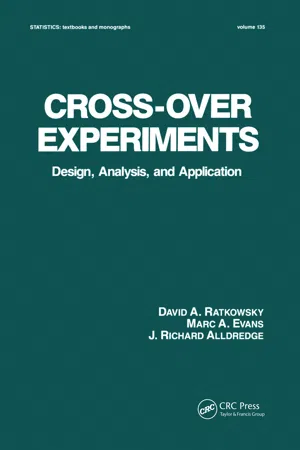
Cross-Over Experiments
Design, Analysis and Application
About this book
Developing a model-based approach that enables any cross-over trial, of any degree of imbalance, to be analyzed both for direct effects and for residual effects, using consistent procedures that employ commercially available statistical software, this text offers a guide to the analysis of cross-over designs.;Illustrating practical applications throughout with examples, this book: emphasizes the importance of choosing highly efficient designs that separate treatment and carryover effects; demonstrates the exact methodology needed to handle the analysis of data; presents a new methodology for the analysis of binary and categorical data; and considers the effects of blocking. The appendices facilitate the choosing of an appropriate design for every experimental need.
Information
1
Introduction to the Analysis of Cross-over Designs: Basic Principles and Some Useful Tools
The goal of this chapter is to establish some basic tools that will enable the user to analyze any cross-over design for which the effects are estimable. The two major tools are: (1) a method of coding, by which any cross-over design can be prepared for parameter estimation and subsequent statistical analysis; (2) a measure of “separability” of treatment and carryover effects in a model. In addition, this chapter deals with a variety of other issues and principles which are necessary in order to analyze cross-over trials in a systematic and correct way, making appropriate use of statistical testing procedures. An important feature of the approach is the fact that it is model-based, as the viewpoint is taken that appropriate statistical tests can only be valid when the estimation procedure is an attempt to estimate parameters previously defined by a model, prior to the data having been collected. In this way, there ceases to be any ambiguity or confusion about which statistical tests are the appropriate ones to use. They are determined in advance and are not influenced by the actual numerical results.
1.1. A General Method for Coding Treatment and Carryover Effects
We adopt the view in this book that carryover effects are a manifestation of treatment in subsequent periods of time. Although this is not the only viewpoint for carryover, it is one that is consistent with the notion that a treatment may persist into a later time period and influence or modify the effect of subsequently applied treatments. Carryover effects can have a variety of forms. They can be learning effects or fatigue effects, having, respectively, a positive or negative effect on the response, or they can be of a psychological, rather than of a physical, form. The latter may occur with human subjects, when the outcome of the treatment that was first applied, if it had no effect or a negative effect, could condition the subject into producing a poor result (that is, a negative effect or no effect) in the second treatment period. Conversely, a positive response in the first treatment period may cause the subject to experience an improvement in the second treatment period, that is, a type of placebo effect, even if the treatment applied in the second period lacks efficacy.
It is easier to illustrate the method of coding using an example than to present it in abstract form. We emphasize that ...
Table of contents
- Cover
- Half Title
- Series Page
- Title Page
- Copyright Page
- Preface
- Table of Contents
- Chapter 1. Introduction to the Analysis of Cross-over Designs: Basic Principles and Some Useful Tools
- Chapter 2. Latin Square Designs
- Chapter 3. The 2-Treatment, 2-Period, 2-Sequence Design
- Chapter 4. Modifications of the 2-Treatment, 2-Period, 2-Sequence Design
- Chapter 5. Cross-over Designs With Variance Balance
- Chapter 6. Cross-over Designs Lacking Variance Balance
- Chapter 7. The Analysis of Categorical Data from Cross-over Designs
- Chapter 8. Ordinary Least Squares Estimation Versus Other Criteria of Estimation: Justification for Using the Methodology Presented in This Book
- Chapter 9. Other Topics in Cross-over Designs
- References
- Solutions
- Author Index
- Subject Index
Trusted by 375,005 students
Access to over 1.5 million titles for a fair monthly price.
Study more efficiently using our study tools.
Frequently asked questions
Yes, you can cancel anytime from the Subscription tab in your account settings on the Perlego website. Your subscription will stay active until the end of your current billing period. Learn how to cancel your subscription
No, books cannot be downloaded as external files, such as PDFs, for use outside of Perlego. However, you can download books within the Perlego app for offline reading on mobile or tablet. Learn how to download books offline
Perlego offers two plans: Essential and Complete
- Essential is ideal for learners and professionals who enjoy exploring a wide range of subjects. Access the Essential Library with 800,000+ trusted titles and best-sellers across business, personal growth, and the humanities. Includes unlimited reading time and Standard Read Aloud voice.
- Complete: Perfect for advanced learners and researchers needing full, unrestricted access. Unlock 1.5M+ books across hundreds of subjects, including academic and specialized titles. The Complete Plan also includes advanced features like Premium Read Aloud and Research Assistant.
We are an online textbook subscription service, where you can get access to an entire online library for less than the price of a single book per month. With over 1.5 million books across 990+ topics, we’ve got you covered! Learn about our mission
Look out for the read-aloud symbol on your next book to see if you can listen to it. The read-aloud tool reads text aloud for you, highlighting the text as it is being read. You can pause it, speed it up and slow it down. Learn more about Read Aloud
Yes! You can use the Perlego app on both iOS and Android devices to read anytime, anywhere — even offline. Perfect for commutes or when you’re on the go.
Please note we cannot support devices running on iOS 13 and Android 7 or earlier. Learn more about using the app
Please note we cannot support devices running on iOS 13 and Android 7 or earlier. Learn more about using the app
Yes, you can access Cross-Over Experiments by David Ratkowsky,Richard Alldredge,Marc A. Evans in PDF and/or ePUB format, as well as other popular books in Mathematics & Probability & Statistics. We have over 1.5 million books available in our catalogue for you to explore.