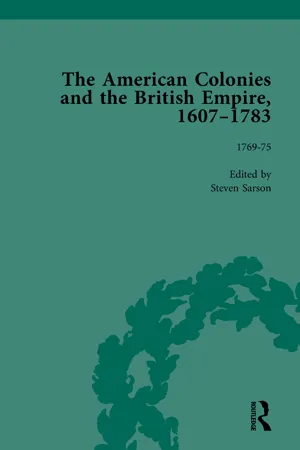
eBook - ePub
The American Colonies and the British Empire, 1607-1783, Part II vol 6
- 944 pages
- English
- ePUB (mobile friendly)
- Available on iOS & Android
eBook - ePub
The American Colonies and the British Empire, 1607-1783, Part II vol 6
About this book
This second part of an eight-volume reset edition, traces the evolution of imperial and colonial ideologies during the British colonization of America. It covers the period from 1764 to the end of the American Revolutionary War in 1783.
[CARTWRIGHT], A LETTER TO EDMUND BURKE, ESQ
[John Cartwright], A Letter to Edmund Burke, Esq; Controverting the Principles of American Government, Laid down in his Lately Published Speech on American Taxation, Delivered in the House of Commons, on the 19th of April, 1774 (London: J. Wilkie, 1775).
After a distinguished naval career from 1758 until invalided in 1769, John Cartwright, the ‘Father of Reform’ (1740–1824), educated himself in politics and from 1774 published over eighty books and pamphlets as well as numerous letters to the press. One of his first publications was American Independence: The Glory and Interest of Great Britain (London, 1774), some of which was repeated and much of which was expanded on in A Letter to Edmund Burke.
Burke’s April 1774 speech, published in January 1775, argued that Parliament had the constitutional right to tax the colonies, but it was impolitic to exercise it. Cartwright avoided a personal attack, though he launched a major one on Samuel Johnson for Taxation No Tyranny (1775), considering Burke ‘one of our great national “lights”’ (below, p. 201), but for that reason considered his pronouncements all the more dangerously misleading. Cartwright thus focuses in the first section of his tract on the 1766 Declaratory Act. He asks three questions, invoking both constitution and natural rights. First,
Doth not the British constitution, and the law of nature, which may in no wise be overturned by any human constitution whatsoever … absolutely require that the people, those at least who are proprietors of, and are thereby permanently attached to, the soil, shall actually share in the powers of legislation; by giving their consent either personally or by representatives of their own choosing, to all laws which are to be the rules of their actions[?] (below, p. 205)
Then, he asks,
What share or participation in the powers of the British parliament is possessed by any American, as an American? 3. If no individual then, in America, by sharing in, be subject to, the powers of the British parliament; how can all of them, in their collective capacities as states and civil communities, be subject to this power? (below, p. 205)
Much of the rest of this section comprises familiar historical, constitutional and natural rights justifications of American freedom from Parliamentary authority, denouncing the Navigation Acts as well as more recent legislation, and refuting the notion of virtual representation. He cites authorities from John Locke’s Two Treatises on Government (1690) to John Dickinson’s Letters from a Farmer in Pennsylvania (1767–8), adding his own extended and extravagant rhetorical flourishes, including Shakespearean and biblical allusions and analogies.
One interesting aspect of Cartwright’s literary experimentation is his attempt to subvert the familiar imperial ‘mother country’ paradigm. He offers at one point that ‘America may now be considered, as an industrious and intelligent youth just arriving at man’s estate; who, having chearfully served a long apprenticeship under us, must now, if not admitted into partnership, become our rival in trade’ (below, p. 208). He also proposes, ‘that America shall become the wife of Great-Britain … [although] I do not mean she shall therefore obey his arbitrary will, nor that he shall have a direct power to rule over her’ (below, p. 217). But Cartwright’s most original contribution to the American debate comes in the form of ‘A draught for a bill, proposed to be brought into parliament, for restoring peace and harmony between Great-Britain and the British colonies in North-America’ (below, p. 241). This proposed a treaty creating ‘The Grand British League and Confederacy’ of eighteen North American ‘free and independent states, owing no obedience or subjection whatsoever to the parliament of Great-Britain, which doth hereby … relinquish all claims and pretensions to sovereignty’ but would be obliged to protect each state’s liberty and sovereignty (below, pp. 244, 242). Each state would owe allegiance to the crown, and the crown would have sovereignty over the seas, lakes, rivers and unsettled territories (Cartwright identifies nineteen such territories north, west and south of the already existing colonies) until their populations reached 50,000 whereupon each could apply for full membership of the ‘grand league and alliance’ (below, p. 243). He also proposed a ‘monopoly of the North American commerce’ with ‘use of British money only’ (below, p. 246).
American Independence saw Cartwright embark on a lifelong mission to reform Parliament, beginning with Take Your Choice! (London 1776), his best-remembered work, advocating abolition of property qualifications for voters and MPs, payment of MPs to reduce corruption, annual elections, secret ballots and abolition of rotten boroughs. He also helped found the Society for Constitutional Information and the Society of Friends of the People to popularize these causes, undertook nationwide speaking tours, organized reformist petitions and became MP for Nottinghamshire in 1780, though he later lost an election to represent Boston, Lincolnshire. His support for American independence ended his naval career, but he became a major in the Nottinghamshire militia.1
Notes:
1. R. T. Cornish, ‘Cartwright, John (1740–1824), political reformer’, in Oxford Dictionary of National Biography, ed. H. C. G. Matthew and B. Harrison, 60 vols (Oxford: Oxford University Press, 2004), vol. 10, pp. 400–3.
A
LETTER
TO
EDMUND BURKE, Esq;
Controverting the Principles of
AMERICAN GOVERNMENT,
Laid down in his lately published
SPEECH
ON
AMERICAN TAXATION,
Delivered in the
HOUSE of COMMONS,
On the 19th of APRIL, 1774.
LONDON:
Printed for the AUTHOR, by H.S. Woodfall. Sold by J. WILKIE, No. 71, St. Paul’s Church-yard.
M.DCC.LXXV. /
ADVERTISEMENT.
‘IT may not be improper to inform the public that this letter was ready for the press when Lord Chatham’s conciliatory proposal made its appearance. In hopes that some feasible plan of accommodation with the colonies would thereupon have taken place, and such measures have ensued as might have made it unnecessary for the advocates of American freedom any longer to have kept up in its full force their contention against an overstrained and unjustifiable authority, the author thought proper to with-hold it awhile from the public eye: but being totally disappointed in his wishes, and now despairing that any good consequences whatever can result from the measures determined to be pursued by government (notwithstanding the late attempt of administration to amuse us by making a shew of taking new ground) he now humbly submits it to the perusal of his fellow-citizens; in hopes that, small as may be its comparative weight, it yet may prove a mite not unacceptable in the scale which the good genius of Britain and of British America is anxious should preponderate. In saying that he despairs of any good consequences from administration’s pertinacious oppression of the colonies, he begs to be understood as meaning only those good consequences which the authors of the present measures esteem to be such, and which they propose to bring about. /
‘Indeed he hopes, and will venture to prophecy, that, odious and shocking as are the means by them to be made use of, yet the end will be the same as himself hath proposed to obtain by a very different way of proceeding; and that, take which course we will, the present dispute cannot possibly terminate in any thing short of American Independence. Whether it will prove better to have severed the colonies from this country by the hellish sword of war, or by the generous hand of equity; whether it will prove better to have inspired them with revenge and deadly hatred, or with gratitude and warm affection; and whether one or the other will prove most beneficial to us, time alone must finally determine.’ /
TO E. B. ESQ;
SIR,
February, 1775.
WHEN my twelfth letter to the Legislature, proposing the independency of America, went to the press (see Public Advertiser, Jan. 23, 24,) I thought I had taken a final leave of the subject; but several passages in your late published speech tending, as I fear, to mislead the public judgment, teach me that it lies too near my heart for me to suffer them to pass altogether unnoticed. It is the convincing argumentation with which you demonstrate the folly, as well as injustice, of taxing America; together with the persuasive powers of eloquence there displayed, powers which can sometimes charm us into a belief of what we do not comprehend, that make your error, with regard to the sovereignty of Great-Britain, the more dangerous at this crisis, when all good men are anxious for the rights of America, though few of them are free from your own mistake, and when even the dissipated triflers of the age have a wish at least, if not a thought, to bestow in their favour. The multitude in this kingdom, when they become serious, and take a thing up in earnest, are too formidable for a minister to contend with; but alas! they believe only as they are taught by some great authority: and even men of knowledge and reflection pay it sometimes too much respect. For my own part, Sir, I look up to you as to one of those ‘guide-posts and landmarks of state whose credit in the nation’ gives general currency to your opinions; I consider you as one of our great national ‘lights.’ I wish therefore, as a matter of the last importance to the public, that you may ever hold on your course with regularity and truth: and not, like the changeful ‘luminary*’ you so happily describe, misguide your observers. / Believe me, Sir, I am not one of those who can, without a painful reluctance, withdraw my admiration from the glories of the sun, in order to contemplate his spots. But it is by an accurate observation of them, that we correct erroneous science; causing, as I may say, by these means, even the darknesses of that brilliant orb to throw light upon objects of importance to mankind. Had I a bad opinion of your heart, I would not make the vain attempt to argue you into the right; nor would I provoke you to exert your superior talents still more, in order to destroy the truth. ’Tis not as you are ingenious, but ingenuous, that I mean to dispute with you. Nor is it for me to take the large field of discussion; to lay open all history, or to unfold the legitimate laws of our constitution. I leave these deep and capacious reservoirs of knowledge and policy to be ransacked by those who are my superiors in learning and eloquence; and are better able to take a laborious part in the great cause we are now engaged in; contenting myself to draw from the fountain head, a small portion of the waters of truth; which, like a dew from heaven, have, I believe, the most kindly influence upon the production and growth of true wisdom. It is to the pure, the genuine principles of our perfect constitution, and the unalterable law of nature, that I will refer; it is to your reason and your conscience I will appeal. This will bring the question within a very small compass, and to a short issue. But be apprized, Sir, that it is not to any creature of your own imagination, an ideal ‘constitution of the British Empire [94.],’ (for I totally deny its existence, and believe that a faith and hope in it lead to perdition,) which I now mean to refer to; but to the constitution of Great-Britain; whose existence, divinity, and powers of salvation, are known to us all. This is the only compass that ever proved a sure guide upon the tempestuous sea of politics. It is a sure guide, because it is a compass without variation. It points not to any earthly loadstone, jostled by some convulsion of nature out of the true axis of our crazy planet, but the cause of its magnetism is the rock of truth, fixed in the pole of heaven from all eternity; immoveable as the throne, immutable as the nature of God. He who shall imagine that the British constitution is a compass adapted only to / one latitude and longitude; and when he arrives with it at a distant shore, depending on delusive observations, shall suppose a very considerable variation; and then, like the ignorant skipper of some little coasting bark, shall go about to adjust it, to the imaginary occasion, by giving the needle a corresponding deviation from its representative on the card, or rather chart; shall soon find himself in a most dangerous, if not a fatal error. Happy if he make not shipwreck of the political vessel. Great knowledge and practical experience may be necessary to those who hold the command, who guide the helm, and direct all the manœuvres in the ship; but the very cabin-boy knows his compass; and when the port is in sight, and all the dangers of the navigation are above water and in view, he can tell, as well as the pilot, how to steer for the one or from the other. When out of sight of land, he knows equally well, that in order to arrive safe in America, he must steer to the Westward; nor could all the sophistry of the pilot, though he spoke with the tongue of an angel, nor the authority of the captain, though aided by the logic of the cat-o’-nine-tails, ever convince him, that it would be possible to secure a prosperous voyage by steering either East, South, or North. So when the British constitution, whose form is so manifest to the eye of common sense, and whose principles by their self-evidency are so simple and so obvious, lies before us, ’tis in vain for ministers, for statesmen, or even for orators, to endeavour to impose upon our understandings, by representing that we must hold one course in Britain, and another in America, for attaining civil security and happiness; when it is impossible to arrive at them, but by keeping the prow in a true direction for liberty, whose star, like as the rock of truth, is in the pole and fast by the throne of heaven. It is true indeed, and for the reasons you have [91] assigned, that the nearest course we can keep is but ‘an approximation towards the right one;’ yet we shall run into a most ruinous error, if, to the unavoidable deviations caused by the intestine motion and tempestuous agitations of the political element, we make any intentional one, by playing tricks with our needle, and departing from that course which our compass, if faithfully consulted, shews to be the true one. You desire / Great-Britain to ‘be content to bind America by laws of trade; because she hath always done it: and not to burthen her with taxes, because she was not used to do so from the beginning. These,’ you add, ‘are the arguments of states and kingdoms.’ [89, 90.] But, with your leave, Sir, these are the arguments of Egyptian task-masters, of Carthaginian blood-suckers, of Roman monsters and Spanish tyrants; for silencing the murmurs of their fleeced, pardon me, I mean flead provinces and miserable bond-men. What! Sir; are prescripts and precedents, be they natural or unnatural, be they good or bad, be they just or unjust; the proper arguments of states and kingdoms? So then, nothing is wanting to reconcile us to the most infernal way of governing, but that our tyrant hath always done so; that he was used to act the tyrant from the beginning! – Fie, if e! What a lesson for a young Telemachus to learn from the lips of his Mentor!1 ‘You may be as great a tyrant as you please, provided you only establish your precedents in the beginning.’ Should murmurs afterwards arise, or the accumulating weight of your power in length of time become so intolerable as to cause your right to be called in question; – ‘reason not at all – oppose the ancient policy and practice of the empire, as a rampart against the speculations of innovators, – and you will stand on great, manly, and sureground.’ – Excellent doctrine! O Locke,2 thou reputed sage, ‘hide thy diminished head!’ What are all thy refinements, [94] thy ‘metaphysical distinctions [89,’] to maxims such as these! – You expressly acknowledge, Sir, [41] that ‘you think the commercial restraint is full ...
Table of contents
- Cover
- Half Title
- Title Page
- Copyright Page
- Table of Contents
- An Inquiry into the Nature and Causes of the Present Disputes between the British Colonies in America and their Mother Country (1769)
- [Sir Hercules Langrishe], Considerations on the Dependencies of Great Britain. With Observations on a Pamphlet, Intitled Th e Present State of the Nation (1769)
- [Thomas Pownall], State of the Constitution of the Colonies ([1769])
- Observations on Several Acts of Parliament, Passed in the Fourth, Sixth and Seventh Years of his Present Majesty’s Reign (1770)
- Rev. John Lathrop, Innocent Blood Crying to God fr om the Streets of Boston. A Sermon (1770)
- [Rev. John Allen], An Oration on the Beauties of Liberty, or The Essential Rights of the Americans (1773)
- [William Bollan], The Rights of the English Colonies Established in America Stated and Defended (1774)
- [John Cartwright], A Letter to Edmund Burke, Esq; Controverting the Principles of American Government, Laid Down in his Lately Published Speech on American Taxation (1775)
- Editorial Notes
Trusted by 375,005 students
Access to over 1.5 million titles for a fair monthly price.
Study more efficiently using our study tools.
Frequently asked questions
Yes, you can cancel anytime from the Subscription tab in your account settings on the Perlego website. Your subscription will stay active until the end of your current billing period. Learn how to cancel your subscription
No, books cannot be downloaded as external files, such as PDFs, for use outside of Perlego. However, you can download books within the Perlego app for offline reading on mobile or tablet. Learn how to download books offline
Perlego offers two plans: Essential and Complete
- Essential is ideal for learners and professionals who enjoy exploring a wide range of subjects. Access the Essential Library with 800,000+ trusted titles and best-sellers across business, personal growth, and the humanities. Includes unlimited reading time and Standard Read Aloud voice.
- Complete: Perfect for advanced learners and researchers needing full, unrestricted access. Unlock 1.5M+ books across hundreds of subjects, including academic and specialized titles. The Complete Plan also includes advanced features like Premium Read Aloud and Research Assistant.
We are an online textbook subscription service, where you can get access to an entire online library for less than the price of a single book per month. With over 1.5 million books across 990+ topics, we’ve got you covered! Learn about our mission
Look out for the read-aloud symbol on your next book to see if you can listen to it. The read-aloud tool reads text aloud for you, highlighting the text as it is being read. You can pause it, speed it up and slow it down. Learn more about Read Aloud
Yes! You can use the Perlego app on both iOS and Android devices to read anytime, anywhere — even offline. Perfect for commutes or when you’re on the go.
Please note we cannot support devices running on iOS 13 and Android 7 or earlier. Learn more about using the app
Please note we cannot support devices running on iOS 13 and Android 7 or earlier. Learn more about using the app
Yes, you can access The American Colonies and the British Empire, 1607-1783, Part II vol 6 by Steven Sarson,Jack P Greene, Steven Sarson in PDF and/or ePUB format, as well as other popular books in History & World History. We have over 1.5 million books available in our catalogue for you to explore.