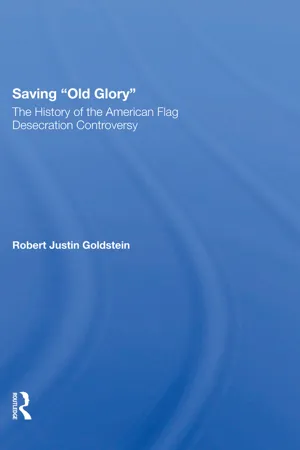
First published in 1995, Saving Old Glory provides a detailed account of the origins and development of the American flag desecration controversy.
eBook - ePub
Saving Old Glory
The History Of The American Flag Desecration Controversy
- 280 pages
- English
- ePUB (mobile friendly)
- Available on iOS & Android
eBook - ePub
1
Origins of the American Flag Desecration Controversy, 1890-1907
THE AMERICAN FLAG played a very minor role in the political, or even in the decorative, life of the United States until the Civil War. Only the outbreak of the Civil War transformed the flag into a genuinely popular, and frequently displayed, symbol of the nation, or, more precisely, of the North, in its struggle to maintain the Union against the Confederacy, which, of course, had its own flag. The enhanced popularity of the flag continued, at least in the North, after the conclusion of the Civil War. However, this new popularity at first contained within it no widespread sense, of the sort so clearly manifested by President George Bush and many others during the 1989-90 "flag burning" controversy, that the Stars and Stripes should be regarded as a sacred or holy relic of any kind that could or should be used for what the Supreme Court in 1989 termed "only a limited set of messages."1
In fact, aside from the far greater general display of the flag as compared to the antebellum era, the flag's new popularity was mostly manifested by its increasing use by the emerging advertising industry as the nation modernized. Representations of the flag were used to help sell products of all sorts, including liquor, cigars, fruit, and even toilet paper. Additionally, the growing popularity of the flag was manifested by the increased frequency with which politicians were willing to use it, both symbolically and literally, for uses far more crass and profane than sacred.
What might be termed the iconization of the flag is historically quite recent and developed, not as a result of any gradually emerging spontaneous popular consensus that the flag should be treated as a sacred object, but rather as the result of a deliberate, extensive, and prolonged campaign engineered during the post-1890 period by a variety of veterans groups, mostly Union Civil War survivors, such as the Grand Army of the Republic (GAR), and hereditary-patriotic groups, such as the Daughters of the American Revolution (DAR) and Sons of the American Revolution (SAR), whose members claimed to be descendants of revolutionary fighters. As a result of this campaign, either (but not both) the U.S. Senate or House of Representatives passed bills to outlaw "desecration" (by definition the sacrilegious treatment of a holy object) of the flag on nine separate occasions between 1890 and 1943, and Congressional hearings on the subject were held approximately a dozen times during the same period.
Although it was not until 1968, during the Vietnam War, that flag desecration was outlawed by the national government, in a transparent attempt to suppress a particular form of antiwar dissent, between 1897 and 1932 every state passed its own flag desecration law. One of the historical descendants of Texas's original flag desecration law, enacted in 1917, was struck down (along with, by implication, the 1968 federal law and many, if not all, of the other state laws) in the famous (and to some infamous) 1989 U.S. Supreme Court decision of Texas v. Johnson.2
The original effort to outlaw flag desecration especially flourished between about 1895 and 1910, a time of rapidly increasing immigration and industrialization. During this period, many middle-class Americans of northwest European descent became alarmed over what they perceived as a rapidly growing threat to the cohesion of American society—and their own traditional dominance of that society—by a variety of forces, including immigrants from southern and eastern Europe, political radicals, trade unions, and upstart venal businessmen. To a large extent, the campaign to turn the American flag into a holy object represented an attempt by traditionally dominant groups both to assert their own position as the most "true blue" patriots, and to provide criminal penalties for those elements who—already suspiciously "un-American" by virtue of their political beliefs, ethnic or regional backgrounds, and occupations—refused to conform to their demands for proper reverence of the flag.
In a broader symbolic sense, the turn-of-the-century flag desecration controversy represented an attempt by traditionally dominant groups to use the flag as a sort of psychological lance to slay their perceived enemies, much as the display of the cross (to which the flag was repeatedly compared by the supporters of flag desecration laws) reportedly could force the mythological vampire Dracula to flee.
The 1989-90 flag desecration controversy was not the first, but in fact the third time that the issue of flag desecration became the focus of considerable debate in American society. Memories of the 1989-90 and, to a lesser extent, the Vietnam era flag desecration controversies are still fresh in the minds of many living Americans. However, the first flag desecration controversy, which centered around 1895-1910 but encompassed in a less intense sense the entire 1890-1943 period (from the first to the last passage by one Congressional house of flag desecration legislation until the Vietnam period), has been almost forgotten. This original controversy was virtually never even mentioned during the 1989-90 conflict, for example, even though it was this earliest dispute that largely "created" the twentieth-century iconization of the American flag.3 This original controversy, therefore, not only laid, in a narrow sense, the legal and ideational groundwork for both subsequent controversies, but it created, in broader terms, the popular and political sense of the power and importance of the flag that has been dominant since the turn of the century. This unexplored and forgotten controversy therefore cries out for examination.
The Flag in the Antebellum and Civil War Eras
The approval of the stars-and-stripes design for the new American flag by the Continental Congress on June 14, 1777, aroused little public interest at the time, and during the following eighty-five years there were few signs of general interest in or display of the flag. In fact, the first newspaper report about the approval of the new flag design appeared only seventy-five days after the fact in the August 30, 1777, Pennsylvania Evening Post. The primary reason for the approval of a new flag was to designate and hopefully protect American ships at sea. Speaking in the early 1800s, Massachusetts Congressman Josiah Quincy warned, however, that the flag would be a meaningless symbol unless the new country maintained substantive naval power to back it up: making an argument similar in tone to that made almost two centuries later by those who argued that forbidding flag desecration would betray the substantive freedoms represented by the flag in order to protect a mere symbol, Quincy attacked those who spoke as if "a rag, with certain stripes and stars upon it, tied to a stick and called a flag, was a wizard's wand" when in fact "if you have no maritime power to maintain it, you have a name and no reality; you have the shadow without the substance."
Until the outbreak of the Civil War, the flag was displayed on land almost exclusively on federal government buildings and forts (such as Ft. McHenry during the War of 1812, the setting for Francis Scott Key's penning of "The Star Spangled Banner," which was officially designated the United States national anthem only in 1931). Exhaustive collections of contemporaneous songs, prints, and drawings about the American Revolution include very few references whatever to the flag, and as late as 1794, according to flag historian Milo Quaife, "the vast majority of Americans never came in contact" with a flag. U.S. Army units continued to fly distinct regimental emblems until 1834, and the army fought under the American flag for the first time only during the Mexican War of 1846-48.4
During the antebellum period, the flag was not unfurled over American schools; as the director of the Betsy Ross house in Philadelphia noted during the 1989-90 flag desecration controversy, "It would have been unthinkable to fly an American flag at a private home. It simply was not done." Textbooks used inside the schools, and even Fourth of July oratory throughout the country, made few or no references to the flag. Examinations of various artifacts of popular culture during the antebellum period, such as textiles, china, glass, and wallpaper, disclose that although the flag was occasionally utilized as a motif, especially after the War of 1812, it was very markedly less popular than other themes such as, above all, depictions of George Washington, personifications of Liberty and Columbia, and even the bald eagle. As one historian has noted, by 1810 it was the eagle, not the flag, that had become the "country's most popular emblem and the universal badge of an American." Another historian, in a comment that could apply today to the flag but in fact referred to the eagle, declared that "probably no modern civilized nation has venerated its national emblem so much as Americans." Because general display of the flag was virtually nonexistent during the antebellum period, the first full-time American commercial flag manufacturer was not established until the Mexican War stimulated enough demand to make such a venture worthwhile. In short, as cultural historian Wilbur Zelinsky summarized, "During its early career, the national flag was remarkably unimportant to the citizenry at large."5
One of the clearest indications of the relative lack of importance of the flag during the antebellum period was the fact that there was no officially prescribed standardized length-height ratio, color order of the stripes, or even arrangement of the stars in the field (and there would not be until President Taft issued an executive order concerning such matters in 1912). Thus, the canton of stars rested on a red stripe in some flags but on a white stripe in others, the constellation of stars varied wildly in design, and even the number of stripes displayed was often inconsistent (although this latter aspect of the flag had been officially established by law).
Eighteen months after the flag was created, American emissaries abroad could not accurately describe it. As late as 1847 the Dutch government politely inquired of the American government, "What is the American flag?" A 1793 watercolor depicts an American flag with green and red stripes, containing a yellow canton with 13 crosses, while a Liverpool jug from about the same period displays a flag with yellow and blue stripes. In 1817 Congressman Peter Wendover of New York lamented to the House of Representatives that although, by law, the flag should then have contained 15 stripes, in fact a 13-stripe flag was flying over the Capitol, the nearby Navy Yard and Marine Barracks was displaying a flag with "at least" 18 stripes, and the previous Congress had sat under a 9-stripe flag. (In 1818 the number of stripes was permanently fixed at 13; previously the number of stripes corresponded to the number of states.)6
In addition to the lack of any standardized flag design, another clear indication of the lack of the flag's importance for the general citizenry before the Civil War was the fact that it was hardly ever used for the purposes of expressing symbolic political protest. Two of the very few instances in which the flag was used in an unorthodox manner to convey protest before 1861 occurred in Boston in 1854, when abolitionists flew flags upside down to protest the return of a runaway slave and their leader, William Lloyd Garrison, protested the same event by burning a copy of the U.S. Constitution while speaking in front of a backdrop of a flag draped in black.7
Although the popularity of the flag received at least minor boosts from the patriotic fervor stirred up by the War of 1812 and the Mexican War, only the outbreak of the Civil War, symbolically begun by Confederate troops firing on the American flag-bedecked Fort Sumter, South Carolina, transformed the Stars and Stripes into a true focus for nationalist feelings (although, of course, only in the North). As flag historian Robert Philipps has noted, before Fort Sumter the flag had been regarded as "peculiarly governmental property," but thereafter it became "the flag of the people"; similarly, an 1896 report by the Connecticut SAR declared that although before 1861 there had been "comparatively but little display" of the flag, with the outbreak of war, "all at once the people of the Northern States of the Union discovered that there was an American Flag and towns and villages, cities and county hamlets blossomed full-bloom with a most gorgeous display of the Red, White and Blue."8
The leading nineteenth-century historian of the flag, George Preble, summarized its dramatic change in status in a romanticized but no doubt reasonably accurate account:
The fall of Sumter created great enthusiasm throughout the loyal states, for the flag had come to have a new and strange significance. ... One cry was raised, drowning all other voices,—"War! war to restore the Union! war to avenge the flag!" ... When the stars and stripes went down at Sumter, they went up in every town and county in the loyal states. Every city, town and village suddenly blossomed with banners. On forts and ships, from church-spires and flag-staffs, from colleges, hotels, store-fronts, and private balconies, from public edifices, everywhere the old flag was flung out.... The demand for flags was so great that the manufacturers could not furnish them fast enough. Bunting was exhausted and recourse was had to all sorts of substitutes. In New York the demand for flags raised the price of bunting from $4.75 a piece to $28.... Cincinnati, after the fall of Sumter, was fairly iridescent with the red, white and blue.
Numerous ceremonial flag raisings were conducted in the North shortly after the outbreak of the war. At one such ceremony in Boston on April 27, 1861, the well-known orator Edward Everett declared that the "flag of the country always honored, always beloved, is now at once worshipped, I may say, with the passionate homage of this whole people." At a flag raising ceremony that attracted 100,000 people at Union Square in New York City on April 20, 1861, the tattered remnants of the Fort Sumter flag were placed in the hands of a statue of George Washington; throughout the war, this relic was used as a fund-raising device, and upon the recapture of Sumter in 1865, the flag was returned and rededicated in an elaborate ceremony. Popular magazines like Harper's, which before the Civil War had paid little attention to the flag, even in connection with Fourth of July celebrations, now focused on it as the preeminent symbol of the nation. The popular northern anthem "The Battle Cry of Freedom" featured the line, "we'll rally round the flag, boys," and " Marching through Georgia" promised southern slaves that northern troops bore "the flag that makes you free." One of the most famous poems based on the Civil War was John Greenleaf Whittier's "Barbara Frietchie," in which the fictional heroine hangs a flag out of her window in Frederick, Maryland and speaks to occupying troops: "'Shoot if you must, this old gray head/But spare your country's flag,' she said." However, to Boston writer and abolitionist Lydia Maria Child, Lincoln's failure to order an immediate end to slavery made the flag only a symbol of slavery; in a letter written during the early part of the war, she declared, "May the curse of God rest upon it! May it be trampled in the dust, kicked by the rebels and spit upon by tyrants."9
In fact, the flag's new status in the North and the desperate passions invoked by the war quickly made the emblem, for the first time, both the object of organized and deliberate physical assault (among those who opposed the North) and the object of governmental efforts to punish such forms of symbolic dissent. On January 29, 1861, ten weeks before the outbreak of the war, President Buchanan's treasury secretary John Dix telegraphed to a clerk in New Orleans, with regard to an attempt by Louisiana to confiscate a revenue cutter, "If anyone attempts to haul down the American flag, shoot him on the spot." Nonetheless, upon the war's outbreak, American flags were publicly torn down in Richmond on April 18, buried in Memphis on April 21, and burned in Liberty, Mississippi, on May 10, in what seems to have been the first protest flag burning in American history. During Christmas of 1862, Confederates danced on American flags used to carpet the floors at a wedding celebration in Murfreesboro, Tennessee, shortly before the inconclusive Battle of Stones River fought nearby.10
While the Union was helpless to prevent such incidents in regions under Confederate control, punishments did occur where Union authority existed. In some cases vigilantes forced suspect individuals or organizations to display the flag: thus, in New York, Philadelphia, Trenton and many other cities mobs compelled newspaper offices and stores to display the flag, and, as historian Preble relates "haste was made to borrow, beg or steal something red, white and blue, to protect property with." In other cases, official measures were taken against those deemed to have desecrated the flag. Thus, in Union-controlled Nashville in 1865, a schoolgirl was court-martialed, fined $300 and sentenced to 90 days in a military prison for tearing down and trampling an American flag (although, on review, the penalty was remitted, essentially on the grounds that she had been entrapped).
The outcome was far more serious in New Orleans during the Union reoccupation, where William B. Mumford was hung before a large crowd on June 7, 1862, after being convicted of treason in a military court for, on April 27, 1862, pulling down, dragging in the mud, and tearing to shreds an American flag that had been hoisted over the New Orleans mint. The death sentence was confirmed on June 5, 1862 by the autocratic Gen. Benjamin Butler (whose harsh rule in 1862 as military governor of New Orleans earned him the nickname of "Beast" and caused President Lincoln to withdraw him after eight months). Butler had earlier issued an order on May 1, demanding the suppression of "all ensigns, flags or devices" representing any authority but that of the United States, as well as demanding the "utmost deference" for the "American ensigns" and "severe punishment" for those acting otherwise. In confirming the execution order, Butler effectively made his May 1 decree retroactive to cover Mumford's action of four days earlier, at a time when Union authority had not been fully secured. He declared that Mumford had intended to incite "evil-minded persons to further resistance to the laws and arms of the United States."
Mumford reportedly met his death bravely and quickly became a Confederate martyr. The deposed and fugitive Confederate governor of Louisiana, Thomas Moore, referred to Mumford's "noble heroism" and, commenting on Mumford's reported refusal to save his own life at the last minute by swearing loyalty to the Union, declared that he had bravely scorned to "stain his soul with such foul dishonor" and "transmitted to his countrymen a fresh example of what one will do and dare under the inspiration of fervid patriotism." Moore added that he would neither "forget the outrage" of Mumford's murder nor let it "pass unatoned." In a December 1862 proclamation Confederate President Jefferson Davis termed Mumford's execution the "deliberate murder" of "an unresisting and non-combatant captive" and declared Butler an "outlaw...
Table of contents
- Cover
- Half Title
- Title
- Copyright
- Dedication
- Contents
- Preface
- List of Abbreviations
- 1 Origins of the American Flag Desecration Controversy 1890-1907
- 2 The Interpretation and Application of State Flag Desecration Laws, 1899-1964
- 3 The Vietnam War Era Flag Desecration Controversy, 1965-1974
- 4 Flag Desecration Laws in the Courts During the Vietnam War Era
- 5 The Great 1989-1990 Flag Burning Controversy
- Notes
- Appendix
- About the Book and Author
- Index
Trusted by 375,005 students
Access to over 1.5 million titles for a fair monthly price.
Study more efficiently using our study tools.
Frequently asked questions
Yes, you can cancel anytime from the Subscription tab in your account settings on the Perlego website. Your subscription will stay active until the end of your current billing period. Learn how to cancel your subscription
No, books cannot be downloaded as external files, such as PDFs, for use outside of Perlego. However, you can download books within the Perlego app for offline reading on mobile or tablet. Learn how to download books offline
Perlego offers two plans: Essential and Complete
- Essential is ideal for learners and professionals who enjoy exploring a wide range of subjects. Access the Essential Library with 800,000+ trusted titles and best-sellers across business, personal growth, and the humanities. Includes unlimited reading time and Standard Read Aloud voice.
- Complete: Perfect for advanced learners and researchers needing full, unrestricted access. Unlock 1.5M+ books across hundreds of subjects, including academic and specialized titles. The Complete Plan also includes advanced features like Premium Read Aloud and Research Assistant.
We are an online textbook subscription service, where you can get access to an entire online library for less than the price of a single book per month. With over 1.5 million books across 990+ topics, we’ve got you covered! Learn about our mission
Look out for the read-aloud symbol on your next book to see if you can listen to it. The read-aloud tool reads text aloud for you, highlighting the text as it is being read. You can pause it, speed it up and slow it down. Learn more about Read Aloud
Yes! You can use the Perlego app on both iOS and Android devices to read anytime, anywhere — even offline. Perfect for commutes or when you’re on the go.
Please note we cannot support devices running on iOS 13 and Android 7 or earlier. Learn more about using the app
Please note we cannot support devices running on iOS 13 and Android 7 or earlier. Learn more about using the app
Yes, you can access Saving Old Glory by Robert Justin Goldstein in PDF and/or ePUB format, as well as other popular books in History & World History. We have over 1.5 million books available in our catalogue for you to explore.