- 258 pages
- English
- ePUB (mobile friendly)
- Available on iOS & Android
eBook - ePub
Tales from the Arab Tribes
About this book
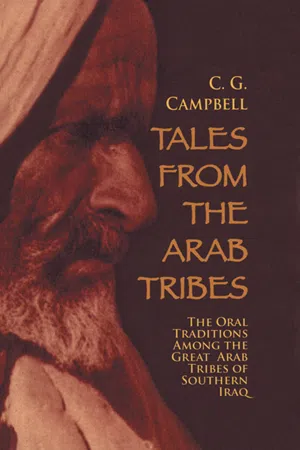
First published in 2007. The tales contained in this collection are part of the oral traditions of the great Arab tribes of Southern Iraq. They have the authentic flavor of The Thousand and One Nights, and are alive with the same robustness as most Islamic popular legends- full of taste for heroic gesture, a voluptuous delight in scent and colour, and a broad, earthy humour. Charles Campbell captures the elusive cadences of style, flowing and elegant. This is an unusual volume with an appeal for all who like romance and adventure and who take pleasure in good stories, well told. John Buckland-Wright's delightful drawings capture the character and atmosphere of the people and the stories.
Information
The Story of Khalid, The Coppersmith of Nasiriya

Let the name of Mohammed Hassan be written, that he is the teller of this story.
ONCE, in the days when the Turks ruled Iraq, there was a coppersmith of Basra, and Khalid was his name. He was born in Nasiriya, and lived there until the sixteenth year of his life. Then, when his father died, he took his mother and went to Basra and he worked as a coppersmith in the bazaar of Umm el Brum, that he might earn enough with which to live. Now, the amount he earned each month from the owner of the coppershop was only enough for food and rent and clothes for his mother and himself, nor could he save money enough to buy a shop of his own or to marry a wife. And Khalid and his mother lived in a poor house, and she did the cooking and all the work of the house was in her hands.
There came a day that the mother of Khalid fell sick and died and he was left alone in the house, nor was there anyone to do the cooking and the work of the house. As for Khalid, he had to go to work from the rising of the sun until its setting, so he could not go to the bazaar to buy vegetables and meat, nor could he cook his food. He therefore thought: Since I do not earn enough to keep a servant it is necessary that I marry a wife, and this course I would surely take if I had the money, since it is incumbent on a man to take to himself a wife. But since I have little money, let me seek out one who is less desired by men for some reason, that she may be cheap, and though she may not be perfect in all the requirements of a wife, she will at least buy the supplies from the market and cook them and clean the house.
Then Khalid sent for a wise woman who acted as a gobetween for those about to marry, and he said to her: Know you that my income is small and my capital is none and I desire to marry a wife. Therefore seek out one whose father will not require of me more than one gold lira, and if she is lame or has only one eye, it matters not, but let her be able to cook. And the wise woman replied and said: I already know of such a one. Her father requires only a date stone. She is perfect in figure and in her face she has the beauty of the moon, she can recite poetry, and as for her cooking, verily it is said that there is a commotion in the heavens, for it is necessary to restrain the angels that they come not down to partake of it whenever she cooks a dish.
Khalid then said to the wise woman: If she be indeed as you say, then why the date stone? Perchance her name is dishonoured and such a one I do not want. But the woman said: If she be not a virgin, then return her to her father. Verily she is honourable, and as for the reason for the date stone, let it be known to you that this girl has the temper of a fiery steed, and her father has recently taken a wife of the same age as this girl, and she beats and torments the new wife of her father without mercy, nor is there peace in his house. Therefore he will give her to you in marriage and her name is Khalila. But she needs a firm hand on the reins. Khalid was happy that he should get a wife beautiful in face and figure, so he said to the wise woman: It shall be as you say. I shall marry this girl, and I shall control her, nor can her temper matter to me, for I am a man, and she is but a woman.
And so the arrangements were made and a day came on which Khalid sat in his house and his friends went and brought the girl Khalila to him and he took her in marriage. And Khalid’s heart was filled with joy, for he found that the girl was beautiful of face and beautiful of figure and he spent the night in the delights and joy of matrimony, and he was happy and thought: I am only a poor coppersmith, yet I have a bride fit for the Sultan himself. And after a few days spent in married bliss Khalila woke Khalid at the rising of the sun and she said to him: Rise and go to your work, for the house is dirty and it needs cleaning and attention. And Khalid rose and he went to his work.
At the setting of the sun the coppersmiths in the bazaar of Umm el Brum closed their shops and Khalid’s master permitted him to go and return to his home. And Khalid entered his house and he stood and rubbed his eyes, for he thought he was in a dream and that what he saw could not be true. For his house was carpeted with the most beautiful carpet made of silk, and it was truly worth not less than one hundred gold liras, and on it stood chairs and tables made of the finest woods, and on the tables were dishes and vases of silver. And Khalid saw that his house looked richer than that of the wealthiest merchant in Basra, and he was amazed at what he saw.
And he said to his wife Khalila: From whence is this wealth? She replied and said: Did you think that I was going to live in a mud hut with no carpet, and with chairs and tables of white deal, and with dishes of earthenware? I am of gentle birth and I need delicate and beautiful things. Therefore have I pledged your credit and brought these few poor things we need, and even this was difficult, for the merchants did not seem to think much of your ability to pay. And Khalid became angry and he said: Woman, what have you done? Know you it will take me fifty years to pay for this merchandise? She replied: Am I then to live in squalor? Are you not a man that you cannot pay for the needs of the house?
Then Khalid’s fury grew, and it was in his thoughts that he should beat his wife, and he picked up a stick and got in a few blows on her, but when he put out his hand to hold her in one place that he might beat her the better, she bit his wrist to the bone, and it became apparent to Khalid that his wife had indeed the temper of a fiery steed.
The night passed in fighting and quarrelling and in the morning Khalid’s face was covered with scratches from the finger-nails of his wife, and as for Khalila, her back was bleeding and her eyes were yellow from blows. And at the rising of the sun Khalila stayed in her bed, and she refused to make the breakfast for Khalid, and he went to his work hungry and empty, without even a sip of tea.
Khalid sat in the shop of the coppersmith and he fashioned vessels of copper and brass according to the orders of his master, but his heart was full of sadness and grief, and he thought: It was better that I had not married this girl, for now I am indebted to the extent of several hundred gold liras, whereas before I did not owe a single copper coin. And as for my food, she will not prepare it, for she is a fine lady. And at the setting of the sun Khalid sought out a wise woman who lived in the market and he said to her: My state is thus and thus. How can I tame my wife and make her obedient to me?
The woman thought much and she questioned Khalid concerning the nights of bliss, for she was an expert in these matters, and she said: When you go to your house you shall refrain from your wife and remain far from her, and this shall be for many days. Then shall you arrange to marry another wife, but I promise you that she will come to her senses and be obedient to you before this happens.
Khalid returned to his house and he entered, but he did not greet his wife. Instead he went to the carpet and stroked it with his hand and he said: O lovely carpet, how beautiful is your silken pile, how gay your colours. Verily, beauty is reserved to carpets only, nor do women have any share of it, for women are all alike. They have hair as black as a spider’s legs, a pair of eyes similar to the eyes of a dog, mouths like monkeys’ mouths, breasts like the udders of a water buffalo, and their skin is the colour of mud. How, then, can a man love a woman? But you, dear carpet, are of many gay colours, you have the colour of red roses, the blue of the morning sky, the green of young grass, and the yellow sheen of gold. What is more, you have the precious gift of silence, nor do you speak in shrill tones as do the cats when they fight in the moonlight. And that night and on the next night and on every night Khalid rolled up the carpet and took it with him to bed, nor did he speak to his wife. And as for Khalila, she thought: Unhappy is my lot, for I am married to a madman.
Now, let it be known to you that in those days the Turkish Governor of Basra kept a spy at Baghdad, that he might receive information and warning that he be not surprised by his superiors, for truly the revenue of Basra was great, and the Governor took more than three-quarters of it for himself and for the expenses of his house, and the remainder he sent to Baghdad, saying: Basra is but a poor city.
One day the Governor received a letter from his spy at Baghdad, and the letter read as follows:
O honoured and respected Governor, Let it be known to you that through the exercise of my secret trade I have discovered that a spy has been sent to Basra, and he has been ordered to report on your administration, and on the several revenues of the City. And as for his name, I know it not, and even if I knew it, then it would be of no value, for he would change it. But he is said to be such a man as would work as a smith or artisan, and I enjoin Your Honour to be on your guard against this dangerous man.
The Governor read the letter and his face turned as pale as milk, and he sent for his agents and spies, of whom he had many in the City of Basra, that they might inform him which of the merchants hid and concealed their wealth from him. And he said: Go to the bazaars and to the markets and make full enquiries concerning the smiths and artisans in this City, and inform me of one who is not a native of this place, and who is different from what he appears to be.
The spies and agents went off to execute the orders of their master the Governor, and for a whole week they made discreet enquiries in the bazaars and coffee-houses and they came back and reported to their master and they said: We have enquired diligently concerning every smith and every artisan of this City, and we have found one who says he comes from Nasiriya, and his name is Khalid. But these facts may be false, and he is certainly other than what he appears to be. For though he is only a poor coppersmith earning less than one gold lira a month, yet his house is furnished in a richer fashion than is your palace, and his wife goes to the market and she buys silken carpets and silver vessels worth hundreds of gold liras without a thought to the price.
The Governor dismissed them from his presence, and he thought: Verily this is he, for no doubt he was given a bag of gold for his expenses, and he has misappropriated the money for his own ends. And the Governor sent for his secretary, and this man enjoyed the fullest confidence of his master, and he said to his faithful secretary: The situation is thus and thus. Let us kill this dangerous man.
But the secretary thought for a long time, and then he spoke after this fashion: To kill him would be folly, for another might come in his place. The Government has many hands and many eyes. Let us rather do another thing, let us incline this man to our side, for it is said that the heart of a man may be turned either by women or by gold. And the Governor agreed with his secretary and approved his words.
So the next day the secretary of the Governor went to the market of the coppersmiths and he went to the shop in which Khalid worked. And the master of the shop was pleased at his distinguished visitor, and he ordered a glass of tea from the coffee-house. But the secretary did not speak to the master of the shop. He turned to Khalid, and he examined the copper bowl he was making, and he said: This is indeed the best workman in Basra. And the master of the shop thought: Has the Governor’s secretary been attracted by the eyes of our Khalid, for that bowl is no better and no worse than hundreds of others in this bazaar?
Then the secretary spoke and said: Know you that my master, the Governor, is always careful of the welfare of the people of Basra, and he is a lover of artistic and beautiful things, and he has heard that some of the copper vessels in the houses of the people of Basra are lacking in beauty and in skilful workmanship. Therefore has he commanded me that I find the most skilful coppersmith in Basra, that he may be appointed Inspector of Coppersmiths, and after due enquiry I find that you are indeed the best. I therefore appoint you Inspector of Coppersmiths at a salary of one hundred gold liras per month, and your duty shall be to inspect and license the coppersmiths of Basra, and you may charge them such fees as you deem suitable.
Khalid heard the words of the secretary, and his heart was filled with a great joy, and as for the master of the shop, he thought: I knew that Khalid was a handsome young man, but I never thought that he would come to this, for it must be his beauty that the secretary admires, for as for his skill, it is not great.
Khalid thanked the secretary and he got up and left the coppersmith’s shop, nor did he continue to work. And he went to his house to tell his wife to pack the furniture that they might move from the mud house to a house of marble and fine stones. And Khalid entered his house and he said to his wife: Pack the carpet and furniture that we may move to a palace fit for our high estate.
Khalila heard the words of her husband and her heart was filled with grief, and she thought: Truly I have driven this poor man mad, for he is only a poor coppersmith unable to find the money for even this house. Yet he talks of moving to a palace. How unlucky is my lot, for even if he divorces me, who will marry a divorced woman? And it appears I shall spend my life married to a madman, and never again shall I taste of the joys of marriage.
So Khalila cast herself at her husband’s feet, and her body vibrated with sobs, and she said: O my husband, only be as you were on the night of our wedding, and you may take a stick and beat me as much as your heart desires, for I merit a beating. And Khalid thought: She indeed merits a beating, and if I do this to her she will be obedient in future. So he took a stick and beat his wife until the blood came, nor did she fight or resist him.
Then Khalid took his wife and he moved to a fine house and he spent many years in the enjoyment of love and in drawing the emoluments of his high office. And Khalila returned his love exceedingly and she obeyed him in everything, and as for the Governor of Basra, he was happy for he thought that he had inclined the heart of the Government spy towards him. And as for the real spy, he was never heard of for he was set on and killed by the Maadan on his way to Basra, and they took from his body his bag of gold, nor did the Government send another spy in his place.
The Story of the Son of the Pilgrim

Verily man cannot die before his appointed time, nor can he live after it for even as long as it takes a stone to drop from the hand to the ground.
ONCE in ancient times there was or there was not a great landowner, master of vast estates, to whom the sheikhs of the Arabs and of the bedouin paid tribute and in God only is there belief.
The name of the landowner was Hassan, and he had a young wife beautiful as a moon, and a faithful slave who had been with him since boyhood and whose name was Ahmed, and Ahmed was devoted to his master and obeyed him in everything.
There came a year in which the Sultan sent a command to the landowner Hassan, and he appointed him Prince of the caravan which was setting out on the Pilgrimage. The wife of Hassan was at that very time with child, and Hassan loved her greatly, nor did he like to leave her. So he ordered that a seat and canopy should be prepared for her on a camel, and he said: It is fitting that my son be born on the Pilgrimage.
The Pilgrimage set out and its destination was Mecca, and it marched according to the orders of the Prince of the Caravan, and with him went his wife and Ahmed his faithful slave. And the caravan reached the Valley of Tos and halted there for the night. Now, with the caravan were many Indian pilgrims, and amongst them was the sickness of cholera, and in the Valley of Tos the sickness spread to many men and many women in the caravan, and they rolled on the ground in the agony of death.
And on that very night the child in the wife of Hassan reached his appointed hour for entering the world, and Hassan said to his faithful slave: Summon the midwife and the wet nurses. For he had arranged for them to be with the caravan. But the slave Ahmed answered and said: Master, they are dead of the sickness. Then Hassan and the slave Ahmed attended themselves to the wife of Hassan and they brought forth from her a fine boy and he lived, but as for Hassan’s wife, she died in the pangs and labour of childbirth. Then Hassan asked the slave Ahmed to enquire if there was any woman in the caravan who could nurse the boy, but Ahmed returned and said: Master, we of this caravan are now only of one sex, for those women who were amongst us are dead, and even the camels are not in milk.
Hassan’s heart was full of grief and he thought: My beloved wife is dead and now my son will die, and he ordered Ahmed: Dig a tomb and place in it my wife and my son. Ahmed said: Master, will you, then, bury a living boy? Hassan answered: Is there, then, milk in your breast that you will nurse him? Rather should we leave him to the will of God. So the slave Ahmed dug a tomb and he placed in it the woman and the boy, and the boy still lived.
In the morning after they had buried those who had died of the sickness the caravan marched on, and they came to the valley of Faratos, where they camped for the night. The sickness had not departed from them, and the night was filled with the screams of the dying. And the Prince of the Caravan fell sick and he died on that very night.
And in the morning the slave Ahmed looked around him and he saw that he was the only one of that company to rise from the ground to say the morning prayer, and as for the rest of them they were all in the stillness of death. The slave Ahmed collected the camels and the bags of money and supplies, and he tied the body of his master to a camel, for he thought: It is fitting that the Prince of the Caravan should complete the Pilgrimage.
The slave Ahmed loaded the camels and set out on the road to Mecca, and he arrived there after a journey free from further misfortunes. At Mecca he remained for many months, and he sold the camels and the property of his master, for there were too many camels for one man...
Table of contents
- Cover
- Half Title
- Title Page
- Copyright
- Contents
- Preface
- From the Muntafiq
- From the Beni Huchaim
- From Al Fetla
- The Muntafiq Revisited
- Appendix
Trusted by 375,005 students
Access to over 1.5 million titles for a fair monthly price.
Study more efficiently using our study tools.
Frequently asked questions
Yes, you can cancel anytime from the Subscription tab in your account settings on the Perlego website. Your subscription will stay active until the end of your current billing period. Learn how to cancel your subscription
No, books cannot be downloaded as external files, such as PDFs, for use outside of Perlego. However, you can download books within the Perlego app for offline reading on mobile or tablet. Learn how to download books offline
Perlego offers two plans: Essential and Complete
- Essential is ideal for learners and professionals who enjoy exploring a wide range of subjects. Access the Essential Library with 800,000+ trusted titles and best-sellers across business, personal growth, and the humanities. Includes unlimited reading time and Standard Read Aloud voice.
- Complete: Perfect for advanced learners and researchers needing full, unrestricted access. Unlock 1.5M+ books across hundreds of subjects, including academic and specialized titles. The Complete Plan also includes advanced features like Premium Read Aloud and Research Assistant.
We are an online textbook subscription service, where you can get access to an entire online library for less than the price of a single book per month. With over 1.5 million books across 990+ topics, we’ve got you covered! Learn about our mission
Look out for the read-aloud symbol on your next book to see if you can listen to it. The read-aloud tool reads text aloud for you, highlighting the text as it is being read. You can pause it, speed it up and slow it down. Learn more about Read Aloud
Yes! You can use the Perlego app on both iOS and Android devices to read anytime, anywhere — even offline. Perfect for commutes or when you’re on the go.
Please note we cannot support devices running on iOS 13 and Android 7 or earlier. Learn more about using the app
Please note we cannot support devices running on iOS 13 and Android 7 or earlier. Learn more about using the app
Yes, you can access Tales from the Arab Tribes by Buckland,Charles G. Campbell in PDF and/or ePUB format, as well as other popular books in Social Sciences & Anthropology. We have over 1.5 million books available in our catalogue for you to explore.