eBook - ePub
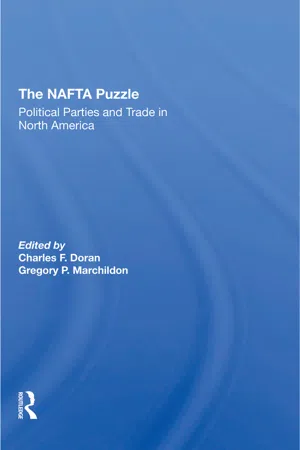
The Nafta Puzzle
Political Parties And Trade In North America
- 264 pages
- English
- ePUB (mobile friendly)
- Available on iOS & Android
eBook - ePub
About this book
The editors would like to thank the Donner Foundation, the Draeger Foundation, and the Government of Canada for their timely and generous support of this study. The study was initiated by the editors as part of the research program of the Center of Canadian Studies at the Paul H. Nitze School of Advanced International Studies, The Johns Hopkins University, Washington, D.C., and the emerging affiliated program in North American Studies. Particular appreciation goes to Dr. Barbara G. Doran for the final editing of the entire manuscript. In addition to the individuals acknowledged in each of the chapters, the editors thank those scholars who helped guide the project at various times with constructive criticism and discussion: Tom Barnes, Robert Bothwell, Reuven Brenner, David Calleo, Colin Campbell, Benjamin Ginsberg, Judith Goldstein, Peter Katzenstein, Allan Kornberg, Jonathan Lemco, Seymour Martin Lipset, Charles Lipson, Charles Pearson, Richard Rosecrance, and Sidney Weintraub.
Information
1
Introduction: The Trade and Political Party Flip-Flop
Charles F. Doran
On November 17,1993, a Democratic president passed a Republican initiative on trade and commercial regionalism in North America over the heads of the reluctant members of his own party. Is this the end of political party in the United States? Does this mean that government can make trade policy without taking political party into account? Or is there a more fundamental and complex relationship between trade and political party underlying this result? How, for instance, did each party come to adopt the outlook on free trade that goes with the party label? And when?
Three large puzzles confront the origin of the North American Free Trade Agreement (NAFTA). This book attempts to provide background material necessary to answer these puzzles.
The initial puzzle concerns the reason why the North American trade agreement ever was conceived in the first place. For those who may presently take NAFTA as an article of faith in terms either of its utility or of its inevitability, reference need only be made to the abortive North American Accord idea. Leading candidates in both the Republican and Democratic parties during the 1980 election campaign, including the eventual winner, proposed a far-reaching trade agreement with Canada and Mexico. The idea got nowhere. Indeed, the trade proposal was dropped from the campaign platforms largely because it met an extremely cool response in both Ottawa and Mexico City.
Moreover, as the essays in this volume reveal, North American trade liberalization historically has often experienced a bad reception in each of the three countries. This historical antipathy provides all the more justification for questioning why a regional trade agreement should come into existence. Deep suspicion of U.S. motives often shaped Canadian and Mexican foreign policy toward their larger neighbor, all but ruling out a trade initiative, especially one so restrictive in scope yet so demanding in terms of depth as NAFTA. Under both Diefenbaker and Trudeau, for example, Canada sought a North Atlantic trade pact with Europe to lessen trade dependence upon the United States; and President Salinas of Mexico first sought association with the European Community. For its part, the United States frequently discounted the significance of more formalized trading rules with its two smaller partners.
Strong protectionist lobbies and interest groups operate in each of these polities. At any time in the twentieth century perhaps a majority of the populations could be counted on to oppose free trade. In fact, the historic defeat of the Laurier government (1911) on the issue of free trade with the United States rang in the ears of Canadian government leaders and served to illustrate how few votes trade liberalization was likely to garner for any head of government courageous enough to propose the notion. Thus, alike for policy-maker and analyst, the puzzle concerning why NAFTA happened, why in the early 1990s and why in this format, remains a mystery worth examining.
A second puzzle, cutting in something of the opposite direction to the first, is why in the spring and summer of 1993 NAFTA began to run aground politically. What slowed its advancement, and why of all places did this loss of momentum occur in the United States? The two longstanding opponents to regional free trade, Mexico and Canada, had already put in place the legislation to make the agreement reality. A measure of the lack of anticipation for U.S. recalcitrance was the way the treaty had been drafted. According to the treaty, if one of the partners dropped out—and the architects had in mind Canada because of the unpopularity of further regional free trade agreements there beyond the highly criticized Canada-U.S. Free Trade Agreement (FTA)—the other two partners could go ahead with the arrangement. Without the United States, the agreement made no sense. Little did anyone suspect that the United States, the principal partner to the agreement, would be the country with "the coldest feet."
Arguments against the treaty discussed in the United States were easily enough identified. Environmental fears of a "pollution haven" in Mexico for foreign and U.S.-based industry on the one hand, and "unfair labor practices" linked to child-labor, unsatisfactory working conditions, and low wages on the other, were the most commonly asserted complaints. Behind these complaints lay the deeper anxiety of loss of U.S. jobs to Mexican industry. But what makes these "explanations" unsatisfactory is the fact that corresponding anxieties could be heard, and were heard, in both Mexico and Canada, albeit with slightly different slants. At base, the same refrain in each country was trepidation over "investment diversion" and "trade diversion." Was this consternation more severe in the United States than in Canada or Mexico? To assume so automatically, because the United States became the laggard in signing the treaty, is potentially a mistake of causal inference. Deeper structural differences between the governments may be at work. Similarly, the arguments of tactical timing inside the Clinton agenda can be overplayed as to explanation, since the issue of timing was more a response to a difficult situation than itself a cause.
Hence the second puzzle as to why, in the principal trading partner, where leadership is normally expected on most trade matters, there was instead hesitance and even back-sliding, is a perplexing question that goes beyond mere personality of leadership, bureaucratic style, or political happenstance. The answer, if it is to be found, must come from both careful comparative assessment and thorough historical examination of the interplay between politics and economics in each polity, in brief, in terms of the assessment of international political economy and of how it actually shapes trade policy. This study is an essential backdrop to a fuller understanding of the internal determinants of foreign trade policy in the modern state.
Why did passage of the North American Free Trade Agreement become such a cause celeb? Why was the opposition to it so virulent? How did free trade contribute to the bringing down of a government in Canada, and to the virtual destruction of the Conservative Party, leaving it with only two parliamentary seats after the 1993 elections? Why did President Clinton have to rely more on the Republican Party for Congressional votes for NAFTA, and to confront more opposition votes from within his own party? Why, indeed, did the Democratic president choose to support this initiative of the opposition party when it was so unpopular within his own? In short, is the nature of the relationship between trade and political party in North America changing?
According to the thesis of this book, the history of free trade and party politics in the United States, Canada, and Mexico reveals the third and most important political economy puzzle, a puzzle of far wider and deeper reach than those involving the specific trade agreements. That so much trade liberalization could occur in so short an interval is surely a story that has a political foundation, for it is within the leadership of governments and of political parties that the hard decisions were first made to put the trade negotiators to work. To answer the first puzzle, how and why trade took a front seat in foreign policy conduct for these three countries in a way that was politically unthinkable a decade prior, the analyst must also assess this political dynamic within each country. Therein the analyst will discover the surprising pattern of change that prompted this study.
The third and largest puzzle is that, on matters of trade liberalization, party politics appears to have flip-flopped in each of these countries. It is the chief theoretical contention of this volume that the major political parties in these polities have not only reversed their historical positions on trade. Each party has adopted the position of its principal contender. By exchanging positions on foreign trade, these parties have created one of the great conundrums of trade politics.
Historically, the Democratic Party, supported by labor, favored free trade because consumers benefitted from it and because protectionism, favored by Republicans, gave business a "monopoly rent" which had to come out of the consumer's pocket. Contemporaneously, the Republican Party favors free trade because multinational corporations need open markets everywhere, starting at home, and the Democratic Party tends to oppose it because organized labor favors protectionism in the attempt to "save jobs." In Canada, the Liberal Party favored free trade at the turn of the twentieth century while the Conservative Party opposed it. In the 1980s the Liberal Party opposed free trade with the United States because free trade supposedly threatened jobs and undermined nationalism, while the Conservative Party, supported by business, sought a free trade deal with the United States so as to safeguard access to the U.S. market.
What explains these historic flip-flops in which political parties in each country have taken the position of the other party regarding whether trade liberalization was or was not a good idea? In Canada, why has the Liberal party taken the Conservative's old outlook, and vice-versa? In the United States, why has the Republican Party taken the old position of the Democrats, and vice-versa? Similarly in Mexico, why did the governing party, the Partido Revolucionario Institutional (PRI), sack its old policies of government control and come out for free trade? These are truly monumental historical and partisan shifts that have no slight significance for the final outcome of North American trade regionalism.
Finally, why did President Clinton choose to back the Bush proposal at all, much less so vigorously? The short answer is that Clinton came to believe that regional free trade was in his nation's broad interest and was best for his presidency. Indeed, regional free trade become a test of Clinton's capacity to lead in foreign policy. This more than anything else determined the strategy of the president.
A large structural reason existed in favor of NAFTA. In contrast to prior periods of history, trade today is investment-driven. That is why every country in the world seeks foreign investment. Moreover, most foreign trade is intra-industry and intra-firm. Low-end jobs can be retained in the rich countries only as a part of a globalized network of production. This creates new high-end jobs where the skills, technology, and capital permit. Hence, only by using the external market forces outside North America, not by trying to exclude them, could the U.S. economy break out of its somnolence. Restructuring is painful. The only way it is likely to happen in a fashion that will keep the North American region competitive with Asia is for the United States and Canada to feel the brunt of low-wage pressure from Mexico in a kind of controlled experiment, preparing North America for the world in the next stage.
A tactical reason for NAFTA bolstered the structural argument. Without NAFTA, North America confronted the possibility of a long slide into protectionism. With NAFTA, Clinton could go to the Asia Pacific Economic Council meetings later that month, hopefully with the support of Canada, and obtain at least a symbolic show of support for additional global trade liberalization. He could then go back to Europe and the Uruguay Round of tariff talks with a balance of power composed of North America and Asia at his back, urging the Europeans to make some of the needed concessions on agriculture in order to consummate a global trade agreement.
But broader economic regionalism was quite unpopular with the American electorate, reflected in the voting behavior of both parties, but especially the Democratic Party. Only 102 Democratic members of Congress voted for NAFTA while 156 voted against it. Those voting for it often did so under intense duress, or extraordinary incentive, thus indicating the distaste for the agreement in home districts. On the Republican side, 134 members voted for NAFTA, but interestingly, despite the fact that this was a Bush proposal, combined with arm-twisting by the Republican leadership and a letter from Clinton indicating that he would not make trade a partisan issue in the next campaign, some 43 Republican members of Congress voted against NAFTA as well.
What a contrast to Canadian parliamentary behavior with its extreme party discipline! In the U.S. case, the members of the governing party, the majority party in Congress, did not accept the lead of their president, yet the measure passed because of the favorable votes of the opposition party. In the United States, partisanship is supposed to stop at the "water's edge." Here partisanship seemed to so disappear that opposition party votes were far more numerous on behalf of NAFTA than those of the governing Democratic Party. Is this the end of political party in the United States? Certainly the 1993 Canadian federal election, where the Conservative, pro-trade liberalization governing party went from 169 to 2 seats in Parliament, seems to give "party elimination" concrete meaning.
But the answer is no, party is not collapsing in either Canada or the United States. The Liberal Party after all won an astounding majority in that Canadian election. Nor were U.S. voters or Democratic members of Congress very troubled in procedural terms by the NAFTA outcome, in spite of some disclaimers regarding the "buying of a victory." As noted above, what was at stake were the prestige of the presidency in foreign policy conduct and over-whelming issues in international political economy. The NAFTA would determine whether momentum would continue in terms of trade liberalization on the part of the United States, and by extension to some degree throughout the international system. A lot was riding on this vote. No member of the Democratic Congressional majority misunderstood these facts.
Ironically, perhaps the only way the trade initiative would have passed in a period when North America was still slowly climbing out of a recession, and when all trade initiatives were looked upon by voters with suspicion, was for a Democratic president to back it vigorously while Congressional Democrats opposed it. Many Democratic members of Congress quietly voted against NAFTA, knowing that in the last analysis the agreement would pass with the polite help from the apparently very loyal Republican opposition. In Congress, a vote is not always just a vote. In assessing policy-making in the U.S. House of Representatives, the analyst must look behind the vote to comprehend its meaning.
One conclusion of this book is that governments cannot make trade policy without taking political party into account. Detailed historical chapters demonstrate the important link between party and trade policy for the United States, Canada, Mexico, and Quebec during the past century. They also document the hypothesized flip-flop and reversal in party position on trade liberalization for the principal parties in the United States and Canada. As the information on party platforms in the Uslaner chapter shows for the U.S. case, the flip-flop in party position on trade was a long-term, gradual, one-time exchange. In Canada, the Conservatives were more doctrinaire, perhaps, in their posture of protectionism for most of the twentieth century, except for hesitant apostasy under Bennett. But, superficially more prone to experimentation, as McDowall makes clear, the Liberals were true to freer trade ideas through the King governments until the middle of the post-1945 interval. That this same political phenomenon occurred in both countries suggests that the flip-flop was a mechanism of political change which had at least a region-wide origin. It certainly highlights the role of party in issues of trade liberalization.
A skeptic might argue, on the contrary, that party flip-flops and rollcall defections indicate that party is largely irrelevant in the formulation and implementation of trade policy. If party flip-flop on trade orientation has indeed taken place, certainly political party could not possibly be considered a meaningful explanatory variable. The very fact that the same political party at opposite ends of a century could hold contrasting positions on trade liberalization implies that something else, not party, is responsible for the contrary views. Add to this the reality that a Buchanan (Republican) and a Gephardt (Democrat) could both oppose NAFTA, while a Gingrich (Republican) and a Foley (Democrat) could favor NAFTA, and the immateriality of political party certainly seems unambiguous.
But the role of party is not so easily dismissed by these realities. As argued theoretically in Chapter 10, party is an intermediate variable between the voter and interest group on the one hand, and trade policy on the other. And, notwithstanding its intermediate role, political party is a crucial variable to that outcome. Moreover, insofar as party hangs together as a concept and a political force in decisive votes on trade liberalization within Congress or Parliament, roll call defections do not automatically cancel the relevance of party. Defections notwithstanding, the political party possesses an identifiable outlook on free trade that goes with the party label and is understood by press and citizen.
A multi-causal model of the trade-party relation fully acknowledges the multiple, simultaneous, and interwoven operation of several variables in explaining the party flip-flop regarding trade liberalization. Hence, different explanations can account for the mechanism and level of causation of the party flip-flop at different times, and one explanation does not operate to the total exclusion of all others. The underlying constituency or interest group base of the party could flip-flop, taking party position with it. Or, once a party comes to power, incumbency could force it into a flip-flop against the wishes of the elected party officials and/or the constituency it represents. Or, the ideology of the party itself could change. Although the level of explanation and to some extent the timing and mechanism may differ with each explanation, it is important to note that in no case is the flip-flop explained absent political party.
Moreover, as demonstrated empirically in Chapter 11, the NAFTA vote itself shows that the link between political party and trade liberalization is quite alive, strong, and enduring. Based on party unity scores, roll call on NAFTA reveals above-average party cohesion. The party split on the vote regarding NAFTA proves very little since party discipline in most democracies (with the exception of Canada) is far from perfect. Party voting on NAFTA thus is more identifiable than on many other issues.
An even more telling argument is that if Clinton had not worked so hard to change the trade vote of his own party, partisan division on NAFTA would have been even more stark. The Republicans would have voted for NAFTA, more Democrats would have voted against it, and the agreement would have failed in Congress. The general conclusion stands. Political party continues to be a strong factor in trade liberalization policy-making, even though the major parties over time have flip-flopped on this issue. Flip-flop is possible in party orientation without destroying either party unity or party identification on the trade issue.
Thus, while the main contribution of this book is its analysis of the trade-party relationship in North American polities over the past century, and its assessment of an apparent flip-flop in historic party positions across these countries, the book also challenges the notion that political parties could not possibly contribute to the formulation of trade policy. Political party may furnish a bellwether of change regarding trade matters inside the democratic polity. A kind of early warning mechanism concerning willingness to support additional liberalization in the future, political party may reveal the limits of the possible in regional bloc formation and the expansion of the global trade order. For the likely future, if governmental trade policy is the horse, political party will continue to be its essential harness.
Table of contents
- Cover
- Half Title
- Title
- Copyright
- Contents
- Acknowledgments
- 1 Introduction: The Trade and Political Party Flip-Flop
- 2 Trade and Political Party Orientation in North America
- 3 Political Parties and Free Trade in the United States
- 4 What Forces Shape American Trade Policy?
- 5 The Trade Policies of Canada's Grits and Tories, 1840-1988
- 6 The NDP and Free Trade: Facing the American Capitalist Empire
- 7 Free Trade and Party Politics in Quebec
- 8 Trade Policy and Economic Development in Twentieth Century Mexico
- 9 The Free Trade Policy "Revolution" and Party Politics in Mexico
- 10 Trade and Party: Flip-Flops and Causal Linkages
- 11 The NAFTA Vote and Political Party: A Partial Test
- About the Book
- About the Contributors
Trusted by 375,005 students
Access to over 1.5 million titles for a fair monthly price.
Study more efficiently using our study tools.
Frequently asked questions
Yes, you can cancel anytime from the Subscription tab in your account settings on the Perlego website. Your subscription will stay active until the end of your current billing period. Learn how to cancel your subscription
No, books cannot be downloaded as external files, such as PDFs, for use outside of Perlego. However, you can download books within the Perlego app for offline reading on mobile or tablet. Learn how to download books offline
Perlego offers two plans: Essential and Complete
- Essential is ideal for learners and professionals who enjoy exploring a wide range of subjects. Access the Essential Library with 800,000+ trusted titles and best-sellers across business, personal growth, and the humanities. Includes unlimited reading time and Standard Read Aloud voice.
- Complete: Perfect for advanced learners and researchers needing full, unrestricted access. Unlock 1.5M+ books across hundreds of subjects, including academic and specialized titles. The Complete Plan also includes advanced features like Premium Read Aloud and Research Assistant.
We are an online textbook subscription service, where you can get access to an entire online library for less than the price of a single book per month. With over 1.5 million books across 990+ topics, we’ve got you covered! Learn about our mission
Look out for the read-aloud symbol on your next book to see if you can listen to it. The read-aloud tool reads text aloud for you, highlighting the text as it is being read. You can pause it, speed it up and slow it down. Learn more about Read Aloud
Yes! You can use the Perlego app on both iOS and Android devices to read anytime, anywhere — even offline. Perfect for commutes or when you’re on the go.
Please note we cannot support devices running on iOS 13 and Android 7 or earlier. Learn more about using the app
Please note we cannot support devices running on iOS 13 and Android 7 or earlier. Learn more about using the app
Yes, you can access The Nafta Puzzle by Charles Doran,Gregory P Marchildon in PDF and/or ePUB format, as well as other popular books in Politics & International Relations & Politics. We have over 1.5 million books available in our catalogue for you to explore.