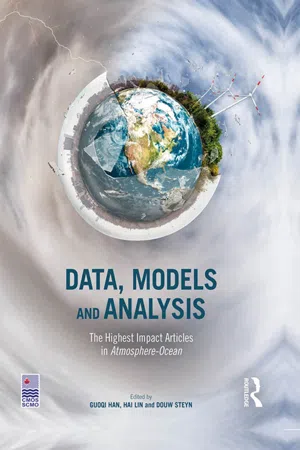
This volume contains the ten most cited articles that have appeared in the journal Atmosphere-Ocean since 1995. These articles cover a wide range of topics in meteorology, climatology and oceanography. Modelling work is represented in five papers, covering global climate model development; a cumulus parameterization scheme for global climate models; development of a regional forecast modelling system and parameterization of peatland hydraulic processes for climate models. Data rehabilitation and compilation in order to support trend analysis work on comprehensive precipitation and temperature data sets is presented in four papers. Field studies are represented by a paper on the circumpolar lead system. While the modelling studies are global in their application and applicability, the data analysis and field study papers cover environments that are specifically, but not uniquely, Canadian. This book will be of interest to researchers, students and professionals in the various sub-fields of meteorology, oceanography and climate science.
eBook - ePub
Data, Models and Analysis
The Highest Impact Articles in 'Atmosphere-Ocean'
- 242 pages
- English
- ePUB (mobile friendly)
- Available on iOS & Android
eBook - ePub
Data, Models and Analysis
The Highest Impact Articles in 'Atmosphere-Ocean'
About this book
Information
Introduction
This book celebrates the 50th anniversary of the Canadian Meteorological and Oceanographic Society (CMOS) by republishing a compilation of papers published in the CMOS flagship journal Atmosphere-Ocean. The republished papers were selected from all papers published in Atmosphere-Ocean, and its predecessor Atmosphere on the basis of being the most-cited papers in the past five years, with some attention paid to papers highly cited in 2015. This was done in order to capture very recently published papers of note.
Readers of this compilation will notice a number of features common to the selection. All works address either meteorological or oceanographic phenomena of importance to Canada, or important advances made by Canadian scientists. While Atmosphere-Ocean is a venue for publication on meteorological and oceanographic phenomena wherever they might occur, it is not surprising that Canadian authors publish their best work on Canadian phenomena in a Canadian Journal. While Canadian authors do publish their work in non-Canadian journals, it is gratifying that they publish some of their highly cited works in Atmosphere-Ocean. Readers might also notice that the most highly cited papers in the journal span meteorology, climate science and oceanography, the three editorial “departments” of Atmosphere-Ocean. This is a satisfying reflection of the strength of all branches of the sciences represented in CMOS.
CMOS is a bilingual society, and Atmosphere-Ocean contains papers written in both French and English, though French language papers form a small minority. It is therefore not surprising, though disappointing, that there are no French language papers in this book. While this is in part due to the small number of French language papers in Atmosphere-Ocean, it is also due to the fact that English has become the lingua franca of science. Scientists whose first language is not English often choose to publish their work in English in order to maximize their readership.
The papers in this book generally do not represent the last word in their topic, but rather, like all scientific works, represent a significant point of progress in a journey of discovery. Each of the papers has built on preceding work, and leads to subsequent work. The high frequency of citation clearly demonstrates their impact on their respective fields. In order to give readers a sense of the background work underlying the papers, and to provide some insight into the influence the papers have had on their field, we have asked corresponding authors of each of the papers to provide a short description. Papers are ordered as follows: A description of a field study; four papers on climate data sets and their analysis; and five papers on numerical model development, roughly in order of increasing scale.
Introduction
Ce livre célèbre le cinquantième anniversaire de la Société canadienne de météorologie et d’océanographie (SCMO) en publiant une compilation d’articles déjà parus dans Atmosphere-Ocean, la revue phare de la SCMO. Les articles republiés ont été sélectionnés parmi tous ceux parus dans Atmosphere-Ocean et son prédécesseur Atmosphere en fonction de leur fréquence de citation au cours des cinq der-nières années, et particulièrement en 2015. Cette approche permet de promouvoir les articles éminents publiés récemment.
Les lecteurs de cette compilation remarqueront un certain nombre de caractéristiques communes à la sélection. Tous les travaux abordent des phénomènes météorologiques ou océanographiques d’importance pour le Canada, ou des progrès importants réalisés par les scientifiques canadiens. Bien que Atmosphere-Ocean publie des articles touchant à des phénomènes météorologiques et océanographiques où qu’ils puissent se produire, il n’est pas étonnant que les auteurs canadiens publient leurs meilleurs travaux concernant des phénomènes canadiens dans une revue canadienne. Bien que les auteurs canadiens publient une partie de leurs travaux dans des revues étrangères, nous sommes fiers que certains de leurs articles fréquemment cités paraissent dans Atmosphere-Ocean. Les lecteurs pourraient aussi remarquer que les articles hautement cités dans la revue englobent les domaines de la météorologie, de la climatologie et de l’océanographie, les trois « départements » éditoriaux d’Atmosphere-Ocean. Il s’agit d’une réflexion satisfaisante de la force de tous les domaines scientifiques représentés par la SCMO.
La SCMO est une société bilingue et Atmosphere-Ocean publie des articles rédigés en français et en anglais, bien que les articles en langue française s’y retrouvent en minorité. Il n’est donc pas étonnant, bien que décevant, qu’aucun article rédigé en français ne soit inclus dans ce livre. Ceci est en partie dû au fait que seul un petit nombre d’articles sont publiés en français dans Atmosphere-Ocean, mais aussi que l’anglais est devenu la lingua franca de la science. Les scientifiques dont la langue maternelle diffère de l’anglais choisissent régulièrement de publier leurs résultats en anglais afin de maximiser leur lectorat.
En général, les articles publiés dans ce livre ne représentent guère le dernier mot sur un sujet, mais plutôt, comme tout ouvrage scientifique, un progrès important sur le parcours de la découverte. Chaque article est fondé sur des travaux précédents et contribue à l’avancement de la recherche. La fréquence élevée des citations démontre clairement l’impact des travaux dans leurs domaines respectifs. Afin d’offrir aux lecteurs une vue d’ensemble du travail que sous-tendent les articles et de fournir un aperçu de l’influence qu’ils ont dans leur domaine, nous avons demandé aux auteurs correspondants de fournir une brève synthèse de leur article. Les articles sont classés comme suit : la description d’une étude sur le terrain ; quatre articles sur des ensembles de données climatiques et leur analyse, et enfin cinq articles sur l’élaboration de modèles numériques, en ordre de l’échelle du projet.
The International Polar Year (IPY) Circumpolar Flaw Lead (CFL) System Study: Overview and the Physical System
D.G. Barber1, M.G. Asplin1, Y. Gratton2, J. V. Lukovich1, R. J. Galley1, R. L. Raddatz1 and D. Leitch1
1Centre for Earth Observation Science, Department of Environment and Geography University of Manitoba, Winnipeg, Manitoba
2Institut National de Recherche Scientifique, Centre Eau, Terre et Environnement, Québec, Quebec
2Institut National de Recherche Scientifique, Centre Eau, Terre et Environnement, Québec, Quebec
ABSTRACT The Circumpolar Flaw Lead (CFL) system study is a Canadian-led International Polar Year (IPY) initiative with over 350 participants from 27 countries. The study is multidisciplinary in nature, integrating physical sciences, biological sciences and Inuvialuit traditional knowledge. The CFL study is designed to investigate the importance of changing climate processes in the flaw lead system of the northern hemisphere on the physical, biogeochemical and biological components of the Arctic marine system. The circumpolar flaw lead is a perennial characteristic of the Arctic throughout the winter season and forms when the mobile multi-year (MY) pack ice moves away from coastal fast ice, creating recurrent and interconnected polynyas in the Norwegian, Icelandic, North American and Siberian sectors of the Arctic. The CFL study was 293 days in duration and involved the overwintering of the Canadian research icebreaker CCGS Amundsen in the Cape Bathurst flaw lead throughout the annual sea-ice cycle of 2007–2008.
In this paper we provide an introduction to the CFL project and then use preliminary data from the field season to describe the physical flaw lead system, as observed during the CFL overwintering project. Preliminary data show that ocean circulation is affected by eddy propagation into Amundsen Gulf (AG). Upwelling features arising along the ice edge and along abrupt topography are also detected and identified as important processes that bring nutrient rich waters up to the euphotic zone. Analysis of sea-ice relative vorticity and sea-ice area by ice type in the AG during the CFL study illustrates increased variability in ice vorticity in late autumn 2007 and an increase in new and young ice areas in the AG during winter. Analysis of atmospheric data show that a strong northeast–southwest pressure gradient present over the AG in autumn may be a synoptic-scale atmospheric response to sensible and latent heat fluxes arising from areas of open water persisting into late November 2007. The median atmospheric boundary layer temperature profile over the Cape Bathurst flaw lead during the winter season was stable but much less so when compared to Russian ice island stations.
RÉSUMÉ [Traduit par la rédaction] L’étude du système du chenal de séparation circumpolaire (CSC) est une initiative de l’Année polaire internationale (API) menée par le Canada et à laquelle 350 participants provenant de 27 pays ont pris part. L’étude, de nature multidisciplinaire, fait appel aux sciences physiques et biologiques ainsi qu’au savoir traditionnel Inuvialuit. L’étude du CSC vise à examiner les répercussions des processus climatiques changeants dans le système du chenal de séparation de l’hémisphère Nord sur les composantes physiques, biogéochimiques et biologiques du système marin arctique. Le CSC est une caractéristique permanente de l’Arctique durant la saison d’hiver et se forme quand la banquise mobile de glace de plusieurs années s’éloigne de la banquise côtière fixe en créant des polynies récurrentes et interconnectées dans les secteurs norvégien, islandais, nord-américain et sibérien de l’Arctique. Pour mener l’étude du CSC, qui a duré 293 jours, le brise-glace de recherche canadien NGCC Amundsen est demeuré dans le chenal de séparation du cap Bathurst tout l’hiver, c’est-à-dire pendant tout le cycle annuel des glaces de mer de 2007–2008.
Dans cet article, nous fournissons une introduction au projet du CSC, puis nous utilisons les données préliminaires de la saison sur le terrain pour décrire le système physique du chenal de séparation, tel qu’observé durant l’hiver du projet du CSC. Les données préliminaires montrent que la circulation océanique est influencée par la propagation de tourbillon dans le golfe d’Amundsen (GA). Des caractéristiques de remontée d’eau le long de la lisière des glaces et le long d’éléments topographiques abrupts ont aussi été observées et identifiées comme des processus importants apportant des eaux riches en nutriments jusqu’à la zone euphotique. L’analyse de la vorticité relative de la glace de mer et de la superficie de la glace de mer par type dans le GA durant l’étude du CSC révèle une variabilité accrue dans la vorticité de la glace à la fin de l’automne 2007 et un accroissement des superficies de nouvelle et de jeune glace dans le GA durant l’hiver. L’analyse des données atmosphériques montre que la présence d’un fort gradient de pression nord est – sud ouest au-dessus du GA en automne peut être une réponse atmosphérique d’échelle synoptique aux flux de chaleur sensible et latente à partir des zones d’eaux libres qui ont persisté jusque vers la fin de novembre 2007. Le profil thermique de la couche limite atmosphérique médiane au-dessus du chenal de séparation du cap Bathurst durant la saison hivernale était stable, ...
Table of contents
- Cover
- Half Title
- Title Page
- Copyright
- Contents
- Citation Information
- Notes on Contributors
- Foreword – for CMOS 50th Anniversary Publication
- Préface — concernant la publication du cinquantième anniversaire de la SCMO
- 1. Introduction
- 2. The International Polar Year (IPY) Circumpolar Flaw Lead (CFL) System Study: Overview and the Physical System
- 3. Rehabilitation and Analysis of Canadian Daily Precipitation Time Series
- 4. Temperature and Precipitation Trends in Canada During the 20th Century
- 5. Changes in Daily and Extreme Temperature and Precipitation Indices for Canada over the Twentieth Century
- 6. An overview of the Second Generation Adjusted Daily Precipitation Dataset for Trend Analysis in Canada
- 7. Parametrization of Peatland Hydraulic Properties for the Canadian Land Surface Scheme
- 8. The 15-km Version of the Canadian Regional Forecast System
- 9. The Canadian Fourth Generation Atmospheric Global Climate Model (CanAM4). Part I: Representation of Physical Processes
- 10. Sensitivity of Climate Simulations to the Parameterization of Cumulus Convection in the Canadian Climate Center General Circulation Model
- 11. The UVic Earth System Climate Model: Model Description, Climatology, and Applications to Past, Present and Future Climates
- Index
Trusted by 375,005 students
Access to over 1.5 million titles for a fair monthly price.
Study more efficiently using our study tools.
Frequently asked questions
Yes, you can cancel anytime from the Subscription tab in your account settings on the Perlego website. Your subscription will stay active until the end of your current billing period. Learn how to cancel your subscription
No, books cannot be downloaded as external files, such as PDFs, for use outside of Perlego. However, you can download books within the Perlego app for offline reading on mobile or tablet. Learn how to download books offline
Perlego offers two plans: Essential and Complete
- Essential is ideal for learners and professionals who enjoy exploring a wide range of subjects. Access the Essential Library with 800,000+ trusted titles and best-sellers across business, personal growth, and the humanities. Includes unlimited reading time and Standard Read Aloud voice.
- Complete: Perfect for advanced learners and researchers needing full, unrestricted access. Unlock 1.5M+ books across hundreds of subjects, including academic and specialized titles. The Complete Plan also includes advanced features like Premium Read Aloud and Research Assistant.
We are an online textbook subscription service, where you can get access to an entire online library for less than the price of a single book per month. With over 1.5 million books across 990+ topics, we’ve got you covered! Learn about our mission
Look out for the read-aloud symbol on your next book to see if you can listen to it. The read-aloud tool reads text aloud for you, highlighting the text as it is being read. You can pause it, speed it up and slow it down. Learn more about Read Aloud
Yes! You can use the Perlego app on both iOS and Android devices to read anytime, anywhere — even offline. Perfect for commutes or when you’re on the go.
Please note we cannot support devices running on iOS 13 and Android 7 or earlier. Learn more about using the app
Please note we cannot support devices running on iOS 13 and Android 7 or earlier. Learn more about using the app
Yes, you can access Data, Models and Analysis by Guoqi Han,Hai Lin,Douw Steyn in PDF and/or ePUB format, as well as other popular books in Scienze fisiche & Ecologia. We have over 1.5 million books available in our catalogue for you to explore.