eBook - ePub
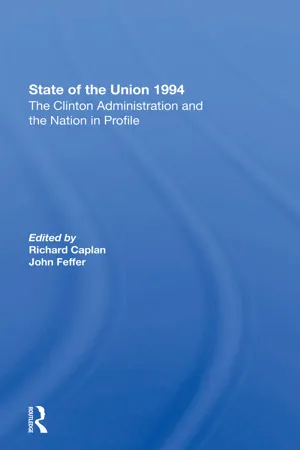
State Of The Union 1994
The Clinton Administration And The Nation In Profile
- 300 pages
- English
- ePUB (mobile friendly)
- Available on iOS & Android
eBook - ePub
State Of The Union 1994
The Clinton Administration And The Nation In Profile
About this book
Clinton rode into office on the promise of "change." It was a safe, content- free slogan. After all, in recent years, the most radical proposals for change have come not from the Democrats but from the Republican right. "Change" could mean the further downsizing of government and neglect of social problems, or, of course, the reversal of these trends. When they went to the polls in 1992, however, most Americans had a good idea of what kind of change they wanted.
Trusted by 375,005 students
Access to over 1.5 million titles for a fair monthly price.
Study more efficiently using our study tools.
Information
1
Challenges of a New Era
RICHARD CAPLAN AND JOHN FEFFER
"The great thing about the dead," John Updike once wrote, is that "they make space." The collapse of the Cold War order and the end of the Reagan-Bush era have indeed opened up enormous opportunities at the international and national levels. The Berlin Wall, symbolic of the world's partition into two hostile camps, is no more. The Doomsday Clock, which once ticked but three minutes from nuclear midnight in the Bulletin of the Atomic Scientists, has been turned back to a more reassuring 11:43 P.M. The vast sums of money devoted to keeping the blocs armed to the teeth can now be reinvested into improving the lives of people, nations, and the planet itself.
Meanwhile, the end of twelve years of Republican presidential rule, which greatly encouraged divisions of wealth and power both at home and abroad, has elevated hopes for a sweeping domestic renewal. Reaganomics, with its Laffer curves, trickle-down rhetoric, and Dickensian miseries, has been publicly repudiated. A national healthcare system is in the offing. Campaign-finance reform, designed to inject a dose of democracy into the political system, is finally on the table.
Of course, the obstacles to renewal are both many and great. The Cold War and the Reagan-Bush presidencies may be dead, but their legacies are not easily overcome. Into the space created by their official demise has rushed all manner of ills. Madness is raging across the former Yugoslavia. Wars are burning throughout the former Soviet Union. India seems on the verge of anarchy. Latin America and Africa are struggling with the debt and economic misery of the "lost decade" of the 1980s. The global economy is stagnant. Threats to the ecosystem have grown ever more menacing.
Here in the United States, economic decline and social discord have taken their toll on the nation's health. An enormous federal debt and a deteriorating public infrastructure are the results of astronomical military expenditures and imprudent taxation policies. U.S. citizens have lost faith in a political system characterized by a surfeit of corruption and a dearth of accountability. Society at large struggles with persistent homelessness, crumbling cities, and a woefully inadequate educational system.
The world and the nation are thus caught between singular opportunity and the stale residue of the past. It is a time of seismic shifts in international and domestic events that permits a rethinking of policy in both the grandest sweep and the most stubborn of details. With so much at stake—for the globe and for our country—the Democratic administration of Bill Clinton has taken office. It is a presidency that has promised change, and the American people in turn now expect a great deal of the new president.
How well the president has delivered after one year in office—not just on his promises but on the promise inherent in the moment—is the subject of the essays that comprise this book. To gauge the administration's performance, however, one must first understand the international and domestic context of its actions. What are the dimensions of this space that has opened up before us at the end of the Cold War and the Reagan-Bush era?
The End of the Cold War
Rare are the moments in world history when events allow a virtual remaking of global policy. The failure of the Napoleonic campaigns pre
"The end of the Cold War and the Reagan-Bush era has opened up enormous opportunities at the international and national levels."
sented the European powers in 1815 with an opportunity to construct a reactionary political order of such durability that their Concert of Europe lasted nearly 100 years. World War I's devastation inspired a much shorter-lived attempt at global order epitomized by the League of Nations. And from the wreckage of World War II emerged a commitment to collective security and global Keynesianism in an era defined, no less, by the decades-long Cold War.1
The end of that conflict represents another historic opportunity both to revamp the global order and to redefine America's national strategy within it. The dissolution of the Soviet empire, the eclipse of national economic sovereignty, the emergence of an environmental crisis of staggering proportions—these developments bespeak the end of an era and the increasing obsolescence of the post-World War II verities. It is against this broad international backdrop that Bill Clinton assumed the U.S. presidency—the first president since Harry Truman to face truly fundamental choices concerning America's role in the world.2
For nearly fifty years, U.S. foreign policy has been governed by two overriding and largely unquestioned objectives: the containment of Communism and the promotion of a liberal economic order. Both goals required that the United States play a leadership or, more accurately, a hegemonic role—to bear the costs of an enormously expensive military alliance and to provide the resources needed to fuel worldwide economic development.
The price America has paid for its anti-Communist crusade cannot be measured solely by the trillions of dollars it has spent. We must also count among the costs the legacies of that crusade—among them an entrenched national security state, a triumphalist faith in the virtue of military solutions, the nuclear contamination of the environment, and an international arms trade that eludes regulation.
U.S. underwriting of the postwar liberal economic order has meanwhile yielded certain advantages. For one thing, the dominance of the dollar has allowed the United States to finance enormous budget deficits by simply going into debt to foreign creditors, much to the resentment of every Third World country forced to atone for its "profligacy." Yet those deficits have also had negative economic and political effects. And a dollar-denominated world economy has at times brought U.S. economic requirements into conflict with the needs of the international economy.3
Despite the end of the Cold War, George Bush chose to navigate by the same compass that has guided the United States for nearly half a century. He spent massively on military preparedness even after the Soviet Union had collapsed. He supported repressive governments around the world (Zaire, Haiti, China, Mexico) in the belief that U.S. security and economic needs dictated such a policy. He touted the virtues of collective security yet viewed the United States as the self-appointed guardian of global stability. And while stubbornly insisting on the prerogatives of a world hegemon, he relied increasingly on other countries such as Japan and Germany to bail out the international economy.
"Bush studiously avoided the many difficult adjustments the new era requires. Clinton has no such luxury."
George Bush, the last World War II-era president, used his tenure to buy time. He studiously avoided the many difficult adjustments the new era would require. His successor has no such luxury. The global order is under strains too serious to continue to ignore for very long. This is evident if one considers the specific international challenges Clinton faced in each of three areas—security, the world economy, and the global environment—on the eve of his first year in office.
International Insecurity
In a speech at Georgetown University in 1989, then Deputy Secretary of State Lawrence Eagleburger expressed some unease about the end of the Cold War. "For all its risks and uncertainties, the Cold War was characterized by a remarkably stable and predictable set of relations among the great powers," he observed.4 Conveniently ignoring the price paid for that "stability"—nuclear terror, proxy wars, exorbitant military budgets—Eagleburger nevertheless anticipated correctly the turbulent period that lay ahead.
With the end of the Cold War, the old bipolar world has given way to a brave new world fraught with conflicts once considered unthinkable. In the past, one could scarcely have imagined violent conflict between "fraternal republics" within the Soviet Union, as was now occurring between the newly independent states of Armenia and Azerbaijan and between Georgia and Russia. Just as implausible had been the possibility of conflict in Yugoslavia, a traditional buffer zone between the East-West blocs. Indeed conflict appeared to be erupting across the globe. Early in 1993 the New York Times published a listing of violent conflict in forty-eight countries, and that was just a partial count.5 Conditions, of course, had been ripe for conflict in many of these areas for quite some time, but the superpower standoff—Eagleburger's stability—had frequently exerted a strong restraining effect.
These violent impulses had not resulted simply from the collapse of the bipolar order. In many cases violence had sprung from aggressive forms of nationalism, which, with worsening economic conditions, fragmenting political institutions, and the weakening of secular authorities, offered an attractive ideology for dispirited populations. Aggressive nationalism, and the demagogues that frequently exploited it, thus represented a serious security challenge in the post-Cold War world—with the former Yugoslavia the most pressing case. As pundits and editorial writers insistently reminded their audiences, much was at stake in the Balkan crisis: the danger of a wider war in a notoriously volatile region, the future of the Atlantic Alliance, and, not least of all, operative norms and values in the fabled "new world order."
Other security challenges confronting Clinton more accurately reflected the stubborn persistence of practices and ways of thinking commonly associated with the old world order. A corrupt military continued to threaten democratic rule in Haiti, where a popularly elected government led by the Rev. Jean-Bertrand Aristide had been toppled by a coup a year and a half earlier. The dangers of nuclear proliferation were heightened by the emergence of new nuclear states in the wake of the Soviet collapse. The unrestrained traffic in conventional arms and military technology that played such a central role in major conflicts—So malia, Cambodia, and Angola—continued to bedevil the international community. Peace talks between Israel and its Arab neighbors in the wake of the war against Iraq were at a standstill. And the deterioration of relations between the two Koreas—where the United States maintains its second-largest assembly of forces—was a growing concern.
These threats, old and new, all increased the strain on U.S. and multilateral capacities. With the end of the Cold War came stepped-up demands and higher expectations—for peacekeeping (with as many new UN operations in the past five years as in the previous four decades), for peacemaking (in strife-torn El Salvador, Angola, and Haiti), and even for military intervention (in Iraq and then Somalia). But these developments also revealed the deficiencies of the global security order: its seeming arbitrariness (why Somalia and not Bosnia?), its contradictions (selling arms to belligerent nations), its improvisational basis (funding peacekeeping operations on the fly), and its failure to emphasize early, preventive diplomacy.
Geoeconomic Rut
Clinton assumed the presidency at a time when traditional conceptions of security had been shattered by the growing importance of economic factors. It was, after all, the Soviet Union's inability to compete economically, not militarily, that led to its demise. While the world's largest and most dynamic economy is unlikely to share the fate of its erstwhile opponent, the erosion of U.S. economic strength is a clear and unmistakable trend. From the height of U.S. dominance in the early 1950s until the early 1990s, the U.S. share of global output has declined by 50 percent. U.S. productivity growth, once the envy of the world, has fallen behind that of Japan and Germany. And the dollar, the cornerstone of the world economy, has been weakened by hegemonic overstretch, to paraphrase historian Paul Kennedy.6
Of course, these shifts have been taking place gradually over the course of decades, and the United States could never have expected to maintain its post-World War II economic dominance indefinitely. Still, to be a lesser giant, as Clinton was no doubt aware, meant that the United States was now more vulnerable to outside pressures, and therefore less secure, than at any other time in its recent history.

Reprinted by permission of TOM and the Cartoonists & Writers Syndicate
Clinton the candidate emphasized the economic underpinnings or U.S. security. "Economic strength," he wrote in his campaign manifesto Putting People First, "is a central element of our national security policy."7 The challenge Clinton faced, however, was made more difficult by the very nature of a changing international order. It is no longer possible to devise a national economic policy strictly speaking, when trade constitutes 20 percent of the nation's gross domestic product, when U.S. firms rely increasingly on overseas workers, when foreigners hold nearly one-fifth of all U.S. government debt, and when the United States no longer controls the flow of capital in and out of its borders. The U.S. economy, in short, is intricately bound up with the international economy. It is still true that if the United States sneezes, the rest of the world catches cold. But it is now no less true that if Japan or Germany applies the economic brakes, the United States is likely to get whiplash.
And apply the brakes they did. When Clinton entered office, the continuing strain of German unification and the collapse of the East European economies were seriously hampering economic growth in Europe and, therefore, in the rest of the world as well. Also contributing to this global economic slowdown was Japan's descent into the worst economic and political crisis of its postwar history. And much of the Third World either remained mired in debt—conveniently forgotten now that the big commercial banks had reduced their exposure—or, at the urging of the World Bank and the International Monetary Fund, had oriented their economies toward the export, not the consumption, of goods. All of this translated into stagnant or declining living standards at home and abroad.
In the past, under these circumstances, the United States might have been expected to prime the global economy. But precisely because the U.S. economy had taken such a battering—the consequence both of "natural causes" and several decades of misguided policies—the political climate on the eve of the Clinton presidency did not permit anything but a nod in this Keynesian direction. The federal debt already stood at more than $4 trillion; the trade deficit was at $84 billion; and the dollar—at an all-time low against the yen—could not sustain any further loss in confidence. As The Economist, speaking for many, would intone later in 1993, "Past profligacy has left [the United States] with little or no scope to use borrowed money to support demand."8
As with the global security order, then, so too with the global economic order: the strains were outstripping the capacity of any single nation or multilateral institution to cope effectively. Bush sought a way out by loosening restrictions on regional and international trade, bequeathing to his successor the chronically stalled world trade talks under the auspices of the General Agreement on Tariffs and Trade (GATT) and a framework treaty for a North American Free Trade Agreement (NAFTA). Freer trade, the argument went,...
Table of contents
- Cover
- Half Title
- Title
- Copyright
- Contents
- Foreword
- Introduction
- 1 Challenges of a New Era
- 2 WORLD ECONOMY: Forging a Global New Deal
- 3 FOREIGN POLICY: Promoting Democratic Stability
- 4 NATIONAL DEFENSE: Meeting Real Security Needs
- 5 NATIONAL SECURITY: Dismantling the National Security State
- 6 DOMESTIC ECONOMY: Investing in Our Future
- 7 EMPLOYMENT: Creating Decent Work
- 8 TAXATION: Sharing the Burden
- 9 ENVIRONMENT: Achieving Sustainability
- 10 HEALTH CARE: Providing Comprehensive Coverage
- 11 THE DISENFRANCHISED: Eliminating Poverty
- 12 RACE: Ensuring a True Multiculturalism
- 13 GENDER: Guaranteeing Real Equality
- 14 COMMUNITIES: Building Authority, Responsibility, and Capacity
- 15 DEMOCRATIC REFORM: Restoring Democratic Principles
- ROUNDTABLE: Progressive Reform and the "Clinton Moment"
- Notes
- About the Book and Editors
- About the Contributors
- Index
Frequently asked questions
Yes, you can cancel anytime from the Subscription tab in your account settings on the Perlego website. Your subscription will stay active until the end of your current billing period. Learn how to cancel your subscription
No, books cannot be downloaded as external files, such as PDFs, for use outside of Perlego. However, you can download books within the Perlego app for offline reading on mobile or tablet. Learn how to download books offline
Perlego offers two plans: Essential and Complete
- Essential is ideal for learners and professionals who enjoy exploring a wide range of subjects. Access the Essential Library with 800,000+ trusted titles and best-sellers across business, personal growth, and the humanities. Includes unlimited reading time and Standard Read Aloud voice.
- Complete: Perfect for advanced learners and researchers needing full, unrestricted access. Unlock 1.5M+ books across hundreds of subjects, including academic and specialized titles. The Complete Plan also includes advanced features like Premium Read Aloud and Research Assistant.
We are an online textbook subscription service, where you can get access to an entire online library for less than the price of a single book per month. With over 1.5 million books across 990+ topics, we’ve got you covered! Learn about our mission
Look out for the read-aloud symbol on your next book to see if you can listen to it. The read-aloud tool reads text aloud for you, highlighting the text as it is being read. You can pause it, speed it up and slow it down. Learn more about Read Aloud
Yes! You can use the Perlego app on both iOS and Android devices to read anytime, anywhere — even offline. Perfect for commutes or when you’re on the go.
Please note we cannot support devices running on iOS 13 and Android 7 or earlier. Learn more about using the app
Please note we cannot support devices running on iOS 13 and Android 7 or earlier. Learn more about using the app
Yes, you can access State Of The Union 1994 by Richard Caplan,John Feffer,Gerald Horne,John Cavanagh in PDF and/or ePUB format, as well as other popular books in Politics & International Relations & Politics. We have over 1.5 million books available in our catalogue for you to explore.