- 318 pages
- English
- ePUB (mobile friendly)
- Available on iOS & Android
eBook - ePub
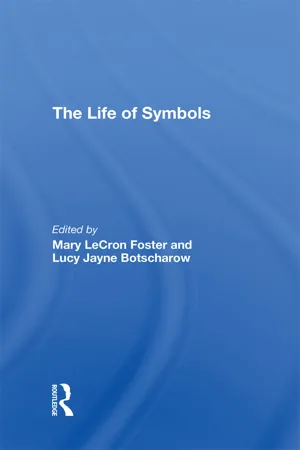
The Life Of Symbols
About this book
This volume considers the role of analogy in symbol formation, with reference to bodily process. It focuses on symbols and symbolic structures that can be traced over millenia and across geographical distance and addresses the beginnings of figurative art in the Upper Paleolithic cave paintings.
Trusted by 375,005 students
Access to over 1.5 million titles for a fair monthly price.
Study more efficiently using our study tools.
Information
Subtopic
AnthropologyIndex
Social SciencesPart One
Beginnings
Symbolic beginnings can be traced in various ways. This means that various kinds of data are relevant to the task. Archaeological data constitute the only concrete evidence of human evolution. While no evidence of complex symbolic systems is available prior to the Upper Paleolithic, in the late Acheulean we see evidence of the start of certain cultural practises that are familiar from historic periods. Such evidence is primarily spatial: e.g. construction of dwellings with areas of specialization for carrying out particular activities, with a hearth fire as the its central focus, greater specialization in tool assemblages, and incisions or other decorative motifs on stone or bone.
During the Mousterian certain practises began which became familiar and widespread. Burial of the dead indicates a cognizance of, or a desire for, some kind of transcendent continuity. Decoration of, or goods buried with, corpses especially emphasizes the early stirring of such feelings or thoughts, and clearly symbolizes something beyond the act itself. Each of the four papers in this section attacks the problem of beginnings from a different methodological standpoint.
Although it is not always thought to be symbolic, the first cultural manifestation revealed through the archaeological record, the manufacture of crude stone tools, also symbolizes something beyond the performance of the act itself—an act, or the hope of an act, which will logically follow: the hunt, and/or the killing and preparation of game to be shared among members of the social group. The archaeological record provides us with a very long history of tool use, exhibiting progressive change and improvement in the sophistication of stone tools. If our definition of symbol includes artifacts, as we believe it should, since the systems of culture are based on the relationships between objects the use of which, or the manufacture of which, is rule-governed, then these early tools are the first evidence we have of what might be considered to be symbols. As tools became more complex, new methods of manufacture were devised and new shapes and relationships between tool and tool use came into being. Some of the major Paleolithic tool watersheds were the achievement of symmetry, perfection of flaking, differention of tool types, introduction of hafting, and the invention of instruments of tool propulsion, such as the bow or the spear-thrower.
Increased proficiency in tool use is accompanied by an ever-greater realization of power and the uses of power in accomplishing a variety of tasks. As tools became more efficient, new tasks came into being because tool specialization provided a proportional increase in possibilities for analogical imaging. This served steadily to increase numbers of symbols and the size of symbolic networks.
This section is concerned with conditions which prefigure symbolizing behavior. Borchert and Zihlman focus on possible biological precursors to language. They argue that a biological substrate for the ability to symbolize was already present in protohominids. Drawing on primate behavior and evolutionary theory, they stress the importance of interactive behavior as a predecessor to natural selection for language. They emphasize the influence on the phenotype of external events, arguing that behavior precedes in evolution and that anatomical, including genetic, changes follow. Natural selection thus operates directly on behavior, and only indirectly on genes. Female hominids created a context in which infant intentional oral production was encouraged to produce or replicate meanings. The authors compare the phylogenetic development of these symbolic capacities in hominids with the ontogenetic development of children and with the biological potential of chimpanzees. The context in which protohominid young were socialized included increase in the use of vocalization for communication.
Although Sheets-Johnstone does not speak of natural selection, her argument is somewhat similar: that upright posture and an upright gait—a behavioral change—brought about a profound change in cognitive focus and symbolic development. A significant difference is that the change was not brought about by social interaction, to which Borchert and Zihlman attribute the stimulus for the invention of language, but instead a change in self-awareness that affected the construction of world view. Pontius' argument that the introduction of writing affects perception and its biological substrate is an additional argument in favor of the evolutionary priority of behavioral change.
Borchert and Zihlman also attribute the origin of language to the outcome of the infant's intentionality: a growing success in manipulating the actions of the mother and other caretakers to the infant's advantage. Maternal sensitivity in reacting to the infant's desires is an important part of this scenario. A similar desire for personal advantage must equally stimulate the direction of any other cultural system. That tool manufacture arose early is not surprising since it gave hominids an advantage in procuring food. One may perhaps assume, then, that unlike language (if Borchert and Zihlman are correct in their analysis), tool use began with the creative intentionality of adults rather than children. Children must be expert mimics if they are to acquire any cultural system. Mimicry of adult tool use by children would give an evolutionary advantage to those children who were exceptionally manually adept, just as mimicry of language would give a similar advantage to children with oral ability. These two developments would give rise to selection far regulatory genes providing the capacity to recognize and exploit both analogy and manual and oral dexterity. Thus, while the Borchert and Zihlman study is essentially in the survivalist tradition (as described in the Introduction), the underlying human capacity for mimicry and representational analogy is implicit.
Sheets-Johnstone presents a kinesthetic model in utilizing the hominid shift to bipedalism as an explanation for the origin of counting. Her hypothesis emphasizes bodily symmetry and the matching of opposing body parts that is brought to awareness through bipedal locomotion. She hypothesizes that this matching led to initiation of a binary system of counting—a system which is widely believed to have preceded other systems of enumeration. In contrast to Borchert and Zihlman's interactive model for the origin of language, Sheets-Johnstone emphasizes self awareness achieved through the periodicity of walking and running experienced by the hominid individual as the major evolutionary touch stone, and the extension through analogy of this binary model to other modes, such as communicative interaction. Periodicity in stone tool flaking of opposing surfaces also worked to emphasize binary themes.
The universal presence of binary opposition in cultural studies has long intrigued anthropologists. Sheets-Johnstone discusses the perception of similarities as a prerequisite to abstraction and classification, and "matching" as a pre-human prerequisite to the human exploitation of similarities. Perception of differences must follow closely. Sheets-Johnstone makes the important point that "the tactile-kinesthetic body gradually became the standard against which the numerical measure of the world was initially taken," and since the human body furnishes a binary frame of reference, this goes far to explain the universality of cultural binarisms.
The semiotic model used for symbolic reconstruction by Botscharow relies on prior abstraction of semantic universals for the reconstruction of the earliest known hominid-created, economically non-useful articles found to date in prehistory. Tropes are the semiotic filaments that provide the semantic linkages underlying the holistic structure of modern culture. Search for evidence of metaphoric, metonymic and synecdochic structures in found artifacts from prehistoric periods provides powerful insights into the otherwise irretrievable cognitive processes of long vanished human ancestors. By this method, Botscharow reveals that universal symbolic patterns had a long history, indicating a high degree of cognitive functioning as early as the Middle Pleistocene. Such a structural approach is particularly revealing of covert meanings—and prehistoric meanings are of necessity covert since no exegesis is possible. Botscharow's study suggests that some degree of language must have been present at least by 700,000 B.P., although it undoubtedly lacked the hierarchical structure of modern language, as Foster emphasizes.
An analogic model is also crucial to Foster's argument that the symbolic process depends upon perception and utilization of likenesses, beginning with mimicry and the immediate present, extending progressively to delayed mimicry, then to expansion from the personal, or bodily, to other kinds of activities that lend themselves to imitative bodily movements, and, finally, to the recognition and exploitation of abstract relational as well as more concrete analogies. Foster argues that culture stems from, and is based on, the faculty for manipulation of samenesses and differences rather than the faculty for logical reasoning, although this faculty, common to some degree for all sentient beings, is greatly enhanced through analogic perception because it extends the conceptual matrix upon which reasoning operates.
It is increasingly apparent that during the Middle Paleolithic, culture was gaining momentum more rapidly than had previously been supposed. Language must have begun very slowly, and Foster's comparative analyses show that the basis of language was iconic representation of movements and spatial relationships through manipulation of the oral cavity. This discovery was one outcome of her effort to reconstruct early language and throws a great deal of light on the early cognitive processes that operated to lead the hominid line into a developmental track that was not followed by other mammals.
Primates are unique among mammals in their capacity for bodily mimicry. This imitative activity need not take place directly after the stimulus but may be delayed, with the stimulus activity reproduced later. It would seem that, for the great apes, imitation is limited to simulation of the bodily behavior of other primates, just as mimicry by human infants is at first limited to copying the movements of other humans. Imitative games such as waving "byebye" and playing "peekaboo" are at first initiated by others, but soon the baby itself starts the game and hopes for a response. Mothers or other caregivers listen to the meaningless babbling of the infant and mimic this, trying to persuade the infant to approximate words associated with a familiar activity, object or person. Before long rudimentary speech is used by the infant to manipulate the behavior of grownups. The more this speech is understood, the more power the infant can exert on caregivers.
As Borchert and Zihlman say, requests are global in nature, meaning something like "pick me up," "I am hungry," or "I want to get down." As caregivers do more pointing or presenting in association with objects, nouns are added to this initial, essentially verbal, vocabulary. In Sheets-Johnstone's terms, this repeated association of word with object is a form of matching, or recognizing the association between entities belonging to different modes, rather than the single mode matching she believes to have been the basis for counting.
The global nature of the semantics of early infant language, stressed by Borchert and Zihlman, is consistent with Foster's discovery of the global nature of Paleolithic sound-meaning units. Thus, contrary to what is often assumed, it would seem that in both ontogeny and phylogeny, development worked from the global, or abstract, to the concrete, or particular. In the early stages of language development, perception of styles of movement would seem to have been more salient than the objects involved in the movement. The fact brought out by Borchert and Zihlman that the two young chimpanzees, Sherman and Austin, first associated the symbol that they were encouraged to manipulate with the whole sequence of tool-using activity, rather than as a representation of an object—a particular tool—is particularly revealing.
Spatially, analysis of tool production shows that symmetry became salient at a prehistorically early period. Sheets-Johnstone provides some interesting kinesthetic clues as to why this should have been so. Botscharow's discussion of the association of aesthetics with symmetry in the Acheulean emphasizes the crucial role of an appreciation of symmetry in the development of cultural symbolism. Opposition, based on an appreciation of symmetrical arrangements, plays an important role in the organization of every culture. The feature oppositions in the construction of sound systems is a linguistic universal and was characteristic of very early language as well, as established by Foster's reconstructed sets.
By stressing human biology, with growing awareness and use of analogy, abstraction, aesthetics, and symmetry, as well as an interactive social mode, as characteristics basic to early culture, these chapters both together and individually provide fruitful avenues for further research.
— The Editors
1
The Ontogeny and Phylogeny of Symbolizing
Catherine M. Borchert and Adrienne L. Zihlman
The emergence of a cultural and symbolic way of life during hominid prehistory is intimately related to the emergence of language from non-linguistic precursors. Part of the difficulty in reconstructing this transition stems from the failure of modern evolutionary theory to articulate clearly the role of development, or ontogeny, in evolution. This omission presents special difficulties in explaining the evolution of complex social behaviors in higher primates. Neo-Darwinians have tended to focus on adult reproductive success and to assume that new behaviors appear first as a result of gene mutations. Such models have thus neglected some of the most important elements of language evolution, involving the social interaction between hominid babies and their mothers, siblings and peers.
Conventions in terminology have contributed to this lack of emphasis on ontogeny. The phrases "emergence of symbolism" and "emergence of language" have been used to refer both to the evolutionary history by which Homo sapiens came to rely on symbols and culture, as well as to the ontogenetic history of symbolic competence in every human child. Here, to avoid this troublesome ambiguity, "development" refers exclusively to ontogenetic transformations within the child, and "evolution" to phylogenetic changes within the species. Development involves a heterogeneous set of processes by which a single fertilized ovum, containing a single copy of an individual's genotype, is transformed into a fully functional adult phenotype; it can be considered synonymous with gene expression. The course of development is determined in part by the environmental context in which organisms—in this case young hominids—grow up. The course of evolution, on the other hand, is represented by a series of successive ontogenies.
We place the emergence of symbolism—the ability to communicate about "internal representations" of objects and actions—in its wider context of the evolution of language. We outline a framework for und...
Table of contents
- Cover
- Half Title
- Title
- Copyright
- Contents
- Preface
- Introduction
- Part One Beginnings
- Part Two Persistence and Congruity
- Part Three Figuration
- Part Four Abstraction
- About the Editors and Contributors
- Index
Frequently asked questions
Yes, you can cancel anytime from the Subscription tab in your account settings on the Perlego website. Your subscription will stay active until the end of your current billing period. Learn how to cancel your subscription
No, books cannot be downloaded as external files, such as PDFs, for use outside of Perlego. However, you can download books within the Perlego app for offline reading on mobile or tablet. Learn how to download books offline
Perlego offers two plans: Essential and Complete
- Essential is ideal for learners and professionals who enjoy exploring a wide range of subjects. Access the Essential Library with 800,000+ trusted titles and best-sellers across business, personal growth, and the humanities. Includes unlimited reading time and Standard Read Aloud voice.
- Complete: Perfect for advanced learners and researchers needing full, unrestricted access. Unlock 1.5M+ books across hundreds of subjects, including academic and specialized titles. The Complete Plan also includes advanced features like Premium Read Aloud and Research Assistant.
We are an online textbook subscription service, where you can get access to an entire online library for less than the price of a single book per month. With over 1.5 million books across 990+ topics, we’ve got you covered! Learn about our mission
Look out for the read-aloud symbol on your next book to see if you can listen to it. The read-aloud tool reads text aloud for you, highlighting the text as it is being read. You can pause it, speed it up and slow it down. Learn more about Read Aloud
Yes! You can use the Perlego app on both iOS and Android devices to read anytime, anywhere — even offline. Perfect for commutes or when you’re on the go.
Please note we cannot support devices running on iOS 13 and Android 7 or earlier. Learn more about using the app
Please note we cannot support devices running on iOS 13 and Android 7 or earlier. Learn more about using the app
Yes, you can access The Life Of Symbols by Mary Lecron Foster,Lucy Botscharow in PDF and/or ePUB format, as well as other popular books in Social Sciences & Anthropology. We have over 1.5 million books available in our catalogue for you to explore.