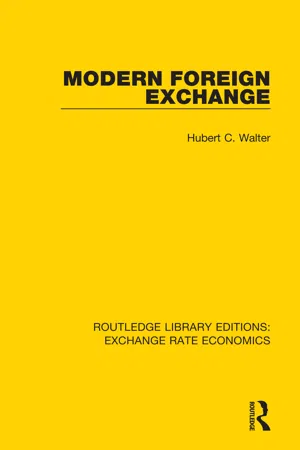
Originally published in 1923. This book describes the working of the exchanges, and explains post-war fluctuations. It describes bills, documentary and blank credits, the mechanism of exchange trading and money market; and explains inflation, floating debts, purchasing power parity, international indebtedness and stabilisation.
- 204 pages
- English
- ePUB (mobile friendly)
- Available on iOS & Android
eBook - ePub
Modern Foreign Exchange
About this book
Trusted by 375,005 students
Access to over 1.5 million titles for a fair monthly price.
Study more efficiently using our study tools.
Information
Subtopic
Business GeneralIndex
BusinessCONTENTS
MODERN FOREIGN EXCHANGE
CHAPTER I
INTRODUCTORY
CURRENCY AND GOLD
Purport of the subject and definitions—Example of exchange transactions—Means of making remittances abroad— Pre-war position of London as a free gold market—Issues involved in remitting money abroad.
IN 1919 the Bankers’ Institute altered the syllabus of their examinations by elevating Foreign Exchange into a separate subject. Previously there had only- been incidental questions on Foreign Exchange in the papers on the Practice and Law of Banking. The change illustrated the way in which the war had increased the importance of the subject. In 1920 a conference of financial experts representing most of the principal nations in Europe was held at Brussels. The report issued by these experts on existing international commercial and financial conditions centred round the unsettlement of the Exchanges. So much for the importance of exchange matters to the financial community. In the business world the use of the phrase “collapsed exchanges” as indicative of one of the causes of the present trade depression, and of “ stabilizing the exchanges “ as one of the remedies for that depression, have become commonplaces : before the war both phrases were unknown to the generality of business men.
It is evident that something of a radical nature has happened as a result of the war which has altogether altered the working of the Foreign Exchanges; and that that alteration is having very far-reaching effects on everyday business life. Perhaps the best example of what the alteration in the exchange position means in practice is this : before the war one pound, when changed into U.S. dollars, would buy dollars’ worth of wheat. During a great part of 1920 the pound would only buy 3-90 dollars’ worth—about 20 per cent. less. That is equivalent to the imposition of a tax of 20 per cent, on wheat imported from the U.S.
The secret of the importance and of the complications of Foreign Exchange to-day is that all the economic forces operating in a country work themselves out in its rate of exchange. The Exchanges register the economic health of a country; to-day they register the extent to which the economic equilibrium of the world, of Europe especially, has been upset by the war.
Foreign Exchange has one quality about it which makes it both more interesting and more difficult than other sections of economics, in that it deals with economic conditions as they exist from day to day. This makes the subject more difficult, because it means the constant revising of explanations and theories. It also makes it more interesting, because we are enabled to apply our principles to the Exchanges as they exist, and check our theories accordingly.
To clarify our ideas at the outset, we may describe Foreign Exchange as the business of exchanging currencies, or as the study of the ways in which currencies are exchanged; the Foreign Exchanges are the markets in which this business is done; and Rates of Exchange are the prices of the various national currencies in terms of other national currencies.
The word “currency” is used in the same sense as the word “ money “ is often used. It is necessary to be clear about the meaning of these two terms. “Money” may mean a number of things, “currency” only one. There are certainly four things which the word “money” may mean:
- The standard or measure of value.
- Medium of exchange.
- Purchasing power.
- A loan of money.
The last mentioned meaning is the one in which the word is customarily used in the money articles in the newspapers.”Money was cheap to-day “ or “ Money was dear “ obviously does not mean that twenty-one shillings could be obtained for one pound or vice versa. It simply means that if anyone wanted to borrow money, he could do so at a low or high rate of interest. There, clearly, money means “the loan of cash or credit.” In the third sense of “purchasing power,” an overdraft is money. In neither of these two senses is money equivalent to currency. The first two meanings quoted are in modern practice merged in each other. There is a clear enough theoretical distinction between the standard which measures value and the instrument or medium by which value is transferred from one person to another;but in the Western European industrial system the monetary system embodies both ideas. In the highly developed commercial system of ancient Babylon, the theoretical distinction was also effective in practice. In a sale of land, the price was agreed in terms of shekel-weights of silver, which were thus the standard of value, but it was paid in corn, slaves, animals, etc., which, valued on the same silver basis, served as the actual media of exchange. 1
Of these four meanings of the word “money,” “ currency “ is equivalent to the second only, viz. a medium of exchange. Currency means this and only this. It has thus a much more circumscribed meaning than “ money,” which may have any of the other three meanings indicated. It has, however, a wider meaning than the term “ Legal tender,” which is that portion of the medium of exchange which a debtor can legally compel his creditor to accept in satisfaction of his debt. Thus an overdraft is money in the sense of purchasing power, but it is not currency. A cheque is currency, but not legal tender. A Treasury note is all three.
The currency of England consists of the following:
(1) Coins.
(2) Treasury notes.
(3) Bank-notes.
(4) Cheques, which are orders to bankers to pay.
(5) Bills of exchange, which are orders to pay.
(6) Interest coupons.
Of the six, the last three are what bankers call “ Instruments of Credit,” i.e. instruments by which credits, that is to say, book-debts, are recorded and transferred from one person to another. Such is our currency to-day. Before the war it was the same, with the exception that there were no Treasury notes.
The business of exchanging currencies became a necessary part of international trade as soon as international trade developed beyond the stage of barter. When we buy materials abroad, our currency has to be exchanged for the currency of the country in which the seller wishes to be paid, which is generally that of the country in which he is resident. Foreign Exchange is concerned with the quantity of our own currency which we give up in exchange for that of the seller. Assume that “A,” a merchant, is trying to sell some mineral that is mined in the United States to a Dutchman. “ A “ knows he can get £33 per ton c.i.f. Amsterdam for the material. The price we will say is $105 per ton at the American mine. Let us call rail freight $5 per ton and ocean freight $30 per ton. That gives a total cost to “ A “ of $140. Pre-war, when the average rate of exchange with the United States was $4.86 to the pound, $140 would represent to “ A “ in sterling £(140÷4.86)= £28 16s.,...
Table of contents
- Cover
- Halftitle
- Title
- Copyright
- Table of Contents
Frequently asked questions
Yes, you can cancel anytime from the Subscription tab in your account settings on the Perlego website. Your subscription will stay active until the end of your current billing period. Learn how to cancel your subscription
No, books cannot be downloaded as external files, such as PDFs, for use outside of Perlego. However, you can download books within the Perlego app for offline reading on mobile or tablet. Learn how to download books offline
We are an online textbook subscription service, where you can get access to an entire online library for less than the price of a single book per month. With over 1.5 million books across 990+ topics, we’ve got you covered! Learn about our mission
Look out for the read-aloud symbol on your next book to see if you can listen to it. The read-aloud tool reads text aloud for you, highlighting the text as it is being read. You can pause it, speed it up and slow it down. Learn more about Read Aloud
Yes! You can use the Perlego app on both iOS and Android devices to read anytime, anywhere — even offline. Perfect for commutes or when you’re on the go.
Please note we cannot support devices running on iOS 13 and Android 7 or earlier. Learn more about using the app
Please note we cannot support devices running on iOS 13 and Android 7 or earlier. Learn more about using the app
Yes, you can access Modern Foreign Exchange by Hubert C. Walter in PDF and/or ePUB format, as well as other popular books in Business & Business General. We have over 1.5 million books available in our catalogue for you to explore.