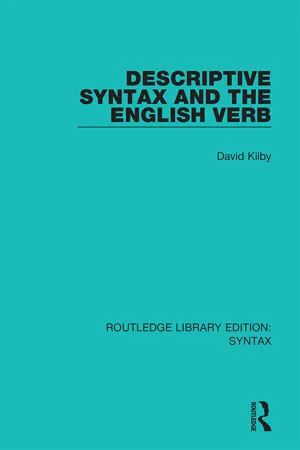
Intended for advanced students and researchers in linguistics, Descriptive Syntax and the English Verb, first published in 1984, focuses on the syntax of the English verb and notions of tense/aspect, transivity, passive, phrasal verb constructions, nominalisations and complement sentence types are explored. These constructions are shown t
- 206 pages
- English
- ePUB (mobile friendly)
- Available on iOS & Android
eBook - ePub
Descriptive Syntax and the English Verb
About this book
Trusted by 375,005 students
Access to over 1 million titles for a fair monthly price.
Study more efficiently using our study tools.
Information
Chapter One
Tense and Aspect
The basic structural form of the English verb group is quite well known and poses few problems; furthermore, the details have been analysed many times in the literature (from virtually every theoretical perspective). We can analyse it as follows, omitting the specification of which suffixes are appropriate on the various elements:

This formula begs certain questions: how are the suffixes specified? does the order of elements in the verb group need to be specified arbitrarily, or does it follow from more general principles? what is the categorial status of all of these elements? These are questions that have been beaten to death in the transformational literature, their major characteristic being that they bear on the types of grammatical device available in linguistic theory. I shall not be concerned with these questions, but rather with the meaning of these various options, and the problem of their compatibility with different verbs.
There is a useful distinction to be made between 'tense' and 'aspect', both of which are found in English. Tense is a category which primarily involves the time of the event or state specified by the verb relative to the moment of utterance; aspect, on the other hand, is notoriously difficult to define: it is perhaps best to see it as focusing round such concepts as completion, repetition, habituality, etc. Look first at the category of tense in English: any of the positions marked 'suffix' in (1) are in principle available to be filled with a tense marker (which on the most regular of verbs corresponds to –0,–s or –ed). It is sometimes assumed that English has three tenses –past, present and future – but in fact there are only two relevant formal distinctions in English (–0 and –s are of course a single option, the difference between them not being a matter of tense, but rather the person and number of their subject noun phrase). For instance, with a simple verb, (2) and (3) exhaust the range of relevant forms:
- 2. The vicar laughs
- 3. The vicar laughed
The same distinction is found with the progressive form (4) and the perfect (5):
- 4.
- The vicar is laughing
- The vicar was laughing
- 5.
- The vicar has arrived
- The vicar had arrived
It is normally (and in accord with general intuition) claimed that these two options represent present and past tense in English. If we assume that these labels mean respectively that the action takes place at the same time as the time of speech, and that the action precedes the time of speech, then certain anomalies become apparent:
- 6.
- Tomorrow we leave
- I was walking along, when up comes this man, and . . . .
- Do it if you like.
- 7.
- If you wanted to you could make a lot of money
- I wish you enjoyed your work more
- That animal you saw was probably a mole
None of the underlined verb forms in (6) refers in any simple way to the time of utterance – as the adverb in (6a) shows very clearly. Similarly the verb forms in (7) do not refer to a time preceding the utterance in any clear way – in (7c), for instance, there is no implication that the animal was a mole then, but is no longer one. Although I shall on occasion continue to use labels such as 'past' and 'present', it is as well to recognise that these labels are far from satisfactory as a representation of the variety of uses of these verb forms, although they may be said to reflect what is felt as the most 'typical' uses of these forms.
A second point to be noted about tense forms in English is that they behave in rather different ways when they are describing events which happened or are expected to happen at some specific time. As (6a) and (6b) show, the 'present' tense can be used to refer to events projected into the future, and also to past events. Naturally enough, the present tense also refers to present time – the time of speaking:
- 8. I am in a telephone kiosk
But the past tense, when used with specific time reference, can only refer to events which have preceded the time of speech (the characteristic of the sentences in (7) is that they are not used with reference to any specific time); whereas (8) can be used in the 'historic present' to narrate events which happened in the past, (9) cannot be used with reference to present time or future time:
- 9. I was in a telephone kiosk
It is for this reason that many linguists prefer to talk of English as having a two-way tense distinction between past and 'non-past'. There is one construction often referred to as a possible exception here – the use of the past tense in a way which indicates (politely) the present intentions of the speaker:
- 10. I was wondering if you would sign this form for me
Clearly this counts as a request. An alternative way of treating it would be to say that this use really is a past tense use – it indicates that the speaker's intention was in the past, and the interpretation as a request is softened by the fact that the speaker is no longer claiming to have that intention. There is always a potential difference between what the speaker says and what the speaker intends, and this seems to be a case where there is a fairly clear difference between them.
Exercise 1
There is some doubt as to whether the category of tense is marked in the modal verbs in English. Look at the following data (and any more you care to invent), and try to decide what is at issue here:
- 11.
- Last year I could beat him at squash but now I can't
- He can't swim, though he said he could
- You could do better than that if you tried
- Will he come? He wouldn't yesterday
- Would you like a drink?
(Remember that the class of modals includes at least the following forms as well: shall, should, must, may, might). There is a further complication, in that a modal verb may be followed by have, with apparently different effects. Can this be considered an expression of past tense?
- 12.
- I must have been able to do it last year
- I could have done it last year
- I ought to have done it by now
One of the ways in which the analysis of tense forms has often been carried out (both for English and in grammatical sketches of other languages) derives from the work of the philosopher Hans Reichenbach. This work starts by postulating three different time points which are relevant in the interpretation of tense. Take, for instance, a sentence such as (13):
- 13. John had eaten his dinner
Sentences such as this illustrate very clearly the distinction between the time of utterance (S for speech time), the time at which the event described in the utterance took place (E for event time), and a reference time (R) – a time with respect to which the event is located. In (13), for instance, the context (probably preceding discourse) must specify a time in the past (preceding the time of utterance) with reference to which we could talk of the event of John eating his dinner having preceded that point. In Reichenbach's notation, this would be (13'):
- 13'. E – R – S
(i.e. the event precedes the reference time which precedes the speech time.) E, R and S are not generally separated from each other in this way: the 'basic' tense forms combine at least two of them at any one point. E. g. the present tense in its normal use shows all three of them at the same point:
- 14. John is eating his dinner
- 14'. E,R,S
(i.e. event, speech and reference time coincide.) The simple past tense, as in (15) obviously has the event preceding the time of utterance: but what of the reference time?
- 15. John ate his dinner
One relevant observation here is that the simple past tense in English is normally used to refer to something which happens at a particular time, often specified by the discourse. Thus, (15) would be inappropriate if it were not clear at what time the dinner–eating had taken place. It therefore seems likely that the reference time should be coextensive with event time, giving:
- 15'. E,R – S
(i.e. event and reference time coincide, and precede speech time.)
It seems to follow that a future tense which corresponds in any way to a past tense, would have the specification
- 16'. S – E,R
(i.e. event and reference time coincide, and follow speech time.)
Indeed, it seems to be true that a natural interpretation of a sentence such as (16) involves there being a specific time in the future at which the event will happen:
- 16. John will tell you how to get there
There have been numerous developments of Reichenbach's approach to tense, and the question of precisely how any particular combination of E, R and S should be interpreted is one that is open to dispute. Indeed, it is not clear to me that one would always wish to recognise a reference time in sentences. Those who adopt such a system generally do recognise a reference time for all types of sentence, but it is conceivable that this is only because of a somewhat misplaced devotion to regularity of analysis. A sentence such as (17) or (18) obviously requires us to recognise a speech time and an event time; but what would a reference time be?
- 17. Attila the Hun killed a lot of people
- 18. The earth will come to an end
Note, in fact, that (17) is ambivalent in this respect, although I would not wish to claim that it was actually ambiguous; it could presuppose a context such as
- 17'. That year was not a good one for the country: Attila the Hun killed a lot of people, and the plague killed off many more
On this interpretation there is a natural reference time (that year). But we could also have it in a different context, e.g.:
- 17". Attila the Hun killed a lot of people, but modern methods of warfare have been infinitely more destructive
In such a context, the fact of Attila the Hun having killed all of these people is important, but the specific time reference is irrelevant. In spite of such reservations and differences of opinion relating to various aspects of the Reichenbach framework, it is a useful and intuitively satisfying tool in the study of tense systems, and the distinctions which it embodies turn out to be among the most crucial ones in tense theory in general.
1.2. Markedness and Tense
The asymmetry of 'past' and 'present' in English reflects the sort of situation which is often discussed in terms of 'markedness'. In a very basic sense, markedness can be looked on as a purely descriptive concept; alternatively it represents a hypothesis as to how languages organise their grammatical categories. This hypothesis can best be specified in terms of the relationship between form and meaning. On the whole, when languages make use of an opposition as a grammatical category of noun (e.g. number, gender) or verb (e.g. mood, tense) this opposition will be expressed by the presence or absence of an affix. Tense in the English verb, and number in the English noun, are normally marked by the presence or absence of a particular suffix. Markedness (in its guise as a genuine hypothesis) involves the claim that the pole of the opposition which is marked by the absence of a suffix is also semantically less specific. E.g. the form lettuces possesses a suffix which is not found in lettuce: it is also more specific semantically, as it can only refer to a number of distinct objects, while the form lettuce can be used to refer to a single object, or some indeterminate number of objects (lettuce-picking), or some undifferentiated mass of vegetable (Fluffy loves lettuce). Similarly with tense forms, the past tense is 'marked' both morphologically and semantically, as it is almost always expressed with a suffix (excluding such exceptional cases as put), and, as we have seen, it is rather specific in meaning. The present tense, by contrast, may be expressed with the bare stem of the verb, and allows a wider range of meaning.
It is important to note that not all linguists who use the term 'markedness' make use of exactly the same notion. At its vaguest, 'marked' in linguistics is used to refer to something which is slightly unusual. Very frequently the formal and semantic sides are separated (at which point, of course, it ceases to be an empirical hypothesis, as opposed to a descriptive tool). One relevant feature of degrees of markedness which has been noted by Greenberg is that unmarked categories tend to display a greater range of internal variation than more marked categories. For instance, in languages which exhibit gender variation in nouns, such as French, the gender distinctions are likely to be more often expressed in unmarked categories (such as singular) than in mark...
Table of contents
- Cover
- Half Title
- Title
- Copyright
- Original Title
- Original Copyright
- Contents
- INTRODUCTION
- 1. TENSE AND ASPECT
- 2. TRANSITIVITY
- 3. FUNCTIONS OF THE PASSIVE
- 4. THE RANGE OF THE PASSIVE
- 5. PASSIVE PARTICIPLES
- 6. PHRASAL VERBS
- 7. NOMINALISATIONS
- 8. ING
- 9. NON-FINITE SENTENCE COMPLEMENTS
- 10. FINITE SENTENCE COMPLEMENTS
- 11. CONCLUSION
- INDEX
Frequently asked questions
Yes, you can cancel anytime from the Subscription tab in your account settings on the Perlego website. Your subscription will stay active until the end of your current billing period. Learn how to cancel your subscription
No, books cannot be downloaded as external files, such as PDFs, for use outside of Perlego. However, you can download books within the Perlego app for offline reading on mobile or tablet. Learn how to download books offline
Perlego offers two plans: Essential and Complete
- Essential is ideal for learners and professionals who enjoy exploring a wide range of subjects. Access the Essential Library with 800,000+ trusted titles and best-sellers across business, personal growth, and the humanities. Includes unlimited reading time and Standard Read Aloud voice.
- Complete: Perfect for advanced learners and researchers needing full, unrestricted access. Unlock 1.4M+ books across hundreds of subjects, including academic and specialized titles. The Complete Plan also includes advanced features like Premium Read Aloud and Research Assistant.
We are an online textbook subscription service, where you can get access to an entire online library for less than the price of a single book per month. With over 1 million books across 990+ topics, we’ve got you covered! Learn about our mission
Look out for the read-aloud symbol on your next book to see if you can listen to it. The read-aloud tool reads text aloud for you, highlighting the text as it is being read. You can pause it, speed it up and slow it down. Learn more about Read Aloud
Yes! You can use the Perlego app on both iOS and Android devices to read anytime, anywhere — even offline. Perfect for commutes or when you’re on the go.
Please note we cannot support devices running on iOS 13 and Android 7 or earlier. Learn more about using the app
Please note we cannot support devices running on iOS 13 and Android 7 or earlier. Learn more about using the app
Yes, you can access Descriptive Syntax and the English Verb by David Kilby in PDF and/or ePUB format, as well as other popular books in Languages & Linguistics & Linguistics. We have over one million books available in our catalogue for you to explore.