eBook - ePub
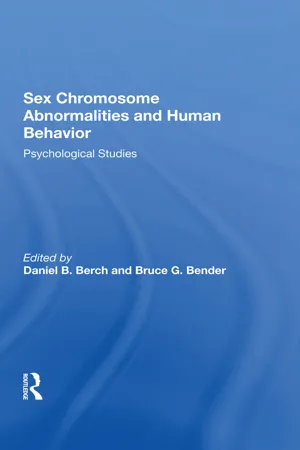
Sex Chromosome Abnormalities And Human Behavior
Psychological Studies
- 244 pages
- English
- ePUB (mobile friendly)
- Available on iOS & Android
eBook - ePub
About this book
This volume is based on a symposium, "Cognitive and Psychosocial Dysfunctions Associated with Sex Chromosome Abnormalities," presented at the 1986 Annual Meeting of the American Association for the Advancement of Science. It contains reports from individual research groups and a psychological study.
Information
1
Overview: Psychological Phenotypes and Sex Chromosome Abnormalities
A remarkable breakthrough in the young science of cytogenetics occurred in 1956, when Tjio and Levan demonstrated that the diploid number of human chromosomes was 46, not 48 as previously believed. For the first time, the chromosomes could be seen and examined under a microscope, and the genetic cause of some birth defects identified. The presence of an extra chromosome in the twenty-first pair, trisomy 21, was found to underlie Down syndrome. Other autosomal aneuploidies, including trisomy 13 and trisomy 18, were linked to other identifiable syndromes, with physical malformations and mental retardation invariably present.
Sex chromosome abnormalities (SCA) presented an intriguing contrast to autosomal abnormalities. Individuals with SCA demonstrated neither marked physical stigmata nor as diminished intelligence. Two known syndromes were found to result from SCAs. In 1959, an extra X chromosome (the 47,XXY karyotype) was documented in a man with Klinefelter syndrome (Jacobs & Strong, 1959). That same year, a missing X chromosome (the 45,X karyotype) was documented in a woman with Turner syndrome (Ford, Jones, Polani, De Almedia, & Briggs, 1959). In other cases, SCAs not previously associated with identified syndromes, including 47,XXX and 47,XYY, were documented. Questions of whether and how the presence of SCA affects ability and behavior quickly emerged, and a sizable literature of psychological and psychiatric studies evolved. Misunderstanding has surrounded much of this early behavioral research, and despite many efforts to sift through the conflicting conclusions, myths about SCA have persisted for 25 years.
However, in the past decade, the use of more sophisticated methodologies has yielded a body of more objective data, enabling clearer interpretation of results. A small number of researchers from around the world, represented in the chapters that follow, are responsible for much of this work. This volume is based on a symposium, “Cognitive and Psychosocial Dysfunctions Associated with Sex Chromosome Abnormalities,” which was presented at the 1986 Annual Meeting of the American Association for the Advancement of Science. Three chapters are included by SCA investigators who were not present at the AAAS meeting but whose work complements the other chapters and provides a more comprehensive treatment of the subject. The various chapters reflect a rich diversity of scientific approaches, including neuropsychology, behavioral genetics, psychoendocrinology, information processing, and cognitive development. The four major subject groups are examined, including 47,XXY, 47,XYY, 47,XXX, and 45,X. Following the seven reports from individual research groups is a chapter that examines special methodological problems encountered by SCA researchers. The final chapter provides a critical commentary on the previous chapters, discussing the contributions of SCA research to our understanding of genetic influences on behavior.
Initial Studies
The remainder of this chapter provides an historical overview of the psychological study of SCA along with the physical and psychological phenotype associated with each karyotype. An appreciation of the history of SCA research is essential to perceiving the gradual changes that have evolved in expectations concerning the behavior of individuals with these conditions.
The suspicion that SCA was associated with behavioral abnormality led to a flurry of chromosome screening studies in mental and penal settings during the early 1960s. The captive populations were easily accessed, and the procedure was relatively simple to perform, consisting of a quick scraping of buccal mucosa followed by confirmatory chromosome analysis in discrepant cases. Over 100 such studies of adult groups were conducted, most in the United States and Europe, and the results were intriguing. The incidence of 47.XXY men and 47,XXX women was four to five times greater in mentally retarded or psychotic groups than their background incidence in the newborn population (Polani, 1977). Among prison populations, an increased representation of SCA men was found, particularly those with 47,XYY (Hook, 1979). In contrast to SCA individuals with excess X chromatin, 45,X women were not found with increased frequency in these groups.
Several chromosome studies of groups of unusual children were also reported. Screening of 48 boys from a juvenile detention center revealed none with SCA (Duffy & Cervenka, 1971). In a larger study of 700 children from a child psychiatric clinic, 11 SCA children were found, reflecting an approximate fivefold increase against the newborn rate (Crandall, Carrel, & Sparkes, 1972). Chromosome screening of 2,606 Swedish children from special education classes resulted in identification of 27 SCA children, again reflecting approximately five times greater representation than found in newborn populations (Eriksson, 1972). Increased representation of SCA children has also been reported among groups of language disordered children (Friedrich, Dalby, Staehelin-Jensen, & Bruun-Petersen, 1982; Garvey & Mutton, 1973; Mutton & Lea, 1980).
Taken together, the studies of chromosomes in abnormal populations established risk factors associated with SCA and began the important process of attempting to understand the underlying causal mechanisms. Hook (1979) proposed three hypotheses that might explain the presence of SCA adults in mental and penal institutions. He immediately rejected the first two; the “associative” hypothesis could not account for the findings on the basis of independent factors such as an increase in adverse economic conditions, while the “social” hypothesis failed to explain maladaptation as a result of physical or external phenotypic correlates, such as tallness. Some available evidence was found to support the third, or “neural” hypothesis, implicating abnormal neurological functioning. In apparent agreement, Polani (1977), following extensive review of the same literature, suggested that SCA may result in brain dysfunction. He further hypothesized that altered brain development may occur because of changes in rate of brain growth, citing evidence that additional chromosomes decrease cell division rate. Polani’s (1977) hypothesis, which he supported with evidence of changes in SCA dermal ridge count, has received considerable attention and support (Netley, 1983; Rovet & Netley, 1982).
Although the institutional studies marked an important first step in understanding SCA’s influence on human development and behavior, their results were often misinterpreted. The investigators of these studies frequently noted the limited generalizability due primarily to sampling bias (Jacobs, Brunton, Melville, Brittain, & McClemont, 1965). Indeed, the several hundred subjects represented less than 1% of the living SCA population and provided little appreciation for the variability of phenotype or the possibility that some SCA individuals might be relatively normal. However, the thrust of public attention directed at this research led quickly to a series of SCA stereotypes. Women with a 47,XXX karyotype were often seen as psychotic, 47,XXY men as mentally retarded and prone to homosexuality, and 47,XYY men as “super males” in possession of the “murder chromosome.” In contrast, 45,X women were seen to have little difficulty in their personal adjustment.
Both Hook (1979) and Polani (1977) warned of the complexity and pitfalls of attempting to generalize from the institution screening studies. Polani (1977) noted the need for:
…special caution in pooling results or in comparing biological parameters where the comparisons are derived from studies and surveys conducted in diverse environmental settings. The complexity of the situation is not surprising when we consider the great variability of individuals which, it is difficult to imagine, would be reduced to a simple stereotype by a chromosome anomaly (p. 93).
Polani also emphasized the need for longitudinal studies of the natural histories of these conditions.
Newborn Studies
Prospective studies of SC A began in the 1960s and have provided a clearer picture of the developmental significance of these abnormalities. The three largest studies were conducted in Edinburgh, Scotland (Court Brown, 1969), Denver, Colorado (Robinson & Puck, 1967), and Toronto, Canada (Bell & Corey, 1974). Taken together, these researchers screened chromosomes of 140,000 newborns and identified nearly 200 SCA infants. As a result, the opportunity existed to follow unselected groups of subjects, providing a body of objective information from infancy into adulthood.
These longitudinal studies of SCA children have revealed increased occurrence of developmental, language, and learning deficiencies, and some behavioral problems that differentiate them from their chromosomally normal siblings. However, in contrast to the largely abnormal picture provided by the institution studies, the development of unselected SCA children seemed, in many ways, relatively normal. In addition, two other important findings emerged. First, there is considerable phenotypic variability, even among children with the same karyotype. For example, some children have intelligence quotients above the average range, while others have severe learning disorders. Second, the quality of environment is an important determinant of developmental outcome. The SCA does not act in isolation but in combination with other genetic and environmental influences. SCA children from stable families tend to have developmental skills similar to their chromosomally normal brothers and sisters, while children from dysfunctional families show a much greater increase in psychosocial and learning problems (Bender, Linden, & Robinson, 1987). Additional developmental characteristics of the Denver SCA cohort are discussed in the following chapter.
Individual SCA Karyotypes
The other chapters in this volume include a variety of studies of SCA groups. Behavior, cognition, brain organization, and hormonal variations are examined in detail. To facilitate the reader’s understanding of these data, a brief overview of the physical and psychological features associated with each karyotype is included in this introduction.
47,XXY
About 1 in 850 males is born with a 47,XXY karyotype. Although birthweight may be slightly reduced, and hypospadias and other mild genital anomalies are occasionally found, the physical appearance of these children is generally unremarkable. After age three, 47,XXY boys tend to be tall, with half of them showing height above the 75th percentile (Robinson, Lubs, Nielsen, & Sorensen, 1979). Motor milestones are often slightly delayed, and sensorimotor integration and motor strength tend to be reduced (Salbenblatt, Meyers, Bender, Linden, & Robinson, 1987). These boys typically demonstrate less speed and coordination than their siblings and are seldom accomplished athletes.
Boys with a 47,XXY karyotype also commonly have small testes. Although incomplete development of secondary sexual characteristics has been associated with this condition, most, in fact, enter puberty normally (Salbenblatt et al., 1985). By mid-puberty, they become hypergonadotropic, testicular growth ceases, and testosterone production decreases. The vast majority of reported cases of adults with 47,XXY have been infertile. They usually demonstrate eunuchoidism, and an undetermined number, possibly one in three, develop gynecomastia. The presence of these features in adults constitutes Klinefelter syndrome, a condition first described in 1942 (Klinefelter, Reifenstein, & Albright, 1942). Gynecomastia can be surgically corrected, and a return to masculine features can be accomplished with testosterone supplementation (Becker, 1972). Few reports are available regarding the use of testosterone in early puberty. A trial of small doses of intra-muscular testosterone (100 mg once every four weeks) over two years in nine boys age 13 years resulted in faster growth in height, pubic hair development, and penile growth than in the 12 control XXY boys. No differences in hormone levels were recorded (or expected) as blood sampling took place one month after the injection of testosterone was given. Behavioral assessment using a self-report questionnaire showed a significant change in the level of anxiety and more negative feelings towards parents (Stewart, Bailey, Netley, Rovet, & Park, 1986).
Full-scale intelligence quotients are, on average, about 10 to 15 points lower among 47,XXY boys than controls. Assuming normal distribution of scores, this would find a slight increase in frequency of mental retardation (i.e., scores below 70), while about 5% have IQs above the average range (Bender & Berch, 1987). Impeded language development remains a consistent finding across prospective studies, affecting at least half of the 47,XXY boys (Robinson et al., 1979). Some investigators have reported lower Verbal than Performance IQs (Stewart et al., 1986; Walzer et al., 1986). Impaired language skills have been commonly documented with specific difficulties in word finding (Bender et al., 1983) and auditory memory (Graham, Bashir, Walzer, Stark, & Gerald, 1981). Associated problems ...
Table of contents
- Cover
- Half Title
- Series Page
- Title
- Copyright
- CONTENTS
- LIST OF TABLES
- LIST OF FIGURES
- ACKNOWLEDGMENTS
- 1 OVERVIEW: PSYCHOLOGICAL PHENOTYPES AND SEX CHROMOSOME ABNORMALITIES
- 2 SCA: IN SEARCH OF DEVELOPMENTAL PATTERNS
- 3 THE COGNITIVE AND NEUROPSYCHOLOGICAL CHARACTERISTICS OF FEMALES WITH TURNER SYNDROME
- 4 PSYCHOSOCIAL AND EMOTIONAL ASPECTS OF TURNER SYNDROME
- 5 SEX HORMONES, BRAIN DEVELOPMENT, AND SPATIO-PERCEPTUAL STRATEGIES IN TURNER SYNDROME
- 6 BEHAVIOUR AND EXTRA X ANEUPLOID STATES
- 7 MEN WITH SEX CHROMOSOME ABERRATIONS—AS SUBJECTS AND HUMAN BEINGS
- 8 COGNITIVE AND BEHAVIOURAL DEVELOPMENT OF THE 47,XYY CHILD
- 9 METHODOLOGICAL ISSUES IN SCA RESEARCH
- 10 THE CONTRIBUTION OF STUDIES ON SEX CHROMOSOME ANEUPLOIDIES TO THE UNDERSTANDING OF GENETIC INFLUENCES ON BEHAVIOR
- ABOUT THE CONTRIBUTORS
- INDEX
Trusted by 375,005 students
Access to over 1.5 million titles for a fair monthly price.
Study more efficiently using our study tools.
Frequently asked questions
Yes, you can cancel anytime from the Subscription tab in your account settings on the Perlego website. Your subscription will stay active until the end of your current billing period. Learn how to cancel your subscription
No, books cannot be downloaded as external files, such as PDFs, for use outside of Perlego. However, you can download books within the Perlego app for offline reading on mobile or tablet. Learn how to download books offline
Perlego offers two plans: Essential and Complete
- Essential is ideal for learners and professionals who enjoy exploring a wide range of subjects. Access the Essential Library with 800,000+ trusted titles and best-sellers across business, personal growth, and the humanities. Includes unlimited reading time and Standard Read Aloud voice.
- Complete: Perfect for advanced learners and researchers needing full, unrestricted access. Unlock 1.5M+ books across hundreds of subjects, including academic and specialized titles. The Complete Plan also includes advanced features like Premium Read Aloud and Research Assistant.
We are an online textbook subscription service, where you can get access to an entire online library for less than the price of a single book per month. With over 1.5 million books across 990+ topics, we’ve got you covered! Learn about our mission
Look out for the read-aloud symbol on your next book to see if you can listen to it. The read-aloud tool reads text aloud for you, highlighting the text as it is being read. You can pause it, speed it up and slow it down. Learn more about Read Aloud
Yes! You can use the Perlego app on both iOS and Android devices to read anytime, anywhere — even offline. Perfect for commutes or when you’re on the go.
Please note we cannot support devices running on iOS 13 and Android 7 or earlier. Learn more about using the app
Please note we cannot support devices running on iOS 13 and Android 7 or earlier. Learn more about using the app
Yes, you can access Sex Chromosome Abnormalities And Human Behavior by Daniel B Berch,Bruce G Bender in PDF and/or ePUB format, as well as other popular books in Biological Sciences & Biology. We have over 1.5 million books available in our catalogue for you to explore.