At the global level, international actors have repeatedly expressed their desire to end hunger and food insecurity. However, food insecurity has persisted. More analysis is hence needed on the link between continuously high levels of global food insecurity and the ever increasing flow of development aid.
Global Food Security and Development Aid investigates the impact that development aid has had on food security in developing countries and includes international case studies on Peru, Ethiopia, India and Vietnam. It examines the effect of development aid in general and the impact of aid divided into different categories based on donor, mechanism and sector to which it is provided. In each examined relationship between aid and food security, particular attention is paid to the potentially intervening role played by the quality of national and/or local governance. The book makes policy recommendations, most importantly that donors should take greater care in considering which types of aid are suitable to which specific countries, localities, and development goals, and account for expected developments in the complex relationship between aid, food security, and governance.
This book will be of considerable interest to students, researchers and policy-makers in the areas of development aid and food security.
Trusted by 375,005 students
Access to over 1.5 million titles for a fair monthly price.
This chapter lays the theoretical and conceptual groundwork for the book’s empirical research. It starts out by defining the main concepts: food security, development aid and governance. Then it deliberates about how aid in general and in different forms might impact food security and what conditioning role the quality of institutions may play, in view of existing research. These deliberations give rise to several hypotheses. The chapter finishes with a discussion of factors other than aid and governance that influence food security.
Defining the main concepts
Food security
Food security is defined by the FAO and the World Health Organisation (WHO) as a state in which ‘all people at all times have access to sufficient, safe, and nutritious food to maintain an active and healthy life’.1 Conversely, food insecurity indicates the uncertainty of access to enough and appropriate foods (Barrett, 2002; also Pinstrup-Andersen, 2009). Food (in)security thus inherently embodies an ex ante condition, with states such as hunger, malnutrition and undernourishment related ex post concepts (ibid.). Maxwell (1996, p. 159) captures this notion by expanding the definition of food security to a condition, in which ‘food systems operate in such a way as to remove the [people’s] fear that there will not be enough to eat’. Food security, he stressed, ‘will be achieved [only] when the poor and vulnerable … have secure access to the food they want’ (ibid.). As the definitions above suggest, food security thus consists of four pillars: food availability, food access, food utilisation and stability or reasonable certainty about the future (FAO, 2015).
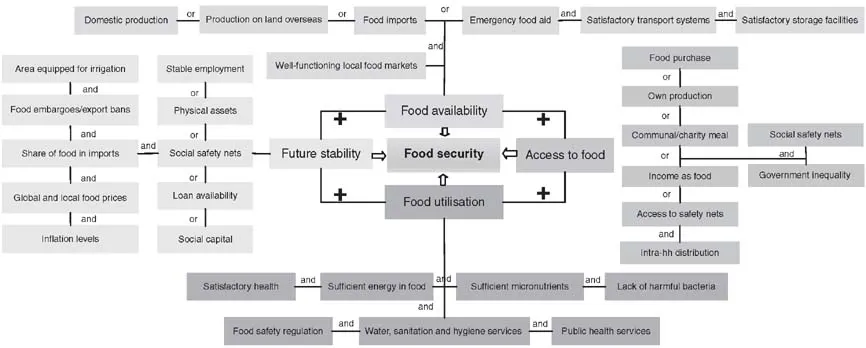
The food availability condition is satisfied when enough food is physically available in a country/region and people can obtain it either through purchase or as a donation. Sufficient access to food refers to people’s ability to obtain enough food for themselves through legal and conventional means, which include producing, buying and receiving a donation but exclude stealing or begging. Food utilisation relates to the body’s physical process of digesting food and utilising its energy and micronutrients in further functioning. Its fulfilment is affected by both the type of food consumed and the health of the body consuming it and thus can be jeopardised by a lack of ingested micronutrients, unhygienic conditions of the food consumed or poor health. While the three elements mentioned so far jointly bring about adequate nourishment, ‘stability’ or ‘reasonable future certainty’ about having access to enough food in the future needs to be fulfilled as well in order to ensure lasting food security. Factors that bolster this dimension on the country level include low climatic vulnerability and low price volatility; at the household/individual level it is stable employment and the ownership of physical assets, the availability of social safety nets and lenders, and access to social capital (strong family, friend and community networks). Figure 1.1 graphically summarises the four aspects of food security.
Causes of food insecurity
The proximate or first-order causes of food insecurity are deficiencies in the four essential aspects of food security described above: that is, a lack of sufficient national food availability, insufficient access to food by households and individuals, improper utilisation of available food resources to secure adequate nutrition and uncertainty/anxiety about access to enough appropriate food in the future.
The distal or second-order causes of food insecurity, underlying the first-order effects, are much more numerous and complex. While they vary between those relevant on the country and on the household level and are highly mutually interlinked, they can be roughly divided into economic, trade and social factors; agricultural factors; political and policy factors; and population and environmental factors (e.g. King and Murray, 2002; Smith et al., 2000). The first category – economic, trade and social factors – includes countries’ economic growth and GDP per capita, development and humanitarian aid, global and local food prices, share of food in imports and the existence of social safety nets and of functioning food transport and storage systems. All of these have a bearing on one or more aspects of food security. The relevant agricultural factors range from food production on domestic or overseas land through food aid shipments to land irrigation and affect primarily countries’ food availability and stability. Relevant political and policy factors include the general quality of countries’ and localities’ institutions and policies and political stability, as well as more specific issues, such as food safety regulation and inspection, availability of public health care and the political will to address existing inequalities. Finally, population and environmental factors that affect food security comprise total population numbers, population density and dependency ratios, along with air and water pollution, the rate of ground water depletion and fertile soil erosion and the quality of available water, sanitation and hygiene services.
In fact, so many aspects of political, economic, social and cultural development can have an indirect effect on food security that it becomes increasingly difficult to pinpoint factors that do not influence food security in any way. Despite the overlapping and numerous nature of second-order influents, however, food security constitutes a relatively easy-to-define concept, particularly in comparison with other popular development ones such as human security or sustainability (Paris, 2001). Consequently, while it may be difficult to always fully disentangle one determinant of food security from another, whether food security has been strengthened or weakened should not be equally contentious. This issue will be addressed further later in this chapter, as well as in Chapters 3 and 4.
Figure 1.1 Basic food security scheme.
Source: Author’s own deliberations
Consequences of food insecurity
The consequences of food insecurity relate to people’s coping strategies and depend on how serious the insecurity is. The first notable consequence is usually decline in the quality and the quantity of food consumption, accompanied by an increase in savings intended to help prevent hunger in the future (Merrigan and Normandin, 1996). The change in consumption patterns or fear thereof tend to inflict upon people negative physical, psychological and social effects, including feelings of exclusion, powerlessness, desperation, fear and stress, decline in productivity and concentration, and even increase in weight (Hamelin et al., 1999; Olson, 1999; Reid, 2000).
If food insecurity persists or heightens to such a degree that simple curbing of consumption patterns no longer prevents undernourishment and hunger, food-insecure households turn to locally available means of credit and/or to selling assets. These survival strategies have significantly longer-lasting negative effects on the households’ livelihoods and are not sustainable over the long term. Once they are no longer viable – because all potential lines of credit have been exhausted and all assets sold – some food-insecure people resort to an even more severe alternative, distress migration in search of sustenance (Barrett, 2002). This response is often the last one in a sequence of responses to food insecurity, as it commonly insinuates the loss of all the assets and employment left behind, and is followed only by death (Corbett, 1988).
Development aid
The term ‘development aid’, as used throughout this book, theoretically refers to all the financial flows from official development agencies and private charities in ‘developed’ countries to ‘developing’ ones that have the official goal of promoting economic and social development and whose grant element constitutes at least one fourth of the amount distributed (Organisation for Economic Cooperation and Development [OECD]). In reality, in the ‘macro’-sections of the book, which examine the relationship between aid and food security on the country level, the measures of aid used capture primarily the flows of official development aid from Development Assistance Committee (DAC)2 countries to the global South, given that the availability of data on aid provided by non-DAC donors and on private aid flows is very limited. However, the data include also information on humanitarian aid. This aid type is often analysed separately from development aid but it is included in the analysis here because 1) often it is very difficult to draw a separating line between a humanitarian and development action and 2) the OECD data on DAC aid includes humanitarian-assistance activities as well. In the ‘micro’ sections that consider the aid–food security relationship at the household/individual level, the measures of aid are further restricted, on the one hand, to aid provided by donors through programmes and projects. On the other hand, these measures include also data on non-DAC and on private aid, as the reporting is done by aid recipients rather than by donors.
As pointed out in the introduction, while it is useful to examine the effect of aid in general on food security because it has not been done to date, development aid constitutes such a varied financial and commodity flow that, in order to conduct meaningful and comprehensive analysis, it is imperative to analyse the effects of different types of aid on food security separately. Researchers thus far have not agreed on a unified systematic classification of aid;3 therefore I have constructed my own, guided by three main dimensions: who gives aid, how it is given and where it goes. Figure 1.2 displays this classification, explained verbally below, graphically.
The first division, made according to the donor’s identity, on the macro level is into official bilateral aid and multilateral aid (the category of ‘private aid’ was not included due to the unavailability of sufficient data). Official bilateral aid is further divided into aid provided by DAC versus by non-DAC members, although this division is difficult to assess accurately due to the limited reporting by non-DAC donors. On the micro level, the categorisation involves aid implemented by governmental versus by non-governmental agencies.4
The suggested divisions of aid according to the giving mechanism are into grants and concessional loans, into budget support as opposed to programme and project aid, into aid channelled through public–private partnerships as opposed to other channels, and into financial versus commodity aid (where food aid constitutes an absolute majority). Aid volatility is also added because, even though it is not a classification per se, it does characterise how aid is distributed. The classifications on the macro and micro level are similar with two exceptions: budget support is provided directly to the government budget and hence its effects on the micro level cannot be observed; and the macro division into loans and grants on the macro level is mirrored by the division of aid into credit and non-credit on the micro level.
In the last dimension of aid categorisation, according to where aid is implemented, a classification of aid into ‘long-term’, ‘short-term’ and humanitarian adopted from Clemens et al. (2004) is utilised, in order to examine whether short-term aid has a more discernibly positive impact on food security in the short run (normally three to five years) than long-term aid, as it does have on growth. Short-term aid encompasses activities that are likely to have a positive impact on countries’ growth in that reasonably short time frame, such as budget support and programme/project aid for real-sector investment, transportation, communications, energy, banking, agriculture and industry. Long-term aid contains activities whose positive impact on growth is likely to become evident only later, such as technical cooperation, aid to research and development, investment in education, health, population control and water sanitation. A second classification in ...
Table of contents
Cover
Half Title
Title Page
Copyright Page
Table of Contents
List of tables, figures and boxes
Acknowledgements
List of abbreviations
Introduction
1 Development aid, governance and food security
2 Methodology, data and methods
3 Cross-country view
4 Peru, India, Ethiopia and Vietnam
5 Aid, governance and food security from the recipients’ perspective
6 Up close and personal in Uttar Pradesh, India
7 Does who gives aid where and how affect food security?
Conclusion
Index
Frequently asked questions
Yes, you can cancel anytime from the Subscription tab in your account settings on the Perlego website. Your subscription will stay active until the end of your current billing period. Learn how to cancel your subscription
No, books cannot be downloaded as external files, such as PDFs, for use outside of Perlego. However, you can download books within the Perlego app for offline reading on mobile or tablet. Learn how to download books offline
Perlego offers two plans: Essential and Complete
Essential is ideal for learners and professionals who enjoy exploring a wide range of subjects. Access the Essential Library with 800,000+ trusted titles and best-sellers across business, personal growth, and the humanities. Includes unlimited reading time and Standard Read Aloud voice.
Complete: Perfect for advanced learners and researchers needing full, unrestricted access. Unlock 1.5M+ books across hundreds of subjects, including academic and specialized titles. The Complete Plan also includes advanced features like Premium Read Aloud and Research Assistant.
Both plans are available with monthly, semester, or annual billing cycles.
We are an online textbook subscription service, where you can get access to an entire online library for less than the price of a single book per month. With over 1.5 million books across 990+ topics, we’ve got you covered! Learn about our mission
Look out for the read-aloud symbol on your next book to see if you can listen to it. The read-aloud tool reads text aloud for you, highlighting the text as it is being read. You can pause it, speed it up and slow it down. Learn more about Read Aloud
Yes! You can use the Perlego app on both iOS and Android devices to read anytime, anywhere — even offline. Perfect for commutes or when you’re on the go. Please note we cannot support devices running on iOS 13 and Android 7 or earlier. Learn more about using the app
Yes, you can access Global Food Security and Development Aid by Ivica Petrikova in PDF and/or ePUB format, as well as other popular books in Economics & Sustainable Development. We have over 1.5 million books available in our catalogue for you to explore.