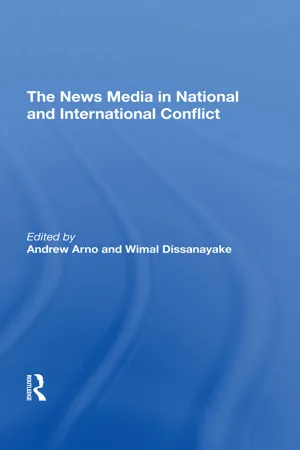
Ironically, as telecommunications technology—the embodiment of modernity—advances, bringing people in different nations into more direct contact during conflict situations, traditional cultural factors become increasingly important as differing ways of thinking and acting collide. The mass media can be seen as a factor in the creation of international conflict; they also, claim many scholars, are the key to control and resolution of those problems. Whichever side of the coin one chooses to look at—mass communication as cause or cure of conflict—there is no doubt that the news media are no longer peripheral players on the global scene; they are important participants whose organizational patterns of behavior, values, and motivations must be taken into account in understanding national and international conflict. In this volume, a distinguished group of authors explores the variety of ways the news media—newspapers, radio, and television—are involved in conflict situations. Conflicts between the United States and Iran, India and Pakistan, and the United States and China are examined, and national-level studies in Sri Lanka, Iran, Hong Kong, and the United States provide varied contexts in which the authors look at the complex interrelationships among government, news media, and the public in conflict situations.
- 250 pages
- English
- ePUB (mobile friendly)
- Available on iOS & Android
eBook - ePub
The News Media In National And International Conflict
About this book
Trusted by 375,005 students
Access to over 1.5 million titles for a fair monthly price.
Study more efficiently using our study tools.
Information
The News Media in International Conflict
Chapter 6
Television in International Conflict
Although this chapter focuses primarily upon television in international conflict situations, the reason for singling out television has nothing to do with the intrinsic merits of the medium. Print, or even radio, does a better job of handling complexity, and complexity is characteristic of most international conflicts. We are bound to look closely at television’s performance for one reason—the vast multitudes it reaches and influences in ways never fully charted by students of the medium.
Limitations of Television News Coverage
Telling the news on television is perhaps the least natural, certainly the least spontaneous, of communication processes. Here I speak from personal experience over a nine-year period in the sixties. The late Edward R. Murrow, that giant among broadcast journalists, confessed that he had never felt at ease before the camera. “Whenever that red light went on,” he said, “I’felt as if there were a mass of molten lead in my stomach. I never got over it. You won’t either.” Murrow was using the past tense because, for him, the ordeal had ended. Mine was just beginning.
What prompted Murrow’s confession was the fact that I had started doing television news and commentary and he had observed that I tended to look nervous—or in pain—on the tube. He was being compassionate, the grizzled veteran offering cold comfort to a novice. Murrow was, of course, a founding father of broadcast news. He had been at the job almost daily since the Munich crisis of 1938. Yet even after all those years on the air—the early years in radio and, by my reckoning, a full decade after that on television—he did not feel comfortable on camera. I found it somewhat reassuring to learn that Murrow, the most admired professional of his time, found it as difficult as I did to address his carefully scripted lines to the cold glassy eye of the camera as if he were talking to live people.
Working in a medium that assigns major priority to physical appearances—how the newscaster looks and sounds—is an element of strain. Details of dress, lighting, voice quality, and even makeup tend, I suggest, to count for a great deal in American television, rather more than understanding of the issues, experience, clarity of thinking, and presentation. Any number of successful broadcasters have acknowledged that television imposes certain cosmetic requirements. According to one experienced practitioner, the image a broadcaster projects necessarily includes “a whole bunch of intangibles… magnetism, style, tilt of the head, animalism, a whole bunch of things that can’t be bottled” (Jensen 1978). These are among the qualities that President Ronald Reagan brought to the presidency, the qualities that make him a more effective communicator than his recent predecessors.
Journalistic excellence is, I suggest, far from being the chief determinant of success in American television. I take a shred of comfort from the recent rise to prominence on CBS of Charles Kuralt, who appears to defy many of the conventions that television networks live by. He is rather stout, mostly bald, and stubbornly nontheatrical. Kuralt, moreover, is well informed, a good writer, and a perceptive reporter. He remains, however, the shining exception in an industry dedicated above all to mass entertainment. The news and public affairs departments of our commercial networks can be compared to a caboose, rattling along at the end of a long string of railroad cars. It is mass entertainment that supplies the motive power, building audience and advertiser appeal. The fact that the industry as a whole lives by show business values dictates its episodic attention to public affairs. Substantial ignorance of issues and events has not, to my fairly certain knowledge, severely handicapped the advancement of many anchorpersons. As long as the competitive ratings hold up, these men—and they are still chiefly men even in this enlightened age of sexual equality—continue to prosper.
What I have said till now may strike some as a diversion from the topic of this book. I would argue, to the contrary, that it bears directly upon the discussion of international conflicts and the role played by the media, at least in the United States. It is not, I believe, a gross exaggeration to suggest that certain characteristics of television news are inherent in a value system that can be traced back to the show business origins of our commercial networks, and that its shortcomings as a medium of information, above all in crisis situations, have something to do with that value system. One has only to sit through an evening of prime time television in Britain or France or the Federal Republic of Germany to understand that other countries live by other values.
It may be useful to begin this assessment with a short checklist of certain salient features associated with news on television. There is:
- The tyranny of the clock;
- The powerful pull of spectacle;
- The concentration upon events, which are visual, as against ideas or trends, which may not be; and
- Above all, the search for dramatic unity as if the television journalist were writing a three-act play with a beginning, a middle, and an end, when in fact he is dealing with fragments of reality as they come to light day by day.
The imperious clock, not unique to American television, is the most obvious of these salient features. The time allotted to news programs varies from country to country, but whether the system schedules ten or twenty or even thirty minutes for news (mostly in the early evening), each fleeting moment is treated as pure gold. There can be no dallying or digression. Each item of news that can be slotted into the program must be concise, uncomplicated, and swiftly paced. The inescapable effect of this forced compression is frequently a loss of nuance, qualification, or perspective. Nothing is gained by reproaching the reporter or anchorperson for superficiality or distortion. Walter Cronkite has made the point that a newspaper can make room for lengthy, complicated items on its inside pages but that television news is all front page.
Only when the camera is eavesdropping on an historic happening (Anwar Sadat in Jerusalem, the recent royal wedding in London, a World Cup soccer final, the funeral of a fallen leader) does television free itself from the tyranny of time. It is not, perhaps, accidental that on such great occasions television seems to be at its best, its most memorable. It becomes the great unifier, creating a community of shared feeling and excitement across a nation and, in some cases, around the world. Many of these events are, of course, carefully staged; not, however, by television producers. The Prince of Wales did not in fact marry his princess for the sake of that vast international television audience, even though the camera shots inside St. Paul’s Cathedral made magnificent television images. The absence of commercial interruptions helps mightily to sustain the mood of the occasion. But there are other hazards. A contemporary critic noted that the network commentators seemed intent not only on convincing the audience that the event was “historic” but also on emphasizing their own roles in it.
A shrewd judgment, I believe. The intrusive babble added little to this viewer’s experience of the event. I recall learning that lesson from a viewer in California back in 1963 as President Kennedy’s funeral cortege, led by a riderless horse, was making its way along Pennsylvania Avenue in Washington. The caller pleaded for less talk from my colleagues stationed along the line of march. “We can scarcely hear the drums,” she complained. “The beat is so very moving. Please tell them to talk less.” My caller had it right, I felt at the time. Those muffled drums needed no explication. They spoke directly to a grieving woman as they did to millions of others.
TV Coverage of Pseudo-Events
We are all familiar with Boorstirïs (1971) distinction between events, real events, and what he has called pseudo- or nonevents. Television is not fastidious about such distinctions. It feasts on wars, insurrections, hostage-takings—all of these legitimate events by Boorstirïs definition. But television is equally hospitable to pseudo-events: press conferences, hearings, so-called photo opportunities, contrived confrontations designed to catch the camera’s eye to dramatize a cause or issue, and gimmicks devised for commercial exploitation. Let me suggest that Boorstirïs distinction is difficult to apply in all circumstances. There is a quality of ambiguity about certain happenings that defies resolution. Consider, for example, the scene that was reenacted day after day on our home television screens in front of the United States Embassy in Tehran in 1980.
That first day and for a day or two thereafter we were, I suppose, observing a real event. A group of Iranians calling themselves students had violated the extraterritorial rights of the United States Embassy, seized the compound, and taken hostage all staff members who were not occupied elsewhere at the time. Here was an overt expression of the depth of feeling among a group of Iranians against the departed shah and his American allies. No one will argue, I suspect, that the embassy takeover was not real news. The difficult question was to decide how long it would be treated as real news: Two days longer? A week? A month? At what point did these carefully stage-managed demonstrations become a pseudo-event? You will recall how day after day, for many wearying weeks, we were shown the same dismal scene: downy-cheeked boys and grizzled elders shouting “Death to Carter!” and “Death to the shah!” in raucous unison, burning both in effigy, hurling imprecations against “The Great Satan” and shaking their fists on cue. Day after day we winced at the sight. But what did we learn, what could we have learned, from all that shouting and fist-shaking? Had a whole nation gone berserk? Did other Iranians approve of the hostage-taking? Was nothing else happening in Tehran? Were the peasants outside the capital still working their land? What was going on in the oil-fields and refineries? There were so many questions, so few answers. And there was no direct contact between the two governments. From time to time Iran’s foreign minister or President Abholhassan Bani-Sadr would appear to be sending a message to Washington through the camera crews, in the absence of official channels. But it was all too clear that these gentlemen were not in charge of events inside Iran.
We cannot in fairness charge the network crews with lack of enterprise; I am sure they tried to do more than they were allowed to do. Suppose they had attempted to roam elsewhere in the city and indeed to other regions of the country. Even if the authorities, such as they were, had allowed them free movement, their home offices expected daily coverage of the noisy charade outside the embassy. Thus day after day, until the crews were finally expelled from Iran, that was what we saw and heard. The deeper problem was that most of the correspondents, through no fault of their own, were poorly equipped to understand and explain the convulsion Iran was experiencing. They were transients, flown into Tehran at the first hint of trouble in all but total ignorance of Iran’s language, history, politics, or culture. These were not specialists with the benefit of long years of residence in the country such as Eric Rouleau, the correspondent of Le Monde, whose dispatches offered a depth of perspective other correspondents could not match.
The technological revolution we are living through has, by my observation, decimated the ranks of resident network correspondents. The jet plane, the satellite, and electronic newsgathering techniques have seen to that. Why keep a highly paid and presumably competent correspondent in one post long enough to understand the play of social and political forces in his assigned country or region when he may not get air time for weeks on end? The networks today shuttle correspondents and crews around the world as if they were chessmen; they seem to concede that expertise and seasoned judgment belong in newspapers and magazines, but not on the tube. The few overseas bureaus the networks still maintain (in London, for example) are essentially forward bases from which they can dispatch reporters, cameramen, and equipment on a moment’s notice to Iran, Pakistan, or Nigeria. They rush in, alerted by the news agencies to the possibility of action, do a piece or two, and then they are off again, like firemen, to the next hot spot. Most know little about the country when they arrive, and they don’t stay long enough to learn a great deal more before they are reassigned. The product we see on the evening news is marvelously fresh, almost instantaneous. It is also marvelously superficial.
An event, however defined, is easier to report than a trend or an idea. It takes less time, meets the definition of hard news more squarely, and is, of course, inherently visual. Hence the preoccupation with the hostage story and the angry...
Table of contents
- Cover
- Half Title
- Title
- Copyright
- CONTENTS
- ACKNOWLEDGMENTS
- INTRODUCTION
- PERSPECTIVES ON COMMUNICATION AND CONFLICT
- THE NEWS MEDIA IN INTERNATIONAL CONFLICT
- NATIONAL LEVEL CONFLICT AND THE MEDIA
- CONCLUSION
- ADDITIONAL READINGS
- CONTRIBUTORS
- NAME INDEX
- SUBJECT INDEX
Frequently asked questions
Yes, you can cancel anytime from the Subscription tab in your account settings on the Perlego website. Your subscription will stay active until the end of your current billing period. Learn how to cancel your subscription
No, books cannot be downloaded as external files, such as PDFs, for use outside of Perlego. However, you can download books within the Perlego app for offline reading on mobile or tablet. Learn how to download books offline
Perlego offers two plans: Essential and Complete
- Essential is ideal for learners and professionals who enjoy exploring a wide range of subjects. Access the Essential Library with 800,000+ trusted titles and best-sellers across business, personal growth, and the humanities. Includes unlimited reading time and Standard Read Aloud voice.
- Complete: Perfect for advanced learners and researchers needing full, unrestricted access. Unlock 1.5M+ books across hundreds of subjects, including academic and specialized titles. The Complete Plan also includes advanced features like Premium Read Aloud and Research Assistant.
We are an online textbook subscription service, where you can get access to an entire online library for less than the price of a single book per month. With over 1.5 million books across 990+ topics, we’ve got you covered! Learn about our mission
Look out for the read-aloud symbol on your next book to see if you can listen to it. The read-aloud tool reads text aloud for you, highlighting the text as it is being read. You can pause it, speed it up and slow it down. Learn more about Read Aloud
Yes! You can use the Perlego app on both iOS and Android devices to read anytime, anywhere — even offline. Perfect for commutes or when you’re on the go.
Please note we cannot support devices running on iOS 13 and Android 7 or earlier. Learn more about using the app
Please note we cannot support devices running on iOS 13 and Android 7 or earlier. Learn more about using the app
Yes, you can access The News Media In National And International Conflict by Andrew Arno,Wimal Dissanayake in PDF and/or ePUB format, as well as other popular books in Politics & International Relations & Politics. We have over 1.5 million books available in our catalogue for you to explore.