Contemporary philosophy has seen a proliferation of complex theories and intricate arguments brought to bear on the mind-body problem, perhaps the most intractable of perennial philosophical problems. In this concise and accessible text, Barbara Hannan provides an elegant introduction to this contemporary debate. Her emphasis is upon the clear and even-handed presentation and evaluation of the major theories of the mind, but she does not shrink from contributing to the advancement of the argument, including the presentation of an original account, the theory of "content internalism." Along the way to the formulation of this account, Hannan puts into context and discusses the views of all the major contemporary philosophers writing on the mind, including Lewis, Putnam, Searle, Davidson, Dennett, and Fodor. Combining a deep respect for the depth of the issues with clarity of thought and lucidity of expression, Subjectivity and Reduction is the ideal introduction to the central problem of today's philosophy of mind.
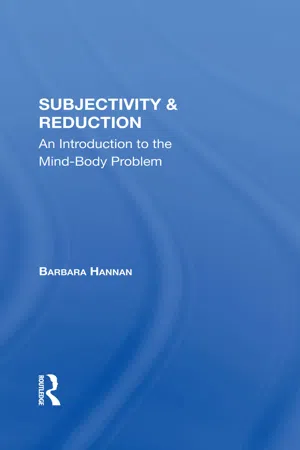
- 140 pages
- English
- ePUB (mobile friendly)
- Available on iOS & Android
eBook - ePub
About this book
Trusted by 375,005 students
Access to over 1.5 million titles for a fair monthly price.
Study more efficiently using our study tools.
Information
Topic
PhilosophySubtopic
Philosophy History & Theory1
The Mind-Body Problem and Substance Dualism
ONE'S LIFE, from beginning to end, is a sequence of subjective experiences. Because we are so utterly accustomed to being selves, unified centers of subjectivity, we seldom pause to reflect on how mysterious and intriguing is this phenomenon of subjective consciousness. Sometimes, however, perhaps in a moment of extraordinarily intense subjective experience, the wonder of being a conscious self can strike a human being with compelling force.
I recently had such an experience. I was in the middle of a long car trip from northern California to southern Arizona. On the road between Barstow and Needles, the desert and the mountains began to look peculiarly beautiful to me. I was playing some quiet, atmospheric music on the cassette player and reflecting on some recent good fortune. The scenery, the music, and my generally pleased state of mind combined to produce a temporary euphoria. A feeling of great happiness washed over me like a wave. At the very moment of experiencing this wave of joy, it occurred to me: How strange it is that there is an I who experiences this. Here is this organism, responding to various sensory stimulations and neural memory traces. Somehow, this organism experiences itself as a unified subject. There is a person, a self, to whom a wave of joy happens here, and not just a collection of neurons and muscles and electrochemical impulses. Why should this be so? What makes it so?
This is, in its most naked form, the mind-body problem. We know that we have minds; we have mental lives consisting of feelings, thoughts, memories, urges, obsessions, qualms, and so on. We also know that we have brains, nervous systems, and physical bodies. What, precisely, is the relationship between the mental being and the physical being?
What happens when we think or feel? Something goes on in the brain, surely. But does something go on as well in another place, the mind? When we look at brains we see masses of neural tissue. When we look through a microscope we see the tiny, cellular components of this tissue. We never catch a glimpse of a feeling, or a thought, or an urge, however. Yet such things make up the fabric of our subjective lives. Where are these mental things? Does it even make sense to ask?
Reflective individuals have been trying to say something illuminating about the mind-body problem for thousands of years. Until roughly the 1700s, there were no clear dividing lines among the disciplines we now call empirical science, psychology, and philosophy. Thinkers who called themselves 'philosophers' freely speculated on the possible relationships between mind and body and suggested principles to systematize and explain what goes on within consciousness. Nowadays, the philosophy of mind has become distinct from biological science and from psychology.
Neurobiologists, acting on the (well-justified) hypothesis that the activity of the brain gives rise to the phenomena we call 'mental', investigate how the brain and nervous system work, seeking some clue as to how this horrendously complicated mass of 'wetware' produces consciousness. Psychologists, also proceeding from the modern assumption that the relationship between mind and brain is a very intimate one, concentrate upon finding the principles and mechanisms governing the inner, subjective lives of persons. Philosophers tend to concentrate their attention on conceptual difficulties that arise from the fact that our ways of thinking and talking about persons are inherently dualistic, despite the mind-brain unity that has become scientific orthodoxy.
This is the fact upon which philosophers concentrate: We describe persons and explain their behavior in two ways. On the one hand, a person is taken to be a biological organism, the behavior of which is explainable in terms of events in its environment and in terms of physical goings-on in the brain and nervous system. On the other hand, a person is taken to be a subjective self, a rational agent with a point of view and purposes who performs actions for reasons and is responsible for his or her behavior. Just how these two conceptual schemes or descriptive/explanatory vocabularies mesh is less than clear. It is this latter, peculiarly philosophical, mind-body problem that is treated in this book.
Before the philosophical mind-body problem can be discussed in any detail, it is necessary to set aside a certain widespread and almost certainly mistaken view of the nature of the mind: substance dualism. Substance dualism is the idea that every person is composed of two distinct substances—a physical substance (the body) and a mental substance (the mind or soul).
We live in a time when two views of the nature of persons, fundamentally incompatible with each other, are both widely accepted (often by the same individuals, who somehow remain blissfully unaware of the inconsistencies within their own thoughts). I mean the view of the nature of persons taken by physical science and a more ancient view of the nature of persons associated with many traditional religions.
Children in contemporary America, for example, grow up being taught in school that human beings, like other animals, are complex physical organisms, their nature and behavior based in biological, chemical, and physical processes. (Call this the scientific view.) But the same children are taught in church, and by various sources in the popular culture, that human beings are fundamentally non-physical souls or spirits; these spirits inhabit the physical body and are released from it upon death. (Call this the substance dualist view. Notice, the substance dualist view is not necessarily associated with religion.) The irreconcilable conflict between these two views is obvious if one devotes barely more than passing thought to the matter.
The scientific view is that life, consciousness, and rational thought are phenomena that have evolved in certain complex physical systems; these phenomena arise from the functioning of those physical systems. Scientists operate on the faith that, in time, we will fully understand the nature of these phenomena. When the physical system deteriorates or is damaged and ceases to function, life and mental phenomena cease; the individual consciousness that once characterized that organism is no more. The self or individual consciousness of an organism can no more continue to exist after the organism dies than the running of an automobile can continue to exist after the engine is switched off or melted down. The substance dualist view suggests that human life, consciousness, and rational thought are properties of a substance or entity separable from the physical organism. When the human body deteriorates or is damaged and ceases to function, the person's life, consciousness, and rational thought may go on, because the spirit leaves the body and goes elsewhere. Human life, consciousness, and rational thought are not functions of material substance, but something wholly different, and physical science will never be able to discover and understand their nature.
It is often held, as a part of the substance dualist view, that other animals, unlike human beings, do not have this spiritual nature; other animals cease to exist upon death, but not human beings. This is absurdly ad hoc, as many small children naively realize when they ask whether the soul of a deceased pet will go to heaven. More consistent than their elders, such children can see that there is no fundamental biological distinction between human beings and other kinds of animals, and they draw the reasonable conclusion that if the life and consciousness of one sort of animal is due to the presence of a soul, as they have been told, then so must be the life and consciousness of other sorts of animals. They are understandably confused (or outraged, as I remember being) when told that this is not so. As I recall, it was this sort of consideration that first led me to be suspicious of my parents' Christian religion. It cannot be that both the substance dualist view and the scientific view of the nature of persons are true. One view asserts what the other explicitly denies. These two views of the nature of persons are irreconcilably at odds with each other. I shall now argue that the scientific view is rationally preferable.
When two theories compete for our allegiance, it is good methodology to prefer the theory with greater explanatory power. The scientific view of the nature of persons explains much that the substance dualist view does not. For example, the scientific view explains why persons with damaged brains cannot think as well as persons with undamaged brains: It is the brain's normal functioning that constitutes thinking, and when the brain can no longer function normally due to structural damage, of course thinking will be substandard. The competing, substance dualist view cannot explain the effects of brain damage upon thinking. If it is the non-physical soul or spirit that thinks, why can't it think just as well in a damaged brain as in an undamaged brain? After all, the soul is supposed to be able to think without any brain at all.
The scientific view also explains why mental functioning develops ontogenetically right along with the physical development of the brain and nervous system. Fetuses, babies, and small children possess characteristic levels of mental functioning, lower than the levels of mental functioning possessed by adults, and these levels coincide with the degree of development of the brain. Again, the substance dualist view cannot explain this; the soul is supposed to inhabit the body at some point, at which point the body should presumably possess full mental functioning. There are degrees of mental development, and they appear to depend upon degrees of physical development. For the substance dualist view, this must remain a mystery.
The scientific view, similarly, can explain why mental capacities apparently developed phylogenetically in tandem with brain development. If mental functions are just brain functions, then it makes perfect sense that early hominids with less sophisticated brains were not so bright as more evolutionarily advanced hominids with more sophisticated brains. How is the substance dualist view going to explain this? Did early hominids just happen to have unsophisticated souls, this fact having no relation at all to their degree of brain development? The substance dualist view cannot even explain why humans and dogs have more powerful minds than grasshoppers and lizards. After all, it is supposed to be the non-physical soul that has the thinking power. Why should it be the case that the best-thinking souls always inhabit the bodies with the most highly evolved brains?
Not only does materialism regarding minds have great explanatory power that spiritualism lacks, the assumption that having a mind is just having a functioning brain has brought about much successful research and useful results. Certain forms of mental illness, such as depression, have proven to be treatable by drugs that affect brain chemistry. The drug Prozac, for example, successfully alleviates depression in many individuals by inhibiting the brain's reuptake of the neurotransmitter serotonin. Surely, to think that such effects are just coincidence stretches credibility to the limit.
Some people suggest, methodological considerations such as the above aside, that there is empirical evidence of the existence of non-physical souls or spirits. For example, it is commonly asserted (by beginning philosophy students, among others) that so-called 'out of body experiences,' including near-death experiences, constitute such evidence. Let us evaluate this suggestion.
Let us assume for the sake of argument that it is empirically well established that 'out of body experiences' do occur as subjective phenomena. Suppose that people of many different cultures, ages, and backgrounds, when exposed to certain types of physical trauma, report remarkably similar subjective sensations of 'floating' over their bodies, moving disembodied through space, and so on. The question is, Does the existence of such subjective phenomena lend any logical support to the claim that minds are nonphysical spirits?
Not much. Because people can have hallucinatory subjective experiences, the mere report of a subjective experience does not by any means establish that the experience portrays the reality of what is happening. Compare: Suppose it is established that cocaine addicts of all ages and cultures report remarkably similar subjective experiences of bugs crawling all over their bodies. Does it follow from this that cocaine addicts really do have bugs crawling all over their bodies? Of course not. All that follows from the phenomenon of 'cocaine bugs' is that the physical trauma of cocaine addiction sometimes has a certain effect that manifests itself psychologically as the illusion that bugs are crawling on the body. Likewise, all that follows from the phenomenon of 'out of body experiences' is that certain physical traumas (perhaps heart stoppage, oxygen deprivation, the ingestion of certain psychoactive drugs, etc.) sometimes have effects that manifest themselves psychologically as the illusion that one's consciousness is floating disembodied.
What would qualify as serious empirical evidence for mind-body dualism? This is an interesting question, because some dualists assert that the mind is a non-physical substance that has no weight or mass and takes up no space. Such a substance could not possibly register on any instrument or be empirically detectable in any way.
Compare the situation with the cocaine bugs. What would constitute serious empirical evidence of the actual existence of bugs crawling on the skin of cocaine addicts? If we could capture such bugs and observe them, weigh them and measure them, record their attributes, and so on, that would count. Of course we cannot do that; cocaine addicts experiencing 'cocaine bugs' have no unusual observable or capturable creatures crawling on their skin, even if we look with our best microscopes. But suppose the advocate of the actual existence of cocaine bugs asserts, "Cocaine bugs are very special bugs. They are non-physical. They take up no space; they have no weight and no mass. They are detectable only from the subjective point of view. Nevertheless, they have real and objective existence."
If cocaine bugs are presumed to be invisible to objective observers and not detectable by physical instruments, then no possible empirical evidence could qualify as evidence of cocaine bugs' existence. This is why we don't believe in the actual existence of cocaine bugs and consider the bugs to be a subjective phenomenon only: There is no actual or possible physical evidence of the existence of the bugs.
Many people reject the hypothesis of non-physical minds, souls, or spirits for similar reasons; there is no physical evidence of the existence of such minds. There are no observations that we need the hypothesis of non-physical minds to explain. All of our observations can seemingly be explained more simply and more coherently with the hypothesis that the mind is just the functioning brain. The plea of those who persist in believing in nonphysical minds, souls, or spirits is no better than the plea of our fictional eccentric who persists in believing in cocaine bugs: "Minds are very special things. They are non-physical...." Why should we believe in these 'very special' entities? Their existence appears to be an unnecessary hypothesis.
The substance dualist, however, may argue that he has an ace up his sleeve. He may argue that there are convincing a priori reasons to believe in the existence of non-physical souls or spirits, whereas there are no convincing a priori reasons to believe in the existence of cocaine bugs.
It is necessary at this point to digress briefly and explain the philosophical distinction between a priori reasons and a posteriori reasons. Both sorts of reason are rational considerations (premises) in support of some conclusion. A posteriori reasons are evidential in character, drawing upon experiment and observation. A priori reasons are conceptual in character, drawing upon what one can know without making observations about the external world.
As an example of an a posteriori argument, consider the following. Faraday observed that whenever a magnetic field changes in the presence of a conductor, an electric current is generated in the conductor. Faraday drew the conclusion that this must be a law of nature: Whenever there is a changing magnetic field in the presence of a conductor, an electric current is generated in the conductor. Notice that Faraday's argument depends on his observations of the behavior of magnetic fields, not on any 'armchair' analysis of the concept of a magnetic field.
By contrast, consider the case of Saint Anselm's a priori argument for the existence of God. Anselm argued as follows: It is part of the very concept of God that God is the greatest being that can be imagined. A thing is greater if it exists in reality than if it merely exists as an idea in the mind; this follows from the concept of greatness. Therefore, God must exist in reality. Notice that Anselm does not predicate his argument on any observed evidence at all; he proceeds by analyzing the concepts of God and greatness, by appealing to what everybody can be expected to know who has mastered these concepts. (One must not conclude that all a priori arguments are fallacious on the basis of Anselm's example.)
What would constitute an a priori reason to believe in the existence of non-physical minds, souls, or spirits? René Descartes thought he had such reasons. In his Meditations on First Philosophy, Descartes argues as follows:
... because I know that all the things that I clearly and distinctly understand can be made by God exactly as I understand them, it is enough that I can clearly and distinctly understand one thing without the other in order for me to be certain that the one thing is different from the other, because at least God can establish them separately.... For this reason, from the fact that I know that I exist, and that meanwhile I judge that nothing else clearly belongs to my nature or essence except that I am a thing that thinks, I rightly conclude that my essence consists in this alone: that I am only a thing that thinks. Although perhaps (or rather, as I shall soon say, to be sure) I have a body that is very closely joined to me, nevertheless, because on the one hand I have a clear and distinct idea of myself—insofar as I am a thing that thinks and not an extended thing— and because on the other hand I have a distinct idea of a body—insofar as it is merely an extended thing, and not a thing that thinks—it is therefore certain that I am truly distinct from my body, and that I can exist without it.1
Descartes offers an additional argument for substance dualism:
... there is a great difference between a mind and a body, because the body, by its very nature, is something divisible, whereas the mind is plainly indivisible. Obviously, when I consider the mind, that is, myself insofar as I am only a thing that thinks, I cannot distinguish any pa...
Table of contents
- Cover
- Half Title
- Title
- Copyright
- Dedication
- Contents
- Preface
- Acknowledgments
- 1 The Mind-Body Problem and Substance Dualism
- 2 Reductive Materialist Mind-Body Theories
- 3 Functionalist Mind-Body Theories
- 4 Arguments for Eliminative Materialism
- 5 Arguments Against Eliminative Materialism
- 6 Two Versions of Non-Reductive Materialism
- 7 In Defense of Content Internalism
- 8 The Problem of Mental Causation
- 9 Summary, Loose Ends, Conclusions
- Notes
- References
- About the Book and Author
- Index
Frequently asked questions
Yes, you can cancel anytime from the Subscription tab in your account settings on the Perlego website. Your subscription will stay active until the end of your current billing period. Learn how to cancel your subscription
No, books cannot be downloaded as external files, such as PDFs, for use outside of Perlego. However, you can download books within the Perlego app for offline reading on mobile or tablet. Learn how to download books offline
Perlego offers two plans: Essential and Complete
- Essential is ideal for learners and professionals who enjoy exploring a wide range of subjects. Access the Essential Library with 800,000+ trusted titles and best-sellers across business, personal growth, and the humanities. Includes unlimited reading time and Standard Read Aloud voice.
- Complete: Perfect for advanced learners and researchers needing full, unrestricted access. Unlock 1.5M+ books across hundreds of subjects, including academic and specialized titles. The Complete Plan also includes advanced features like Premium Read Aloud and Research Assistant.
We are an online textbook subscription service, where you can get access to an entire online library for less than the price of a single book per month. With over 1.5 million books across 990+ topics, we’ve got you covered! Learn about our mission
Look out for the read-aloud symbol on your next book to see if you can listen to it. The read-aloud tool reads text aloud for you, highlighting the text as it is being read. You can pause it, speed it up and slow it down. Learn more about Read Aloud
Yes! You can use the Perlego app on both iOS and Android devices to read anytime, anywhere — even offline. Perfect for commutes or when you’re on the go.
Please note we cannot support devices running on iOS 13 and Android 7 or earlier. Learn more about using the app
Please note we cannot support devices running on iOS 13 and Android 7 or earlier. Learn more about using the app
Yes, you can access Subjectivity And Reduction by Barbara Hannan in PDF and/or ePUB format, as well as other popular books in Philosophy & Philosophy History & Theory. We have over 1.5 million books available in our catalogue for you to explore.