- 152 pages
- English
- ePUB (mobile friendly)
- Available on iOS & Android
eBook - ePub
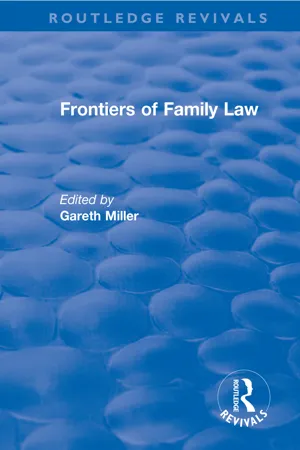
Frontiers of Family Law
About this book
This title was first published in 2003. The essays in this collection are written by academics and practitioners who look at some of the key aspects of family law. Papers include one from Lord Justice Ward, who gave the first judgement in the Court of Appeal on the case of the conjoined twins from Malta, another from Judge Pearl who has been responsible for training the judiciary on the impact of the Human Rights Act on family law, while Dr C. Ball contributes a paper on aspects of the 1989 Children Act. Parent and child contact across borders is dealt with in a paper by William Duncan, who is Deputy Director General of the Hague Conference. Other topics include medical evidence in child cases, pre-nuptial agreements and the re-establishing of contact after divorce.
Trusted by 375,005 students
Access to over 1.5 million titles for a fair monthly price.
Study more efficiently using our study tools.
Information
Chapter 1
The Changed Nature of Adoption: A Challenge for the Legislators
Caroline Ball
Introduction
Adoption, a legal order effecting the irrevocable transfer of a child from one family to another, is a familiar concept. For all those involved in the so-called 'adoption triangle', the process is to a greater or lesser extent bound to be one in which deep emotions, uncertainty and unresolved conflicts are experienced. The law can only regulate the process, but in doing so it provides the framework within which difficult decisions involving children's lives and complex personal sensitivities are taken. The regulation of adoption has to achieve a delicate balance that places the child's welfare throughout life at the heart of decision making, and at the same time is fair to all the parties. For more than a decade it has been apparent that because of the changed nature of adoption practice, regulation of the process under the Adoption Act 1976 no longer meets these basic requirements.
The long overdue Adoption and Children Act 2002, replacing the 1976 Act, is likely to be fully implemented in 2004. Reforms after the introduction of legal adoption in 1926 and prior to 1975 were largely concerned with regulating the process of adoption to eliminate perceived abuses,1 and with equating the adopted child's legal status within the adoptive family more closely with that of birth children for the purposes of inheritance.2 At the beginning of the 21st century the context is very different. Since 1976, the nature of adoption has altered to such an extent that a much more radical reform of its regulation is required than has been the case in the past. This chapter will consider, within the context of societal and practice changes, the themes that dominate the reforms and attempt critical evaluation of the extent to which the Act responds to the changed nature of adoptive relationships.3
Adoption: the first 50 years
There were two main policy imperatives behind the introduction of legal adoption in 1927: the need for recognition of the many de facto adoptions in existence, and the encouragement of the provision of family life for large numbers of illegitimate children and orphans who would otherwise be likely to spend their childhood in institutions. De facto adoptions, in which children were brought up outside their birth families by agreement were commonplace but existed without any security for the arrangement. Without recourse to costly and risky litigation, the people who had raised the child were unable to resist demands by birth parents for return, often at a time when the child was old enough to contribute to family finances. The 1920s saw increased professional interest in children's welfare and recognition that allowing the early adoption of illegitimate babies would spare children both the bleak reality of life in an institution and the stigma of illegitimacy. This led to the setting up of many charitable agencies arranging placements of babies in parallel to the increase in the number of de facto adoptions of orphans and abandoned children by relatives and strangers which followed the First World War. Pressure grew for the legalisation of adoption, to remedy the weaknesses inherent in de facto arrangements and with the additional benefit that the creation of new, secure, nuclear families would relieve many infertile couples from the misery of childlessness.
Despite the strength of the case made by protagonists and the fact that legal adoption, long embedded in legal systems based on Roman Law, had by that time been introduced in many other common law jurisdictions, opposition to legal adoption was deeply entrenched in a property oriented psyche. This is well illustrated by the early 1920s response of Edward Manson, a barrister, to a query from an academic in New York researching the law of adoption.
The law of England knows nothing of adoption. Its theory is that the father, as legal guardian - and the same principle applies to the mother - cannot abdicate by any contract the position of parental responsibility, or rid himself irrevocably of the sacred duties of fatherhood. He may purport to do so, but the law will not recognise any such promise as binding; it allows him to retract and repudiate it at any time.4
Such was the weight of opposition in the House of Lords that it was only after reports from two departmental committees,5 which both favoured the introduction of legal adoption, though for disparate reasons and in differing forms, and several failed Bills, that the Adoption of Children Act 1926 finally reached the statute book. Implemented in 1927, it introduced an order effecting the complete and irrevocable transfer of the child from the birth family to the adopters for all purposes apart from succession.
Adoption practice
Contrary to expectations prior to legalisation in 1926,8 adoption proved popular. There was a steady rise in the number of orders, with unsurprising and erratic surges during the 1939-45 war, from nearly 3,000 orders in 1927 to a high of 24,831 in 1968. The vast majority of orders during this period were so-called private law adoptions of illegitimate babies or young children by strangers, or their own children by parents (generally mothers) often with a step-parent7 At that time, only a minute proportion, 3.2 per cent in 1952, were adopted out of local authority care.8
During this period, adoption law developed in a way that increasingly, through mechanisms that cloaked the process in secrecy, separated the child for all time and for all purposes from his or her birth family, providing corresponding security within the adoptive family 9 Effectively law and practice encouraged the fiction that the adopted child's birth family did not exist and many people adopted as babies grew up not knowing, often until late in life, that they were adopted.10
The winds of change
In-country adoption Adoption statistics, beyond the numbers of orders made annually and even they are somewhat unreliable, are woefully inadequate. Because of the failure to collect and record essential data, many of the vital questions properly asked by researchers and policy makers remain unanswered and unanswerable.11 Despite this, and some disparity between the numbers of adoption orders recorded according to the source of the statistics,12 there is no doubt about the overall trends over the last 75 years.
After the high watermark of 1968, for a variety of well-explored reasons relating to the legalisation of abortion,13 changing attitudes to illegitimacy, and the availability of welfare benefits and housing for single mothers, the number of illegitimate babies available for adoption in the United Kingdom declined very rapidly. From a peak of nearly 25,000, the number of adoption orders made annually fell to just over 10,500 in 1980, 6,500 in 1990, and just under 4,500 in 2000 (slightly more than in 1999).14 Over the same period, the age of children when the order was made continued to rise reflecting the shift away from baby adoption. Figures in the 1993 white paper Adoption: the future indicate that the number of babies under 12 months fell from 23 per cent of the total of nearly 13,000 children adopted in 1977 to 12 per cent of the just over 7000 children adopted in 1991.15 The proportion of older children (1-17) had risen from 77 per cent to 88 per cent. The somewhat convoluted way in which the comparisons are presented in the white paper reflects the lack of detail available. Although the 1977 figures divided the older children into 1-14 and 15-17 year olds, even that distinction could not be drawn from the 1991 data.
Intercountry adoption As the supply of babies dwindled in all Western European and other developed countries across the world, and especially after the revolutions in Eastern Europe, childless couples increasingly looked to poor countries in South America and Asia as well as Eastern Europe, where there was a ready supply of babies who without adoption faced a bleak future. In 1991, UNICEF estimated that in developing countries 155 million children under five lived in absolute poverty and the Secretary General of International Social Service referred to over 100 million children being abandoned to subsist by providing cheap labour or engaging in petty crime or prostitution 16 Since then, population control policies have led to the abandonment to orphanage life of thousands of female babies in China. As Triseliotis identifies, in the growth of intercountry adoption initially compassion and humanitarianism went side by side with the wish to create or expand a family. As the supply of babies to adopt in-country declined, 'the latter came to predominate', leading to the growth of a global trade in children, driven more by market forces than the rights and needs of children.17
The changed adoptive population
From the late 1970s, local authority child care practice, helped by greater powers to carry out plans based on 'permanence' for children in long term care provided by the Children Act 1975, increasingly saw adoption as a solution for children across the age range unable to be rehabilitated within their birth families.18 Despite local authorities becoming adoption agencies with duties in regard to the provision of services to support adoption, and the introduction of allowances to encourage the adoption of children classified on account of age or disability as 'hard to place', outcomes wer...
Table of contents
- Cover
- Half Title
- Title
- Copyright
- Contents
- List of Contributors
- Introduction
- 1 The Changed Nature of Adoption: A Challenge for the Legislators
- 2 Contact after Divorce: What has the Law to Offer?
- 3 Cross-frontier Contact between Children and their Parents: Identifying the Problems
- 4 Recent Developments and Problems in Scottish Children's Law
- 5 'Please, Sir, I want some more': New Developments in the South African Saga of Child Maintenance and Children's Rights
- 6 The Care Standards Tribunal of England and Wales: A Contribution to Human Rights
- 7 When Cultures Clash: Aborigines and Inheritance in Australia
- 8 Pre-nuptial Agreements and Financial Provision
- Index
Frequently asked questions
Yes, you can cancel anytime from the Subscription tab in your account settings on the Perlego website. Your subscription will stay active until the end of your current billing period. Learn how to cancel your subscription
No, books cannot be downloaded as external files, such as PDFs, for use outside of Perlego. However, you can download books within the Perlego app for offline reading on mobile or tablet. Learn how to download books offline
Perlego offers two plans: Essential and Complete
- Essential is ideal for learners and professionals who enjoy exploring a wide range of subjects. Access the Essential Library with 800,000+ trusted titles and best-sellers across business, personal growth, and the humanities. Includes unlimited reading time and Standard Read Aloud voice.
- Complete: Perfect for advanced learners and researchers needing full, unrestricted access. Unlock 1.5M+ books across hundreds of subjects, including academic and specialized titles. The Complete Plan also includes advanced features like Premium Read Aloud and Research Assistant.
We are an online textbook subscription service, where you can get access to an entire online library for less than the price of a single book per month. With over 1.5 million books across 990+ topics, we’ve got you covered! Learn about our mission
Look out for the read-aloud symbol on your next book to see if you can listen to it. The read-aloud tool reads text aloud for you, highlighting the text as it is being read. You can pause it, speed it up and slow it down. Learn more about Read Aloud
Yes! You can use the Perlego app on both iOS and Android devices to read anytime, anywhere — even offline. Perfect for commutes or when you’re on the go.
Please note we cannot support devices running on iOS 13 and Android 7 or earlier. Learn more about using the app
Please note we cannot support devices running on iOS 13 and Android 7 or earlier. Learn more about using the app
Yes, you can access Frontiers of Family Law by Gareth Miller in PDF and/or ePUB format, as well as other popular books in Business & Business General. We have over 1.5 million books available in our catalogue for you to explore.